Overview
New York, NY – Sep 25, 2026 – The global Agricultural Variable Rate Technology Market is moving into a stronger growth phase as farmers use digital tools to apply seed, fertilizer, chemicals, and irrigation water more precisely. The market was valued at USD 5.7 billion in 2025 and is projected to reach about USD 17.5 billion by 2035, expanding at an 11.9% CAGR. Variable rate technology combines GPS guidance, field maps, sensors, controllers, prescription software, and connected equipment to change application rates across different parts of the same field. This approach helps growers respond to differences in soil fertility, moisture, crop condition, and yield potential while reducing unnecessary input use.
Adoption is being supported by higher farm input costs, wider use of precision agriculture, and better digital connectivity. USDA reported that 22% of U.S. farms used precision agriculture practices in 2025, while 85% had internet access and 82% used smartphones.
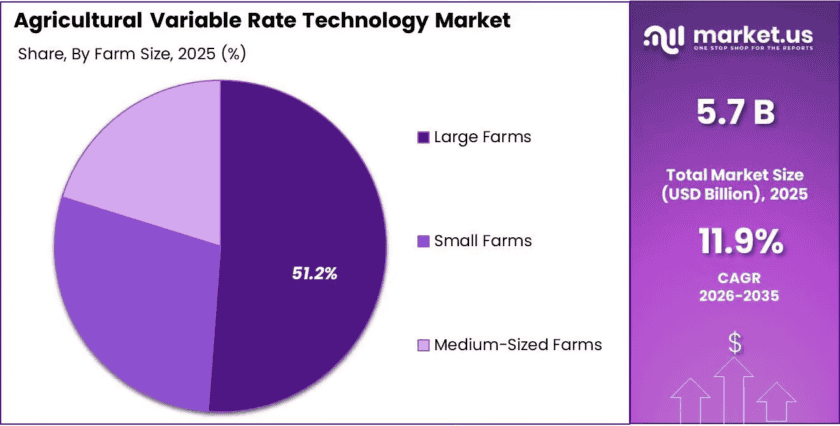
Hardware remained the largest offering segment with a 47.9% share, while map-based VRT accounted for 72.0%. Fertilizer VRT led applications with 45.2%, large farms represented 51.2%, and cereals and grains held 43.0%. North America remained the leading regional market with a 38.6% share in 2025. These trends are expanding demand for smarter, site-specific farm management systems rapidly worldwide.
Key Takeaways
- The Agricultural Variable Rate Technology Market was valued at USD 5.7 billion in 2025 and is projected to reach USD 17.5 billion by 2035, growing at an 11.9% CAGR.
- North America held the leading regional position in 2025, accounting for more than 38.6% of the global market.
- By offering, Hardware dominated with a 47.9% share, supported by demand for GPS receivers, controllers, sensors, cameras, flow meters, and variable-rate application equipment.
- By technology, Map-Based VRT accounted for more than 72.0% of the market as prescription maps and GPS-based field management remained widely used.
- By application, Fertilizer VRT held a dominant 45.2% share, reflecting growers’ focus on improving nutrient placement and controlling fertilizer expenses.
- By farm size, Large Farms captured more than 51.2% of the market because larger acreages help spread technology costs across wider production areas.
- By crop type, Cereals and Grains led with a 43.0% share, supported by extensive corn, wheat, barley, and other broad-acre crop production.
- USDA NASS reported that 22% of U.S. farms used precision-agriculture practices during 2025, showing a growing digital foundation for VRT adoption.
Regional Analysis
In 2025, North America held a dominant market position, capturing more than a 38.6% share of the Agricultural Variable Rate Technology Market. The region benefits from highly mechanized crop production, established GPS infrastructure, strong machinery ownership, precision-farming services, and extensive production of corn, soybeans, wheat, cotton, and other broad-acre crops.
The United States provides a strong technology base for regional adoption. USDA NASS reported that 22% of U.S. farms used precision-agriculture practices in 2025. Adoption was much higher in several major agricultural states, reaching 50% in North Dakota, 42% in Iowa, 42% in Illinois, and 41% in Nebraska. Digital connectivity also supports VRT deployment: 85% of U.S. farms had internet access, 74% used cellular data plans, 55% used broadband, and 82% owned or used smartphones in 2025. These conditions make it easier for growers to connect GPS equipment, prescription software, field maps, sensors, and farm-management platforms.
Market Dynamics
Driver – Rising Input Costs Strengthen the Business Case for VRT
Rising input costs are pushing growers toward variable rate technology because it helps place fertilizer, seed, and crop-protection products only where they are needed. USDA Economic Research Service reported that fertilizer represented 33% to 44% of corn operating costs and 34% to 45% of wheat operating costs since 2020. USDA also found that VRT adoption on corn acreage increased from 11.5% in 2005 to 37.4% in 2016. As farm margins remain sensitive to fertilizer and chemical prices, producers have a stronger reason to use field maps, sensors, and automated controllers to reduce overlaps and improve input efficiency each season.
Trend – Farming Is Moving Toward Sensor-Based and Connected VRT
Agricultural VRT is shifting from fixed prescription maps toward connected, sensor-based and data-driven application. USDA Agricultural Research Service reported in 2025 that 93% of 247 surveyed Midwest farmers used some form of digital agricultural technology. More than 10 years of use was reported by 55% for auto-guidance, 52% for yield mapping, and 35% for variable rate technologies. At the same time, USDA is developing systems that combine remote sensing, soil information, weather data, machine learning, and near-real-time processing for variable-rate irrigation. This trend is making VRT more responsive to changing crop and field conditions during operations in the field.
Restraint – Cost, Compatibility and Rural Connectivity Remain Barriers
High equipment cost, uncertain payback, and connectivity gaps continue to slow VRT adoption, particularly among smaller farms. A 2025 USDA ARS study of 247 farmers found that 31% identified high cost relative to perceived benefit as a main barrier, while 16% cited small farm size and 14% pointed to equipment incompatibility. Digital infrastructure is another limitation. USDA NASS reported that 85% of U.S. farms had internet access in 2025, but only 55% used broadband connections. These gaps can make cloud-based prescriptions, equipment synchronization, software updates, and real-time data transfer more difficult in rural farming areas for many growers today.
Opportunity – Nutrient Management and Precision Spraying Open New Growth Areas
Variable rate technology has a strong opportunity in nutrient management and precision spraying because growers face pressure to improve both farm economics and environmental performance. In June 2025, the U.S. EPA selected 4 organizations for USD 3.71 million in grants to support nutrient-management work in the Western Lake Erie Basin. One Ohio project targets technical assistance across 300,000 acres and aims to prevent about 10,000 pounds of phosphorus from reaching waterways. USDA ARS also reported that an intelligent variable-rate sprayer cut pesticide volume by 58%, reduced non-target ground losses by 41%, and saved about USD 114 per acre annually.
Emerging Trends
1. Sensor-Based Application
Real-time sensing is gaining ground as VRT moves beyond pre-made prescription maps. USDA ARS reported that intelligent spraying reduced pesticide volume by 58% and non-target ground losses by 41%, showing the operational value of automated sensing in orchards.
2. Long-Term Yield Mapping
Multi-year field data are becoming more important for identifying stable and weak production zones. A 2025 USDA ARS survey found 52% of respondents had used yield mapping for more than 10 years, supporting map-based prescriptions across farms.
3. Connected Farm Platforms
VRT systems increasingly depend on smartphones, computers, cloud software, and connected machinery. USDA NASS reported that 82% of U.S. farms had smartphones in 2025, while 68% had desktop or laptop computers for digital farm activities and management.
4. Precision Irrigation
Variable-rate irrigation is moving toward sensor, remote-sensing, soil, and weather integration. USDA ARS projects are developing near-real-time decision tools, while research notes irrigated agriculture can generate 2 to 3 times the economic yield of rainfed production under drought.
5. Digital Soil Management Zones
High-resolution soil mapping is becoming a stronger base for variable-rate decisions. USDA ARS research published in 2025 tested digital soil maps and clustering methods to create management zones for fertilization, seeding, and herbicide applications more accurately.
Use Cases
1. Variable-Rate Fertilizing
Farmers can change nutrient rates across field zones instead of applying one uniform amount. USDA data show fertilizer represented 33% to 44% of corn operating costs since 2020, making precise placement valuable for controlling production expenses each season.
2. Variable-Rate Seeding
Prescription maps can change plant populations according to soil, moisture, and historical yield potential. USDA ERS reported VRT use on 37.4% of corn acres in 2016, demonstrating how broad-acre cropping can support automated site-specific input decisions at scale.
3. Precision Crop Spraying
Sensors and automated nozzle controls can vary pesticide delivery according to crop structure or pest pressure. USDA ARS trials reported 58% lower pesticide volume and around USD 114 per acre in annual insecticide and fungicide savings yearly.
4. Variable-Rate Irrigation
Farmers can divide fields into irrigation zones and apply different water volumes according to soil and crop conditions. USDA ARS is developing systems that combine remote sensing, soil information, weather data, and models for near-real-time irrigation decisions efficiently.
5. Yield-Zone Management
Multi-year yield maps can identify consistently productive, unstable, or unprofitable areas for different input strategies. USDA ARS research across 9 Texas corn fields found that removing persistently unprofitable areas could have avoided USD 13,800 in input costs previously.
Frequently Asked Questions on Agricultural Variable Rate Technology
What is Agricultural Variable Rate Technology?
Agricultural Variable Rate Technology is a precision farming system that changes seed, fertilizer, pesticide, or irrigation rates within the same field. It uses GPS, sensors, field maps, software, and automated equipment to match applications with local conditions.
How large is the Agricultural Variable Rate Technology Market?
The global Agricultural Variable Rate Technology Market was valued at USD 5.7 billion in 2025. According to the referenced Market.us dataset, it is expected to reach USD 17.5 billion by 2035, growing at an 11.9% CAGR.
Which offering leads the market?
Hardware was the leading offering in 2025, holding a 47.9% market share. This category includes GPS receivers, sensors, controllers, flow meters, cameras, variable-rate nozzles, and other field equipment needed for automated site-specific application.
Which VRT technology has the largest share?
Map-based VRT led the technology segment in 2025 with a 72.0% share. It uses soil maps, yield maps, satellite information, GPS positioning, and prescription files to set input rates before equipment moves across the field.
Which application leads Agricultural VRT?
Fertilizer VRT held the largest application share at 45.2% in 2025. It helps producers vary nutrient rates by field zone, which is important because fertilizer accounted for 33% to 44% of U.S. corn operating costs since 2020.
Why are large farms important to VRT adoption?
Large farms represented 51.2% of the market in 2025 because they can spread hardware, software, and service costs across more acres. USDA research also shows that precision technology adoption generally rises sharply as farm size increases.
What limits wider adoption of variable rate technology?
Major barriers include equipment cost, uncertain returns, smaller farm size, incompatible machinery, and weak rural connectivity. A USDA ARS survey found 31% of respondents cited high cost relative to expected benefits as the main adoption barrier.
Which region leads the Agricultural Variable Rate Technology Market?
North America held the leading position with a 38.6% share in 2025. The region benefits from mechanized farming, strong GPS use, digital farm systems, and broad precision-agriculture adoption across major grain-producing states in the United States.
Conclusion
The Agricultural Variable Rate Technology Market is gaining momentum as growers look for better control over fertilizer, seed, pesticides, and water. Market.us estimates the sector at USD 5.7 billion in 2025, rising to USD 17.5 billion by 2035 at an 11.9% CAGR. Government data support the wider digital shift, with 22% of U.S. farms using precision agriculture practices in 2025. High input costs, sensor-based equipment, yield mapping, precision irrigation, and nutrient-management programs are expanding practical VRT use. Cost, connectivity, and equipment compatibility remain barriers, but continued innovation is making site-specific farming more accessible, measurable, and economically useful for modern growers.
Discuss your needs with our analyst
Please share your requirements with more details so our analyst can check if they can solve your problem(s)