Overview
New York, NY – Sep 30, 2026 – The global Food Thickeners Market is gaining steady momentum as food manufacturers increase their use of ingredients that improve viscosity, consistency, stability, and mouthfeel. The market was valued at USD 13.11 billion in 2025 and is projected to reach approximately USD 22.75 billion by 2035, expanding at a 6.3% CAGR between 2026 and 2035.
Food thickeners include starches, hydrocolloids, gums, pectin, gelatin, and other functional ingredients used in bakery products, sauces, dairy foods, desserts, beverages, and convenience meals. The U.S. FDA identifies gelatin, pectin, guar gum, carrageenan, xanthan gum, and whey among stabilizers and thickeners used to provide uniform texture and improve mouthfeel.
Strong spending on prepared food is supporting ingredient consumption. USDA reported that total U.S. food spending reached USD 2.51 trillion in 2025, including USD 1.41 trillion spent on food away from home.
At the same time, manufacturers are shifting toward plant-derived, clean-label, and multifunctional texturizing ingredients. Starch-based products remain widely used because of their cost, processing flexibility, and established role in food formulation, while hydrocolloids are gaining importance in reduced-fat, plant-based, and specialty foods.
Key Takeaways
- The global Food Thickeners Market was valued at USD 13.11 billion in 2025 and is projected to reach USD 22.75 billion by 2035, growing at a 6.3% CAGR.
- Starch-Based Thickeners held a dominant market position in 2025, accounting for more than 37.0% of total market share.
- Within starch-based products, Corn Starch accounted for 18.5%, followed by Potato Starch at 9.3% and Cassava at 7.4%.
- Plant-Based sources dominated the market with more than a 66.0% share, supported by broad use of starches, pectin, gums, and other plant-derived texturizers.
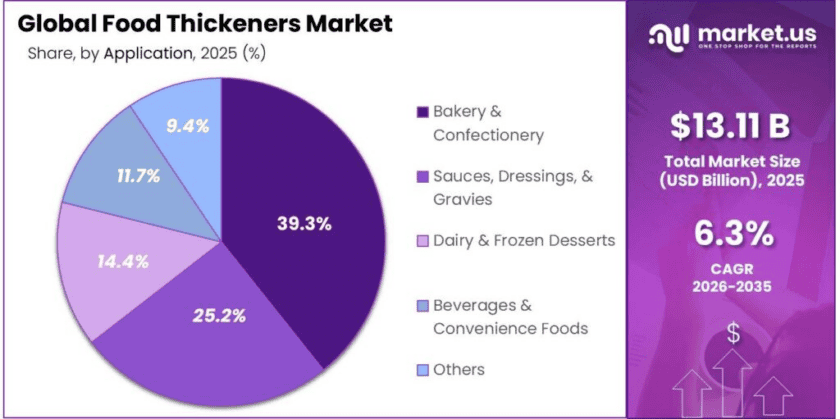
- Bakery & Confectionery represented the largest application category, capturing more than 39.0% of the Food Thickeners Market in 2025.
- Asia-Pacific led the global market with more than a 39.0% share, representing approximately USD 5.11 billion in 2025.
Regional Analysis
Asia-Pacific Leads with 39.0% Share and USD 5.11 Billion
In 2025, Asia-Pacific held a dominant Food Thickeners Market position, capturing more than a 39.0% share and generating approximately USD 5.11 billion. Large food-processing industries, growing consumption of packaged meals, bakery products, sauces, beverages, dairy foods, and expanding urban populations continue to support regional ingredient demand.
Starch-based thickeners remain particularly important across the region because manufacturers can use corn, cassava, potato, and other starch sources across noodles, soups, sauces, bakery fillings, dairy products, confectionery, and prepared meals. Growing production of convenience foods is also supporting wider use of hydrocolloids such as xanthan gum, pectin, carrageenan, and guar gum.
North America remains an important food-thickener consumption base because of its mature packaged-food and foodservice industries. In the United States alone, inflation-adjusted food spending reached USD 2.51 trillion in 2025, while food-away-from-home expenditure represented 56.3% of overall food expenditure. These spending patterns support continuing industrial consumption of texture modifiers in sauces, desserts, dressings, soups, bakery foods, and restaurant preparations.
Market Dynamics
Driver – Expanding Processed and Foodservice Consumption
Growing consumption of prepared and foodservice meals is supporting steady demand for food thickeners. USDA reported that U.S. food spending reached USD 2.51 trillion in 2025, rising from an inflation-adjusted USD 1.56 trillion in 1997. Food-away-from-home spending reached USD 1.41 trillion, representing 56.3% of total food expenditure. Thickening ingredients are routinely used in sauces, gravies, soups, desserts, dressings, dairy products, and prepared meals to maintain consistent texture during manufacturing and serving. As consumers spend more through restaurants, institutional kitchens, and packaged-food channels, manufacturers require dependable starches, gums, pectin, and other texturizers for high-volume production.
Trend – Shift Toward Plant-Based and Multifunctional Hydrocolloids
Food manufacturers are increasingly adopting plant-derived and multifunctional texturizers that can provide thickening, stabilization, moisture control, and improved mouthfeel within one formulation. FDA identifies pectin, guar gum, carrageenan, and xanthan gum among ingredients used as stabilizers and thickeners, while xanthan gum is specifically recognized for thickening and texturizing functions under federal food regulations. Hydrocolloids are also finding wider use in low-fat and lower-calorie formulations because they can alter rheology while supporting texture. FAO AGRIS notes that hydrocolloids can function as thickeners, gelling agents, emulsion stabilizers, and fat substitutes, expanding their usefulness across modern food development.
Restraint – Strict Food-Additive and Labeling Requirements
Regulatory compliance remains an important restraint because thickener suppliers and food manufacturers must meet safety, labeling, purity, and approved-use requirements. FDA states that food additives generally require authorization before being marketed in the United States, while direct additives such as xanthan gum must comply with applicable regulatory requirements. In Europe, authorized additives must meet legal specifications and must appear in ingredient lists using their function and either their name or E-number. These requirements can increase testing, documentation, reformulation, and compliance costs, particularly when manufacturers sell one formulation across multiple countries with different regulatory frameworks.
Opportunity – Growing Demand for Texture-Modified Foods
Ageing populations are creating an opportunity for thickeners used in texture-modified meals and beverages. WHO states that the global population aged 60 years and above is expected to increase from 1.1 billion in 2023 to 1.4 billion by 2030. In the United States, the population aged 65 and older reached 61.2 million in 2024, increasing 3.1% from the previous year and accounting for 18.0% of the population. This demographic shift creates additional opportunities for manufacturers developing softer foods, controlled-viscosity drinks, clinical nutrition products, desserts, sauces, and prepared meals that require stable and predictable texture.
Emerging Trends
1. Plant-Based Thickeners Continue Gaining Ground
Plant-derived ingredients are becoming central to new formulations. In 2025, plant sources represented 66.0% of the Food Thickeners Market. FDA already recognizes widely used plant-related ingredients including pectin and guar gum for thickening and stabilization applications.
2. Hydrocolloids Move into Multifunctional Formulations
Hydrocolloids are increasingly selected for more than simple thickening. FAO AGRIS identifies their roles in 4 major areas—thickening, gelling, emulsion stabilization, and control of crystal formation—making them useful in dairy products, frozen desserts, sauces, and reduced-fat foods.
3. Foodservice Demand Supports Texture Ingredients
Food-away-from-home expenditure reached USD 1.41 trillion in the U.S. in 2025, accounting for 56.3% of total food expenditure. This large commercial foodservice channel supports regular use of starches and gums in gravies, dressings, soups, sauces, and desserts.
4. Modified Starches Maintain Industrial Importance
Modified food starch remains a widely regulated functional ingredient. FDA lists modified food starch under 21 CFR 172.892 and recognizes functions including stabilizing and thickening, supporting its continued use in processed foods requiring heat, storage, and processing stability.
5. Age-Friendly Food Formulation Creates New Demand
The number of people aged 60 and above worldwide is projected to reach 1.4 billion by 2030, according to WHO. This demographic trend is encouraging greater development of smooth, soft, and viscosity-controlled foods for elderly and specialized nutrition applications.
Use Cases
1. Bakery and Confectionery Products
Bakery and confectionery represented 39.0% of Food Thickeners Market demand in 2025. Starches, gums, and pectin control viscosity in pie fillings, custards, glazes, creams, icings, and confectionery while reducing separation during processing and storage.
2. Sauces, Dressings, and Gravies
Thickeners provide uniform flow, suspension, and mouthfeel in sauces and gravies. U.S. food-away-from-home spending reached USD 1.41 trillion in 2025, supporting large commercial demand from restaurants and institutional kitchens for stable, repeatable sauce and dressing formulations.
3. Dairy and Frozen Desserts
FDA identifies stabilizers and thickeners for use in products including frozen desserts and dairy foods. Ingredients such as gelatin, pectin, guar gum, carrageenan, and xanthan gum help maintain smooth texture, reduce separation, and improve consistency through storage.
4. Reduced-Fat Food Formulation
Food hydrocolloids can act as texture modifiers and fat substitutes. FAO AGRIS reports their use in low-calorie foods as well as conventional formulations, allowing manufacturers to reduce certain fat components while maintaining viscosity, creaminess, and acceptable mouthfeel.
5. Texture-Modified Nutrition
The global population aged 60 and above is expected to grow to 1.4 billion by 2030. This expanding population supports applications for controlled-viscosity beverages, soups, purees, dairy foods, and clinical nutrition products designed around easier texture management.
Frequently Asked Questions on Food Thickeners Market
What is the Food Thickeners Market size?
The global Food Thickeners Market was valued at approximately USD 13.11 billion in 2025 and is projected to reach around USD 22.75 billion by 2035, expanding at a 6.3% CAGR during 2026–2035.
What are food thickeners?
Food thickeners are ingredients used to increase viscosity and improve texture, stability, and mouthfeel. Common examples include starch, pectin, gelatin, carrageenan, guar gum, and xanthan gum used across sauces, dairy foods, desserts, and bakery products.
Which product type dominates the Food Thickeners Market?
Starch-Based Thickeners held the dominant market position in 2025 with more than a 37.0% share. Corn starch alone accounted for 18.5%, reflecting its broad availability, cost efficiency, and versatility in processed foods.
Which source dominates the Food Thickeners Market?
Plant-Based Thickeners dominated the market in 2025, accounting for more than a 66.0% share. Starches, pectin, guar gum, and related plant-derived ingredients remain widely used across packaged food, bakery, beverage, and dairy applications.
Which application leads the Food Thickeners Market?
Bakery & Confectionery was the largest application segment in 2025, representing more than 39.0% of the market. Thickeners support fillings, custards, creams, icings, glazes, and confectionery products by improving viscosity and product stability.
Which region dominates the Food Thickeners Market?
Asia-Pacific held the dominant regional position in 2025 with more than a 39.0% share, generating approximately USD 5.11 billion. Expanding food manufacturing and packaged-food consumption remain important factors supporting regional demand.
Why is xanthan gum used in food?
Xanthan gum is used to increase viscosity and support texture and stability. FDA recognizes it as a stabilizer or thickener and texturizer, among other technical functions, under applicable U.S. food regulations.
What is driving demand for food thickeners?
Growth is supported by processed-food consumption, foodservice spending, plant-based formulations, and demand for better texture stability. U.S. total food spending reached USD 2.51 trillion in 2025, indicating the large commercial base served by food ingredients.
Are food thickeners regulated?
Yes. FDA requires applicable food additives to meet authorization and safety requirements, while the European system requires approved additives to comply with legal specifications and appear clearly on ingredient labels by name or E-number.
What future opportunities exist for food thickener manufacturers?
Opportunities are growing in plant-based foods, reduced-fat products, clean-label formulations, clinical nutrition, and texture-modified meals. WHO expects the global population aged 60 and above to reach 1.4 billion by 2030, strengthening specialized nutrition demand.
Conclusion
The Food Thickeners Market is moving toward more functional, plant-based, and specialized texture solutions. Valued at USD 13.11 billion in 2025, the market is projected to reach USD 22.75 billion by 2035, expanding at a 6.3% CAGR. Asia-Pacific leads with a 39.0% share, while starch-based products, plant sources, and bakery applications remain major market segments.
Rising processed-food consumption, foodservice activity, and changing formulation requirements are supporting demand. At the same time, hydrocolloids, modified starches, and texture-controlled nutrition are opening new opportunities for manufacturers seeking better stability, mouthfeel, functionality, and formulation flexibility.
Discuss your needs with our analyst
Please share your requirements with more details so our analyst can check if they can solve your problem(s)