Report Overview
In 2025, the Global Oil and Gas Data Monetization Market was valued at US$27.2 billion and is projected to grow at a CAGR of 11.5% from 2026 to 2035, reaching approximately US$80.3 billion by 2035. North America dominated the market in 2025, accounting for more than 38.6% of the market with revenue of US$10.5 Billion.
Oil and gas data monetization is becoming a key component of the industry’s digital transformation, as operators increasingly utilize geological, seismic, drilling, production, equipment, and commercial data to enhance asset economics. The industry’s large operational scale provides a substantial foundation for data-driven services. According to the International Energy Agency, global upstream oil and gas investment was expected to remain just below USD 570 billion in 2025, representing a decline of around 4%, with approximately 40% of upstream spending allocated to slowing production declines at existing fields. These conditions are encouraging operators to generate greater value from existing assets through analytics, predictive models, and integrated data platforms.
The industry is increasingly focused on improving productivity without a proportional increase in physical operations. According to the U.S. Energy Information Administration, U.S. crude oil production reached a record 13.6 million barrels per day in 2025, rising by 3%, despite the average number of active Lower-48 rigs being 5% lower than the previous year. This environment strengthens the demand for reservoir analytics, drilling optimization, automated workflows, digital twins, and machine-learning systems that enable companies to increase output from existing infrastructure while generating measurable financial value from operational data.
The commercial performance of oilfield technology companies further demonstrates the growing revenue potential of digital information. SLB reported USD 825 million in fourth-quarter 2025 Digital revenue, reflecting 17% year-over-year growth. At the end of 2025, annual recurring revenue for its Digital Division reached USD 1.0 billion. These results highlight how cloud platforms, exploration software, AI-enabled operations, and digital applications are evolving from internal efficiency solutions into independent commercial offerings for energy producers.
Government funding is also expected to support the expansion of this trend. In July 2026, the U.S. Department of Energy announced up to USD 65.5 million for oil and natural gas research, development, and deployment, along with another USD 150 million funding opportunity focused on unconventional resource recovery and related technologies. The program includes continuous monitoring, AI-supported digital twins, and infrastructure optimization aimed at increasing saleable hydrocarbons and reducing operating costs, thereby supporting broader adoption of data monetization technologies.
Future opportunities are expected to extend beyond conventional upstream optimization. Shared subsurface databases, AI-driven production forecasting, predictive maintenance, emissions monitoring, equipment-performance analytics, and data-as-a-service platforms can unlock additional value from information already generated during exploration and production activities. Norway’s Diskos system currently includes data from 25 members, approximately 22 associated members, and 39 universities and research institutions. This demonstrates how petroleum data can contribute to a wider ecosystem involving operators, service companies, and researchers. As datasets become increasingly standardized and accessible through cloud platforms, monetization opportunities are expected to expand into areas such as carbon storage, geothermal development, asset trading, and energy-transition planning.
Key market segment
- The Global Oil and Gas Data Monetization Market was valued at US$27.2 billion in 2025.
- The market is projected to grow at a CAGR of 11.5% and is estimated to reach US$80.3 billion by 2035.
- On the basis of component, Software Platform dominated the market, constituting 63.5% of the total market share.
- Based on the method, Indirect Data Monetization dominated the market, with a substantial market share of around 64.67%.
- Based on the application, Upstream led the market, comprising 47.3% of the total market.
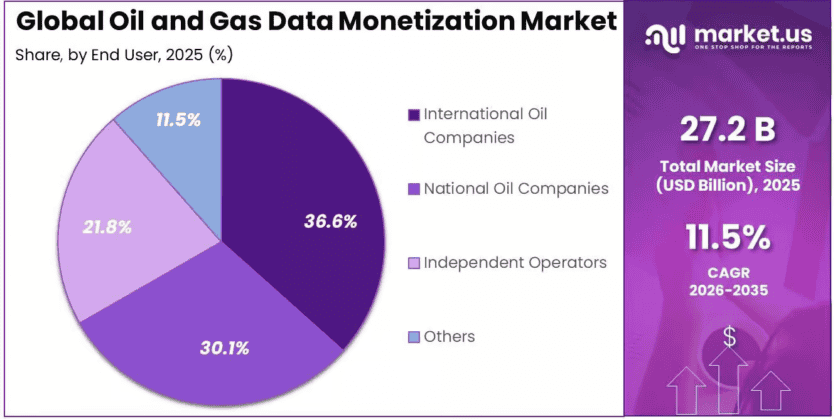
- On the basis of end user, International Oil Companies dominated the market, constituting 36.6% of the total market share.
- In 2025, North America was the most dominant region in the market, accounting for 38.6% of the total global consumption.
Component Analysis
Software Platform dominates with a 63.5% share as oil and gas operators rely on digital tools to manage growing production data.
In 2025, Software Platform led the Oil and Gas Data Monetization Market by component with more than a 63.5% share, supported by its role in collecting, integrating, visualizing, and analyzing well, reservoir, production, equipment, and operational data. According to the U.S. Energy Information Administration (EIA), U.S. crude oil production reached a record 13.6 million barrels per day in 2025, with new wells contributing around 2.9 million barrels per day and wells drilled before 2025 contributing about 8.3 million barrels per day, increasing the need for continuous data processing, forecasting, performance tracking, and analytics. Services is the fastest-growing segment, driven by rising demand for data migration, platform implementation, system integration, cybersecurity, consulting, and technical management as operators connect legacy systems with cloud, analytics, and digital platforms.
Method Analysis
Indirect Data Monetization dominates with a 64.7% share as oil and gas companies gain more value from data-driven operational decisions.
In 2025, Indirect Data Monetization held the leading position with more than a 64.7% share, as oil and gas companies primarily use operational, seismic, well, production, and asset data internally for field planning, maintenance, reservoir management, cost control, and investment decisions. The UK government’s North Sea Transition Authority reported that 374 TB of reportable data was loaded into the National Data Repository during 2025, including 73 TB made publicly available for download, supporting wider use of structured data and analytics. Direct Data Monetization is the fastest-growing segment, supported by increasing commercialization of geological, seismic, drilling, production, asset-performance data, analytics services, digital platforms, and data-access solutions for technology providers, engineering firms, investors, researchers, and other energy businesses.
Application Analysis
Upstream dominates with 47.3% as high production activity increases the value of operational data.
In 2025, Upstream dominated the market with more than a 47.3% share, driven by continuous data generation across exploration, drilling, reservoir management, and production activities. According to the EIA, data published on May 11, 2026, U.S. dry natural gas production increased by more than 4% in 2025 to a record 39 trillion cubic feet, with strong growth across Appalachia, Permian, and Haynesville. This high production activity is increasing demand for analytics platforms used for production optimization, predictive maintenance, asset monitoring, and operational planning. Midstream is the fastest-growing segment, supported by greater use of real-time data from pipelines, compressor stations, storage facilities, metering systems, terminals, and transportation networks to improve reliability, reduce downtime, and strengthen infrastructure management.
End User Analysis
International Oil Companies dominate with a 36.6% share, backed by data-intensive offshore operations.
In 2025, International Oil Companies held the leading position with more than a 36.6% share, supported by their large upstream portfolios and extensive data generation from seismic surveys, drilling systems, subsea equipment, production facilities, and asset monitoring. According to the U.S. Bureau of Safety and Environmental Enforcement, oil production from the U.S. Outer Continental Shelf reached a record 714 million barrels in 2025, with major deepwater projects contributing to the higher output. National Oil Companies are the fastest-growing segment, as state-owned producers increasingly adopt centralized data platforms, cloud-based asset management, artificial intelligence, reservoir modeling, and real-time production monitoring to improve recovery rates, control production costs, plan infrastructure, and manage long-life assets.
Emerging Trends
AI and Digital Twins Are Increasing the Value of Oil and Gas Data
Artificial intelligence, advanced analytics, and digital twins are becoming important tools for converting operational data into measurable business value. In July 2026, the U.S. Department of Energy announced up to USD 65.5 million for projects involving digitalization, continuous monitoring, AI-supported digital twins, and infrastructure optimization.
Production Efficiency Is Driving Data Analytics Adoption
Higher production with fewer drilling resources is increasing demand for data-driven optimization. U.S. crude oil production reached a record 13.6 million barrels per day in 2025, up 3%, while the average number of active Lower-48 rigs was 5% lower than in 2024. This supports greater use of analytics for well performance, forecasting, and production optimization.
Cloud-Based Platforms and Recurring Digital Services Are Expanding
Oil and gas technology providers are increasingly commercializing digital platforms, analytics, and subscription-based solutions. SLB reported USD 825 million in fourth-quarter 2025 Digital revenue, up 17% year over year, while Digital annual recurring revenue reached USD 1.0 billion, increasing 15% from USD 876 million in 2024.
Shared Industry Data Ecosystems Are Growing
National data repositories are creating opportunities to share, standardize, and reuse petroleum information. Norway’s Diskos database had 25 members, about 22 associated members, and 39 universities and research institutes in 2025, covering seismic, well, and production data.
Existing-Asset Optimization Is Becoming a Priority
Data monetization is increasingly focused on extracting more value from existing fields and infrastructure. The IEA estimated global upstream oil and gas investment at just under USD 570 billion in 2025, down around 4%, with 40% allocated to slowing production declines at existing fields.
Use Cases
Production Optimization
Oil and gas companies use well, reservoir, and production datasets to identify performance gaps and optimize output. U.S. crude oil production reached 13.6 million barrels per day in 2025, with new wells contributing 2.9 million barrels per day and wells drilled before 2025 contributing 8.3 million barrels per day, highlighting the value of continuous production analytics.
Predictive Maintenance
Equipment-performance data can be monetized through predictive maintenance services that identify potential failures before they cause costly downtime. Applications include pumps, compressors, drilling equipment, pipelines, and production systems, allowing operators to combine historical maintenance records with real-time sensor information for more efficient asset management.
Reservoir and Well Analytics
Geological, seismic, drilling, and reservoir data can be analyzed to improve well placement, production forecasting, and recovery decisions. The IEA estimates that 40% of upstream oil and gas investment in 2025 was directed toward slowing production declines at existing fields, strengthening the need for data-driven reservoir optimization.
Digital Twins and Infrastructure Monitoring
Digital twins combine operational information, sensors, engineering models, and analytics to create virtual representations of physical assets. The U.S. DOE’s 2026 funding program specifically supports continuous monitoring, AI-supported digital twins, and infrastructure optimization to increase saleable hydrocarbons and reduce operating costs.
Data-as-a-Service
Specialized geological, seismic, production, and asset datasets can be packaged and provided to technology companies, engineering firms, investors, researchers, and other energy businesses. Norway’s Diskos ecosystem demonstrates this model at scale, with 25 members, around 22 associated members, and 39 universities and research institutions using shared petroleum information.
Exploration and Development Decisions
Historical seismic, well, reservoir, and production datasets can help companies evaluate new exploration opportunities and reduce uncertainty. Large shared databases allow operators to combine historical information with modern analytics, improving geological interpretation, prospect evaluation, and development planning.
Infrastructure Optimization
Pipeline, storage, terminal, compressor, and transportation data can support real-time monitoring and operational decision-making. The DOE’s USD 65.5 million funding opportunity targets technologies designed to improve the efficiency, reliability, and performance of critical oil and natural gas infrastructure.
Enhanced Oil and Gas Recovery
Data monetization can support improved recovery from unconventional reservoirs by combining production histories, hydraulic-fracture information, geological data, and advanced analytics. In July 2026, the DOE announced up to USD 150 million for improved unconventional oil and gas recovery, hydraulic-fracture characterization, and produced-water management.
Conclusion
The Oil and Gas Data Monetization Market is moving from basic data management toward AI-driven analytics, digital twins, shared databases, and commercial data services. Record U.S. production of 13.6 million barrels per day in 2025, combined with nearly USD 570 billion in global upstream investment, highlights the scale of information generated across the industry. As operators focus on improving existing assets, reducing costs, and increasing productivity, structured operational data is becoming an increasingly valuable commercial and strategic resource.
Frequently Asked Questions
What is the Oil and Gas Data Monetization Market?
The Oil and Gas Data Monetization Market involves generating financial or operational value from geological, seismic, drilling, production, equipment, and commercial data. Companies monetize data through analytics, software platforms, consulting, data services, and improved operational decision-making.
Why is data monetization important in the oil and gas industry?
Data monetization helps oil and gas companies improve production, reduce operating costs, manage equipment, optimize reservoirs, and make better investment decisions. It also creates opportunities to sell specialized datasets, analytics, digital platforms, and information services to external users.
What are the major sources of oil and gas data?
Major data sources include seismic surveys, drilling records, well logs, reservoir models, production systems, equipment sensors, pipeline networks, maintenance records, commercial transactions, and environmental monitoring systems. These datasets can be combined to support analytics and operational optimization.
Which technologies support oil and gas data monetization?
Key technologies include artificial intelligence, machine learning, cloud computing, digital twins, Internet of Things sensors, advanced analytics, data platforms, and automated workflows. These technologies help companies process large datasets and convert information into operational and commercial value.
How is AI used for oil and gas data monetization?
AI helps analyze large volumes of geological, production, equipment, and operational information to identify patterns and predict outcomes. Applications include production forecasting, predictive maintenance, reservoir optimization, drilling analysis, anomaly detection, and digital-twin development.
What is indirect data monetization?
Indirect data monetization occurs when companies use data internally rather than selling it directly. Oil and gas operators can use operational and production information to improve field planning, reduce downtime, optimize maintenance, control costs, increase recovery, and strengthen investment decisions.
What is direct data monetization?
Direct data monetization involves generating revenue by providing datasets, analytics, digital platforms, technical information, or data-access services to external customers. Potential users include energy companies, engineering firms, technology providers, investors, researchers, and other organizations requiring specialized industry information.
What is the role of cloud platforms in data monetization?
Cloud platforms make large oil and gas datasets easier to store, integrate, analyze, and share across locations and organizations. They also support scalable analytics, subscription-based applications, data-as-a-service models, collaboration, and faster access to operational information.
Which oil and gas segment generates the most data?
The upstream segment generates significant volumes of data because exploration, drilling, reservoir management, and production continuously create seismic, well, equipment, and operational information. This makes upstream activities a major area for analytics, optimization, and data monetization applications.
What are the major challenges in oil and gas data monetization?
Major challenges include inconsistent data formats, legacy systems, cybersecurity risks, data ownership, privacy, integration difficulties, poor data quality, and limited technical skills. Companies must establish strong governance and standardized systems before extracting maximum value from large datasets.
How can data monetization improve oil and gas production?
Data monetization can improve production by identifying inefficient wells, forecasting output, optimizing reservoir performance, detecting equipment problems, and supporting better drilling decisions. U.S. crude production reached 13.6 million barrels per day in 2025, highlighting the scale of operations where these tools can be applied.
What is the future outlook for oil and gas data monetization?
The market is expected to increasingly focus on AI, digital twins, predictive analytics, cloud platforms, shared databases, and data-as-a-service models. Government funding for digitalization and infrastructure optimization, including USD 65.5 million announced in July 2026, is also supporting technology adoption.
Discuss your needs with our analyst
Please share your requirements with more details so our analyst can check if they can solve your problem(s)