Overview
New York, NY – Sep 22, 2026 – The global Gas-Insulated Substation Market is moving into a stronger investment cycle as utilities expand transmission capacity, replace aging equipment, connect renewable generation, and manage rising electricity demand. The market was valued at USD 33.1 billion in 2025 and is projected to reach USD 73.5 billion by 2035, advancing at an 8.3% CAGR.
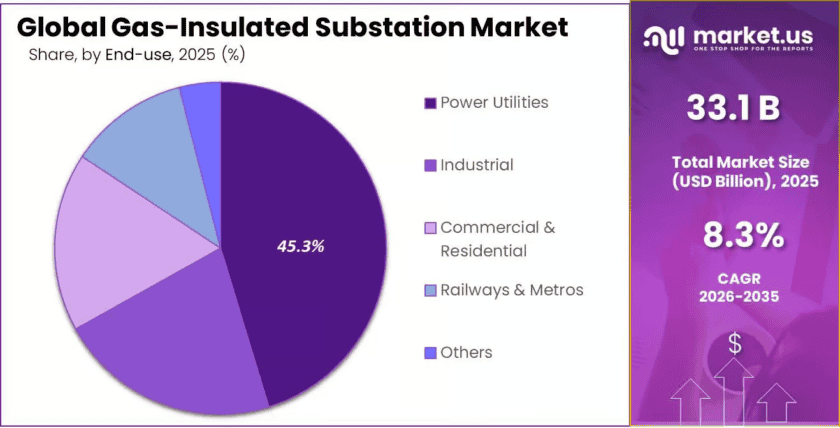
Gas-insulated substations combine circuit breakers, busbars, disconnectors, protection systems, and other high-voltage equipment inside compact metal enclosures, making them suitable for dense cities, industrial sites, renewable-energy connections, and space-constrained grid locations. High Voltage represented 51.90% of the market, while Indoor installations accounted for 58.70%. Power Transmission held 42.00%, and Power Utilities represented 45.30%.
Industry conditions remain supportive. The International Energy Agency estimates that about USD 400 billion is spent on electricity grids worldwide each year, while global electricity demand is expected to rise from 28,600 TWh in 2025 to 30,700 TWh in 2027. At the same time, environmental rules are accelerating development of SF₆-free switchgear, encouraging suppliers to combine compact GIS designs with digital monitoring, condition assessment, and lower-emission insulation technologies. These changes are making GIS an increasingly strategic asset for reliable, flexible, high-capacity and lower-emission electricity networks worldwide.
Key Takeaways
- The global Gas-Insulated Substation Market stood at USD 33.1 billion in 2025 and is forecast to reach around USD 73.5 billion by 2035, expanding at an 8.3% CAGR.
- High Voltage remained the leading voltage category with more than 51.90% market share in 2025.
- Indoor installation held more than 58.70% of the market, reflecting the need for compact and protected high-voltage equipment.
- Indoor GIS also represented more than 58.70% of the insulation-type segment in 2025.
- Power Transmission accounted for more than 42.00%, supported by transmission expansion and grid reinforcement.
- Power Utilities remained the largest end-user category with more than 45.30% share.
- Asia Pacific led the regional market with more than 46.50% share and approximately USD 15.3 billion in 2025 revenue.
- Global grid spending is currently around USD 400 billion annually, supporting a sustained project pipeline for substations and related high-voltage equipment.
Regional Analysis
Asia Pacific Leads as Large-Scale Grid Investment Supports GIS Deployment
Asia Pacific remained the dominant Gas-Insulated Substation Market in 2025, holding more than 46.50% of global revenue and approximately USD 15.3 billion. China continues to support regional demand through large transmission, distribution, renewable, and urban-grid programs. China’s National Energy Administration reported CNY 639.5 billion of grid investment during 2025, including CNY 321.8 billion for networks rated 110 kV and below. The country also operated more than 1 million kilometres of transmission lines rated 220 kV and above.
These investments strengthen demand for high-voltage GIS, compact substations, digital protection, and modern switching systems in locations where reliability and space efficiency remain important.
Middle East Builds Momentum Through Transmission and Renewable Expansion
The Middle East is developing as a fast-growing regional market as electricity consumption, solar generation, and transmission infrastructure expand. The IEA reported that Middle Eastern electricity demand increased by nearly 4% in 2025, while solar generation rose by 20% or more across the region.
Saudi Electricity Company reported that its transmission network reached 108,141 circuit-kilometres in the first half of 2026. The system included 1,364 transmission substations, 4,346 transformers, and total substation capacity of 559,831 MVA. During the same period, 49 new transmission substations were energized. These additions provide a strong project base for high-voltage GIS and associated automation systems.
Market Dynamics
Driver – Grid Expansion and Renewable Integration Increase GIS Requirements
Grid expansion and renewable integration remain the strongest demand drivers for gas-insulated substations. The IEA reports that around USD 400 billion is currently invested in grids each year, yet annual grid investment must rise by roughly 50% by 2030 to meet forecast electricity demand. More than 2,500 GW of renewable, storage, and large-load projects are already waiting in grid connection queues. Europe also estimates EUR 477 billion is needed for transmission development through 2040. These investments create steady demand for compact high-voltage GIS where utilities need reliable switching, transformation, protection, and connection capacity within limited space across modern power networks.
Trend – SF₆-Free and Digitally Monitored GIS Gains Importance
The market is shifting toward SF₆-free and digitally monitored GIS as utilities respond to environmental rules and tighter operating requirements. European Union Regulation 2024/573 restricts certain fluorinated-gas switchgear up to 24 kV from January 2026, extends restrictions to high-voltage equipment from 52 kV through 145 kV from January 2028, and covers higher voltage classes from January 2032. This timetable is pushing manufacturers toward alternative insulating gases, vacuum interruption, sensors, remote diagnostics, and condition monitoring. The trend is gradually changing GIS purchasing decisions from equipment-only procurement toward lower-emission, digitally connected lifecycle platforms for modern electricity networks and utility asset management.
Restraint – Long Equipment Lead Times Increase Project Risk
High upfront project costs and strained grid-equipment supply chains remain important restraints for GIS deployment. Utilities must coordinate specialized switchgear, transformers, protection systems, civil works, engineering, testing, and commissioning before a substation becomes operational. The U.S. Department of Energy reported in 2026 that lead times for large transformers used in substations and generation facilities can reach 3 to 4 years. DOE also noted that some critical grid equipment has experienced lead times of 2 years or more, while certain transformer prices increased 4 to 9 times over five years. These constraints can delay projects, increase financing costs, and complicate utility expansion schedules globally today.
Opportunity – Data Centers and Grid Modernization Open New Project Pipelines
Rising digital infrastructure and electricity demand create a major opportunity for compact high-capacity substations. The IEA estimates global data-center electricity consumption will increase from about 485 TWh in 2025 to around 950 TWh by 2030, adding pressure for faster grid connections and stronger transmission capacity. Europe separately estimates EUR 730 billion of distribution-grid investment and EUR 477 billion of transmission investment will be required through 2040. In the United States, DOE announced approximately USD 1.9 billion in 2026 for rapid grid upgrades. GIS suppliers can benefit through compact substations, digital monitoring, SF₆-free equipment, and lifecycle service offerings for utilities worldwide.
Emerging Trends
1. SF₆-Free GIS Adoption
SF₆-free GIS is moving from pilot projects toward wider utility procurement. EU rules restrict certain fluorinated-gas switchgear from 2026, extend requirements to 52–145 kV equipment from 2028, and reach higher-voltage classes from 2032, accelerating alternative-insulation product development across power networks.
2. Digital Substations and Automated Monitoring
Digital substations are gaining attention as utilities add sensors, intelligent protection, remote diagnostics, and automated controls. A March 2026 U.S. DOE project included 84 new reclosers across 13 substations and 28 distribution circuits, illustrating broader investment in monitored grid assets.
3. Higher Investment in Transmission Capacity
High-voltage grid expansion is supporting larger GIS project pipelines. The IEA estimates annual global grid investment must increase about 50% from roughly USD 400 billion by 2030, while more than 2,500 GW of projects remain in connection queues worldwide currently.
4. Data-Center-Driven Substation Development
Data-center growth is increasing demand for compact, high-reliability substations near concentrated loads. The IEA projects global data-center electricity use to rise from 485 TWh in 2025 to about 950 TWh by 2030, strengthening requirements for high-capacity grid connections worldwide.
5. Cross-Border and Offshore Grid Expansion
Cross-border and offshore transmission development is expanding GIS opportunities. ENTSO-E estimates Europe could economically benefit from 108 GW of additional cross-border capacity by 2040 and another 224 GW by 2050, supporting demand for compact high-voltage switching infrastructure across utility networks.
Use Cases
1. Urban Transmission Substations
Urban transmission substations use GIS where utilities need high-voltage equipment within compact sites and protected enclosures. European Commission estimates show EUR 477 billion may be required for transmission-grid development through 2040, supporting modernization projects in dense and space-constrained electricity networks.
2. Renewable Energy Grid Connections
Renewable-energy connections use GIS to switch and protect power moving from wind and solar projects into transmission networks. Renewables supplied 34% of global electricity generation in 2025, while wind and solar together reached 17%, according to the International Energy Agency.
3. Cross-Border Power Interconnectors
Cross-border interconnectors use high-voltage substations to control power flows between national grids and strengthen system security. ENTSO-E identifies 108 GW of economically beneficial additional cross-border capacity by 2040, increasing requirements for reliable switching, protection, and transformation infrastructure across Europe today.
4. Data Center Power Infrastructure
Data centers require highly reliable power connections, making compact GIS useful near digital campuses and constrained grid nodes. Global data-center electricity consumption reached about 485 TWh in 2025 and is projected to approach 950 TWh by 2030, according to the IEA.
5. Industrial High-Voltage Power Systems
Industrial facilities use GIS where large electricity loads, limited plant space, and reliability requirements favor enclosed high-voltage systems. U.S. industrial customers consumed about 1.04 trillion kWh in 2025, representing 25.7% of national retail electricity sales, according to EIA that year.
Frequently Asked Questions on Gas-Insulated Substation Market
What is a Gas-Insulated Substation?
A gas-insulated substation is a compact electrical facility where circuit breakers, busbars, disconnectors, and related high-voltage equipment are enclosed in grounded metal compartments and insulated with gas or alternative insulating media for reliable operation in constrained locations.
What is the size of the Gas-Insulated Substation Market?
The global Gas-Insulated Substation Market was valued at USD 33.1 billion in 2025 and is projected to reach approximately USD 73.5 billion by 2035, representing an 8.3% CAGR during the forecast period.
Which region dominates the Gas-Insulated Substation Market?
Asia Pacific led the Gas-Insulated Substation Market in 2025 with more than a 46.50% share and around USD 15.3 billion in revenue, supported by large-scale transmission construction, renewable integration, urban expansion, and grid-modernization investment.
Which voltage segment leads the Gas-Insulated Substation Market?
High Voltage was the leading voltage segment in 2025, capturing more than 51.90% of the market. Demand is supported by transmission expansion, interconnection projects, renewable connections, and compact substations required in high-load urban and industrial locations.
How are environmental regulations affecting GIS technology?
Environmental regulation is accelerating SF₆-free GIS development. EU rules restrict certain fluorinated-gas switchgear from 2026, extend restrictions to 52–145 kV high-voltage equipment from 2028, and apply to higher voltage classes from 2032, subject to specified conditions and exemptions.
What is driving future demand for Gas-Insulated Substations?
Grid expansion is a major market driver. The IEA estimates around USD 400 billion is currently invested in grids each year, while more than 2,500 GW of generation, storage, and large-load projects remain stalled in connection queues worldwide.
Conclusion
The Gas-Insulated Substation Market is positioned for steady expansion as electricity demand, renewable integration, urban grid upgrades, and digital infrastructure increase pressure on transmission networks. Market value is projected to rise from USD 33.1 billion in 2025 to USD 73.5 billion by 2035, supported by an 8.3% CAGR. Asia Pacific remains the leading regional market, while high-voltage, indoor, transmission, and utility applications form important demand centers.
Future competition will increasingly focus on SF₆-free insulation, digital monitoring, compact equipment, reliability, and lifecycle services. Strong grid investment and stricter environmental requirements should continue shaping procurement decisions through the forecast period for utilities.
Discuss your needs with our analyst
Please share your requirements with more details so our analyst can check if they can solve your problem(s)