Overview
New York, NY – Oct 12, 2026 –The global Meat Testing Market plays an important role in protecting food quality, verifying product authenticity, and reducing the risk of foodborne illness. Meat testing helps processors, laboratories, retailers, and regulatory agencies identify harmful microorganisms, chemical residues, undeclared animal species, and other contaminants in raw and processed products. Common methods include polymerase chain reaction (PCR), microbiological analysis, immunoassays, chromatography, and spectroscopy.
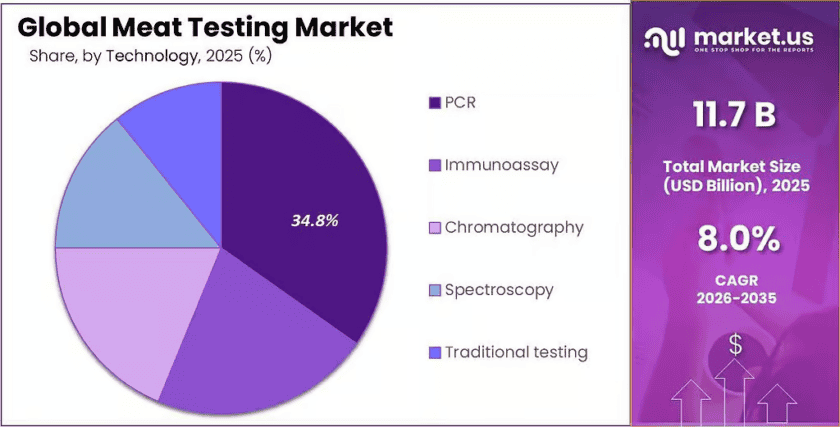
According to the supplied Market.us report, the market was valued at USD 11.7 billion in 2025 and is projected to reach USD 25.2 billion by 2035, reflecting a stated compound annual growth rate (CAGR) of 8.0%. North America accounted for 39.00% of the market in 2025, representing USD 4.5 billion in revenue. The report also identifies pathogens as the leading target-tested segment, with a 51.00% share, while meat accounted for 79.00% by sample type.
Government testing programmes reinforce the importance of reliable testing procedures. The United States Department of Agriculture’s Food Safety and Inspection Service (USDA FSIS) maintains laboratory methods for pathogen detection, species identification, and antimicrobial residue analysis. Its ready-to-eat sampling programme covers Listeria monocytogenes and Salmonella in applicable meat and poultry products.
Key Takeaways
- Market value: The report estimates the market at USD 11.7 billion in 2025.
- Forecast growth: Revenue is projected to reach USD 25.2 billion by 2035, at a stated 8.0% CAGR.
- Dominant region: North America held a reported 39.00% share, equivalent to USD 4.5 billion, in 2025.
- Leading target tested: Pathogen testing accounted for a reported 51.00% share.
- Leading sample type: Meat represented 79.00% of the market by sample type.
- Leading meat category: Poultry accounted for a reported 36.00% share.
- Key technology: PCR represented a reported 34.00% share of the technology segment.
- Industry focus: Food safety programmes continue to require testing for pathogens, species identity, and chemical residues.
Regional Analysis
North America: Dominant region, 39.00% share and USD 4.5 billion in 2025
According to the supplied report, North America led the Meat Testing Market in 2025 with a 39.00% share, valued at USD 4.5 billion. Its market position is supported by established food inspection systems, laboratory networks, and routine testing across meat processing facilities.
In the United States, USDA FSIS uses laboratory sampling to monitor food safety risks and investigate potential non-compliance. Its laboratory methods cover microbiological hazards, meat species identification, and antimicrobial residues. These activities help processors verify product safety and meet applicable requirements.
Market Dynamics
1. Driver: Stronger Food Safety Monitoring
Food safety monitoring remains a major driver of meat testing because contaminated products can cause illness, recalls, and financial losses. The World Health Organization estimates that unsafe food causes around 600 million illnesses and 420,000 deaths annually, based on its global estimates for 2010.
These figures cover all food types, not meat alone, but demonstrate the wider public health challenge. Government inspection programmes use laboratory testing to identify pathogens such as Salmonella and Listeria. USDA FSIS’s ready-to-eat sampling directive, issued on January 17, 2025, supports testing of applicable meat and poultry products.
2. Trend: Greater Use of Molecular and Genetic Testing
Meat testing is increasingly supported by molecular techniques that help laboratories identify pathogens and verify species identity. PCR can detect targeted genetic material, while whole-genome sequencing provides a more detailed genetic profile of a microorganism.
The United States Food and Drug Administration’s GenomeTrakr network shares pathogen sequence data to help public health agencies investigate contamination and trace possible sources. As of the latest information on its official network page, GenomeTrakr includes 62 laboratories across 35 US states and 24 laboratories across 13 countries outside the United States. These tools can strengthen investigations and improve understanding of contamination patterns.
3. Restraint: Testing Costs and Laboratory Capacity
The cost of equipment, reagents, trained staff, quality systems, and sample transport can limit access to advanced meat testing. Smaller processors may find it difficult to maintain in-house laboratories for multiple testing methods, especially when sample volumes are low or specialist confirmation is needed.
USDA FSIS operates an Accredited Laboratory Program that recognises non-federal laboratories for selected microbiological, chemical residue, and food chemistry analyses. This highlights the importance of laboratory competence and quality assurance. Processors can manage costs by using qualified external laboratories, selecting validated methods, and planning regular sampling based on product risks and applicable requirements.
4. Opportunity: Digital Traceability and Outbreak Investigation
Digital laboratory records and genetic data create opportunities to improve meat safety investigations. When testing results are linked with sample location, production dates, and processing records, companies and authorities can more efficiently investigate potential contamination sources.
The FDA’s GenomeTrakr programme uses whole-genome sequencing to compare pathogens collected from food, environmental, and other sources. The agency reports that genomic data have supported outbreak investigations and regulatory action. Meat testing providers can build services around sample tracking, electronic reporting, trend analysis, and integration with plant quality systems. These services may help processors respond faster to positive results and document corrective actions more clearly.
Emerging Trends
1. Rapid PCR Testing
PCR-based testing supports the detection of specific pathogens and the identification of animal species in meat. USDA FSIS includes molecular methods in its laboratory guidance. Faster screening can help processors investigate potential problems sooner, although confirmation and release decisions must follow validated procedures.
2. Whole-Genome Sequencing
Whole-genome sequencing helps compare the genetic profiles of foodborne pathogens. FDA’s GenomeTrakr network includes 62 laboratories in 35 US states and 24 international laboratories across 13 countries, supporting data sharing and outbreak investigations.
3. Wider Environmental Sampling
Testing is increasingly used beyond finished products, including food-contact surfaces and processing environments. USDA FSIS’s January 2025 ready-to-eat sampling directive covers relevant product testing for Listeria monocytogenes and Salmonella, supporting the role of monitoring in food safety programmes.
4. More Species Authentication
DNA-based species identification can help identify undeclared meat substitutions and support accurate product labelling. The USDA FSIS Microbiology Laboratory Guidebook includes methods for meat tissue species identification. Such testing is relevant to processed foods where visual inspection alone may not reliably establish the animal species.
5. Broader Laboratory Accreditation
Laboratory accreditation and proficiency testing are important for consistent results. USDA FSIS offers accreditation for selected microbiological analyses, including Salmonella testing, and for certain chemical residue and food chemistry tests. This supports demand for laboratories with documented procedures and demonstrated technical competence.
Use Cases
1. Pathogen Screening in Poultry
Poultry processors can test raw products and production environments for pathogens such as Salmonella and Campylobacter. USDA FSIS maintains verification programmes for raw poultry. Testing results help facilities review hygiene controls, investigate positive samples, and assess whether corrective action is needed.
2. Ready-to-Eat Meat Safety
Manufacturers of ready-to-eat meat products can use product and environmental testing to monitor Listeria monocytogenes and Salmonella. USDA FSIS issued updated ready-to-eat sampling instructions on January 17, 2025. Testing supports sanitation verification and follow-up when results indicate a possible food safety concern.
3. Meat Species Verification
Laboratories can analyse DNA to check whether meat products contain the animal species declared on the label. This is useful for processed meats, mixed products, and authenticity investigations. USDA FSIS includes species identification methods in its laboratory guidebook, supporting structured analysis rather than relying only on appearance.
4. Chemical Residue Screening
Meat testing can help identify certain chemical residues and support regulatory monitoring. USDA FSIS laboratory programmes cover selected antimicrobial residues and other chemical analyses in meat, poultry, and egg products. These checks help authorities and processors assess compliance with relevant requirements and investigate potential contamination.
5. Foodborne Outbreak Investigations
When illnesses are linked to a possible food source, laboratories can compare pathogen samples using whole-genome sequencing. FDA’s GenomeTrakr programme shares genetic and geographic information to support investigations. The results can help distinguish related cases, investigate possible contamination sources, and guide public health responses.
Frequently Asked Questions
1. What is meat testing?
Meat testing is the laboratory examination of meat and meat products for pathogens, chemical residues, species identity, and other quality or safety concerns. It helps producers, regulators, and retailers verify product safety and investigate possible contamination.
2. What is the projected value of the Meat Testing Market?
According to the supplied Market.us report, the Meat Testing Market was valued at USD 11.7 billion in 2025 and is projected to reach USD 25.2 billion by 2035, with a stated compound annual growth rate of 8.0%.
3. Which region led the Meat Testing Market in 2025?
The supplied report identifies North America as the leading region in 2025, with a 39.00% market share and revenue of USD 4.5 billion. These are commercial market estimates from the report, not figures independently verified by government agencies.
4. Which target-tested segment held the largest share?
The supplied report identifies pathogen testing as the leading target-tested segment, with a 51.00% share in 2025. Pathogen testing focuses on identifying harmful microorganisms that may create food safety risks during meat production, processing, storage, or distribution.
5. Which sample type dominated the market?
Meat accounted for a reported 79.00% share of the market by sample type in 2025, according to the supplied report. Testing may cover raw and processed meat products, depending on the hazard, product category, and applicable testing programme.
6. Which meat category held the leading share?
Poultry held a reported 36.00% share of the Meat Testing Market by meat type in 2025. Poultry testing often focuses on foodborne pathogens, processing hygiene, and verification that production controls are working as intended.
Conclusion
The Meat Testing Market supports food safety by helping detect pathogens, verify species identity, and identify selected chemical residues in meat products. According to the supplied Market.us report, the market is projected to grow from USD 11.7 billion in 2025 to USD 25.2 billion by 2035, at a stated CAGR of 8.0%.
North America held a reported 39.00% share in 2025, while pathogen testing and meat samples led their respective categories. Government laboratory programmes and molecular testing technologies demonstrate the continuing role of testing in food safety monitoring. Future demand will depend on reliable methods, laboratory capability, regulatory requirements, and stronger traceability systems.
Discuss your needs with our analyst
Please share your requirements with more details so our analyst can check if they can solve your problem(s)