Overview
New York, NY – Nov 18, 2026 – The global Collagen Market is experiencing strong growth as demand increases for collagen-based food products, dietary supplements, pharmaceutical ingredients, and personal care formulations. The market was valued at USD 7.8 billion in 2025 and is projected to reach USD 19.0 billion by 2035, registering a compound annual growth rate (CAGR) of 9.3% during 2026–2035.
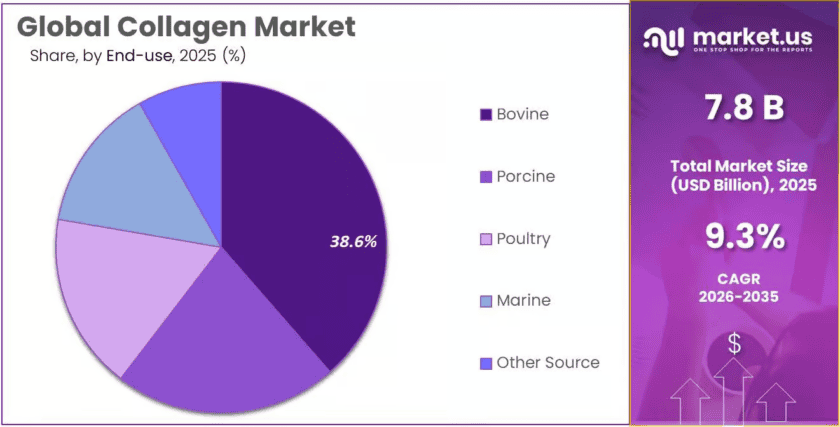
In 2025, Asia Pacific held a dominant market position, capturing more than 41.23% of global revenue, equivalent to approximately USD 3.2 billion. By product, Gelatin dominated with a 62.23% share, while Bovine collagen led the source segment with 38.60%. Food and Beverages accounted for 53.45% of application revenue, and Distributors held 67.56% of the distribution channel.
Increasing use of collagen in functional foods, beauty supplements, wound care products, and pharmaceutical formulations is supporting market expansion. Manufacturers are also focusing on improved processing, product quality, and alternative collagen sources to meet changing customer requirements. These developments are expected to create new opportunities for collagen producers and ingredient suppliers through 2035.
Key Takeaways
- Market Valuation: The global Collagen Market was valued at USD 7.8 billion in 2025.
- Market Forecast: The market is projected to reach USD 19.0 billion by 2035.
- Growth Rate: The market is expected to register a CAGR of 9.3% during 2026–2035.
- Dominating Region: Asia Pacific led the global market with a 41.23% share, valued at approximately USD 3.2 billion.
- Leading Product: Gelatin dominated the product segment with a 62.23% share.
- Leading Source: Bovine collagen accounted for 38.60% of the source segment.
- Leading Application: Food and Beverages captured 53.45% of application revenue.
- Leading Distribution Channel: Distributors held the largest share at 67.56%.
Regional Analysis
Asia Pacific – Dominating Region
Asia Pacific dominated the Collagen Market in 2025, accounting for 41.23% of global revenue, equivalent to approximately USD 3.2 billion. The region benefits from strong demand for dietary supplements, functional foods, pharmaceutical ingredients, and personal care products. China, Japan, and South Korea are important markets because of their established food processing, cosmetics, and healthcare industries.
Growing consumer interest in beauty nutrition, healthy ageing, and protein-enriched products is supporting collagen consumption. The region also benefits from established manufacturing capabilities and access to raw materials used in gelatin and collagen production. Increasing product development in functional beverages, nutritional supplements, and skincare formulations is expected to support regional demand.
North America – Growing Demand for Health and Nutrition Products
North America represents an important collagen market due to demand for dietary supplements, sports nutrition, functional foods, and advanced medical products. The United States has an established supplement and food manufacturing industry, supporting the use of collagen peptides and gelatin in different formulations.
The U.S. Food and Drug Administration provides specific requirements for dietary supplement labelling, including ingredient declarations and the quantity of dietary ingredients per serving. This regulatory framework makes product composition and labelling important considerations for collagen manufacturers. Healthcare applications, particularly wound-care materials, also provide opportunities for specialized collagen products.
Europe – Focus on Quality and Specialized Applications
Europe is an important market for collagen ingredients used in food processing, pharmaceuticals, cosmetics, and medical products. Demand is supported by established food and healthcare industries and increasing interest in functional nutrition.
Manufacturers are focusing on product traceability, raw material quality, and processing standards. Gelatin continues to have important applications in food formulations and pharmaceutical products, while hydrolyzed collagen is used in dietary supplements and personal care products.
Market Dynamics of the Collagen Market
1. Driver: Increasing Demand for Functional Foods and Dietary Supplements
Increasing demand for functional foods and dietary supplements is a major driver of the Collagen Market. Consumers are showing greater interest in protein-enriched products, nutritional powders, beverages, and supplements containing collagen peptides. Food manufacturers use gelatin and collagen ingredients in confectionery, dairy products, protein bars, and ready-to-drink formulations.
The U.S. Food and Drug Administration requires dietary supplement labels to disclose the amount of dietary ingredients per serving, supporting greater attention to ingredient information and product composition. The growing use of collagen across food and nutrition applications is encouraging manufacturers to expand production and develop convenient product formats.
2. Trend: Growing Adoption of Hydrolyzed Collagen Products
Hydrolyzed collagen is gaining attention because it can be incorporated into powders, beverages, capsules, and functional food formulations. It is produced by breaking collagen proteins into smaller peptides, making it suitable for different product formats.
A 2026 systematic review published in the European Journal of Clinical Nutrition examined 25 randomized controlled trials involving hydrolyzed collagen and skin health. Improvements in skin hydration were reported in 10 of 15 trials, while improvements in elasticity were reported in 10 of 13 trials. However, the researchers highlighted limitations in study quality and called for further standardized research.
3. Restraint: Raw Material Dependence and Product Quality Challenges
Dependence on animal-based raw materials can create supply and quality challenges for collagen manufacturers. Bovine, porcine, and poultry collagen production depends on the availability and quality of animal tissues, while marine collagen requires suitable fish-processing by-products. Differences in raw material quality, processing conditions, and purification methods can affect the consistency of finished products.
The U.S. Food and Drug Administration also identifies specific regulatory considerations for collagen and gelatin derived from animal materials under its bovine spongiform encephalopathy guidance. Manufacturers must therefore maintain suitable sourcing, processing, and quality-control procedures, which can increase production costs and operational complexity.
4. Opportunity: Expansion of Collagen-Based Medical and Wound-Care Products
Collagen-based medical products offer an important opportunity for manufacturers because collagen is used in wound dressings, tissue-support materials, and specialized healthcare formulations. Research published in 2022 evaluated collagen dressings across 11 randomized controlled trials involving 961 patients with chronic wounds.
The analysis reported a higher wound-healing rate in the collagen dressing group than in the standard-care group. These findings support continued research into collagen-based wound-care products, although further clinical evaluation remains necessary. Manufacturers investing in medical-grade collagen processing, specialized formulations, and quality-controlled materials can explore opportunities in advanced wound management.
Emerging Trends in the Collagen Market
1. Growing Demand for Hydrolyzed Collagen
Hydrolyzed collagen is gaining popularity in powders, beverages, and dietary supplements. A 2026 systematic review examined 25 clinical trials, with improvements in skin hydration reported in 10 trials, although further high-quality research is required.
2. Increasing Use of Marine Collagen
Marine collagen is attracting interest as an alternative to bovine and porcine sources. Fish skin and other processing by-products can provide collagen raw materials. USDA documentation identifies gelatin as a product obtained from animal collagen through hydrolysis.
3. Expansion of Collagen-Based Wound Dressings
Collagen-based wound dressings are receiving attention in healthcare applications. A clinical meta-analysis covering 11 randomized trials and 961 patients reported a higher wound-healing rate with collagen dressings compared with standard wound care.
4. Development of Beauty and Nutrition Supplements
Collagen is increasingly included in beauty and nutrition supplements targeting skin health. A 2025 systematic review evaluated 23 randomized controlled trials involving 1,474 participants, but found that study quality and funding influenced the reported results.
5. Greater Focus on Ingredient Traceability
Collagen manufacturers are placing greater attention on raw material sourcing, ingredient identification, and product labelling. FDA supplement requirements include ingredient quantities, serving sizes, and other ingredient declarations, making transparency important for collagen-based nutritional products.
Use Cases of Collagen
1. Food and Beverage Manufacturing
Food manufacturers use gelatin and collagen in confectionery, dairy products, desserts, and functional beverages. FDA’s food-substance database lists collagen for technical uses including flavor enhancement and flavoring. This supports its role in specialized food formulations.
2. Dietary Supplements and Joint Nutrition
Collagen supplements are used in products targeting joint and musculoskeletal health. A systematic review covering 11 randomized trials and 870 participants reported improvements in knee osteoarthritis pain and function, although results require careful clinical interpretation.
3. Wound Care and Medical Dressings
Healthcare providers use collagen-based dressings in chronic wound management. A meta-analysis of 961 patients across 11 studies reported complete healing in 53.4% of wounds receiving collagen dressings, compared with 34.5% under standard care.
4. Cosmetics and Skincare Products
Cosmetic manufacturers incorporate collagen-related ingredients into skincare formulations, creams, and beauty products. A 2025 systematic review assessed 23 clinical trials involving 1,474 participants and highlighted the need for better-quality evidence before making strong claims about oral collagen benefits.
5. Pharmaceutical and Capsule Manufacturing
Gelatin, which is derived from collagen, is used in pharmaceutical formulations, including capsule production. USDA documentation identifies gelatin as a protein obtained from animal collagen through hydrolysis. Its processing properties make it useful in pharmaceutical ingredient applications.
Frequently Asked Questions on Collagen and Collagen Market
1. What is the Collagen Market?
The Collagen Market includes the production and supply of collagen, gelatin, and related ingredients used in food and beverages, dietary supplements, pharmaceuticals, cosmetics, and medical products.
2. What is the global Collagen Market size in 2025?
The global Collagen Market was valued at approximately USD 7.8 billion in 2025. Demand is supported by increasing applications in functional foods, beauty supplements, healthcare products, and pharmaceutical formulations.
3. What is the expected market size by 2035?
The global market is projected to reach USD 19.0 billion by 2035, registering a CAGR of 9.3% during 2026–2035. Growing applications across nutrition, cosmetics, and healthcare are supporting this outlook.
4. Which region dominates the Collagen Market?
Asia Pacific dominated the global Collagen Market in 2025, accounting for 41.23% of total revenue, valued at approximately USD 3.2 billion. Demand for supplements, functional foods, and personal care products supports its leadership.
5. Which product segment dominates the Collagen Market?
Gelatin dominated the product segment with a 62.23% share in 2025. Its applications in confectionery, dairy products, pharmaceutical capsules, and food processing support its leading market position.
6. Which collagen source holds the largest market share?
Bovine collagen led the source segment with a 38.60% share in 2025. Its established supply chain and use in food, nutritional supplements, and healthcare products support its market position.
Conclusion
The global Collagen Market is expected to experience strong growth as demand increases across food and beverages, dietary supplements, cosmetics, and healthcare applications. The market is projected to expand from USD 7.8 billion in 2025 to USD 19.0 billion by 2035, registering a CAGR of 9.3%.
Asia Pacific remains the leading regional market, supported by growing consumption and manufacturing capabilities. Gelatin, bovine collagen, and food and beverage applications represent important market segments. Increasing interest in hydrolyzed collagen, marine collagen, and medical-grade wound-care products will create additional opportunities. Product innovation, quality control, and reliable sourcing will remain important industry priorities.
Discuss your needs with our analyst
Please share your requirements with more details so our analyst can check if they can solve your problem(s)