New York, NY – October 9, 2026 – The global Automatic Feeding Market is gaining momentum as livestock farms increasingly adopt robotics, sensors, and digital feeding technologies to improve productivity and manage daily operations. According to the provided market report, the market was valued at USD 7.9 billion in 2025 and is projected to reach USD 38.0 billion by 2035, expanding at a compound annual growth rate (CAGR) of 17.0% from 2026 to 2035.
Automatic feeding systems help farmers prepare, measure, transport, and distribute feed with less manual work. These systems include rail-guided feeders, conveyor-based equipment, self-propelled feeding robots, and digitally controlled feeding units. Growing demand for consistent feed delivery, improved labour efficiency, and better livestock nutrition is encouraging farms to invest in automated solutions.
Key Takeaways
- The Automatic Feeding Market is projected to increase from USD 7.9 billion in 2025 to USD 38.0 billion by 2035, registering a 17.0% CAGR during 2026–2035.
- Rail-guided feeding systems accounted for a reported 38.0% share in 2025, supported by their ability to deliver feed along fixed routes.
- Hardware captured more than 61.0% of the market, reflecting demand for robots, sensors, weighing equipment, controllers, and feed-distribution machinery.
- Filling and screening accounted for a reported 62.6% share, highlighting the importance of controlled feed preparation and handling.
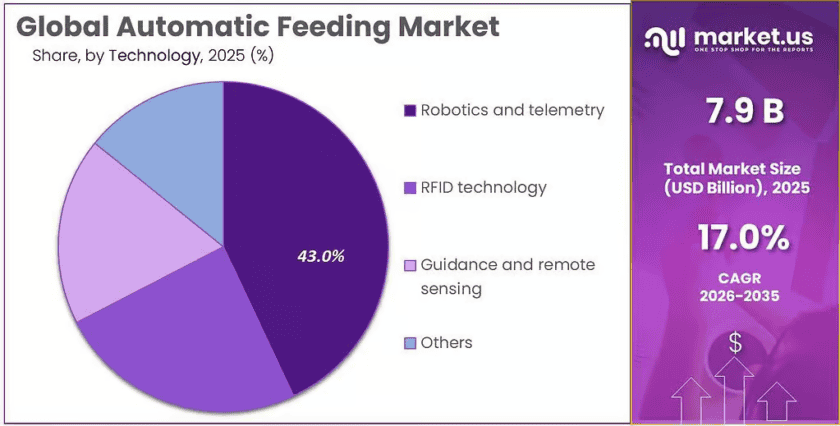
- Robotics and telemetry held a reported 43.0% share, reflecting growing interest in connected feeding equipment and automated monitoring.
- Ruminants represented more than 44.0% of the market, supported by feeding requirements across cattle and dairy farms.
- North America was the leading region in 2025, with the report’s regional analysis estimating a 35.0% share and USD 2.7 billion in revenue.
Regional Analysis
North America
North America led the Automatic Feeding Market in 2025, with a reported 35.0% share valued at USD 2.7 billion. Large dairy, beef, and swine farms support demand for automated feeding robots, conveyors, sensors, and ration-management equipment. The US Department of Agriculture reported 86.2 million cattle and calves in the United States as of January 1, 2026, including 9.57 million milk cows. Canada’s cattle and calf inventory reached 12.1 million on July 1, 2026, according to Statistics Canada. These large livestock operations provide a strong base for automated feeding adoption.
Asia Pacific
Asia Pacific is identified as the fastest-growing regional market as livestock producers modernise feeding operations and improve labour productivity. Demand is supported by large agricultural economies, expanding commercial livestock production, and increasing interest in digital farm management.
Australia illustrates the scale of regional livestock activity: the report cites 2.4 million cattle slaughtered in the December 2025 quarter and beef production of 727,921 tonnes. Automated feed preparation, conveying, distribution, and monitoring systems can help farms manage repeated feeding tasks more consistently as operations expand.
Market Dynamics
Driver: Growing Demand for Labour Efficiency and Consistent Feeding
Automatic feeding systems help livestock farms reduce repetitive work and maintain regular feeding schedules. Farmers can use robotic mixers, conveyor systems, feed pushers, and electronic feeders to distribute feed across large barns with less manual handling. This is especially useful for dairy and cattle farms that require repeated feed delivery throughout the day.
A January 2026 study from the US Department of Agriculture’s Economic Research Service found that robotic milking or the adoption of at least two precision dairy technologies increased average dairy farm net returns by 13%. Although this result concerns dairy automation rather than automatic feeding alone, it supports the wider business case for farm technology investments.
Trend: Integration of Robotics, Sensors, and Digital Farm Management
Automatic feeding is moving towards connected systems that combine robotics, sensors, telemetry, and livestock-management software. These technologies help farmers schedule feed distribution, monitor equipment, and adjust feeding operations according to farm requirements. RFID identification can also connect individual animals with feeding records, supporting more detailed nutrition management.
In July 2025, the USDA Animal and Plant Health Inspection Service awarded a contract worth up to USD 20 million over five years for RFID ear tags for sow and exhibition-swine producers. While the programme focuses on animal traceability rather than feeding equipment, it demonstrates growing government support for digital identification technologies that can also complement automated feeding systems.
Restraint: High Initial Investment and Maintenance Costs
The initial cost of automatic feeding equipment can discourage smaller farms from adopting the technology. Installation may require feeding robots, conveyors, sensors, software, charging stations, barn modifications, and employee training. Regular maintenance and replacement parts can add to operating expenses.
The UK’s Farming Equipment and Technology Fund 2026 provides an example of the investment involved: a robotic silage pusher had an expected average equipment cost of £17,000, with a potential grant contribution of £6,800 per unit under the specified scheme. Actual costs vary by system and farm design. Producers therefore need to compare expected labour savings, feed efficiency, and equipment utilisation against total ownership costs.
Opportunity: Precision Feeding and Individual Animal Nutrition
Precision feeding creates opportunities for equipment makers to develop systems that measure feed quantities, recognise animals, and adjust distribution according to nutritional requirements. These capabilities may help reduce unnecessary feed use and support more consistent livestock management. The supplied market report cites USDA information estimating that sensor-based precision feeding could reduce feeding costs by approximately USD 0.12 per cow per day.
For a farm with a large herd, even a modest daily saving could accumulate over time, although actual results depend on feed prices, herd size, system performance, and management practices. Combining automated feeders with animal identification and feeding records may create further opportunities for data-driven livestock production.
Emerging Trends in the Automatic Feeding Market
1. Autonomous Feeding Robots
Autonomous feeding robots are gaining attention because they can mix, transport, and distribute feed with limited manual intervention. In March 2025, Lely introduced its Vector MFR Next, with a loading capacity of up to 800 kg, a reported 35% increase over the previous generation.
2. RFID-Based Animal Identification
RFID technology allows feeding systems to recognise individual animals and record feeding activity. In July 2025, USDA APHIS awarded a contract worth up to USD 20 million over five years for RFID ear tags for certain swine producers. Such identification can support more detailed feed management.
3. Artificial Intelligence in Feeding Management
AI-enabled cameras and digital monitoring tools can help farmers adjust feeding plans using animal weight and activity data. In September 2026, Schauer Agrotronic introduced Pigxcel Select, an AI camera system connected to its Qanto feeding platform. The company also reported more than 10,000 Compident feeding stations across 50 countries.
4. Connected Sensors and Telemetry
Connected sensors can track equipment movement, feeding schedules, and livestock activity. Robotics and telemetry accounted for a reported 43.0% share of the Automatic Feeding Market in 2025. Their role is expected to expand as farms seek better visibility into feeding operations and equipment performance.
5. Government Support for Farm Automation
Public programmes are encouraging farmers to consider agricultural robotics and digital tools. The European Union’s Common Agricultural Policy covers 2023–2027, with support for agricultural modernisation and digitalisation. The UK also recognises autonomous robotic feeding equipment within its farm productivity support framework, helping improve awareness of these technologies.
Use Cases of Automatic Feeding
1. Dairy Cattle Feeding
Dairy farms can use automatic mixers and feed pushers to deliver fresh rations throughout the day. DeLaval’s OptiDuo can perform up to 10 feed push-ups daily and operate over distances of 100–200 metres. This helps farms maintain feed access while reducing repetitive manual work.
2. Beef Cattle and Feedlots
Large beef operations need to distribute substantial quantities of feed across pens and feeding lanes. Automated mixing and delivery systems help maintain consistent ration distribution. The USDA reported 13.8 million cattle on feed in the United States on January 1, 2026, illustrating the scale of one important application base.
3. Pig and Swine Farms
Pig farms can use automatic feeding stations to control feed portions and support different nutritional requirements across animal growth stages. In September 2026, Schauer Agrotronic reported more than 10,000 Compident feeding stations operating across 50 countries. Connected animal identification can further support individual feeding management.
Calf Rearing Facilities
Automatic calf feeders can deliver measured milk or milk replacer and record individual feeding activity. According to the supplied market report, GEA’s automated calf-feeding technology can serve 50 calves through as many as two sucking stations. This setup illustrates how automated systems can help farms manage feeding routines in young livestock.
Multi-Group Livestock Feeding
Large dairy facilities may need to prepare different rations for animals with different nutritional requirements. GEA’s DairyFeed F4500 can weigh, mix, and distribute up to 2.2 cubic metres of fresh total mixed ration per hour and serve as many as 300 animals across different nutrition groups. This demonstrates the potential for automated systems to support large-scale feeding operations.
Frequently Asked Questions About Automatic Feeding and the Automatic Feeding Market
1. What is the Automatic Feeding Market?
The Automatic Feeding Market includes equipment, software, and services used to prepare, transport, measure, and distribute feed to livestock. It covers rail-guided systems, conveyors, feeding robots, electronic feeders, sensors, and connected farm-management technologies.
2. What is the projected size of the Automatic Feeding Market by 2035?
According to the supplied report, the global Automatic Feeding Market was valued at USD 7.9 billion in 2025 and is expected to reach USD 38.0 billion by 2035, growing at a projected CAGR of 17.0% from 2026 to 2035.
3. Which region leads the Automatic Feeding Market?
North America led the market in 2025. The report’s regional analysis gives the region a 35.0% share, valued at USD 2.7 billion. Commercial dairy, beef, and swine operations support demand for automated feeding equipment.
4. Which segment holds the largest share by offering?
Hardware held the leading position by offering, with a reported 61.0% share in 2025. This segment includes physical equipment such as feeding robots, conveyors, weighing units, sensors, motors, controllers, and feed-distribution machinery.
5. What are the main types of automatic feeding systems?
The main types include rail-guided feeding systems, conveyor feeding systems, self-propelled feeding systems, and other automated arrangements. These systems transport and distribute feed through fixed routes or mobile equipment, depending on farm layout, herd size, and feeding requirements.
6. Which livestock category dominates the market?
Ruminants accounted for a reported 44.0% share in 2025. Cattle and dairy operations require regular feed distribution and large feed volumes, making automated mixers, feed pushers, electronic feeders, and precision feeding systems useful for daily farm management.
Conclusion
The Automatic Feeding Market is positioned for strong expansion as livestock producers increasingly seek better productivity, reliable feed distribution, and reduced manual work. The market is projected to grow from USD 7.9 billion in 2025 to USD 38.0 billion by 2035, at a CAGR of 17.0%. North America currently leads, while Asia Pacific offers considerable growth potential through farm modernisation.
Hardware, rail-guided systems, robotics, and ruminant applications remain important market categories. Although installation and maintenance costs may limit adoption, advances in precision feeding, RFID, sensors, and autonomous robots are creating new opportunities for farmers and technology suppliers.
Discuss your needs with our analyst
Please share your requirements with more details so our analyst can check if they can solve your problem(s)