Report Overview
In 2025, the Global UHT Cream In Foodservice Market was valued at USD 4.6 billion. Between 2026 and 2035, the market is estimated to register a 4.8% CAGR, reaching approximately USD 7.3 billion by 2035. Europe held the leading position in the market, accounting for more than a 32.50% share and generating USD 1.48 billion in revenue.
Ultra-High-Temperature cream is a heat-treated dairy or plant-based ingredient supplied to restaurants, bakeries, cafés, hotels, caterers, and institutional kitchens. It is widely used for whipping, cooking, desserts, and beverages. In the United States, regulation defines ultra-pasteurized dairy products as those thermally processed at or above 280°F for at least 2 seconds to extend refrigerated shelf life. This treatment helps support centralized purchasing, simpler inventory management, lower exposure to spoilage, and consistent texture for high-volume foodservice operations that require reliable cream supplies.
In November 2025, Eurostat reported that European Union dairies processed 8 million tonnes of whole milk during 2024. Cream production generated 13.9 million tonnes of skimmed milk, demonstrating the substantial scale of fat separation across the region’s dairy processing operations.
Market opportunities are developing through organic products, plant-based formulations, resealable packaging, and creams formulated to provide stable whipping or heat resistance. Government-supported financing is also contributing to dairy innovation. In September 2025, the European Investment Bank provided Sodiaal with a €70 million Invest EU-guaranteed loan to support research, development, and innovation programmes scheduled to run from 2025 to 2028.
In February 2026, the United Kingdom Department for Environment, Food and Rural Affairs reported that non-residential catering generated £45.2 billion in Gross Value Added during 2023. The same source recorded 1.938 million food and drink catering employees in 2025, highlighting the size of the customer base for portion-controlled, stable and labour-saving food ingredients.
In 2025, global milk production was projected to reach approximately 1,005 million tonnes, representing a 2.1% increase compared with the previous year. This increase supports the availability of dairy ingredients for industrial and foodservice applications.
Fonterra Co-operative Group Limited continues to focus on high-value dairy ingredients and business-to-business solutions. In 2025, Fonterra announced a strategic transaction with Groupe Lactalis involving the sale of Fonterra’s global consumer businesses and related foodservice and ingredients operations. The agreement had a transaction value of NZ$3.845 billion and covered Fonterra’s foodservice and ingredients activities across regions including Oceania, Sri Lanka, and the Middle East and Africa.
Key Takeaways
- The global UHT cream in foodservice market was valued at USD 4.6 billion in 2025.
- The global market is projected to grow at a CAGR of 4.8% and is estimated to reach USD 7.3 billion by 2035.
- On the basis of product type, whipping cream dominated the market, constituting 38.0% of the total market share.
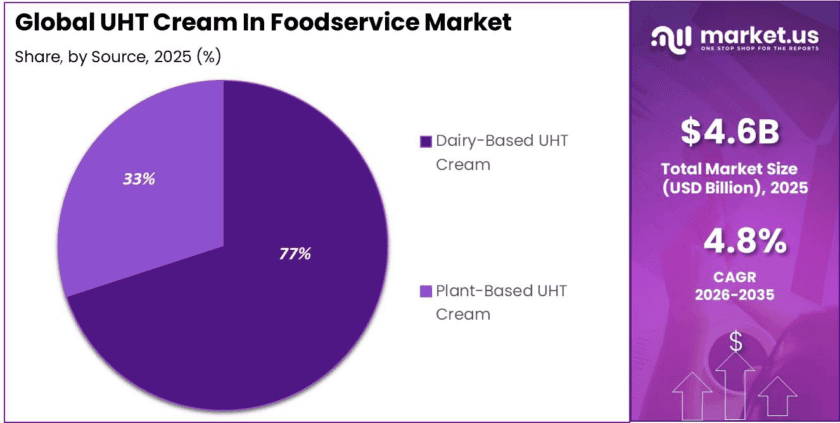
- Based on source, dairy-based UHT cream dominated the market, with a substantial market share of around 77.0%.
- Based on nature, conventional UHT cream led the market, comprising 91.0% of the total market share.
- Among applications, bakery and confectionery held a major share in the UHT cream in foodservice market, accounting for 39.0% of the market share.
- In 2025, Europe was the most dominant region in the UHT cream in foodservice market, accounting for 32.5% of the total market share.
Product Type Analysis
Whipping Cream dominates with 38.0% because its versatile texture supports broad foodservice use.
In 2025, Whipping Cream held a dominant market position, capturing more than a 38.0% share. Its leading position was supported by widespread use across bakeries, cafés, hotels, restaurants, and catering kitchens. Foodservice operators use whipping cream for cake decoration, pastry fillings, mousses, beverages, and plated desserts because it can develop volume quickly while providing a smooth finish. Ultra-high-temperature processing also helps professional kitchens maintain consistent quality, simplify inventory management, and reduce preparation pressure during busy service periods. Its versatility across both sweet and savoury menus further supports demand.
For instance, in August 2025, according to Arla Foods, the company’s half-year report identified cooking cream as a leading contributor to the growth of its Puck brand.
Cooking Cream is expected to be a growing segment. Its expansion is supported by increasing demand for convenient ingredients that deliver consistent performance in sauces, soups, pasta dishes, curries, and prepared meals. Professional chefs value its pourability, heat tolerance, and ability to provide richness without requiring lengthy preparation. These characteristics support broader adoption across high-volume kitchens and institutional catering operations.
Source Analysis
Dairy-Based UHT Cream dominates with 77.0% because familiar performance and dependable supply support foodservice use.
In 2025, Dairy-Based UHT Cream held a dominant market position, capturing more than a 77.0% share. Its leading position was supported by established use across bakeries, cafés, hotels, restaurants, and institutional kitchens. Professional users value its familiar flavour, smooth mouthfeel, whipping properties, and compatibility with both hot and cold recipes. Established dairy-processing networks also support consistent sourcing, standardized quality, and dependable delivery for kitchens operating on regular production schedules. These practical advantages help dairy-based UHT cream remain a preferred option for sauces, desserts, beverages, fillings, and finishing applications.
For instance, in February 2026, according to Arla Foods, its annual report stated that a new plant-based range strengthened a strategic brand by attracting younger consumers and expanding its reach.
Plant-Based UHT Cream is expected to be a growing segment. Its expansion is supported by changing menu requirements, increasing interest in dairy-free choices, and demand for versatile products suitable for both cooking and whipping. Foodservice operators are evaluating plant-based creams as a way to serve broader customer groups while maintaining consistent kitchen performance at scale.
Nature Analysis
Conventional dominates with 91.0% because established dairy supply chains support dependable foodservice purchasing.
In 2025, Conventional held a dominant market position, capturing more than a 91.0% share. Its leadership was supported by broad availability, familiar taste, standardized processing, and reliable performance in professional kitchens. Restaurants, bakeries, cafés, hotels, and caterers commonly select conventional cream because it fits established purchasing systems and performs consistently across sauces, fillings, beverages, toppings, and prepared desserts. Large dairy networks also help suppliers maintain regular production, stable specifications, and convenient pack formats for customers managing frequent orders and high-volume service.
For instance, in January 2025, according to Organic Valley, the cooperative introduced organic oat creamers made with oats sourced directly from certified organic family farms, expanding its organic creamer portfolio.
Organic is expected to be a growing segment. Its expansion is supported by demand for menu differentiation, certified sourcing requirements, and growing customer interest in products produced under recognized farming standards. Foodservice operators can use organic cream to strengthen premium offerings, serve ingredient-conscious consumers, and provide clearly identified choices across specialty cafés, bakeries, hospitality venues, and institutional menus.
Application Analysis
Bakery and Confectionery dominates with 39.0% because cream supports dependable finishing, filling, and preparation.
In 2025, Bakery and Confectionery held a dominant market position, capturing more than a 39.0% share. Its leading position was supported by the regular use of UHT cream in cakes, pastries, muffins, fillings, ganache, and decorative toppings. Professional bakers value products that provide consistent whipping, smooth texture, and reliable performance throughout production schedules. Longer shelf life also helps kitchens manage inventory efficiently, reduce product losses, and achieve uniform results across multiple outlets. These practical benefits keep UHT cream an important ingredient in bakery and confectionery operations.
For instance, in January 2025, according to Elle & Vire Professionnel, the company became the main partner of the Coupe du Monde de la Pâtisserie, strengthening its engagement with professional pastry chefs and high-end dessert preparation.
Desserts are expected to be a growing segment. Demand is supported by the wider use of UHT cream in puddings, mousses, layered desserts, plated creations, and chilled preparations. Foodservice operators value the ingredient for its convenience, smooth mouthfeel, and ability to provide stable results across different recipes and service formats while maintaining consistent quality.
Emerging Trends
The foundation of the UHT cream category rests on the raw milk supply that feeds it, and that supply base is steadily expanding. EU farms produced an estimated 161.8 million tonnes of raw milk in 2024, an increase of 0.9 million tonnes compared with 2023 and a rise of 12.1 million tonnes compared with 2014. Of this, 150.8 million tonnes were delivered to dairies, where cream fabrication alone generated 13.9 million tonnes of skimmed milk as a byproduct, confirming that Europe’s dairy processors now have a growing and stable cream feedstock to draw on for shelf-stable, foodservice-ready formats like UHT cream.
India has emerged as the world’s largest raw milk base and is becoming an increasingly important source of dairy exports, including UHT-processed products destined for foodservice channels. The country produced 239.30 million tonnes of milk during 2023-24, ranking 1st in the world in total milk production, with output rising 3.78% over the prior year. On the export side, India shipped 113,350.36 metric tonnes of dairy products worth $492.86 million during FY25, with UAE, Saudi Arabia, Bahrain, the USA, and Egypt as the leading destinations, underscoring the country’s growing role in cross-border dairy trade that increasingly includes shelf-stable cream products suited to long-distance foodservice supply chains.
Demand-side momentum is just as strong. Total inflation-adjusted U.S. food spending reached $2.51 trillion in 2025, up from $2.49 trillion in 2024, and food-away-from-home spending grew faster than at-home spending over the long run, climbing to $1.41 trillion in 2025 from an inflation-adjusted $818 billion in 1997. As a result, food away from home now accounts for 56.3% of total food expenditures, a structural shift that directly expands the addressable base for foodservice-format dairy inputs such as UHT cream, which is prized in commercial kitchens for its ambient shelf life and reduced refrigeration burden.
This spending shift is showing up directly in restaurant industry results. Traditional U.S. restaurant sales were projected to surpass $1.1 trillion in 2025, a year-over-year increase of 4.1%, while the entire restaurant and foodservice industry, including catering, lodging, and institutional channels, was projected to reach $1.5 trillion. This marks a nearly 82% increase in sales from 2020, when annual eating-and-drinking-place sales stood at $605 billion, and it reflects an operating environment in which foodservice operators are scaling volumes and increasingly favor consistent, long-shelf-life dairy inputs like UHT cream to simplify inventory and reduce spoilage-related losses.
Coffee culture is one of the clearest demand drivers for foodservice cream, and out-of-home coffee consumption is climbing. As of Fall 2025, 66% of American adults drank coffee daily, with 82% of past-day drinkers preparing it at home but a rising share purchased away from home; among out-of-home coffee buyers, drive-through purchases hit an all-time high of 59%, up 9% since 2024. Cold and iced coffee formats, which typically rely on cream for texture and flavor, also spiked seasonally, accounting for 31% of coffee consumed in a June survey compared with 23% in January 2025, a pattern that reinforces steady, format-driven demand for reliable, shelf-stable cream supplies across cafes and quick-service coffee outlets.
Use Cases
Commercial Bakeries and Pastry Production UHT cream is a workhorse ingredient in commercial bakeries, where it goes into fillings, glazes, whipped toppings, and enriched doughs that need consistent fat content and a long, unrefrigerated shelf life between deliveries. The scale of this buyer base is substantial: the U.S. baking industry employs almost 800,000 skilled workers, generates more than $42 billion in direct wages, and carries an overall economic impact exceeding $186 billion, with bakers operating in all 50 states plus the District of Columbia and Puerto Rico. For an ingredient category built around shelf stability and format flexibility, this is a deep and geographically dispersed customer base that continues to draw on UHT cream to standardize recipes across multi-site bakery operations.
Hotel Banquets, Catering, and In-Room Dining Hotels represent a major and growing use case for UHT cream, which is favored in banquet kitchens and room-service operations for its predictable performance in sauces, desserts, and coffee service without the cold-chain risk of pasteurized cream. U.S. hotel guest spending is expected to reach nearly $805 billion in 2026, a 1.7% increase over 2025, while the industry paid nearly $128 billion in wages and benefits in 2025 and is projected to employ approximately 2.2 million people in 2026. This scale of food-and-beverage-driven guest spending translates into steady institutional demand for shelf-stable dairy inputs that hotel kitchens can stock centrally and distribute across banquet and dining outlets without spoilage risk.
Institutional and School Foodservice Because UHT cream does not require refrigeration until opened, it is well suited to institutional kitchens that prepare large volumes of soups, sauces, and baked goods on tight budgets and irregular delivery schedules, including school cafeterias. On a typical day in the 2023-2024 school year, nearly 29.4 million children participated in the National School Lunch Program, with 21.1 million of them receiving a free or reduced-price lunch, illustrating the sheer scale of centralized meal preparation that favors ambient-stable dairy ingredients capable of being stored and transported across large school districts without cold-chain logistics.
Coffee Shops and Café Beverage Programs Cafes and coffee bars are one of the most direct use cases for UHT cream, which is used in lattes, cold foam, and specialty drinks where a long shelf life supports high-volume, multi-location beverage programs. Coffee supports nearly 2.2 million U.S. jobs and adds more than $343 billion to the U.S. economy every year, with coffee consumers spending nearly $110 billion annually and coffee businesses paying nearly $38 billion in local, state, and federal taxes each year. With 66% of American adults drinking coffee daily, this beverage-driven demand keeps UHT cream in constant rotation behind café counters and espresso bars nationwide.
Quick-Service and Fast-Casual Restaurant Chains Quick-service and fast-casual chains use UHT cream in frozen beverages, dessert soft-serve bases, and sauce programs where central commissaries need an ingredient that survives distribution to thousands of outlets without refrigeration until use. As of June 2026, employee counts at U.S. quickservice and fast-casual restaurants stood at 64,000 jobs, or 1.4%, above pre-pandemic levels, reflecting continued expansion of this segment’s footprint. This steady growth in limited-service restaurant staffing and outlet activity supports sustained commissary-level demand for shelf-stable cream formats that can move efficiently through centralized supply chains to high-volume, standardized menus.
Conclusion
UHT cream has moved from a niche shelf-stable product to a core input across the foodservice value chain, and the numbers back this up. Global milk supply keeps expanding, with EU output reaching 161.8 million tonnes in 2024 and India producing 239.30 million tonnes in 2023-24, giving processors a growing raw material base to convert into ambient, long-life cream formats. On the demand side, U.S. food-away-from-home spending hit $1.41 trillion in 2025, restaurant and foodservice sales are tracking toward $1.5 trillion, and coffee alone drives nearly $110 billion in consumer spending each year, all of which lean on ingredients that can survive multi-site distribution without refrigeration. This pattern repeats across every use case examined, from commercial bakeries employing almost 800,000 workers to hotels spending nearly $805 billion on guest services in 2026, school programs feeding 29.4 million children daily, and quick-service chains expanding staffing 1.4% above pre-pandemic levels. Taken together, these figures point to a straightforward conclusion: UHT cream’s appeal in foodservice rests on a simple operational advantage, its long shelf life and reduced cold-chain dependence, and as out-of-home food and beverage spending keeps climbing across bakeries, hotels, cafes, institutions, and restaurant chains, this advantage should keep translating into steady, broad-based demand for UHT cream well beyond any single segment.
Frequently Asked Questions
What is UHT cream?
UHT cream is dairy cream heated briefly to ultra-high temperatures, typically around 135-150°C, then aseptically packaged. This process kills bacteria and enzymes, giving the product an ambient shelf life of several months without refrigeration until opened, unlike standard pasteurized cream.
Why do foodservice operators prefer UHT cream over regular cream?
Foodservice operators favor UHT cream because it removes cold-chain dependency, reduces spoilage losses, and simplifies inventory across multi-site kitchens. Bakeries, hotels, cafes, and quick-service chains can stock it centrally and distribute it without refrigerated trucks, lowering logistics costs and waste.
Which foodservice segments use UHT cream the most?
Commercial bakeries, hotel banquet and catering kitchens, coffee shops, institutional and school foodservice programs, and quick-service or fast-casual restaurant chains are the heaviest users. Each segment relies on UHT cream’s long shelf life to support high-volume, standardized, multi-location food and beverage production.
Is UHT cream nutritionally different from pasteurized cream?
UHT cream retains a similar fat and nutrient profile to pasteurized cream, though the higher heat treatment can slightly affect flavor and texture. Most foodservice buyers find the difference minimal, especially in cooked applications like sauces, bakery fillings, and coffee beverages.
How long can UHT cream be stored unopened?
Unopened UHT cream typically stays shelf-stable for several months at room temperature due to aseptic processing and packaging. Once opened, it should be refrigerated and used within a few days, similar to regular pasteurized cream, to maintain freshness and safety.
What is driving growth in UHT cream demand within foodservice?
Growth is driven by rising food-away-from-home spending, expanding coffee and quick-service consumption, and operators seeking supply chain resilience. Rising raw milk production globally, combined with foodservice operators prioritizing reduced spoilage and simplified logistics, continues to support steady UHT cream adoption.
Is UHT cream commonly used in coffee shops and cafes?
Yes, UHT cream is widely used in cafes for lattes, cold foam, and specialty beverages because its shelf stability supports high-volume, multi-location beverage programs. With most American adults drinking coffee daily, cafes represent one of the most consistent UHT cream use cases.
Does UHT cream support sustainability goals in foodservice?
UHT cream can support sustainability by reducing food waste through longer shelf life and fewer spoiled deliveries. It also lowers transportation emissions since it does not require constant refrigerated shipping, making it attractive to operators managing environmental and cost efficiency goals together.
Discuss your needs with our analyst
Please share your requirements with more details so our analyst can check if they can solve your problem(s)