Report Overview
In 2025, the Global Sugar-free Ice Cream Market was valued at USD 3.7 billion. From 2026 to 2035, the market is projected to grow at a CAGR of 9.2%, reaching approximately USD 8.9 billion by 2035. North America led the market in 2025, accounting for more than 34.78% of the global share and generating approximately USD 1.29 billion in revenue.
The sugar-free ice cream industry is evolving beyond its traditional positioning as a product mainly for people with diabetes and is becoming part of the broader better-for-you frozen dessert category. Manufacturers are increasingly using sweeteners and functional ingredients such as stevia, monk fruit, erythritol, allulose, and soluble fibers to reduce sugar while maintaining creaminess, freezing stability, and appealing flavour.
According to the USDA, U.S. ice cream and frozen dairy production reached 1,386 million gallons in 2024. Regular ice cream accounted for approximately 60–65% of production, while low-fat and nonfat products represented around 24–34%, highlighting continued opportunities for differentiated and health-focused frozen dessert formulations.
Market demand is further supported by increasing diabetes prevalence, calorie-conscious consumers, and growing awareness of added sugar intake. The International Diabetes Federation (IDF) reported that 589 million adults were living with diabetes in 2024, equivalent to approximately 1 in 9 adults, and projects this number to rise to 853 million by 2050. These trends are encouraging retailers and food-service operators to expand reduced-sugar product options. However, factors such as taste, texture, ingredient costs, and digestive tolerance remain important challenges for manufacturers and consumers.
Future market growth is expected to be supported by high-protein recipes, plant-based ice cream bases, portion-controlled formats, and clean-label sweetener blends. In the U.S., FDA regulations permit a “sugar free” claim when a product contains less than 0.5 gram of sugars per serving. The FDA’s Daily Value for added sugars is 50 grams per day, while dietary guidance recommends limiting added sugars to less than 10% of total daily calories. These nutritional standards are likely to continue influencing product formulation, labeling, and consumer demand for sugar-free frozen desserts.
Key market segment
- The global Sugar-free Ice Cream market was valued at USD 3.7 billion in 2025.
- The global market is projected to grow at a CAGR of 9.2% and is estimated to reach USD 8.9 billion by 2035.
- On the basis of type, the Vanilla Sugar-free Ice Cream dominated the market, constituting 33.45% of the total market share.
- Based on the Form, the Bar/Stick dominated the Sugar-free Ice Cream market, with a substantial market share of around 42.34%.
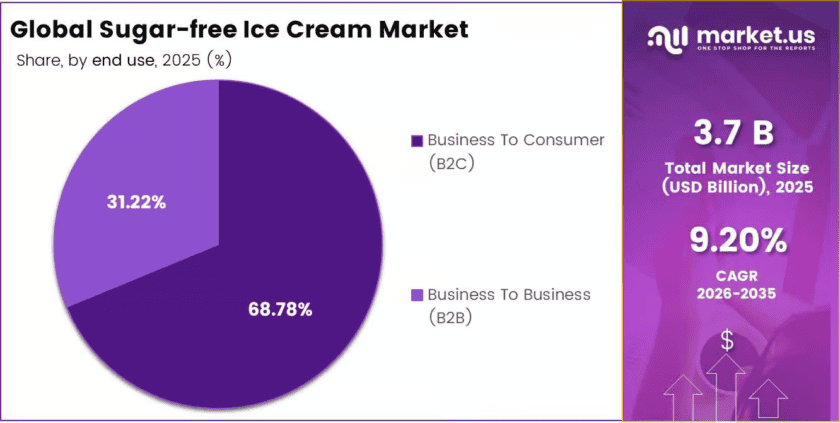
- Based on the End Use, Business To Consumer (B2C) led the market, comprising 68.78% of the total market.
- Among the Distribution Channel, the Supermarkets and Hypermarkets held a major share in the Sugar-free Ice Cream market, 39.78% of the market share.
- In 2025, the North America was the most dominant region in the Sugar-free Ice Cream market, accounting for 34.78% of the total global consumption.
Type Analysis
Vanilla represents dominant Segment in the Market.
Vanilla leads the sugar-free ice cream market with a 33.45% share, supported by its familiar taste and compatibility with stevia, monk fruit, allulose and other sugar alternatives. It is widely used across retail tubs, food-service desserts and plant-based products, while also pairing well with fruits, nuts and sauces. In 2025, U.S. milk production exceeded 231 billion pounds, providing a strong dairy supply base for conventional and reduced-sugar frozen desserts.
Chocolate is emerging as the fastest-growing flavour as manufacturers improve cocoa intensity while controlling sugar and calories. Its indulgent profile helps sugar-free ice cream attract a wider consumer base. In 2026, CDC reported that desserts and sweet snacks contributed 19% of U.S. added-sugar consumption, while FDA regulations allow a reduced-sugar claim when a product contains at least 25% less sugar than an appropriate reference product.
Form Analysis
Bar/Stick a significant form.
Bar/stick dominated the sugar-free ice cream market with a 42.34% share, driven by its portion-controlled format, easy handling and individual packaging. It is suitable for convenience stores, supermarkets, vending points and food-service outlets, supporting quick and convenient consumption. U.S. food-away-from-home spending reached USD 1.41 trillion in 2025, according to USDA, creating a strong consumer base for portable frozen desserts.
Pints are emerging as the fastest-growing form, supported by at-home consumption, resealable packaging and premium sugar-free recipes. They also allow portion control and convenient storage for later consumption. The U.S. Census Bureau reported 39.7 million one-person households in 2025, supporting demand for compact frozen dessert packages suitable for smaller households.
End Use Analysis
Business-to-consumer Are the Most Widely Used Separators.
Business-to-consumer led the sugar-free ice cream market with a 68.78% share, supported by widespread availability through supermarkets, convenience stores, brand websites and online grocery platforms. Direct purchasing allows consumers to compare flavours, ingredients, calories and sweetener claims. U.S. retail e-commerce sales reached USD 326.7 billion in Q1 2026, strengthening opportunities for home delivery, multipacks and direct-to-consumer subscriptions.
Business-to-business is emerging as the fastest-growing end use as restaurants, hotels, cafés, hospitals and institutional caterers increase reduced-sugar dessert offerings. Bulk packaging and recurring contracts can help control serving costs while providing healthier dessert alternatives. U.S. Census Bureau and BLS data indicate that the U.S. food-service sector represents a multi-trillion-dollar market, supporting continued opportunities for commercial sugar-free ice cream suppliers.
Distribution Channel Analysis
Held a Major Share of the Sugar-free Ice Cream Market.
Supermarkets and hypermarkets held the leading position with a 39.78% share, supported by high customer traffic, extensive freezer space and a wide selection of flavours, pack sizes and price points. These stores also allow consumers to compare nutrition labels and sweetener ingredients. USDA reported that U.S. food-at-home expenditure reached USD 1.10 trillion in 2025, highlighting the strong grocery purchasing base for frozen desserts.
Convenience stores are the fastest-growing distribution channel, driven by demand for quick, portable and portion-controlled desserts. Convenient locations, extended hours and grab-and-go layouts support impulse purchases, particularly among commuters and younger consumers. U.S. Census Bureau County Business Patterns data recorded 36,992 convenience-store employer establishments, providing a broad retail network for sugar-free ice cream brands to increase visibility and consumer reach.
Emerging Trends
1. Growing Demand for Low-Sugar and Better-for-You Desserts
Sugar-free ice cream is increasingly moving beyond the traditional diabetic-food segment and becoming part of the broader better-for-you dessert category. In the 2025 IFIC Food & Health Survey, 34% of Americans considered low in sugar a characteristic of a healthy food, while 38% selected “good source of protein.” In addition, 70% of Americans reported trying to consume protein in 2025. This is encouraging manufacturers to develop sugar-free ice cream with improved nutrition rather than simply removing sugar.
2. Shift Toward Natural and Plant-Based Sweeteners
Manufacturers are increasingly experimenting with stevia, monk fruit, and allulose to reduce conventional sugar while maintaining sweetness. FDA states that certain purified steviol glycosides are 200–400 times sweeter than table sugar, allowing manufacturers to use very small quantities. FDA has also reviewed GRAS notices for D-allulose, including its intended use in frozen dairy desserts such as ice cream, soft serve, and sorbet at levels up to 5% in one cited use framework.
3. High-Protein Sugar-free Ice Cream
Protein is becoming an important product-development direction for sugar-free ice cream. According to IFIC, 71% of Americans said they were trying to consume protein in 2024, followed by 70% in 2025, compared with 59% in 2022. As a result, manufacturers are increasingly positioning frozen desserts as snacks that combine reduced sugar with protein, potentially attracting fitness-focused consumers and people seeking more filling snack options.
4. Stronger Focus on Clean-Label Formulations
Consumers are increasingly looking beyond sugar content and paying attention to ingredients and processing. The 2025 IFIC survey found that 25% of Americans considered a limited number of ingredients important when defining a healthy food, while 24% selected limited or no artificial ingredients or preservatives. This trend is encouraging sugar-free ice cream producers to simplify formulations and communicate ingredient choices more clearly on packaging.
5. Diabetes and Sugar-Reduction Needs Support Demand
Growing awareness of diabetes and the health effects associated with excessive added-sugar consumption is creating opportunities for sugar-free ice cream. The CDC estimates that 40.1 million people in the U.S. had diagnosed or undiagnosed diabetes in 2023, equal to about 12.0% of the population. In addition, 115.2 million U.S. adults had prediabetes. These figures support continued demand for lower-sugar food and dessert options, although sugar-free products should not automatically be considered suitable for every person with diabetes.
6. Better Texture and Taste Are Becoming Key Differentiators
Sugar reduction can affect sweetness, body, freezing characteristics and mouthfeel, making formulation quality increasingly important. The opportunity is significant because U.S. ice cream and frozen dairy production reached 1,386 million gallons in 2024. Regular ice cream still represented around 60–65% of production, while low-fat and nonfat products accounted for approximately 24–34%, showing the scale of consumer demand for different frozen-dessert formulations.
7. Portion-Controlled and Calorie-Conscious Formats
Sugar-free ice cream is also well suited to single-serve cups, mini tubs, bars and controlled portions. FDA notes that added sugars have a Daily Value of 50 grams per day on a 2,000-calorie diet and that the Dietary Guidelines recommend keeping calories from added sugars below 10% of total daily calories. These guidelines support product development focused on lower-sugar and portion-conscious desserts.
Use Cases
1. Diabetes-Conscious Dessert Options
Sugar-free ice cream can be used as a reduced-sugar dessert option for consumers who monitor their sugar or carbohydrate intake. The CDC estimated that 40.1 million people in the U.S. had diagnosed or undiagnosed diabetes in 2023, representing 12.0% of the population. This creates a significant consumer base for lower-sugar dessert choices.
2. Low-Sugar Dessert Consumption
Sugar-free ice cream is increasingly relevant for consumers attempting to reduce their overall added-sugar consumption. The FDA states that the Daily Value for added sugars is 50 grams per day based on a 2,000-calorie diet, while dietary guidance recommends keeping calories from added sugars below 10% of daily calories. These recommendations support demand for lower-sugar dessert alternatives.
3. Allulose-Based Ice Cream Formulations
Allulose provides an important application for sugar-free ice cream because it can be used in frozen dairy desserts while maintaining a sweet taste. FDA documentation lists ice cream, soft serve and sorbet among intended applications for D-allulose, with a maximum use level of 5% for frozen dairy desserts in the cited GRAS notice.
4. Reduced-Calorie Frozen Desserts
Sugar-free ice cream can be developed as part of reduced-calorie dessert portfolios by replacing conventional sugar with alternative sweetening ingredients. This application is particularly relevant for consumers seeking desserts that fit calorie-conscious eating patterns while still providing familiar ice cream taste and texture.
5. Retail Frozen Dessert Products
Supermarkets and grocery retailers can use sugar-free ice cream to expand differentiated frozen dessert offerings through pints, tubs, cups and bars. USDA reported that U.S. production of ice cream and other frozen dairy products reached 1,386 million gallons in 2024, indicating a large established production base for specialized frozen-dessert products.
6. Low-Fat and Reduced-Sugar Product Development
Sugar-free formulations can be combined with low-fat positioning to target consumers seeking multiple nutritional attributes. USDA data show that regular ice cream represented approximately 60–65% of U.S. ice cream production, while low-fat and nonfat ice cream represented around 24–34%, demonstrating established demand for differentiated frozen-dessert categories.
7. Alternative Sweetener Applications
Sugar-free ice cream provides an important application for alternative sweeteners used to replace conventional sugar. FDA recognizes the use of various sweetening ingredients in foods and notes that some high-intensity sweeteners can provide sweetness at very low usage levels. This allows manufacturers to develop products with substantially reduced conventional sugar content.
8. Portion-Controlled Dessert Formats
Sugar-free ice cream can be offered through single-serve cups, mini portions and individual bars, helping consumers control their dessert intake. This use case aligns with FDA guidance that added sugars should be limited to 50 grams per day on a 2,000-calorie diet, making portion size an important consideration in lower-sugar product development.
9. Food-Service and Hospitality Applications
Restaurants, cafés, hotels and catering businesses can use sugar-free ice cream as an alternative dessert for customers requesting lower-sugar choices. The application allows food-service operators to broaden dessert menus without completely removing ice cream-based products, particularly where consumers have specific dietary preferences.
10. Product Reformulation and Innovation
Food manufacturers can use sugar-free ice cream as a platform for broader reformulation, combining sugar reduction with ingredients designed to improve taste, texture and nutritional positioning. The opportunity is supported by the scale of the U.S. frozen dairy category, although total production declined 10% from 1,542 million gallons in 2003 to 1,386 million gallons in 2024, increasing the importance of differentiated products.
Conclusion
The sugar-free ice cream segment is developing from a niche dietary product into a broader better-for-you frozen dessert category. Rising interest in lower sugar, protein, clean-label ingredients and alternative sweeteners is creating new product opportunities. With 589 million adults living with diabetes globally in 2024, 76% of surveyed Americans trying to limit or avoid sugars, and 70% trying to consume protein in 2025, manufacturers have a strong consumer base for innovation. Future success will depend on delivering good taste, creamy texture, competitive pricing and credible nutritional benefits rather than relying only on the sugar-free label.
Frequently Asked Questions
1. What is sugar-free ice cream?
Sugar-free ice cream is a frozen dessert formulated without conventional added sugar and designed to meet applicable sugar-free labeling requirements. In the U.S., FDA defines “sugar free” as containing less than 0.5 gram of sugars per labeled serving.
2. Why is demand for sugar-free ice cream increasing?
Demand is supported by greater awareness of sugar intake, diabetes and healthier eating. In the 2024 IFIC survey, 76% of Americans said they were trying to limit or avoid sugars, increasing from 72% in 2023.
3. Is sugar-free ice cream suitable for people with diabetes?
Sugar-free ice cream may provide a lower-sugar dessert option, but it is not automatically appropriate for everyone with diabetes. Consumers should consider total carbohydrates, calories, ingredients and individual dietary requirements rather than relying only on the “sugar-free” claim.
4. Which sweeteners are used in sugar-free ice cream?
Common alternatives include stevia, monk fruit, allulose and sugar alcohols such as erythritol. FDA notes that certain purified steviol glycosides are 200–400 times sweeter than table sugar, allowing manufacturers to achieve sweetness using relatively small quantities.
5. What is driving innovation in sugar-free ice cream?
Innovation is increasingly focused on combining sugar reduction with other consumer benefits, particularly protein, plant-based ingredients, clean labels and portion control. In 2025, 70% of Americans reported trying to consume protein, supporting high-protein frozen dessert development.
6. How large is the opportunity for sugar-free ice cream?
The opportunity is supported by a large existing frozen-dessert industry and changing consumer preferences. U.S. ice cream and frozen dairy production reached 1,386 million gallons in 2024, providing an established category for manufacturers to introduce differentiated reduced-sugar products.
7. What does “sugar-free” mean under FDA rules?
Under U.S. FDA rules, a food can generally use the “sugar-free” claim when it contains less than 0.5 gram of sugars per reference amount customarily consumed and per labeled serving. Additional labeling conditions can also apply to products making the claim.
8. What are the main challenges in making sugar-free ice cream?
The main challenges include maintaining sweetness, creamy mouthfeel, freezing stability and appealing flavor while controlling ingredient costs. Sugar contributes functional properties beyond sweetness, so manufacturers often need carefully balanced sweeteners, fibers, fats and other formulation ingredients.
9. Is high-protein sugar-free ice cream becoming a trend?
Yes. Protein is a major consumer nutrition trend that is influencing frozen desserts. IFIC reported that 71% of Americans tried to consume protein in 2024, while 70% did so in 2025, making high-protein formulations an important product-development opportunity.
10. What is the future outlook for sugar-free ice cream?
The future outlook is positive as consumers increasingly seek desserts with lower sugar and additional nutritional benefits. Growth opportunities are expected across retail, food service, plant-based products, high-protein recipes and portion-controlled formats, provided manufacturers maintain taste and texture quality.
Discuss your needs with our analyst
Please share your requirements with more details so our analyst can check if they can solve your problem(s)