Market Overview
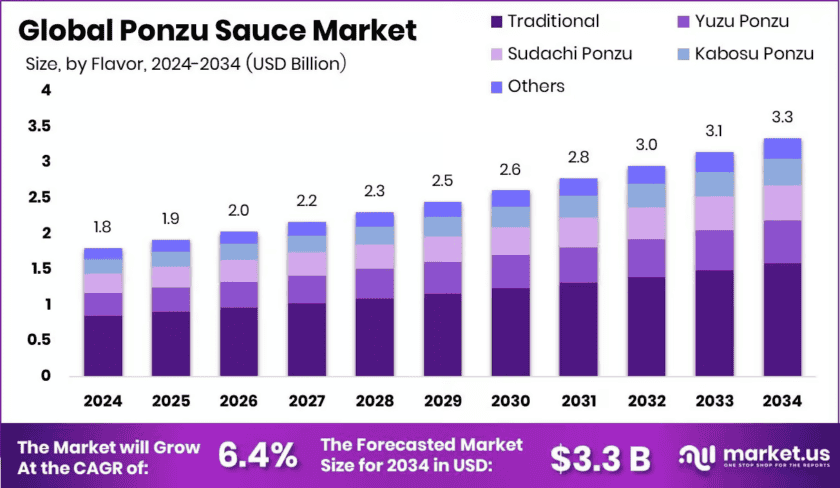
The Global Ponzu Sauce Market demonstrates strong growth potential in 2024. Market value stands at USD 1.8 billion, with projections reaching USD 3.3 billion by 2034. This growth represents a compound annual growth rate of 6.4% from 2025 to 2034. Consequently, manufacturers see increasing opportunities across retail and foodservice channels.
Ponzu sauce combines citrus juice, soy sauce, and rice vinegar for a tangy flavor. This traditional Japanese condiment also includes mirin or dashi for added depth. Its savory and slightly sweet profile works well for dipping, marinating, and dressing. Therefore, restaurants and households value its versatility.
Hyphen recently secured USD 25 million in funding with CAVA support. This investment signals growing confidence in foodservice innovation. Such financial backing helps expand distribution networks for specialty condiments. Consequently, ponzu sauce reaches more consumers through improved supply chains.
Embargo received a GBP 350,000 grant to upgrade its foodservice app. Artificial intelligence integration will streamline ordering and inventory management. This technology helps restaurants track ponzu sauce usage and automate reordering. Therefore, foodservice operators can maintain consistent supply without manual effort.
Key Takeaways
- The Global Ponzu Sauce Market is expected to be worth around USD 3.3 billion by 2034, up from USD 1.8 billion in 2024, and is projected to grow at a CAGR of 6.4% from 2025 to 2034.
- The Ponzu Sauce market shows that traditional flavors lead with a 47.3% share globally.
- Conventional ponzu sauce dominates the market, accounting for 87.9% of overall sales worldwide.
- Foodservice remains the top end-use segment, representing 48.2% of Ponzu Sauce consumption.
- Hypermarkets and supermarkets lead distribution channels, capturing 51.2% of the Ponzu Sauce market reach.
- The Asia Pacific, USD 0.8 billion, drives the Ponzu Sauce market expansion significantly.
➤ Download Exclusive Sample Of This Premium Report (Including Full TOC, Table & Figures)- https://market.us/report/ponzu-sauce-market/request-sample/
Market Segmentation Overview
By Flavor Analysis
Traditional flavor dominates the ponzu sauce market with a 47.3% share in 2024. Consumers trust authentic taste profiles and classic Japanese recipes. Home cooks and professional chefs value traditional ponzu for its versatility. This flavor enhances seafood, salads, and grilled items effectively.
Yuzu, sudachi, and kabosu ponzu represent emerging flavor variants. These citrus-forward options attract adventurous consumers seeking new taste experiences. Manufacturers develop these variants to capture niche market segments. Additionally, flavored ponzu sauces appeal to fusion cuisine applications.
By Nature Analysis
Conventional ponzu sauce commands 87.9% of global sales in 2024. Widespread availability and consistent quality drive this preference. Household consumers find conventional products affordable and reliable. Foodservice providers choose conventional options for cost-effectiveness and familiar taste profiles.
Organic ponzu sauce holds a smaller but growing market position. Health-conscious consumers actively seek organic certification and natural ingredients. This segment benefits from clean-label trends across developed markets. Consequently, manufacturers invest in organic product lines to capture this demand.
By End-Use Analysis
Foodservice represents 48.2% of global ponzu sauce consumption in 2024. Restaurants, hotels, and catering services rely on ponzu for diverse dishes. Professional chefs value its consistent quality and ease of recipe integration. Additionally, ponzu enhances sushi, grilled seafood, salads, and marinades effectively.
Retail accounts for a substantial portion of remaining consumption. Household buyers purchase ponzu sauce for home cooking and entertaining. The industrial segment uses ponzu as an ingredient in prepared foods. Therefore, manufacturers maintain balanced distribution across all end-use channels.
By Distribution Channel Analysis
Hypermarkets and supermarkets capture 51.2% of ponzu sauce distribution in 2024. These retail formats offer convenience, wide product variety, and accessibility. Organized shelf space and promotional activities drive consumer purchases. Additionally, bulk purchasing options appeal to small-scale foodservice operators.
Specialty stores and convenience stores serve niche and impulse purchase needs. Specialty stores attract culinary enthusiasts seeking authentic Japanese products. Convenience stores provide quick access for last-minute meal preparation. Consequently, manufacturers use multi-channel strategies to maximize market reach.
Drivers
The rising global popularity of Japanese cuisine drives the ponzu sauce market growth. Consumers increasingly explore authentic international flavors in restaurants and at home. Sushi, sashimi, and grilled seafood have become household favorites across many regions. Ponzu sauce complements these dishes perfectly with its tangy and savory profile.
Friendlier secured USD 4.5 million to help foodservice operators ditch single-use containers. This funding encourages restaurants to experiment with sustainable, high-quality ingredients. Sustainable packaging initiatives align with consumer preferences for environmentally responsible products. Therefore, ponzu sauce adoption benefits from broader foodservice sustainability trends.
Use Cases
Restaurants use ponzu sauce as a versatile dipping sauce for dumplings and spring rolls. Chefs also incorporate ponzu into marinades for grilled meats and seafood. This condiment works well as a salad dressing base with added oil. Moreover, ponzu adds bright acidity to noodle dishes and rice bowls.
Home cooks utilize ponzu sauce for quick and flavorful weeknight meals. A simple drizzle over steamed vegetables or roasted fish elevates everyday dishes. Ponzu also serves as a finishing sauce for grain bowls and stir-fries. Additionally, consumers mix ponzu with butter for a tangy seafood dip.
Major Challenges
Limited consumer awareness in emerging markets restricts ponzu sauce adoption. Many consumers in these regions remain unfamiliar with Japanese cuisine and its condiments. Without knowledge of ponzu’s flavor profile and uses, demand stays concentrated. Consequently, smaller foodservice operators hesitate to stock specialty sauces due to perceived low demand.
Restaurant365 raised USD 135 million to supersize its foodservice software. However, educating businesses and consumers about authentic ingredients remains challenging. Even with significant industry investments, awareness gaps persist in emerging markets. Therefore, manufacturers must invest in consumer education to expand global reach.
Business Opportunities
Ready-to-use bottled variants present a major growth opportunity for ponzu sauce manufacturers. Convenience drives purchasing decisions for both home cooks and busy foodservice operators. Pre-packaged ponzu allows easy recipe integration without preparation time. Additionally, bottled products support wider distribution through retail and online channels.
The EU-Armenia SME Fund invested USD 5.5 million in Alpha Food Service through Amber Capital Armenia. This funding supports expanded production and distribution capabilities. Manufacturers can develop flavored or organic ponzu variants to attract health-conscious buyers. Consequently, product innovation opens new market segments for ponzu sauce globally.
Regional Analysis
Asia Pacific dominates the ponzu sauce market with 45.8% share valued at USD 0.8 billion in 2024. Japan, China, and South Korea drive adoption through cultural familiarity with Japanese cuisine. Established production infrastructure and strong distribution networks support market growth. Additionally, rising foodservice sector activity increases ponzu consumption across the region.
North America and Europe show gradual growth supported by expanding retail channels. Increasing culinary curiosity encourages consumers to experiment with authentic condiments. The Middle East, Africa, and Latin America represent smaller but emerging markets. Consequently, manufacturers target these regions for future expansion through education and sampling programs.
Conclusion
The global ponzu sauce market demonstrates strong growth potential over the forecast period. Traditional flavors and conventional products currently dominate sales across all regions. Therefore, manufacturers can build on this stable foundation for future expansion. Market drivers include rising Japanese cuisine popularity and sustainable packaging initiatives. However, limited consumer awareness in emerging markets presents a key challenge. Ready-to-use bottled variants and organic product lines offer significant opportunities.
Discuss your needs with our analyst
Please share your requirements with more details so our analyst can check if they can solve your problem(s)