Overview
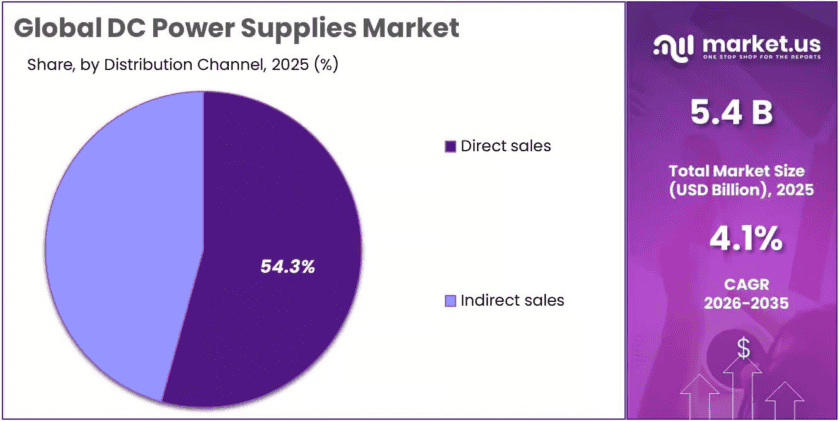
New York, NY – Sep 16, 2026 – The global DC Power Supplies Market is expanding as semiconductor manufacturing, industrial automation, telecommunications, electric vehicles, medical electronics, and data centers require stable and precisely controlled direct-current power. The market was valued at USD 5.4 billion in 2025 and is projected to reach approximately USD 8.1 billion by 2035, growing at a 4.1% CAGR from 2026 to 2035. Asia Pacific remained the leading regional market with a 42.65% share and approximately USD 2.30 billion in revenue.
Industry conditions remain favorable as electronic infrastructure expands. Global semiconductor sales reached USD 791.7 billion in 2025, rising 25.6% from 2024, according to the Semiconductor Industry Association. At the same time, global data-center electricity consumption reached about 485 TWh in 2025 and could rise to 950 TWh by 2030.
Telecommunications and transportation provide additional demand. ITU reported approximately 3 billion 5G subscriptions and 55% global 5G population coverage in 2025. Electric-car sales also exceeded 20 million units, representing 25% of worldwide new-car sales. These developments support demand for programmable, compact, efficient, and high-density DC power systems.
Key Takeaways
- The global DC Power Supplies Market was valued at USD 5.4 billion in 2025 and is expected to reach approximately USD 8.1 billion by 2035, expanding at a 4.1% CAGR.
- AC–DC power supplies dominated by type with more than a 61.00% share.
- Switching power supplies led design architecture with more than a 74.00% share.
- Multiple-output systems captured more than a 55.20% share.
- Industrial and manufacturing held the leading end-use position with more than a 25.10% share.
- Low-output power supplies held more than a 42.00% share.
- Direct sales accounted for more than a 54.00% share.
- Asia Pacific dominated geographically with a 42.65% share, generating approximately USD 2.30 billion in 2025.
Regional Analysis
Asia Pacific dominated the DC Power Supplies Market in 2025 with more than a 42.65% share and approximately USD 2.30 billion in revenue. The region benefits from a large electronics, semiconductor, telecommunications, electric-vehicle, and industrial-equipment manufacturing base.
China produced 484.3 billion integrated circuits in 2025, increasing 10.9% from the previous year. Production of industrial robots reached approximately 773,000 units, increasing 28.0%, while new-energy vehicle production reached 16.52 million units, up 25.1%. These sectors require DC power for electronic testing, automation controls, charging equipment, battery validation, and manufacturing processes.
Digital infrastructure also supports regional demand. ITU reported that 5G coverage reached approximately 70.4% of the Asia-Pacific population in 2025, compared with 55.1% globally. North America also represents an important growth area as semiconductor investment and data-center construction accelerate. The U.S. Department of Commerce reported nearly USD 450 billion in announced semiconductor and electronics investment, while the CHIPS Program Office was investing USD 39 billion in manufacturing incentives.
Market Dynamics
Driver – Semiconductor Manufacturing and Testing Expansion
Semiconductor growth is a major driver for DC power supplies because wafer testing, burn-in systems, component validation, advanced packaging, and laboratory equipment require highly stable voltage and current. Global semiconductor sales reached USD 791.7 billion in 2025, increasing 25.6% year over year. U.S. semiconductor and electronics companies had also announced nearly USD 450 billion in investment by January 2025, while the CHIPS Program Office was investing USD 39 billion in manufacturing incentives and had awarded approximately USD 34 billion. Expansion of fabs and testing capacity creates demand for programmable and multi-channel DC power systems.
Trend – Higher Power Density and Digital Control
DC power supplies are moving toward higher power density, programmable control, modular designs, remote monitoring, and improved conversion efficiency. AI infrastructure is accelerating this shift. The International Energy Agency reported that AI-server power density increased 11 times between 2020 and 2025 and could rise another 4 times by 2027. Global data centers consumed approximately 485 TWh of electricity in 2025, with demand projected at about 950 TWh by 2030. This creates stronger requirements for compact, efficient power conversion, advanced thermal management, and digitally controlled DC architectures in servers and test infrastructure.
Restraint – Component and Electrical Equipment Supply Constraints
Supply-chain pressure remains a restraint because DC power equipment depends on semiconductors, transformers, copper, control electronics, and specialized power components. The U.S. Department of Energy reported that distribution-transformer demand had increased 41% since 2019, while order lead times increased from around 3–6 months in 2019 to roughly 1–2 years or longer by 2024. DOE also highlighted dependence on imported components and materials across power-electronics supply chains. Similar supply pressures can increase component costs, lengthen production schedules, and delay large DC power installations for industrial facilities, laboratories, telecom networks, and data centers.
Opportunity – AI Data Centers and Electrified Transportation
AI infrastructure and electric transportation create significant future opportunities for DC power suppliers. Global data-center electricity consumption could nearly double from 485 TWh in 2025 to 950 TWh by 2030, while AI-focused data-center consumption is expected to triple. Electric-car sales exceeded 20 million units in 2025, increasing 20%, while nearly 22 million electric cars were manufactured globally. These applications require programmable and regenerative DC supplies for battery testing, inverter validation, charging-system development, server testing, and high-voltage electronics, creating opportunities for higher-power and digitally connected systems.
Emerging Trends
1. High-Density Power for AI Infrastructure
AI is changing power-supply design as server racks become more energy intensive. AI-server power density increased 11 times between 2020 and 2025, while data-center electricity demand could rise from 485 TWh to 950 TWh by 2030.
2. Growth of Wide-Bandgap Power Electronics
Power-supply manufacturers are increasingly exploring silicon-carbide and gallium-nitride technologies for smaller and more efficient systems. In January 2025, the U.S. Department of Energy introduced a strategic framework focused on strengthening domestic wide-bandgap power-electronics manufacturing and accelerating adoption.
3. Programmable Power for Electric-Vehicle Testing
Electric-vehicle growth is increasing demand for programmable and regenerative power systems used for battery, inverter, motor, and charging validation. Global electric-car sales exceeded 20 million units in 2025 and represented about 25% of new-car sales worldwide.
4. Telecom Networks Require Reliable DC Architectures
Telecom operators continue deploying DC-powered radios, routers, base stations, backup systems, and edge equipment. ITU estimated approximately 3 billion 5G subscriptions in 2025, while 5G networks reached 55% of the global population.
5. Semiconductor Testing Becomes More Power Intensive
Higher chip complexity is increasing demand for precision voltage control, multi-output power systems, and automated testing. Worldwide semiconductor sales reached USD 791.7 billion in 2025, increasing 25.6%, with logic and memory among the strongest product categories.
Use Cases
1. Semiconductor Testing and Validation
DC power supplies provide controlled voltage and current during wafer probing, burn-in, device characterization, and component validation. Global semiconductor revenue reached USD 791.7 billion in 2025, demonstrating the large industrial base requiring reliable test and measurement equipment.
2. Data Centers and AI Servers
Servers, storage systems, processors, and networking equipment require efficient DC conversion. Global data centers consumed about 485 TWh in 2025, and electricity demand could approach 950 TWh by 2030, increasing demand for high-density power equipment.
3. 5G and Telecommunications Equipment
DC supplies power base stations, communication racks, routers, switches, edge systems, and network testing equipment. ITU reported nearly 3 billion 5G subscriptions during 2025 and global 5G population coverage of approximately 55%.
4. Electric-Vehicle and Battery Testing
Programmable DC supplies simulate batteries and charging conditions during development and production testing. Electric-car sales exceeded 20 million units in 2025, while global electric-car manufacturing reached nearly 22 million units, increasing more than 25%.
5. Medical Electronics Manufacturing
Stable and low-noise DC power is required for medical-device production, development, calibration, and electronic testing. The U.S. FDA recorded 29,178 registered medical-device establishments in fiscal 2025, including 13,328 domestic and 15,850 foreign facilities.
Frequently Asked Questions on DC Power Supplies
What is a DC power supply?
A DC power supply converts electrical energy into stable direct-current voltage and current. It is commonly used to power electronic circuits, industrial controls, laboratory equipment, telecommunications systems, semiconductor testing equipment, medical devices, and automotive electronics.
How large is the DC Power Supplies Market?
The global DC Power Supplies Market was valued at approximately USD 5.4 billion in 2025 and is projected to reach about USD 8.1 billion by 2035, growing at a 4.1% CAGR.
Which type dominates the DC Power Supplies Market?
AC–DC power supplies led the market in 2025 with more than a 61.00% share. Their position reflects widespread use where equipment receives alternating-current grid power but requires regulated direct current for internal electronic operation.
Which power-supply architecture holds the largest share?
Switching power supplies dominated design architecture in 2025 with more than a 74.00% share. They are widely used because compact size, higher power density, and efficient voltage conversion suit telecom, servers, industrial electronics, and computing systems.
Which end-use industry leads the market?
Industrial and manufacturing applications held more than a 25.10% share in 2025. Production lines, semiconductor facilities, robotics, industrial controls, automated test equipment, sensors, and factory electronics require stable DC power for reliable continuous operation.
Why are DC power supplies important for semiconductor manufacturing?
Semiconductor testing requires precise and repeatable voltage and current during device characterization, burn-in, and validation. Global semiconductor sales reached USD 791.7 billion in 2025, increasing demand for accurate programmable power and electronic test infrastructure.
How are electric vehicles affecting DC power demand?
Electric vehicles require DC systems for battery testing, power electronics, charging validation, and component development. More than 20 million electric cars were sold globally in 2025, representing approximately 25% of all new-car sales.
Which region dominates the DC Power Supplies Market?
Asia Pacific led the global market in 2025 with more than a 42.65% share, worth approximately USD 2.30 billion. Its position is supported by major electronics, semiconductor, telecom, industrial-equipment, and electric-vehicle manufacturing activity.
What is driving future DC power-supply demand?
Future demand is being supported by AI data centers, semiconductor manufacturing, electric vehicles, 5G networks, medical electronics, industrial automation, and battery testing. Buyers are increasingly seeking programmable, modular, digitally controlled, and energy-efficient power architectures.
Conclusion
The DC Power Supplies Market is positioned for steady development as electronic systems become more complex, connected, and power intensive. Valued at USD 5.4 billion in 2025, the market is projected to reach approximately USD 8.1 billion by 2035, expanding at a 4.1% CAGR. Semiconductor manufacturing, AI data centers, 5G infrastructure, electric vehicles, industrial automation, and medical electronics are creating wider application opportunities. At the same time, manufacturers must address component availability, thermal management, efficiency, and supply-chain risks. Future competition is expected to focus increasingly on programmable control, higher power density, modular architecture, regenerative operation, and advanced digital monitoring.
Discuss your needs with our analyst
Please share your requirements with more details so our analyst can check if they can solve your problem(s)