Market Overview
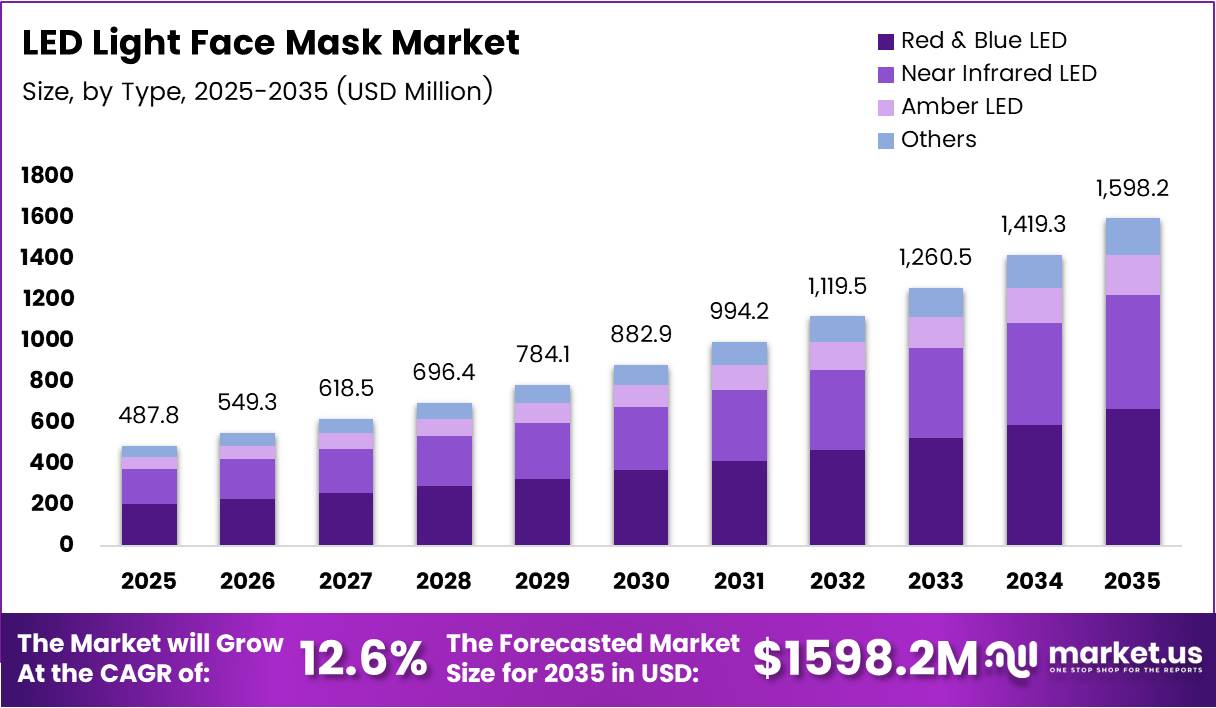
The LED Light Face Mask Market reached USD 487.8 Million in 2025 and is projected to reach USD 1,598.2 Million by 2035. The market is expanding at a CAGR of 12.6% during 2026–2035. This growth reflects rising demand for non-invasive skincare devices and increased consumer adoption of at-home beauty technologies.
LED light face masks use specific light wavelengths to treat skin conditions at a cellular level. These devices emit red, blue, near-infrared, and amber light to address acne, wrinkles, and pigmentation. Consumers and dermatologists use these masks as an alternative to topical products and invasive treatments.
Data-Driven Insights for Smarter Business Decisions: Explore the Full Report
Beauty, dermatology, and wellness industries drive strong adoption of LED skincare devices. Beauty salons use them for client treatments, while hospitals apply them in post-procedure recovery. Meanwhile, consumers increasingly adopt these devices at home for convenience and long-term cost savings.
Manufacturers integrate smart sensors and app connectivity into LED masks to improve treatment precision. These technologies allow users to personalize therapy sessions based on skin conditions. Consequently, brands enhance user experience while increasing product effectiveness and encouraging repeat usage.
Regulatory frameworks such as FDA clearance support product credibility and safety assurance. Authorities require clinical validation before market entry, which strengthens consumer trust. Therefore, approved devices gain competitive advantage, especially in developed markets where compliance standards are strict.
Clinical studies highlight strong effectiveness of LED phototherapy. A 2025 Medicine journal study reported 89.3% wrinkle improvement after 12 weeks, showing proven outcomes. Additionally, Therabody reported 84% improvement in skin radiance, reinforcing consumer confidence and supporting premium pricing across the market.
Key Takeaways
- The market will grow from USD 487.8 Million in 2025 to USD 1,598.2 Million by 2035.
- The CAGR stands at 12.6%, driven by at-home device adoption.
- Red and Blue LED dominates with 58.9% share due to dual-function benefits.
- Anti-aging leads applications with 36.8% due to high demand for wrinkle reduction.
- RE therapy holds 51.7% share supported by strong clinical evidence.
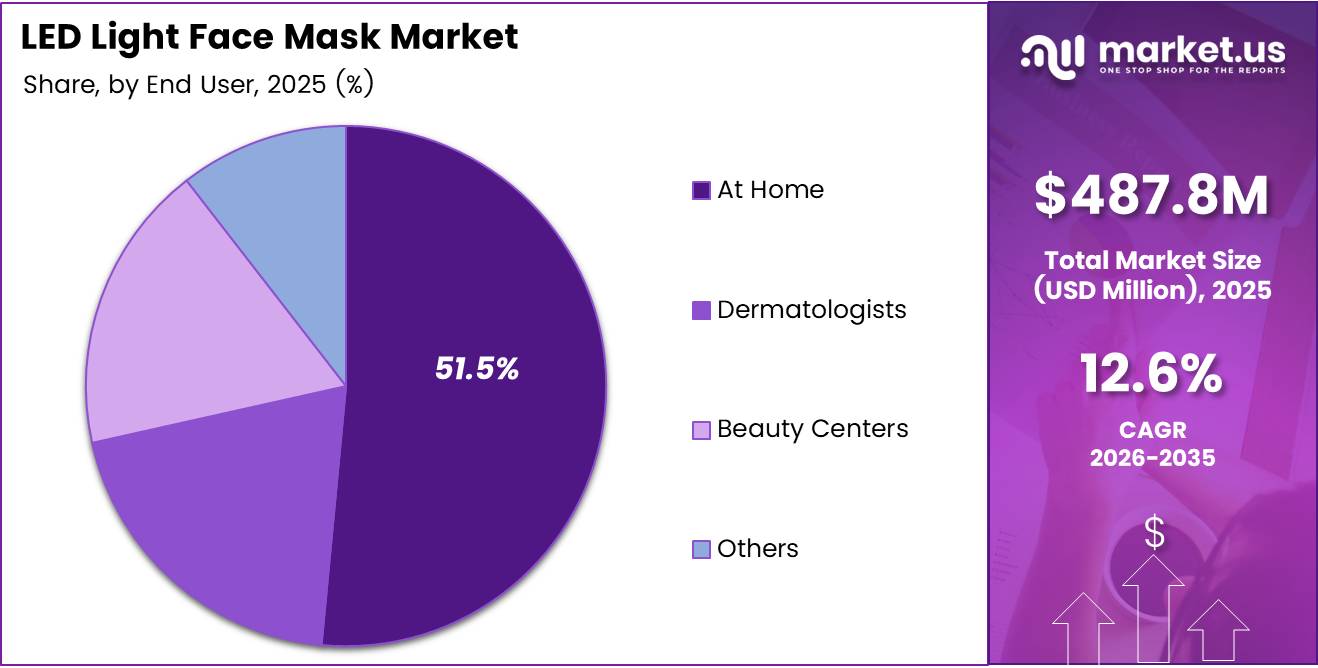
- At-home users account for 51.5% due to convenience and affordability.
- Online and offline channels lead with 41.4% due to omnichannel reach.
- North America dominates with 36.70% share valued at USD 179.0 Million.
Market Segmentation Overview
Red and Blue LED leads the type segment with a 58.9% share. This dominance reflects its ability to treat both acne and aging in one device. Consequently, consumers prefer multifunctional devices, which increases demand concentration and supports higher pricing for combined-therapy products.
Anti-aging dominates the application segment with 36.8% share. This leadership results from strong clinical evidence supporting wrinkle reduction. Therefore, consumers prioritize anti-aging solutions, and companies focus product development on visible skin improvement outcomes.
RE therapy leads the therapy segment with 51.7% share. This dominance reflects extensive clinical validation across multiple skin conditions. Additionally, strong dermatologist recommendations increase adoption, making this therapy the most commercially viable option.
At-home users dominate with 51.5% share due to convenience and cost efficiency. Consumers prefer home treatments over clinic visits, which reduces time and expense. As a result, manufacturers design affordable and user-friendly devices targeting personal care routines.
Online and offline channels lead distribution with 41.4% share. This dominance reflects combined discovery and purchase convenience. Consequently, brands invest in omnichannel strategies to capture customers at multiple touchpoints and improve conversion rates.
Drivers
Consumer preference for non-invasive skincare treatments drives strong demand for LED face masks. Users avoid procedures requiring downtime or medication. This shift increases adoption of daily-use devices and expands the market beyond clinics, creating sustained long-term revenue growth.
Dermatologist endorsement significantly boosts product adoption rates. Clinical validation builds trust and reduces purchase hesitation. For example, studies showing measurable skin improvement encourage doctors to recommend devices, which directly increases sales and strengthens brand credibility.
Use Cases
Beauty salons use LED masks for repeated client treatments, generating steady service revenue. These devices help improve skin appearance through regular sessions. Consequently, salons recover device costs quickly while offering premium skincare services to customers.
Hospitals apply LED phototherapy for post-procedure recovery and wound healing. Medical professionals rely on these devices for safe, non-invasive treatment. Therefore, clinical adoption strengthens device credibility and encourages consumer confidence in at-home versions.
Major Challenges
High device cost limits adoption among price-sensitive consumers. Products often range above standard skincare budgets, which creates hesitation. Consequently, many potential buyers delay purchases, especially in emerging markets with lower disposable income levels.
Limited long-term safety data creates uncertainty among users and regulators. Concerns about prolonged light exposure affect consumer confidence. Therefore, companies must invest in extensive clinical trials to validate safety and support broader market acceptance.
Business Opportunities
Smart and app-connected devices create strong growth opportunities for manufacturers. Personalized treatment plans improve effectiveness and user engagement. As a result, companies generate recurring revenue through subscriptions and increase customer retention rates.
Expansion into male grooming markets offers untapped revenue potential. Men increasingly adopt skincare devices focused on performance outcomes. Therefore, brands can target new demographics without major product changes, expanding total addressable market size.
Regional Analysis
North America leads the market with 36.70% share, valued at USD 179.0 Million. Strong regulatory frameworks, high consumer awareness, and advanced e-commerce infrastructure support growth. Consequently, companies scale faster in this region compared to others.
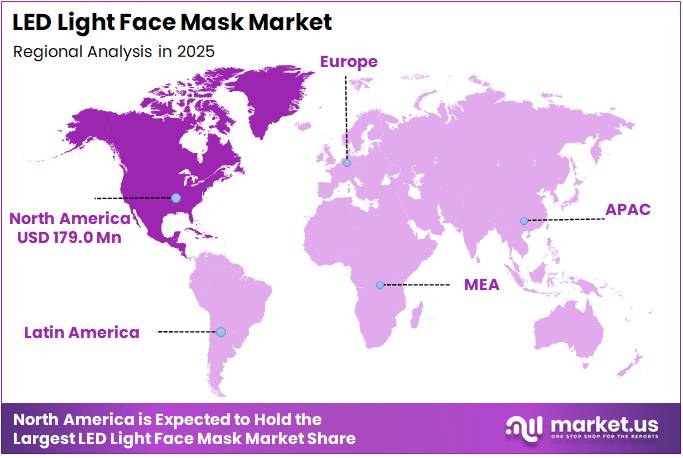
Asia Pacific emerges as the fastest-growing region due to rising middle-class income and strong beauty culture. Countries like China and South Korea drive innovation and adoption. Therefore, manufacturers focus expansion strategies on this region to capture high-growth opportunities.
Recent Developments
- November 2024 — SmoothSkin launched DuoLux LED mask with FDA clearance and wrinkle reduction results in 4 weeks.
- September 2025 — Amorepacific introduced micro-LED mask with 3,770 LEDs and 1,690% elastin increase.
- September 2025 — Ulike launched ReGlow mask with 272 LEDs delivering visible skin improvement within one month.
Conclusion
The LED Light Face Mask Market shows strong growth driven by consumer preference for non-invasive skincare and increasing clinical validation. Technological advancements and dermatologist endorsements further accelerate adoption, making these devices a mainstream skincare solution globally.
Red and Blue LED segments dominate due to multifunctional benefits, while anti-aging applications lead demand. North America remains the leading region, supported by strong infrastructure and regulatory systems. Meanwhile, Asia Pacific offers high growth potential due to expanding consumer base.
Companies must focus on affordability, safety validation, and smart technology integration to remain competitive. Strategic partnerships and demographic expansion will unlock new revenue streams. The market is expected to reach USD 1,598.2 Million by 2035, reflecting sustained long-term growth.
Looking for data tailored to your specific market, region, or business need? Request a custom report or consultation — write to us at sales@market.us
Discuss your needs with our analyst
Please share your requirements with more details so our analyst can check if they can solve your problem(s)