Report Overview
In 2025, the Global Food Waste Composting Machine Market was valued at USD 6.0 billion. Between 2026 and 2035, the market is projected to expand at a CAGR of 8.4%, reaching approximately USD 13.4 billion by 2035. In 2025, Asia Pacific maintained a leading position in the market, accounting for more than a 38.6% share and generating USD 2.32 Billion in revenue.
Food waste composting machines are becoming increasingly important for organic-waste management across food-processing facilities, hotels, restaurants, supermarkets, institutional kitchens, and municipal operations. These systems rely on controlled aerobic treatment, along with processes such as shredding, mixing, aeration, moisture management, temperature monitoring, and odor filtration. By processing segregated food waste under controlled conditions, the machines reduce organic residues and convert them into a stabilized organic output.
The scale of global food waste is creating a substantial opportunity for composting technologies. The United Nations Environment Programme estimated that 1.05 billion tonnes of food were wasted at household, food-service, and retail levels in 2022. This amounted to 132 kilograms per person and represented 19% of food available to consumers. Households generated 60% of the total waste, while food services accounted for 28% and retail contributed 12%.
The Food and Agriculture Organization reports that 13.2% of food is lost after harvest and before reaching retail. Food loss and waste are also responsible for approximately 8% to 10% of global greenhouse-gas emissions. The high volume of discarded food provides a significant feedstock base for both on-site and centralized composting systems, particularly in regions where landfill restrictions and methane-reduction objectives are becoming more stringent.
The food waste composting machine industry is gaining importance as governments expand organic-waste separation, landfill diversion, and circular-economy infrastructure. In January 2024, the U.S. Department of Agriculture announced USD 11.5 million for 38 cooperative agreements supporting composting and food-waste reduction initiatives across 23 states, with implementation planned through 2026. In September 2024, the U.S. Environmental Protection Agency announced USD 117 million through three funding opportunities focused on recycling infrastructure, food-waste prevention education, and composting.
Regulatory developments are also supporting demand for food waste composting machines among restaurants, hotels, supermarkets, institutions, and food-processing facilities. From 31 March 2025, workplaces in England were required to separate food waste, while micro-firms employing fewer than 10 full-time-equivalent employees received an extension until 31 March 2027. Such requirements are supporting the adoption of enclosed composting machines equipped with automated mixing, temperature regulation, moisture control, and odour management capabilities.
Opportunities for decentralized food waste processing systems are expected to remain strong. From 31 March 2026, English waste collectors were required to collect food and garden waste separately from households. The government allocated £340 million to support councils in preparing for the requirement. Official April 2026 data estimated that England generated 58.4 million tonnes of residual waste and 26.1 million tonnes of municipal residual waste in 2024. These volumes further highlight the need for expanded organic-waste processing infrastructure and localized composting solutions.
Key Market Segments
- The global Food Waste Composting Machine market was valued at USD 6.0 billion in 2025.
- The global market is projected to grow at a CAGR of 8.4% and is estimated to reach USD 13.4 billion by 2035.
- On the basis of product type, the Automatic dominated the market, constituting 52.4% of the total market share.
- Based on the Composting Technology, the Aerobic composting dominated the Food Waste Composting Machine market, with a substantial market share of around 55.0%.
- Based on the capacity, 51to 500 kg/day led the market, comprising 45.0% of the total market.
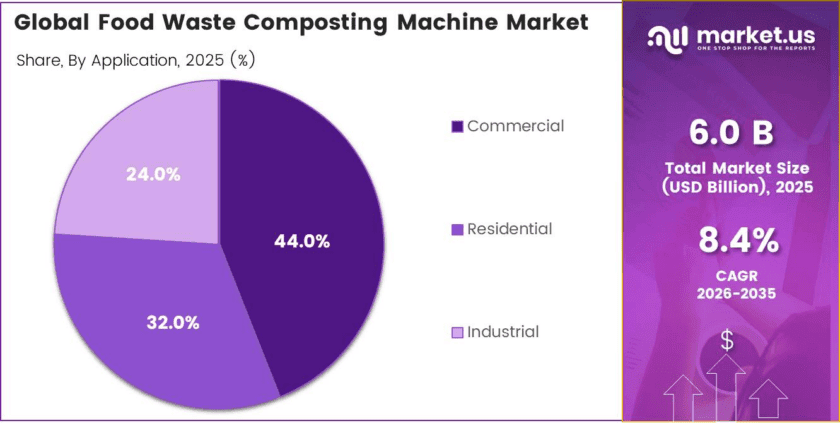
- Among the By Application, the Commercial held a major share in the Food Waste Composting Machine market, 44.0% of the market share.
- Among the Distribution Channel, the indirect sales is the most considerable within the market, accounting for around 58.0% of the revenue.
- In 2025, the Asia Pacific was the most dominant region in the Food Waste Composting Machine market, accounting for 38.60% of the total global consumption.
Product Type Analysis
Automatic food waste composting machines represent the dominant segment in the market.
Automatic food waste composting machines held the leading position with a 52.40% market share. Their strong adoption is driven by enclosed processing, automated mixing, temperature and moisture management, faster waste handling, and reduced dependence on continuous labour. These features make them suitable for municipalities, campuses, supermarkets, hotels, and large commercial kitchens. In December 2024, the USDA invested more than US$7.5 million through 26 Composting and Food Waste Reduction agreements aimed at supporting scalable landfill-diversion plans. This investment is creating a favourable environment for higher-capacity and digitally controlled composting equipment.
Semi-automatic machines represent the growing category, as they combine mechanical processing with operator involvement and provide a practical solution for smaller food businesses and institutions. From 31 March 2025, workplaces in England were required to separate food waste, while micro-firms were given until 31 March 2027 to comply. In March 2024, the government also announced up to £295 million to introduce weekly household food-waste collections by 31 March 2026, supporting demand for flexible composting equipment.
Composting Technology Analysis
Aerobic composting represents a significant composting technology segment.
Aerobic composting held the leading position with a 55.0% share, supported by its straightforward operating process, compatibility with various feedstocks, and ability to produce usable compost without requiring biogas-handling infrastructure. The technology is particularly suitable for municipalities, commercial kitchens, campuses, supermarkets, and food-processing facilities handling dry or mixed organic waste. California’s official organic-waste programme established a goal of reducing landfill disposal of organic material by 75% in 2025, encouraging investment in aerated vessels, shredders, mixers, and temperature-controlled composting equipment.
Anaerobic composting represents the growing technology segment, mainly because it can process wet food waste while producing biogas and nutrient-rich digestate within a sealed system. The UK Government’s 2026 Farm Practices Survey reported that the proportion of farms processing waste, crops, or feedstocks through anaerobic digestion increased from 12% in 2024 and 13% in 2025 to 15% in 2026. This increase is supporting demand for compact digesters, feedstock pumps, gas-storage systems, and automated monitoring equipment.
Capacity Analysis
51 to 500 kg/day represents the most widely used capacity range.
The 51 to 500 kg/day segment led the market with a 45.00% share, offering a practical balance between processing capacity, operating costs, and space requirements. These machines are well suited to supermarkets, hotels, institutional kitchens, campuses, and medium-sized food-processing facilities that generate consistent organic waste but do not require industrial-scale processing plants. In March 2025, the U.S. EPA’s Excess Food Opportunities Map identified more than 960,000 potential industrial, commercial, and institutional excess-food generators and over 15,000 potential recipients, indicating a substantial decentralized market for mid-capacity composting equipment.
Machines processing above 501 kg/day represent the growing segment, supported by expanding citywide collection programmes and increasing centralized waste volumes. In November 2025, New York City collected 5.9 million pounds of compostable material in one week, while Queens generated more than 61 million pounds during the programme’s first year. These volumes are encouraging municipalities and large institutions to adopt higher-capacity composting systems equipped with continuous feeding and automated monitoring.
Application Analysis
Commercial applications held a major share of the Food Waste Composting Machine Market.
Commercial applications led the market with a 44.00% share, supported by consistent food-waste generation from hotels, restaurants, supermarkets, institutional kitchens, and catering facilities. These users are increasingly adopting composting machines because on-site processing can reduce storage requirements, collection frequency, odour, and reliance on landfill disposal.
In January 2025, Washington State required businesses generating at least 4 cubic yards of food and yard waste per week within designated areas across 10 counties to arrange organics collection or approved treatment. The threshold is scheduled to decrease to 96 gallons per week in 2026, which is expected to expand demand for compact commercial composting systems.
Residential applications represent the growing segment as households increasingly receive separate collection services and adopt compact, easy-to-operate composting units. Scottish government statistics published in October 2025 showed that households composted 363,000 tonnes of waste in 2024, an increase of 1,300 tonnes from the previous year. This trend is supporting demand for smaller machines with simple controls and low maintenance requirements.
End Use Analysis
Food waste composting machines are primarily utilized across commercial and institutional waste-management applications.
Indirect sales held the leading position with a 58.00% share, as composting machines frequently require site evaluation, capacity selection, installation, operator training, and after-sales maintenance. Distributors and channel partners enable manufacturers to serve municipalities, hotels, supermarkets, institutions, and food processors without maintaining extensive local service teams. In May 2026, U.S. merchant-wholesaler sales reached US$817.4 billion, increasing 18.1% from May 2025 and demonstrating the continued importance of intermediary-led commercial distribution.
Online channels represent the growing segment, supported by easier product comparisons, digital quotations, remote demonstrations, and improved accessibility for smaller buyers. Customers can evaluate machine capacity, energy consumption, dimensions, and service terms before contacting suppliers for installation and support. In the first quarter of 2026, U.S. e-commerce sales totalled US$302.3 billion, increasing 9.7% from the same quarter of 2025. This broader shift toward digital purchasing is creating additional opportunities for manufacturers to generate leads and sell compact composting systems through online channels.
Emerging Trends
The United States continues to grapple with a substantial food waste diversion gap, creating strong tailwinds for the composting industry. According to the U.S. Environmental Protection Agency, 66.2 million tons of wasted food were generated across the food retail, food service, and residential sectors in 2019, yet only 5% of that volume was actually composted. Food remains the single most common material sent to landfills, comprising 24.1% of municipal solid waste nationwide, and when combined with yard trimmings, wood, and paper, organic materials account for 51.4% of what ends up in landfill. This wide gap between waste generation and composting capture rate is a key driver pushing municipalities, haulers, and composting infrastructure developers to expand organics diversion programs.
State-level regulation is emerging as one of the strongest forces reshaping the composting landscape. California’s Senate Bill 1383, which took effect on January 1, 2022 with mandatory enforcement beginning January 1, 2024, requires nearly all residents and businesses in the state to separate organic waste for composting or other recovery processes. The law sets a target of a 75% reduction in organic waste sent to landfills, measured against 2014 levels, to be achieved by 2025, and it further mandates that 20% of edible food that would otherwise be discarded be redirected to food recovery organizations. Regulatory mandates of this kind are compelling both public and private composting operators to scale collection infrastructure rapidly to remain compliant.
Corporate and industry engagement in food waste reduction is also accelerating, feeding a growing pipeline of organic material toward composting and other recovery pathways. Data compiled by ReFED shows that in 2024, the U.S. Food Waste Pact grew by adding new signatories, including major companies, bringing its total signatory base to 17 businesses spanning retail, manufacturing, and food service. The same analysis found that surplus food in the U.S. reached a value of $381 billion in 2024, of which 85%, or $325 billion, was attributable specifically to food waste. As more businesses formalize waste-reduction commitments, composting providers are positioned to capture a larger share of diverted organic material as a byproduct of these corporate sustainability pledges.
National policy targets set jointly by federal agencies are reinforcing this momentum at a macro level. USDA and EPA jointly established the country’s first food loss and waste reduction goal in September 2015, calling for a 50% reduction in food loss and waste by 2030. Since the launch of the U.S. Food Loss and Waste 2030 Champions initiative in 2016, more than 45 corporations, including major grocery, retail, and food manufacturing companies, have signed on as Champions committing to this reduction target. This sustained federal policy framework is expected to continue directing investment toward composting and organics-recycling infrastructure as businesses work to meet their 2030 commitments.
Use Cases
Municipal curbside composting programs represent one of the fastest-scaling applications of food waste composting infrastructure in the country. New York City collected nearly 130,000 tons of organic material during fiscal year 2024, which ended on June 30, 2024, marking a more than 23% increase over the prior year. This growth followed the completion of the nation’s largest residential curbside organics program, with collection service extended borough by borough until reaching full citywide coverage. As more municipalities adopt similar collection models, composting operators and equipment providers are seeing expanding contract opportunities tied to large-scale residential organics diversion.
Commercial and industrial composting operations rely on a range of processing methods suited to different facility scales, and adoption patterns reveal how the sector is professionalizing. A national operations survey conducted by the Environmental Research & Education Foundation (EREF) in partnership with the US Composting Council, based on responses from more than 300 composting facilities, found that windrow composting is the most common method, used by 42% of facilities, while over 20% of surveyed facilities operate multiple composting methods simultaneously to handle larger or more varied waste streams. The report, released on February 20, 2024, also identified clear regional differences, noting that the Southeast and Pacific regions operate fewer but larger-capacity facilities that lead the country in tons processed. This operational diversification signals a maturing industry increasingly capable of absorbing larger commercial and municipal feedstock volumes.
Institutional food service settings, particularly K-12 school systems, are emerging as a significant use case for structured composting programs. In New York City, the Zero Waste Schools program expanded from 725 schools participating in fiscal year 2017 to all 1,715 schools by fiscal year 2024, and the volume of compostable waste collected nearly quadrupled over that period, rising from 6,278 tons to 24,477 tons. Despite this expansion, food scraps made up about one-third of all waste generated by schools in fiscal year 2023, yet only 37% of those scraps were actually captured for composting, indicating substantial remaining headroom for composting service providers targeting the institutional food service segment.
The global hospitality and food service sector is also becoming a meaningful application area for composting and organic waste diversion programs. Data referenced by the United Nations Environment Programme shows that in 2022, the food service sector generated 290 million tonnes of food waste, accounting for 28% of the total amount of food wasted worldwide. Major hospitality brands are responding with structured diversion initiatives, such as Hilton’s Green Ramadan program, which has been rolled out across 45 hotels in 14 countries as part of a broader food waste measurement and reduction campaign. As hospitality operators face growing pressure to document sustainability outcomes, composting is increasingly positioned as a core component of corporate environmental, social, and governance reporting.
onecleardrop.com has a good, verifiable, current figure — 12 states with enacted food waste bans/mandates as of 2026, up from just 2 a decade ago. Distinct domain from all prior sources. Here’s the conclusion:
Conclusion
The food waste composting sector sits at an inflection point where regulatory pressure, municipal infrastructure investment, and institutional adoption are converging to expand market opportunity. As of 2026, 12 states have enacted food waste bans or mandatory diversion laws, a sharp rise from just two states — Vermont and Massachusetts — a decade earlier, signaling that policy momentum is accelerating rather than plateauing. This regulatory expansion is reinforced by measurable gaps in current diversion performance: nationally, only 5% of the 66.2 million tons of wasted food generated annually is composted, while landmark programs like New York City’s citywide curbside organics system and its Zero Waste Schools initiative demonstrate that participation and tonnage collected can scale rapidly once infrastructure and mandates are in place. For B2B stakeholders, including composting equipment manufacturers, waste haulers, municipal contractors, and organic-input buyers in agriculture and horticulture, this combination of tightening state mandates, corporate sustainability commitments such as the U.S. Food Waste Pact and Hilton’s Green Ramadan program, and persistently low baseline composting rates points toward sustained, multi-year demand growth across collection, processing, and end-market compost distribution segments.
Frequently Asked Questions
What is food waste composting?
Food waste composting is the controlled biological process of breaking down organic kitchen and food scraps into nutrient-rich soil amendment. It diverts material from landfills, reduces methane emissions, and transforms discarded food into a usable product for agriculture, landscaping, and horticulture applications.
Why is food waste composting important?
Composting matters because landfilled food waste generates methane, a potent greenhouse gas, as it decomposes. Diverting food scraps into composting streams reduces landfill volume, lowers emissions, recovers valuable nutrients, and supports healthier soil for farms, gardens, and public green spaces.
Who are the main users of food waste composting services?
Primary users include municipal governments, waste management companies, restaurants, hotels, grocery retailers, schools, and agricultural operations. These generators separate organic waste at the source and rely on haulers or on-site systems to route material to composting facilities.
What drives growth in the food waste composting market?
Growth is driven by state and municipal organic waste bans, corporate sustainability commitments, rising landfill costs, and consumer demand for greener practices. Expanding curbside collection programs and institutional composting initiatives further accelerate adoption across residential, commercial, and industrial sectors.
What are the biggest challenges facing food waste composting adoption?
Key challenges include limited processing capacity, contamination of organic waste streams with non-compostable materials, inconsistent state regulations, collection logistics costs, and low public participation rates. Facility siting and community-level education also remain persistent barriers to scaling programs.
How is finished compost typically used?
Finished compost is primarily applied in commercial horticulture, landscaping, and agriculture to improve soil structure and fertility. It also supports erosion control, wetland restoration, stormwater management, and topsoil production, making it valuable across multiple industrial and municipal end-use categories.
Which regions are leading in food waste composting adoption?
States such as California, Massachusetts, Vermont, and Washington lead in mandatory organics diversion policy. Major cities including New York and San Francisco operate large-scale curbside composting programs, positioning these regions as models for broader nationwide composting infrastructure expansion.
What is the outlook for the food waste composting market?
The outlook remains positive as more states enact organics bans and corporations pursue sustainability targets. Persistent gaps between food waste generation and current composting rates suggest continued investment in collection infrastructure, processing capacity, and end-market compost distribution over the coming years.
Discuss your needs with our analyst
Please share your requirements with more details so our analyst can check if they can solve your problem(s)