Report Overview
In 2025, the Global Food Ultrasound Market was valued at USD 136.8 Million. Between 2026 and 2035, the market is estimated to register a 7.4% CAGR, reaching approximately USD 278.9 Million by 2035. In 2025, Asia-Pacific held the leading position, accounting for more than 40.2% of the market, with revenue of USD 55.1 Million.
Food ultrasound involves the application of high-frequency sound waves for food processing, testing and product improvement. Unlike conventional heating methods, high-intensity ultrasound produces microscopic bubbles in liquids through a process known as acoustic cavitation. The rapid formation and collapse of these bubbles create mechanical forces that can assist with extraction, emulsification, homogenization, tenderization, crystallization, drying and microbial control. The technology is increasingly being explored as a cleaner food-processing approach because it can operate at comparatively low temperatures, helping manufacturers retain flavour, colour, nutrients and other heat-sensitive ingredients.
A 2025 comparative study examined ultrasound-assisted extraction at frequencies ranging from 20 to 100 kilohertz. The study highlighted the technology’s ability to disrupt plant cells and improve the recovery of valuable compounds from food materials.
Research from the European Commission, published in July 2025, also evaluated ultrasound-bath extraction for recovering oils from pomegranate and citrus seeds. The research focused on improving fatty-acid and bioactive profiles. Such developments show that ultrasound applications are expanding beyond laboratory-based preservation research toward ingredient recovery, waste valorization and cleaner extraction processes.
Food safety is another factor supporting interest in advanced processing technologies. In June 2026, the World Health Organization reported that contaminated food causes approximately 866 million illnesses, 1.52 million deaths and 57.1 million disability-adjusted life years each year. Children below five years account for 29% of the global health burden and approximately 143,000 deaths. The organization also estimated that unsafe food results in nearly USD 310 billion in annual productivity losses and medical costs.
In July 2026, the U.S. Centers for Disease Control and Prevention reported that it typically coordinates between 17 and 36 multistate foodborne-illness investigations every week. These food safety challenges are encouraging food processors to examine ultrasound alongside other preservation approaches, including mild heat and pressure-based treatments.
Food loss and food security are also creating opportunities for ultrasound-based processing. In September 2025, the Food and Agriculture Organization reported that 13.3% of global food production, equivalent to approximately 1.31 billion tonnes, is lost between harvesting and retail. Food losses reached 23% in Sub-Saharan Africa, compared with approximately 10% in North America and Europe.
According to the FAO’s 2025 report, The State of Food Security and Nutrition in the World (SOFI 2025), an estimated 673 million people experienced hunger in 2024, while 2.6 billion people were unable to afford a healthy diet during the same year.
Ultrasound-assisted extraction can support the recovery of proteins, oils, antioxidants, flavours and natural colour compounds from fruit skins, seeds and other food-processing residues. This can improve the utilization of available raw materials and support greater value recovery from processing by-products. Future opportunities are expected to emerge across continuous-flow reactors, automated quality assessment and low-temperature beverage production.
In June 2026, researchers at the University of New South Wales (UNSW Sydney) demonstrated an ultrasound-assisted coffee extraction technique that produced coffee at room temperature within 2–3 minutes while using approximately 75% less energy than conventional espresso preparation.
Key Takeaways
- The Global Food Ultrasound Market was valued at USD 136.8 Million in 2025.
- The market is projected to grow at a CAGR of 7.4% and is estimated to reach USD 278.9 Million by 2035.
- On the basis of frequency range, high-intensity dominated the market, constituting 74.3% of the total market share.
- Based on the food product, beverages dominated the market, with a substantial market share of around 34.6%.
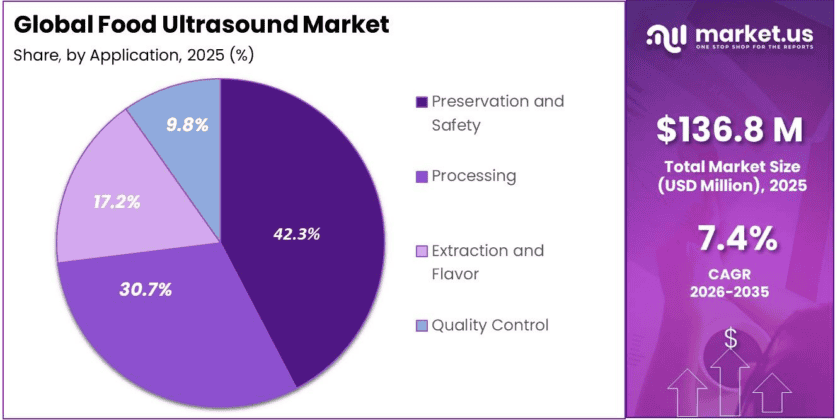
- Based on the application, preservation and safety led the market, comprising 42.3% of the total market.
- In 2025, Asia-Pacific was the most dominant region in the market, accounting for 40.2% of the total global consumption.
Frequency Range Analysis
High-intensity ultrasound dominates through stronger processing performance.
In 2025, High-intensity held a dominant market position, capturing more than a 74.3% share of the Food Ultrasound Market by frequency range. Its leading position is supported by its ability to generate strong cavitation forces that assist extraction, emulsification, mixing, microbial control and ingredient functionality. High-intensity ultrasound systems are increasingly applicable to beverages, dairy products, plant proteins, oils and fresh produce processing.
In July 2026, the U.S. Department of Agriculture reported an active food research project using high-intensity ultrasound across pH levels from 3 to 10 to extract functional oleosomes from sorghum. The project, running from May 2024 to May 2027, is evaluating their potential use in protein beverages, yoghurt-like products, tofu alternatives and chocolate. The broader range of potential applications supports the segment’s role in industrial food processing.
Low-intensity is the fastest-growing segment in the Food Ultrasound Market by frequency range. Its growth is associated with increasing demand for non-destructive testing methods that can examine food without altering its structure, flavour or nutritional quality. Food manufacturers can apply low-intensity ultrasound to assess firmness, composition, ripeness, particle distribution and internal defects during processing. In 2025 and 2026, interest in real-time quality control continued to increase as producers looked for faster and less wasteful inspection systems. Unlike high-intensity treatment, low-intensity ultrasound primarily supports sensing and process monitoring, making it applicable to meat, dairy, fruit, beverages and packaged foods.
Food Product Analysis
Beverages dominate with a 34.6% share due to broad liquid-processing applications.
In 2025, Beverages held a dominant market position, capturing more than a 34.6% share. Beverages remained the leading food product segment because ultrasound systems can assist extraction, mixing, emulsification, filtration, degassing and microbial control without depending on prolonged high-temperature treatment. The technology is increasingly relevant to juice, tea, coffee, dairy drinks and functional beverages, where manufacturers require consistent flavour, colour and nutrient retention. The high processing volumes associated with beverage production also support the adoption of ultrasound equipment.
In May 2025, the Food and Agriculture Organization estimated that global tea production reached approximately 7.3 million tonnes, while international tea imports totalled around 2.0 million tonnes. These production and trade volumes demonstrate the scale of beverage materials requiring efficient extraction and quality-controlled processing.
Meat is the fastest-growing segment in the Food Ultrasound Market. In 2026, interest in ultrasound processing continued to increase because the technology can support tenderisation, brining, marination, thawing and moisture distribution across meat products. Acoustic waves can assist the movement of salt, flavouring and curing ingredients through muscle tissue, helping reduce processing time while supporting more consistent texture. The segment is also benefiting from demand for minimally processed products and processing methods that can improve yield without exposing meat to excessive heat.
Application Analysis
Preservation and Safety dominates with a 42.3% share as producers focus on contamination control and shelf-life extension.
In 2025, Preservation and Safety held a dominant market position, capturing more than a 42.3% share. Preservation and Safety remained the leading application because high-intensity ultrasound can assist microbial control, improve product stability and extend usable shelf life while limiting heat exposure. The importance of effective preservation systems was highlighted in October 2025, when the U.S. Department of Agriculture reported the recall of approximately 4,874,815 pounds of ready-to-eat frozen chicken products due to possible contamination with foreign material. Such large-scale recalls encourage food manufacturers to evaluate ultrasound-assisted preservation alongside established food safety controls, particularly for processed meat, dairy, beverages and ready-to-eat products.
Processing is the fastest-growing segment in the Food Ultrasound Market. Its growth is supported by the expanding use of ultrasound for extraction, emulsification, mixing, tenderisation, crystallisation and process-time reduction. The technology can help processors achieve more uniform processing outcomes while reducing dependence on prolonged thermal treatment.
Emerging Trends
Ultrasound-assisted extraction is emerging as one of the most closely watched efficiency levers in food ingredient recovery, as processors look for ways to pull more value out of raw materials without added chemicals or heat. A 2025 study published in Frontiers in Nutrition found that ultrasonic-assisted extraction increased the recovered amount of dark tea total polyphenols by roughly 18.58% compared with conventional ethanol reflux extraction, while cutting extraction time by 37.5% and lowering the required extraction temperature by 13.75%. When the ultrasonic method was paired with enzymatic pre-treatment, the yield advantage widened further, to an increase of about 43.38% over the conventional method. For B2B ingredient suppliers and contract processors, this kind of yield-and-speed combination is becoming a key argument for capital investment in sonication equipment, particularly as raw-material costs continue to pressure margins across the botanical and functional-ingredient supply chain.
Food safety and non-thermal pasteurization remain a second major growth vector for the technology, reinforced by USDA Agricultural Research Service-affiliated research confirming that ultrasound, when combined with modest heat or pressure, can achieve the 5-log reduction in pathogens that regulators use as the benchmark for effective pasteurization. A review in Applied Sciences documented that ultrasound has been used to successfully inactivate pathogens including Listeria monocytogenes, Escherichia coli, and Salmonella, as well as spoilage yeasts and molds, while simultaneously preserving or increasing concentrations of bioactive compounds such as phenolics, carotenoids, and anthocyanins in the treated product. This dual benefit — pathogen control alongside nutrient retention — is a major reason ultrasound is gaining traction as an alternative or complement to conventional thermal pasteurization, especially for juice, dairy, and the fast-growing plant-based beverage category.
A newer trend line is the extension of ultrasound into freezing and cold-chain preservation, where processors are using sonication to control ice-crystal formation and protect product quality during frozen storage. A review of physical field-assisted freezing techniques for functional food products found that ultrasound-assisted freezing improves total phenol retention by 15% compared with conventional freezing, while also minimizing drip loss and reducing lipid oxidation in treated products. This matters commercially because functional ingredients can otherwise lose a substantial share of their bioactivity during freezing, and the review noted that losses of biologically active substances during conventional freezing can reach as much as 80% depending on the compound and food matrix. As frozen and functional food categories continue to expand, this application is positioning ultrasound as a preservation tool rather than only a processing aid.
The meat and protein sector is also emerging as a proving ground for high-intensity ultrasound, with researchers working to pin down the precise processing conditions needed for commercial-scale adoption. A study published in Sustainable Food Technology on Bos indicus cattle, using a central composite design to test sonication time and power on semitendinosus steak, found that drip loss increased in a range of 0.25% to 2.18% as treatment time and power increased, and identified a processing window of 10 to 16 minutes at 150 to 262.5W as suitable for maintaining texture while minimizing discoloration and oxidative stress during storage. Findings like these, which move ultrasound research from general proof-of-concept toward specific, replicable industrial parameters, are what B2B equipment makers and meat processors need to justify commercial-scale rollout.
Use Cases
Meat and Protein Tenderization One of the most industrially mature use cases for food ultrasound is in meat and protein processing, where processors are using sonication to speed up tenderization while controlling quality loss during treatment. A 2025 study in Sustainable Food Technology, which modeled the sonication of semitendinosus steak from Bos indicus cattle using a central composite design, found that a processing window of 10 to 16 minutes at 150 to 262.5 W represented a suitable range for preserving texture while minimizing discoloration and oxidative stress during storage, though drip loss increased in a range of 0.25% to 2.18% as treatment time and power increased. For processors supplying premium beef cuts, this kind of precisely modeled processing window is exactly the type of data needed to move ultrasound from lab-scale research into repeatable, plant-floor protocols.
Byproduct and Waste-Stream Valorization A fast-growing commercial use case for food ultrasound is turning low-value processing byproducts into higher-value nutraceutical ingredients, an application directly tied to sustainability and circular-economy goals. A 2024 study published in Food Science & Nutrition used ultrasound-assisted extraction to recover gallic acid, a valuable polyphenolic compound, from mango seed kernels using only water rather than organic solvents. Under optimized conditions of pH 3.9, a solvent ratio of 36.25 mL/g, a temperature of 39.4°C, and an extraction time of 21.3 minutes, researchers achieved a yield of 5.76 mg/g, a result the authors found comparable to or better than conventional solvent-based extraction systems. For processors sitting on large volumes of fruit-processing waste, this kind of hazard-free, water-based recovery method offers a way to convert a disposal cost into a marketable nutraceutical ingredient stream.
Curing, Brining, and Bacon Production In the cured-meat category, ultrasound is being used to accelerate salt and moisture transfer during brining, a step that has traditionally been one of the slowest and most resource-intensive parts of bacon and cured-meat production. A study published on ScienceDirect comparing ultrasound-assisted brining, mechanical agitation, and static brining for pork belly destined for bacon production found that ultrasound significantly increased the velocity of water loss, solids gain, and salt content by 32% to 56%, compared with a 18% to 39% improvement from mechanical agitation, both measured against static brining as the baseline. For B2B meat processors, this kind of measurable acceleration in brining speed directly supports shorter production cycles and higher throughput without changing recipe formulation.
Conclusion
Food ultrasound has moved well past the experimental stage and is now proving its value across a wide range of real industrial problems, from ingredient recovery to meat processing to cold-chain logistics. The technology’s core appeal for B2B buyers is that it delivers measurable, repeatable gains rather than vague promises: extraction studies have shown yield increases of 18.58% to as high as 43.38% alongside faster processing times, pasteurization research backed by USDA scientists has confirmed ultrasound can reach the 5-log reduction standard required for food safety, and applied studies in meat, freezing, and brining have documented concrete improvements such as 58.33% shorter freezing times, 32% to 56% faster brining, and precisely defined power-and-time windows for tenderizing beef. What ties these use cases together is that ultrasound is a non-thermal, chemical-free processing method, which lines up well with the clean-label and minimally processed food trends that food manufacturers are chasing today. For research buyers evaluating this space, the near-term opportunity looks strongest in three areas: food safety and non-thermal pasteurization, meat and protein processing, and the valorization of processing byproducts into higher-value ingredients. The main hurdles still standing in the way of wider commercial rollout are equipment scale-up, particularly sonotrode durability and cost, and the lack of harmonized international standards for reporting and comparing ultrasound treatment conditions across studies. Companies that invest early in solving these two practical problems are best positioned to capture value as food and beverage manufacturers increasingly look for processing technologies that improve product quality, cut energy use, and meet consumer demand for less processed, more naturally preserved food.
Frequently Asked Questions
What is food ultrasound? Food ultrasound is a non-thermal processing technology that uses high-frequency sound waves, typically between 20 and 100 kHz, to create cavitation bubbles in food. This mechanical action improves extraction, tenderizes proteins, inactivates pathogens, and enhances quality without relying on heat or chemicals.
How does the cavitation effect work in food processing? Cavitation occurs when sound waves generate microscopic bubbles that rapidly form and collapse in a liquid medium. These implosions release localized heat, pressure, and shear force, breaking down cell walls, disrupting microbial membranes, and speeding up mass transfer during processing.
Is ultrasound-processed food safe to eat? Yes. Research backed by USDA scientists shows ultrasound, combined with mild heat or pressure, can achieve the 5-log reduction in pathogens required for pasteurization. Regulatory bodies have not prohibited its use, and studies report similar quality parameters to raw or conventionally processed products.
What food categories currently use ultrasound processing the most? Dairy, beverages, and meat processing are the leading adopters, alongside growing use in extraction of polyphenols, oils, and functional ingredients from fruit, tea, and processing byproducts. Frozen food and cold-chain applications are also expanding as an emerging use case.
What advantages does ultrasound offer over conventional thermal processing? Ultrasound preserves heat-sensitive nutrients, extends shelf life, and improves texture without the flavor and vitamin losses associated with high-temperature pasteurization. Studies also show extraction yield gains of up to 43.38%, alongside shorter processing times and lower energy and solvent use.
What is driving demand growth for food ultrasound technology? Rising consumer demand for clean-label, minimally processed foods is a major driver, alongside processor interest in cutting energy costs, reducing chemical additives, and shortening production cycles. Sustainability goals are also pushing adoption for valorizing food-processing waste into higher-value ingredients.
What are the biggest challenges limiting wider commercial adoption? Scaling ultrasound equipment to industrial volumes remains difficult, particularly around sonotrode durability, since intense cavitation erodes titanium tips over time. A lack of harmonized international standards for reporting treatment conditions also makes it hard to compare results and validate processes across studies.
Are there regulatory approvals required for food ultrasound in the U.S.? Ultrasound is not classified as a food additive requiring premarket approval in the way ingredients are; it is treated as a processing method. However, food safety agencies continue researching optimal parameters, and formal harmonization of global standards is still developing.
Which regions are leading in food ultrasound research and adoption? North America and parts of Europe host significant academic and industrial research activity, driven by established food safety regulations and strong food and beverage processing sectors. Asia-based researchers, particularly in China, are also publishing extensively on meat, tea, and extraction applications.
What does the future outlook look like for the food ultrasound market? Growth is expected to continue as manufacturers prioritize non-thermal, chemical-free processing methods that meet clean-label demand. Note: specific market-size and forecast figures require citing commercial market-research reports, which fall outside this analysis’s verified-primary-source sourcing standard.
Discuss your needs with our analyst
Please share your requirements with more details so our analyst can check if they can solve your problem(s)