Report Overview
In 2025, the Global Date Palm Market was valued at US$9.5 billion. From 2026 to 2035, the market is projected to register a CAGR of 3.6%, reaching approximately US$13.5 billion by 2035. Asia-Pacific held a leading market position, accounting for more than a 36.6% share and generating USD 3.5 billion in revenue.
The date palm market is an important part of the global fruit and food processing industry, offering fresh and dried dates along with syrups, pastes, powders and ingredients used in packaged foods. Production is largely concentrated in arid and semi-arid regions with established cultivation and processing networks. In 2025, Saudi Arabia produced more than 1.9 million tons of dates from over 37 million palm trees and exported date products to more than 125 countries, demonstrating its strong position in international trade.
The industrial landscape in North Africa is also improving as producers invest in improved varieties, irrigation systems, post-harvest handling and packaging. According to the Food and Agriculture Organization of the United Nations, Morocco’s 2025-2026 date season produced more than 160,000 tons, representing a 55% increase compared with the previous season. Higher production is strengthening supply for domestic processing, retail distribution and exports while supporting investments in cold storage, grading, packaging and value-added date products.
Growing exports and broader retail availability are supporting market demand. In 2025, Saudi Arabia’s date exports reached Saudi Arabian Riyal (SAR) 1.938 billion, marking a 14.3% increase from 2024. The National Center for Palms and Dates also expanded its export empowerment initiative across 15 international retail markets and more than 1,500 branches worldwide. These developments are creating opportunities for processed dates, branded retail products, premium varieties and food ingredients as producers expand distribution and improve value realization in international markets.
Government and institutional initiatives are further supporting standards, investment and market development. Saudi Arabia introduced a mandatory export certificate for date exporters from October 1, 2025, strengthening compliance and product traceability. In Morocco, the Agricultural Development Agency used the 2025 International Date Palm Festival to promote investment under the Generation Green 2020-2030 Strategy and brought together 31 cooperatives and producer groups. Such initiatives are helping strengthen organized supply chains, responsible investment, export preparedness and higher-value processing across the date palm industry.
Key market segment
- The global date palm market was valued at US$9.5 billion in 2025.
- The global date palm market is projected to grow at a CAGR of 3.6% and is estimated to reach US$13.5 billion by 2035.
- On the basis of product type, dried dates dominated the market, constituting 42.11% of the total market share.
- Based on nature, conventional dates dominated the date palm market, with a substantial market share of around 67.56%.
- Among the applications, food and beverage applications held a major share in the date palm market, accounting for 44.78% of the market share.
- In 2025, Asia Pacific was the most dominant region in the date palm market, accounting for 36.6% of the total market share.
Date Palm Market Segmentation
Product Type Analysis
Dried Dates dominate with 42.11% due to strong storage, processing, and retail demand.
In 2025, Dried dates led the market with more than a 42.11% share, supported by their longer shelf life, convenient storage, established retail demand, and extensive use in household consumption and food processing. They are distributed through supermarkets, specialty stores, foodservice channels, and export networks and are widely used in confectionery, bakery, snacks, and food ingredients. In June 2026, according to the Saudi Press Agency, Al-Ahsa Oasis produced more than 120,000 tons of dates annually from over 2 million palm trees and cultivated more than 20 date varieties.
Fresh dates are the fastest growing segment, driven by increasing demand for minimally processed fruit, seasonal sales, and premium varieties offering natural taste and texture. Better cold-chain systems, packaging, and distribution are expanding their availability in urban and export markets, while seasonal supply supports farm sales, specialty retail, and foodservice applications, creating opportunities for producers focused on freshness, quality, and shorter supply chains.
Nature Analysis
Conventional Dates dominate with 67.56% due to broad availability and established consumption.
In 2025, Conventional dates accounted for more than a 67.56% market share, supported by widespread availability, established farming methods, reliable supply, and strong demand across household consumption, retail, food processing, and exports. Established varieties and distribution networks also enable producers to efficiently serve high-volume markets. In June 2026, according to the Saudi Press Agency, the Madinah Region produced 344,000 tons of dates annually, representing about 18% of Saudi Arabia’s national production, while organic date production reached about 4,600 tons annually.
Organic dates are the fastest growing segment, supported by increasing consumer preference for certified agricultural products, clean-label foods, and environmentally responsible cultivation. Expanding organic retail distribution, premium positioning, certification systems, and sustainable farming practices are increasing their presence in premium grocery, health-focused retail, and export channels, creating opportunities for producers targeting higher-value consumer segments.
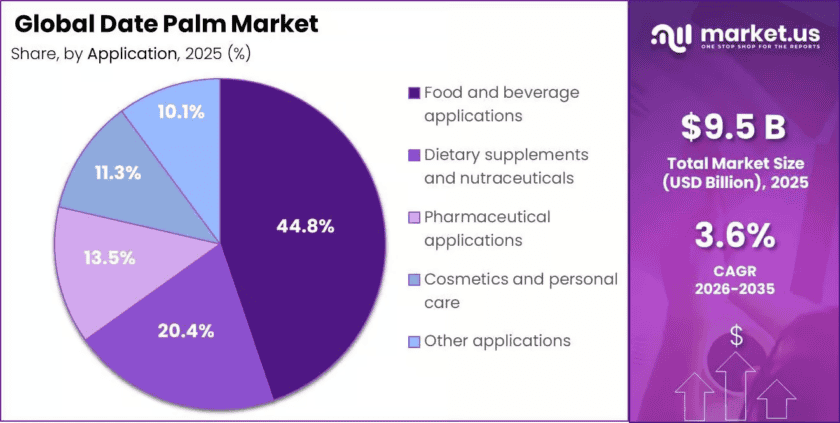
Application Analysis
Food and Beverage Applications dominate with 44.78% due to their wide use across processed foods and beverages.
In 2025, Food and beverage applications led the market with more than a 44.78% share, supported by extensive use of dates in bakery products, confectionery, beverages, syrups, pastes, snacks, and traditional foods. Their natural sweetness, texture, and processing suitability drive demand from food manufacturers, retailers, restaurants, and households. In March 2026, according to the National Center for Palms and Dates, the Eastern Region’s annual date production exceeded 261,000 tons, with more than 26,000 farms and approximately 32 date-processing plants.
Dietary supplements and nutraceuticals are the fastest growing segment, driven by growing demand for date powders, extracts, and concentrated ingredients in health-focused products. Dates are increasingly explored for functional foods and nutrition products because they can be processed into convenient formats. Rising interest in naturally sourced ingredients and ongoing product development are expanding their presence across specialty nutrition, wellness, and functional food channels in international markets.
Emerging Trends
1. Expansion of International Date Exports
International trade is becoming an important growth driver for the Date Palm Market. In 2025, Saudi Arabia’s date exports reached SAR 1.938 billion, up 14.3% from 2024 and 59.5% from 2021. Saudi dates were exported to more than 125 countries, showing wider global market access.
2. Rising Date Production in Major Growing Regions
Production capacity continues to expand in leading date-producing countries. Saudi Arabia produced approximately 1,923 thousand tons of dates in 2024, up 1% from 2023, with more than 37.6 million palm trees, including over 32 million fruitful trees.
3. Strong Recovery in Moroccan Date Production
Morocco is showing strong production growth as climatic conditions and cultivation expertise improve. During the 2025-2026 season, Moroccan date production exceeded 160,000 tons, representing a 55% increase compared with the previous season. This is improving raw-material availability for domestic and export markets.
4. Growing Demand for Value-Added Date Products
The market is moving beyond whole dates toward value-added products such as powders, pastes, syrups, extracts and functional food ingredients. Research shows that date by-products contain phenolic acids, flavonoids, tannins, carotenoids and other bioactive compounds, creating opportunities in food, nutraceuticals and packaging.
5. Increasing Focus on Sustainable Waste Utilization
Sustainability is becoming an important trend as producers seek to generate additional value from date palm waste. Research has shown that date palm residues can be converted into biochar, with one 2025 study achieving a 44.95% biochar yield at 500°C, creating opportunities for agricultural soil applications and waste reduction.
Use Cases
1. Fresh and Dried Food Consumption
Dates are widely used as direct food products because of their natural sweetness, nutritional value and convenient storage characteristics. Saudi Arabia produced approximately 1,923 thousand tons in 2024, while the country had more than 37.6 million palm trees, supporting large-scale domestic consumption and export supply.
2. Food Ingredients and Value-Added Products
Dates are increasingly processed into syrups, pastes, powders, extracts and functional ingredients for food manufacturers. Date processing by-products also contain bioactive compounds such as phenolic acids, flavonoids, tannins and carotenoids, supporting their use in functional foods, nutraceuticals and sustainable packaging.
3. Animal Feed Applications
Date fruit, seeds, pressed cake and other residues can be used as alternative animal-feed ingredients. Research indicates that date stone meal can replace up to 10% of traditional grains such as corn or barley in poultry diets, while fruit pulp can be incorporated at levels of up to 20% in broiler diets.
4. Aquaculture Feed
Date palm by-products are being evaluated as sustainable ingredients for fish and other aquatic animal feeds. Date palm meal contains useful nutrients and can potentially replace or supplement conventional protein sources such as fish meal and soybean meal, helping reduce waste while creating additional economic value.
5. Biochar and Agricultural Soil Improvement
Date palm residues can be converted into biochar for agricultural applications. A 2025 study found that optimized pyrolysis at 500°C produced a 44.95% biochar yield. The resulting porous biochar showed potential for improving soil health and productivity while providing a sustainable method of managing agricultural residues.
6. Date Seed Oil and Functional Ingredients
Date seeds are gaining attention as a source of useful ingredients. Research reports that date seeds contain approximately 7.7%–12.7% oil, while seed powder can be used for animal feed, edible fiber, date-seed oil and coffee-like products. This supports wider commercialization of date-processing by-products.
Conclusion
The Date Palm Market is expanding through rising international exports, higher production, value-added processing and greater utilization of agricultural by-products. Saudi Arabia’s SAR 1.938 billion export value in 2025, Morocco’s production exceeding 160,000 tons, and increasing applications in food, animal feed, nutraceuticals, biochar and sustainable packaging highlight the market’s diversification. Future development will depend on efficient processing, export infrastructure, sustainable farming and improved utilization of date palm waste.
Frequently Asked Questions
1. What is driving the Date Palm Market?
The Date Palm Market is being driven by rising global consumption, expanding exports, growing demand for dried and fresh dates, and increasing use of date-based ingredients. Value-added products, nutraceuticals, animal feed and sustainable by-products are also creating additional opportunities.
2. Which country is a major producer of dates?
Saudi Arabia is one of the major date-producing countries. Its production reached approximately 1,923 thousand tons in 2024, supported by more than 37.6 million palm trees, including over 32 million fruitful trees, according to official statistics.
3. How large were Saudi Arabia’s date exports in 2025?
Saudi Arabia’s date exports reached SAR 1.938 billion in 2025, representing a 14.3% increase from 2024 and a 59.5% increase from 2021. Saudi dates were exported to more than 125 countries worldwide.
4. What are the major applications of dates?
Dates are used for direct consumption and in bakery products, confectionery, beverages, syrups, pastes, snacks and functional foods. Date seeds and other processing residues are also increasingly used in animal feed, nutraceuticals, biochar and sustainable packaging.
5. How are date palm by-products being utilized?
Date palm by-products such as seeds, pomace, leaves and processing residues are being converted into animal feed, functional food ingredients, nutraceutical materials, packaging materials and biochar, helping reduce agricultural waste and improve resource efficiency.
6. Why is date palm waste becoming commercially important?
Date palm waste contains valuable nutrients, fibers and bioactive compounds that can be recovered for commercial applications. Research shows potential in animal feed, food ingredients, packaging and agricultural biochar, creating additional revenue opportunities while supporting circular-economy practices.
7. What is the outlook for date exports?
The outlook for date exports remains positive as producers expand international distribution and develop branded and processed products. Saudi Arabia’s 2025 export growth of 14.3% and presence across more than 125 countries demonstrate expanding international market opportunities.
8. How is sustainability influencing the Date Palm Market?
Sustainability is encouraging producers to reduce waste and recover value from seeds, leaves, pomace and lower-grade dates. These materials can support animal feed, biochar, functional foods and packaging, helping producers improve resource efficiency and develop additional revenue streams.
Discuss your needs with our analyst
Please share your requirements with more details so our analyst can check if they can solve your problem(s)