Report Overview
The Global Plant Based Protein Market is expected to be valued at around USD 24.7 billion in 2025 and is projected to grow at a CAGR of 10.7%, reaching approximately USD 67.9 billion by 2035. North America maintained a leading position in the market, accounting for more than a 47.8% share and generating USD 11.8 billion in revenue.
Government initiatives are further strengthening the market’s long-term growth prospects. The European Commission’s Protein Action Plan focuses on increasing EU protein autonomy by expanding sustainable domestic protein production, diversifying import sources, and strengthening supply chains. The EU reported that 94% of its soya protein crop imports were derived from soya bean and meal protein, with 13.4 million tonnes imported during 2024-25. Meanwhile, only around 33% of high-protein feed materials originated within the EU.
- According to the OECD-FAO Agricultural Outlook 2025-2034, global pulses consumption reached 101 million tonnes in 2024, after recording average annual growth of 2% over the previous decade. This reflects the increasing importance of legumes as a mainstream protein source.
- In the U.S. retail channel, plant-based meat and seafood sales reached approximately USD 1 billion in 2025. However, dollar sales declined by 10%, while unit sales decreased by 11%, indicating that the segment is moving from rapid expansion toward product reformulation and value correction. Plant-based milk remained a larger category at USD 2.7 billion, supported by 38% household penetration and a 75% repeat rate, making it one of the more stable plant-based protein-adjacent categories.
- Alongside rising consumption, public research institutions are also improving feedstock quality. In 2023, the USDA’s Agricultural Research Service reported that newly released soybean germplasm increased meal protein content by two to three percent without compromising yield, supporting the competitiveness of soy-based protein ingredients.
Sustainability remains a major factor driving industrial adoption. According to the Food and Agriculture Organization of the United Nations, plant-based proteins require 38 to 91% less land, 53 to 95% less water, and produce 69 to 92% lower carbon emissions than meat-based alternatives. These environmental advantages are encouraging manufacturers to expand their legume, pea, and soy-based protein portfolios. At the same time, government-supported research focused on extraction efficiency and nutritional quality continues to support the sector’s long-term growth across food, beverage, and nutrition applications.
Key Market segment
- The Global Plant Based Protein Market size was US$ 24.7 billion in 2025.
- The Global Market is estimated to grow to US$ 67.9 billion by 2035.
- The Compound Annual Growth Rate (CAGR) of the market from 2026 to 2035 will be at 10.7%.
- Soy Protein has the largest market share in the source segment, accounting for 34.4% of the total.
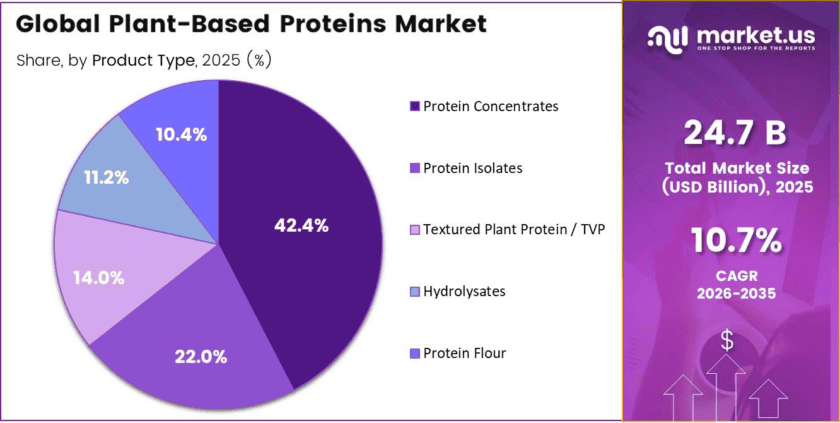
- Protein Concentrates dominated the product type segment, accounting for 42.4% of the total revenue.
- Food & Beverages has the highest revenue share 44.8% of total application income according to the application segment.
- Dry Powder dominates the form sector, accounting for 40.7% of the total.
- Food manufacturers account for 38.7% of total sales, making them the main procurement channel based on the end-user segment.
- North America is the largest regional market, accounting for 47.8% of global revenue.
Source Analysis
Soy Protein Leads Market While Pea Protein Drives Fastest Growth Globally
Soy Protein dominates the source segment with 34.4% of total revenue, supported by its high protein density, cost-effectiveness, established global supply chains, and wide use in meat analogues, milk alternatives, sports nutrition, and bakery products. Regulatory acceptance in the United States, European Union, and China, along with GRAS status and extensive clinical research, further strengthens its position. In 2024, leading plant-protein ingredient manufacturers expanded processing capacity and supply-chain integration, improving commercialization timelines and supply reliability across Europe and North America. Pea Protein is the fastest-growing source due to its non-GMO appeal, allergen-friendly profile, high digestibility, cold-liquid solubility, neutral taste, and suitability for emulsification and texturization, while rising yellow pea cultivation in Europe and North America is improving supply stability and cost competitiveness.
Product Type Analysis
Protein Concentrates Lead Market While TVP Drives Fastest Growth in Plant-Based Protein Segments
Protein Concentrates hold a leading 42.4% market share, supported by established processing infrastructure and broad applications across bakery, beverages, and nutritional supplements. According to the USDA Foreign Agricultural Service, global soybean meal production averaged 251.74 million metric tons during MY 2016-2025, growing at a 3% compound annual rate, reaching 281.74 million metric tons in 2024/2025 and projected to reach 291.31 million metric tons in 2025/2026, representing another 3% year-over-year increase. Textured plant protein is the fastest-growing segment, driven by demand for meat-like textures among flexitarian and vegetarian consumers, while U.S. green pea production reached 4,498.5 thousand hundredweight in 2024, supporting the raw-material supply for pea-based textured proteins.
Application Analysis
Food & Beverages Lead Market While Meat Alternatives Drive Fastest Application Growth Globally
Food & Beverages account for 44.8% of total application revenue, driven by increasing use of plant proteins in protein-enriched snacks, baked goods, prepared meals, dairy alternatives, and health beverages across supermarkets, convenience stores, and online channels. Rising consumer acceptance of high-protein and natural packaged foods has shifted plant proteins from specialty ingredients toward mainstream formulations. Meat Alternatives represent the fastest-growing application, supported by rising demand for plant-based burgers, sausages, and nuggets, increasing health and environmental awareness, improved taste and texture, and wider availability through retail, quick-service restaurants, and foodservice channels.
Form Analysis
Dry Powder Dominates the Form Segment through Long Shelf Life, Logistical Efficiency, and Broad Formulation Compatibility
Dry Powder leads the form segment with a 40.7% market share due to its long shelf life, cost-efficient transportation and storage, and broad compatibility with shakes, baked products, meat substitutes, and supplements. Its high concentration enables precise dosing and easy integration into production lines, making it a preferred format among ingredient suppliers and supplement brands. Ready-to-drink (RTD) plant protein formats are the fastest-growing segment, driven by demand for convenient, portable, high-protein beverages, increasing health awareness, expanding functional beverage offerings, and growing retail and online adoption.
End-User Analysis
Food Manufacturers Lead Market Revenue through Large-Scale Procurement and Long-Term Supply Agreements
Food Manufacturers account for 38.7% of total plant protein ingredient sales, driven by bulk procurement for meat, dairy, snack, and fortified beverage products. Their purchasing decisions emphasize standardized specifications, long-term supply stability, and cost efficiency, favoring suppliers with vertical processing capabilities and diversified sourcing networks. Volume-based pricing and long-term agreements also provide economies of scale compared with retailers and foodservice buyers. Sports Nutrition Brands are the fastest-growing end-user category, supported by increasing global gym memberships, a growing athlete population, and rising consumer interest in protein-rich diets beyond traditional bodybuilding. Other end-users include Retail Consumers, Foodservice & QSR, and Nutraceutical Companies.
Emerging Trends
United States sector while the global plant-based food market kept expanding. According to The Good Food Institute’s (GFI) 2026 State of the Industry Report, global retail sales of plant-based meat, seafood, milk, yogurt, ice cream, and cheese rose 3% between 2024 and 2025, reaching $28.9 billion, based on data from Euromonitor. Category performance, however, was uneven: plant-based meat and seafood sales fell 10% to $1 billion, with unit sales down 11%, while plant-based milk sales declined a more modest 2% to $2.7 billion. One standout was the tofu, seitan, and tempeh segment, which grew 1% even as most other categories contracted, signalling a shift in consumer preference toward minimally processed, whole-food protein formats rather than heavily engineered meat analogues.
Protein diversification is emerging as a growth lever even as alternative meat struggles. Retail data from SPINS, compiled by GFI, shows that while plant-based meat and seafood sales fell 10% to $1 billion in 2025 with units down 11%, plant-based milk sales dipped a smaller 2% to $2.7 billion with units down 5%, and most other plant-based categories declined except for tofu, seitan, and tempeh, which posted a 1% gain. This divergence underscores a broader repositioning within the market, where beverages and traditional soy-based proteins are proving more resilient to shifting consumer sentiment than formulated meat substitutes, prompting manufacturers to rebalance innovation pipelines toward beverage and minimally processed formats.
Precision fermentation is becoming a defining technological trend shaping the broader alternative-protein landscape, including plant-protein-adjacent product development. In the United States, the Food and Drug Administration (FDA) uses a “Generally Recognized as Safe” (GRAS) framework that can enable market entry in roughly one year, and by 2026 multiple precision-fermentation-derived food proteins had been cleared for use in the US. This stands in sharp contrast to the European Union, where Novel Food authorisation, including safety assessment by the European Food Safety Authority (EFSA), often takes 2.5 to 4 years or more, and as of early 2026 zero major precision-fermented proteins had received EFSA safety clearance. The widening regulatory gap is accelerating US-based innovation in hybrid and fermentation-enhanced protein ingredients that increasingly sit alongside plant-derived proteins in food and beverage formulations.
Consumer demand for protein continues to be the single strongest force shaping product development across the category. The 2025 IFIC Food & Health Survey, conducted by the International Food Information Council (IFIC), found that 71% of Americans said they were trying to consume protein, a steady climb from 67% in 2023 and 59% in 2022. A companion 2025 IFIC Spotlight Survey: Americans’ Perceptions of Protein found that more than one-third of Americans, 35%, said they had increased their protein intake in the last year, and a “high-protein diet” ranked as the most followed eating pattern for the third straight year. This sustained, multi-year rise in protein-seeking behavior is a central driver behind manufacturers’ continued investment in plant-based and hybrid protein product lines, even amid softer retail sales in some categories.
Private-label expansion is emerging as a key growth trend in European plant-based markets. According to GFI Europe’s senior market and consumer insights manager Helen Breewood, rising sales volumes of plant-based foods in France, Germany, Italy, and Spain are being driven primarily by growth in private-label products, which are typically less expensive per kilogram than branded alternatives and are sold under retailers’ own brands. These affordable private-label options, particularly plant-based milk and drinks, are described as approaching mainstream status in several European markets, while in certain categories relatively expensive branded products are still driving sales as existing plant-based consumers shift focus toward taste, ease of preparation, and perceived quality now that food inflation has eased. This dual dynamic, of affordability broadening the consumer base while quality-driven branding retains existing buyers, is shaping category strategy across the region.
Use Cases
Foodservice and quick-service restaurants (QSR) represent one of the most closely watched application areas for plant-based protein, even though menu availability still lags behind consumer appetite. According to the Good Food Institute (GFI), 71% of US consumers spanning Gen Z to Gen X say they are open to trying plant-based meat and dairy products, yet in 2025 only around 8% of the top 250 US restaurant chains by revenue offered a plant-based meat dish. Citing Circana restaurant data, GFI found that plant-based meat diners make nearly 50% more restaurant chain purchases per year than the average diner and spend close to $2,000 annually, more than $500 above the average customer, underscoring plant-based protein’s role as a high-value, underserved use case for restaurant operators.
Retail grocery and at-home cooking remain the largest real-world application channel for plant-based protein products. According to Progressive Grocer, citing the “2025 Regional Retail Insights” report from the Plant Based Foods Association (PBFA) and the Plant Based Foods Institute (PBFI), US retail sales for plant-based foods reached $7.9 billion in 2025, more than double 2018 figures, and 60% of US households purchased plant-based foods, with 78% of those households returning to buy again. Regionally, the West emerged as the strongest market, with more than 67% of households across states including Arizona, California, Colorado, and Washington purchasing plant-based foods and 84.1% of those households becoming repeat buyers. Across all regions, at least 95% of plant-based meat shoppers also purchased animal-based meat, representing a flexitarian household segment of roughly 14 million homes that manufacturers view as the core growth audience.
Institutional and school foodservice programs are an emerging but significant application space for plant-based protein in the United States. The US Department of Agriculture (USDA) reports that more than 30 million children are served meals in US schools daily, and on April 24, the agency released updated child nutrition meal patterns aimed at improving student access to plant-based foods, with schools required to implement the menu changes by the 2025–26 school year. This regulatory shift is opening new procurement and product-development use cases for plant-based protein suppliers targeting the National School Lunch Program (NSLP).
Sports nutrition, functional beverages, and everyday meal protein sourcing show how consumers are actively incorporating plant-based protein alongside conventional sources. According to the July 2025 IFIC Spotlight Survey, when respondents were asked about their preferred protein sources, 27% selected protein powders, shakes, or bars, while 18% selected meat alternatives and another 18% selected plant-based dairy alternatives, placing these plant-based formats alongside more traditional choices such as beans, peas, and lentils at 40% and nuts at 38%. This spread of adoption across supplement, beverage, and whole-food formats illustrates the breadth of use cases plant-based protein now serves in everyday US diets.
Dairy-alternative and beverage applications in foodservice are demonstrating some of the strongest commercial traction for plant-based protein outside the retail aisle. GFI’s analysis of Circana broadline distributor data found that plant-based milk sales in US foodservice surged 16% in 2025, reaching a 13% pound share of the total milk market, while plant-based creamer captured a 28% pound share with dollar sales up 4%. Plant-based creamer was priced roughly 41% below its conventional counterpart in 2025, a rare instance of cost parity working in favor of the plant-based option, a dynamic GFI linked in part to coffee chains dropping surcharges on plant-based dairy add-ins.
Conclusion
The plant-based protein category is moving through a period of maturation rather than decline. While US retail sales dipped to $7.9 billion in 2025, a 2% drop, the global market for plant-based meat, seafood, dairy, and related categories still grew 3% year-on-year to reach $28.9 billion, according to the Good Food Institute (GFI). Consumer appetite for protein itself has never been higher, with 71% of Americans telling IFIC they are actively trying to consume more protein in 2025, up from 59% just three years earlier. This demand is reshaping where growth happens: formulated meat analogues are losing ground, while tofu, tempeh, ready-to-drink beverages, bars, and dairy alternatives like milk and creamer are gaining household penetration and foodservice share. Regulatory momentum in precision fermentation and rising private-label adoption in Europe point to a market diversifying its technology base and price points rather than shrinking. For B2B buyers, the opportunity increasingly lies less in mimicking meat and more in whole-food formats, functional beverages, and institutional channels such as school foodservice, where 60% of US households already buy at least one plant-based product and repeat purchase rates exceed 75%.
Frequently Asked Questions
What is plant-based protein?
Plant-based protein refers to protein derived from sources such as soy, peas, wheat, beans, lentils, and nuts, used to replace or supplement animal-derived proteins in foods and beverages. It appears in products ranging from meat and dairy alternatives to protein powders, bars, and fortified snacks marketed to health-conscious and flexitarian consumers.
How big is the global plant-based protein market right now?
According to GFI’s 2026 State of the Industry Report, global retail sales of plant-based meat, seafood, milk, yogurt, ice cream, and cheese reached $28.9 billion in 2025, up 3% from 2024, based on Euromonitor data, even as the US market alone posted a 2% decline to $7.9 billion.
Why did US plant-based meat sales fall in 2025?
US plant-based meat and seafood dollar sales fell 10% in 2025 to $1 billion, with units down 11%, largely due to consumer concerns about taste, price, and ultra-processed ingredients. Meanwhile, less-processed formats like tofu, seitan, and tempeh grew 1%, showing consumers still want protein, just in simpler forms.
Which plant-based protein categories are actually growing?
Despite an overall US retail slowdown, several formats grew in 2025: bars (16%), ready-to-drink beverages (12%), baked goods (9%), yogurt (7%), and eggs (3%), according to GFI. Soy and coconut milk also rose 4% and 27% respectively, showing beverages and snacks are outperforming meat analogues.
How many US households buy plant-based protein products?
60% of US households purchased a plant-based food product in 2025, and 78% of those households repeated their purchase, according to the Plant Based Foods Association (PBFA) and Plant Based Foods Institute (PBFI). Plant-based milk led penetration at 38%, followed by creamer, meat, and butter.
Is protein demand actually rising among consumers?
Yes. The 2025 IFIC Food & Health Survey found 71% of Americans are trying to consume more protein, up from 67% in 2023 and 59% in 2022, marking a five-year upward trend. A “high-protein diet” was also the most followed eating pattern for the third consecutive year.
How available is plant-based protein in restaurants?
Availability lags demand: in 2025, only about 8% of the top 250 US restaurant chains by revenue offered a plant-based meat dish, even though 71% of consumers said they were open to trying one, according to GFI’s foodservice analysis, highlighting a clear commercial gap for operators.
What is precision fermentation, and how does it relate to plant-based protein?
Precision fermentation uses microorganisms to produce dairy or egg proteins without animals, complementing plant-based alternatives. By 2026, multiple such ingredients had received FDA “no questions” GRAS letters in the US, while the EU’s European Food Safety Authority (EFSA) had approved none, creating a notable regulatory divide.
Which region leads global plant-based protein sales?
Europe remains the largest global market for plant-based meat and dairy alternatives, with combined sales reaching $10.1 billion in 2025, ahead of Asia-Pacific ($9.2 billion) and North America ($6.9 billion), according to GFI’s analysis of Euromonitor data.
Discuss your needs with our analyst
Please share your requirements with more details so our analyst can check if they can solve your problem(s)