Report Overview
In 2025, the Global Diesel Generator Market was valued at USD 20.3 billion. The market is expected to expand at a CAGR of 8.9% from 2026 to 2035, reaching approximately USD 47.4 billion by 2035. Asia Pacific held the leading position in the global market in 2025, representing more than 45% of the total market share and generating approximately USD 9.13 billion in revenue.
Diesel generators continue to play an important role in global power infrastructure, offering dependable standby and prime power for industries that require continuous electricity. These generators produce electricity by converting the energy from diesel fuel through an internal combustion engine connected to an alternator. They are commonly deployed in data centers, healthcare facilities, manufacturing units, construction projects, mining sites, oil and gas facilities, and remote areas where access to a stable electricity grid is limited.
- According to the International Energy Agency (IEA), global electricity demand is projected to increase by around 4% annually between 2025 and 2027, adding approximately 3,500 TWh of additional electricity consumption during this period. The growth is being supported by industrial development, increasing electrification, and rising electricity requirements from data centers.
- According to the International Energy Agency (IEA), global data center electricity consumption reached 415 TWh in 2024 and is projected to rise to 945 TWh by 2030. With data centers requiring 99.999% uptime, diesel generators continue to serve as important emergency backup power systems. Asia Pacific accounted for the largest market share of 45% in 2025, generating USD 9.13 billion in revenue.
The limited availability of electricity in emerging economies also contributes to the demand for diesel generators. According to the World Bank and the UN Tracking SDG 7: Energy Progress Report 2025, approximately 666 million people remained without access to electricity in 2023, including 565 million people in Sub-Saharan Africa. In several countries, diesel generators continue to provide essential power for hospitals, telecom towers, commercial buildings, industrial facilities, and remote communities. Demand is further supported by expanding construction, infrastructure development, and mining activities, where dependable off-grid electricity is often required.
The IMF expects the Asia Pacific economy to expand by 4.4% to 4.6% annually through 2025, contributing nearly 60% of global GDP growth. Continued infrastructure development, expansion of remote industrial operations, and the construction of large data center campuses are increasing the need for new and replacement diesel generator systems. These factors are expected to support sustained demand and long-term growth in the global diesel generator market.
Key Market Strategy
- The global Diesel Generator market was valued at US$20.3 billion in 2025.
- The market is projected to grow at a CAGR of 8.9% and is estimated to reach US$47.4 billion by 2035.
- On the basis of portability, the Stationary Generators dominated the diesel generator market, constituting 53% of the total market share.
- Based on the power ranging, the Below 75 kVA dominated the Diesel Generator market, with a substantial market share of around 32%.
- Based on the power rating (kW), Low Power Generator (Below 200 kW) led the market, comprising 60% of the total market.
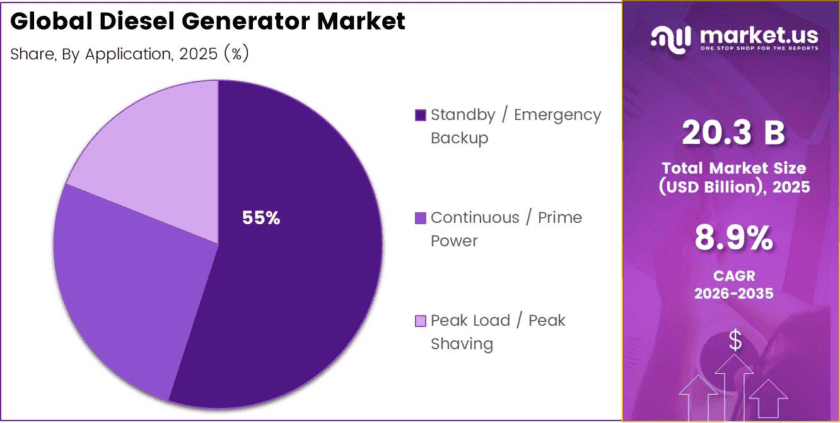
- Among the application, the Standby / Emergency Backup held a major share in the Diesel Generator market, 55% of the market share.
- Among the end user industry, the oil & gas is the most considerable within the market, accounting for around 22% of the revenue.
- In 2025, the Asia Pacific was the most dominant region in the Diesel Generator market, accounting for 45% of the total global consumption.
Portability Analysis
Stationary Generators represents dominant Segment in the Market.
The stationary diesel generator segment held the leading position, accounting for a 53.0% market share. Its dominance is mainly attributed to increasing demand from data centers, hospitals, and telecom infrastructure, where reliable and high-capacity backup power is essential. These facilities generally require permanently installed generators that can start within seconds and continue operating for extended periods during grid outages.
According to the IEA, global data center electricity demand is expected to rise from 415 TWh in 2024 to approximately 945 TWh by 2030, largely due to the rapid expansion of AI and cloud computing. Under NFPA 110 and similar international standards, critical facilities require stationary backup generators capable of supplying 100% of the electrical load within 10 seconds following a power failure. Modern AI data centers commonly require 50–150 kW of power per rack and can operate with continuous electricity demand of 50–100 MW, making portable generators unsuitable for these applications.
The healthcare industry is another major source of demand for stationary diesel generators. According to the WHO, World Bank, and IRENA (2023), more than 1 billion people depend on healthcare facilities that have unreliable or no electricity access. The report also found that 64% of healthcare facilities across 63 low- and middle-income countries require dependable backup power systems. Meeting this need is estimated to require approximately USD 4.9 billion in procurement investment, with stationary diesel generators continuing to be a preferred solution.
Portable diesel generators are witnessing increasing demand from construction projects and disaster response activities. According to the U.S. Federal Emergency Management Agency (2024), the use of portable generators during federally declared disasters increased notably. Diesel-powered units are particularly preferred during flood and hurricane recovery operations across Gulf Coast and Atlantic regions because of their ability to provide extended runtime.
Power Rating (kVA) Analysis
Below 75 kVA a significant power rating.
The 75–375 kVA segment accounted for 48.0% of the market, supported by its ability to meet the power requirements of major end-use sectors such as commercial buildings, telecom infrastructure, and medium-sized manufacturing facilities. Generators within this range can support commercial floors, hospital departments, telecom towers, and industrial facilities while requiring lower installation and infrastructure costs compared with larger high-voltage generator sets.
According to the UNEP and GlobalABC Global Status Report for Buildings and Construction 2024/25, global building floor space is increasing by more than 5 billion square meters each year, with particularly strong expansion across Asia, Africa, and the Middle East. In these regions, unreliable electricity grids continue to increase the need for backup power systems. Commercial buildings covering 1,000–10,000 square meters generally require standby generators in the 100–350 kVA range to operate HVAC systems, elevators, lighting, and emergency functions. This places many new commercial projects within the 75–375 kVA category.
The continued expansion of telecom networks is also supporting demand. According to the GSMA Mobile Economy Report 2026, mobile technologies generated USD 7.6 trillion in global economic value in 2025. The ongoing deployment of 5G networks, particularly in developing countries, is increasing the number of telecom base stations. Most of these installations require backup generators in the 20–200 kVA range to maintain uninterrupted operations in locations with unreliable electricity supplies.
Generators in the 75–375 kVA range can also function as both prime and standby power sources. Their ability to support single-phase and three-phase loads, combined with relatively limited site infrastructure requirements, makes them suitable for a broad range of commercial and institutional applications.
The Above 750 kVA segment is following the fastest growth trajectory, mainly due to the expansion of hyperscale data centers and large industrial facilities. The U.S. Department of Energy’s 2024 data center energy report indicated that backup generation requirements at utility-scale hyperscale facilities are increasingly calling for generator sets exceeding 1,000 kVA to maintain operations during grid disturbances.
Power Rating (kW) Type Analysis
Low Power Generator (Below 200 kW) Are the Most Widely Used.
The below 200 kW segment held a dominant 60.0% share of the low-power diesel generator market. Its strong position is linked to its widespread use among off-grid and backup power users, including rural healthcare facilities, small businesses, farms, and residential communities. These generators offer a practical and cost-effective power solution in areas where grid electricity is unavailable or unreliable.
According to the UN SDG 7 Tracking Report 2025, published by the World Bank, IEA, WHO, IRENA, and UN DESA, approximately 666 million people remained without electricity in 2023, with 85% of them located in Sub-Saharan Africa, primarily across rural and peri-urban areas. At the existing rate of electrification, nearly 645 million people are expected to remain without electricity by 2030, supporting continued demand for small diesel generators.
The healthcare sector is an important contributor to demand for low-power generators. The WHO reports that 15% of healthcare facilities in Sub-Saharan Africa and 12% in South Asia lack electricity access. More than 330,000 healthcare facilities require new off-grid or backup power systems, with many requiring generators below 200 kW, particularly 50–150 kW units.
Agriculture also generates steady demand for smaller diesel generators. According to the World Bank’s Farm Power and Food Security report, diesel generators remain the primary power source for many small-scale agricultural operations in remote locations. They are used for irrigation, post-harvest processing, and cold storage across South Asia, Southeast Asia, and Sub-Saharan Africa, creating consistent and high-volume demand for generators below 200 kW.
The High Power Generator segment, consisting of units above 500 kW, is experiencing the strongest expansion momentum. The U.S. Department of Energy’s 2025 Industrial Decarburization Outlook identified heavy manufacturing and mining operations as key drivers of procurement for generators above 500 kW. Large extraction facilities in remote areas continue to maintain dedicated high-capacity generator systems to ensure operational continuity.
Application Analysis
Standby / Emergency Backup Held a Major Share of the Diesel Generator Market.
Standby and emergency backup applications represented a dominant 55.0% share of the diesel generator market. Increasing requirements for uninterrupted electricity across critical infrastructure are supporting this position. Stricter regulations and concerns regarding grid reliability are also encouraging organizations to treat backup diesel generators as an essential infrastructure investment rather than an optional power source.
According to the North American Electric Reliability Corporation (NERC) 2025 State of Reliability Report, severe weather remained the leading cause of major power outages in 2024. This included 2 major winter storms and 5 hurricanes that resulted in multi-day electricity disruptions across several regions. The report also identified a major grid event in July 2024, when a single 230 kV fault disconnected nearly 1,500 MW of data center load across 60 grid connection points. This highlighted the growing exposure of critical facilities to large-scale power disruptions.
Regulatory requirements are also contributing to demand in Europe. Under Germany’s KRITIS Ordinance, which is aligned with the EU CER Directive 2022/2557, along with the revised EN 50600 Data Center Standard introduced in September 2025, critical infrastructure operators are required to maintain emergency diesel generators capable of supporting full facility operations for 24 to 72 hours. These regulations also require N+1 redundancy, documented load transfer performance, and regular compliance testing.
The Peak Load and Peak Shaving segment represents the fastest-growing application category. The U.S. Energy Information Administration’s 2024 Electric Power Monthly confirmed that peak demand events are becoming more intense across major grid regions. As a result, commercial and industrial operators are increasingly using diesel generator assets during high-tariff peak periods to reduce electricity procurement costs.
End Use Analysis
Diesel Generators Are Mostly Utilized in the Oil & Gas.
The oil and gas sector accounted for 22.0% of the diesel generator market, driven by its continuous electricity requirements in remote and off-grid environments such as offshore platforms, drilling sites, pipeline stations, and LNG terminals. In these applications, diesel generators often function as the primary electricity source rather than simply serving as backup systems.
According to Baker Hughes’ International Rig Count, more than 900 international drilling rigs were active worldwide in early 2025. Each site typically requires between 500 kW and several MW of diesel power to operate drilling equipment, HVAC systems, communication networks, and safety infrastructure continuously.
The International Energy Agency reported in its World Energy Investment 2025 report that global upstream oil and gas investment reached USD 570 billion in 2025. A significant portion of this spending was directed toward upstream and midstream projects that depend heavily on off-grid diesel generation. The agency also estimates that upstream investment must average USD 540 billion annually through 2050 to maintain current production levels, supporting continued demand for diesel-powered infrastructure.
Published offshore engineering data further indicate that more than 6,500 offshore oil and gas production installations are operating across 53 countries. These facilities rely on large-capacity diesel generators as dependable primary power sources, reinforcing the oil and gas sector’s leading position in diesel generator demand.
Data centers represent the fastest-growing end-user category. The U.S. Department of Energy’s 2025 National Data Center Energy Efficiency Report identified rapid hyperscale facility expansion across Northern Virginia, Texas, and the Pacific Northwest as a major factor driving demand for diesel backup generation. New installations increasingly require multi-megawatt emergency generation capacity to meet contractual uptime requirements.
Emerging Trends
The single strongest force reshaping diesel generator demand today is the explosive growth of data center electricity consumption tied to artificial intelligence and cloud computing workloads. According to the U.S. Energy Information Administration’s Annual Energy Outlook 2026, electricity consumed by data center servers could reach between 446 billion and 818 billion kilowatt-hours by 2050, with servers alone accounting for an estimated 7% of U.S. commercial-sector electricity consumption in 2025, a share projected to climb to between 22% and 33% by mid-century. Because these facilities cannot tolerate downtime, this surge in installed computing capacity is translating directly into rising orders for large-capacity standby diesel generator sets that back up grid power at hyperscale and colocation sites.
A second, closely related trend is worsening grid reliability, which is pushing commercial and industrial buyers toward diesel backup as an insurance policy against outages. EIA data show that interruptions attributed to major weather events averaged nearly nine hours per customer in 2024, more than double the roughly four-hour average recorded annually from 2014 through 2023, while routine, non-major-event interruptions continue to average about two hours a year. Customers in South Carolina experienced the longest interruptions of any state in 2024, at nearly 53 hours, following Hurricane Helene and Hurricane Milton. As storm-driven outages lengthen, facility operators are treating diesel generation as a core resilience investment rather than a rarely used contingency.
Diesel generator capacity installed at data centers has surged rather than declined, underscoring how deeply entrenched diesel remains even as alternatives mature. Original reporting from Latitude Media, drawing on findings from the Better Data Center Project, shows that U.S. data center diesel generator capacity nearly tripled in five years, climbing from 20 gigawatts in 2018 to 55 GW in 2024. In Virginia, the world’s largest data center market, more than 10,500 generator units were permitted by the end of 2025, totaling 27 GW of capacity, of which over 70% still runs on older Tier 2 emissions standards even as more than half of newly permitted capacity now meets Tier 4 requirements. This buildout reflects diesel’s continued edge in cost and deployment speed: generators run roughly $1,000 per kilowatt versus about $1,300 per kilowatt for a four-hour battery system, according to June 2025 estimates cited in the report.
Fuel decarbonization is the fourth major trend reshaping the market, led by the accelerating adoption of hydrotreated vegetable oil (HVO) as a drop-in diesel substitute. Amazon Web Services began transitioning its backup generators at European data centre sites to HVO starting in January 2023, with facilities in Ireland and Sweden among the first converted, citing supplier data showing HVO can cut greenhouse gas emissions by up to 90% over the fuel’s lifecycle compared with fossil diesel. Because HVO requires no modification to existing generator infrastructure, it is emerging as the fastest and lowest-capital route for operators to lower the carbon footprint of their diesel fleets while preserving the reliability diesel power is valued for.
Use Cases
Agricultural irrigation represents a significant, if declining, use case for diesel-powered pumping engines across the United States. According to the U.S. Department of Agriculture’s Irrigation and Water Management Survey (IWMS), farmers spent $3.26 billion in 2023 on energy to power pumps that irrigate crops, with electricity holding the largest share of that market but diesel remaining the second-largest power source. The survey identified 95,810 diesel pumps still in operation nationwide as of 2023, most now considered candidates for conversion to alternative fuels. The overall U.S. irrigation pump market grew 24% between 2003 and 2023, but that growth was captured almost entirely by electric pumps, illustrating how diesel-powered irrigation, while still widespread, is gradually losing share to grid-connected and alternative-fuel alternatives even as it remains essential in remote fields without electrical access.
Telecommunications infrastructure is another core diesel generator use case, driven by the industry’s dependence on power resilience to keep 911 and emergency communications online. The Federal Communications Commission has documented that, following a 2007 rulemaking after Hurricane Katrina, wireless and local exchange carriers were required to maintain backup power for a minimum of 24 hours for assets inside central offices and eight hours for cell sites, remote switches, and digital loop carrier terminals. The scale of the underlying problem is significant: the Commission’s own data show that over 50% of cell site outages during major 2020 earthquakes, hurricanes, and storms were caused by power failures, and in 2020 alone the Commission received 9,158 outage reports tied to power failures, potentially affecting 63,097,389 customers, of whom 4.3 million experienced disruption in a single day. Diesel generators, deployed at cell towers, central offices, and mobile “cell on wheels” units, remain the primary tool carriers use to keep networks operating through these outages.
Disaster recovery and emergency government infrastructure form a further significant use case, particularly for critical facilities in hurricane-prone regions. A U.S. Senate office release documents that the Federal Emergency Management Agency awarded $4,775,507.00 to St. Bernard Parish, Louisiana, following Hurricane Ida, specifically to fund the purchase, installation, and management of 18 permanent generators providing backup power for critical facilities to support continuity of services and disaster recovery. Awards of this kind illustrate how diesel generation is treated by federal and local governments as core resilience infrastructure rather than a discretionary purchase, with funding tied directly to named storm events and applied at the level of individual public facilities.
Mining is a long-established industrial use case for diesel generators and diesel-powered equipment, particularly in underground operations where grid power is impractical. According to the U.S. Mine Safety and Health Administration, the number of diesel-powered equipment units operating in underground coal mines rose from approximately 150 in 1974 to more than 2,900 units across 173 mines by 1995. MSHA data further show that approximately 98% of all diesel-powered equipment in underground coal mining is concentrated in large mines, with the average large underground coal mine operating about 18 pieces of diesel-powered equipment compared with about 3 pieces at the average small mine. Because these generators and diesel machines often operate in confined, potentially gas-rich environments, their use is governed by strict ventilation, fuel storage, and fire-suppression requirements, underscoring how deeply diesel power is embedded in mine site operations even as electrification expands elsewhere in the industry.
Conclusion
Taken together, the trends and use cases outlined above point to a diesel generator market that is expanding in scale even as it faces mounting pressure to modernize. Demand is being pulled upward by the same forces reshaping the broader power sector: data center and artificial intelligence workloads that require uninterrupted backup capacity, a U.S. electric grid experiencing longer and more frequent weather-related interruptions, and mission-critical sectors such as hospitals, telecommunications networks, government emergency infrastructure, and mining operations that simply cannot risk downtime. At the same time, the market is not standing still technologically. Buyers are increasingly pairing diesel generators with battery storage in hybrid microgrid configurations, adopting cleaner-burning Tier 4 engines in place of older Tier 2 units, and, in a growing number of cases, switching to renewable drop-in fuels such as hydrotreated vegetable oil (HVO) to cut lifecycle emissions without sacrificing the reliability diesel is valued for. For B2B buyers, this signals a market in transition rather than decline: diesel generation remains the default choice for critical backup power today, but the fastest-growing segment of demand is coming from operators who expect their diesel assets to work alongside, not instead of, cleaner technologies. Companies that can offer higher-efficiency engines, fuel flexibility, and integration with battery and renewable systems are best positioned to capture this next phase of growth, while those relying solely on legacy diesel-only architectures may find themselves increasingly exposed to tightening emissions regulation and shifting buyer expectations.
Frequently Asked Questions!
What is a diesel generator used for?
A diesel generator converts diesel fuel into electrical power through an internal combustion engine connected to an alternator. It is widely used for backup power during grid outages, standby power at hospitals and data centers, and prime power in remote sites like mines and construction locations.
Why is diesel preferred over gasoline for backup generators?
Diesel engines offer higher energy density, better fuel efficiency, and lower flammability risk compared to gasoline. Diesel fuel does not ignite as easily, reducing fire hazards. These engines also provide stronger motor-starting torque, making diesel the preferred choice for hospitals, telecom towers, and industrial facilities.
What is driving growth in the diesel generator market?
Growth is largely driven by rising data center and AI electricity demand, worsening grid reliability due to storms and hurricanes, and continued industrial reliance on diesel power in mining, telecommunications, and emergency government infrastructure across hurricane-prone and remote regions.
How are diesel generators becoming more environmentally friendly?
Operators are increasingly adopting Tier 4 emissions-compliant engines, which cut nitrogen oxide and particulate matter significantly compared to older Tier 2 units. Many are also switching to hydrotreated vegetable oil (HVO), a renewable diesel substitute that can reduce lifecycle greenhouse gas emissions by up to 90%.
Are diesel generators being replaced by battery storage?
Not entirely. While battery energy storage systems are increasingly paired with diesel generators in hybrid microgrids to reduce runtime and emissions, diesel remains dominant due to lower upfront capital costs and its ability to run continuously for extended periods during prolonged outages.
How often must hospital diesel generators be tested?
Under standards enforced by The Joint Commission, diesel-powered emergency generators must undergo a monthly load test at 30% of nameplate rating for 30 minutes, plus annual and triennial load tests to confirm the system will perform reliably during real emergencies.
How much backup power do cell towers typically require?
Following FCC rules adopted after Hurricane Katrina, telecom carriers were historically required to maintain 24 hours of backup power for central offices and eight hours for cell sites, ensuring emergency communications and 911 access remain available during commercial power outages.
Why do mining operations rely so heavily on diesel generators?
Mining sites are frequently located in remote areas without grid access, making diesel generators essential for powering drilling, hauling, and ventilation equipment. Regulatory bodies like MSHA require strict safety standards for diesel-powered equipment used underground due to fire and explosion risks.
Discuss your needs with our analyst
Please share your requirements with more details so our analyst can check if they can solve your problem(s)