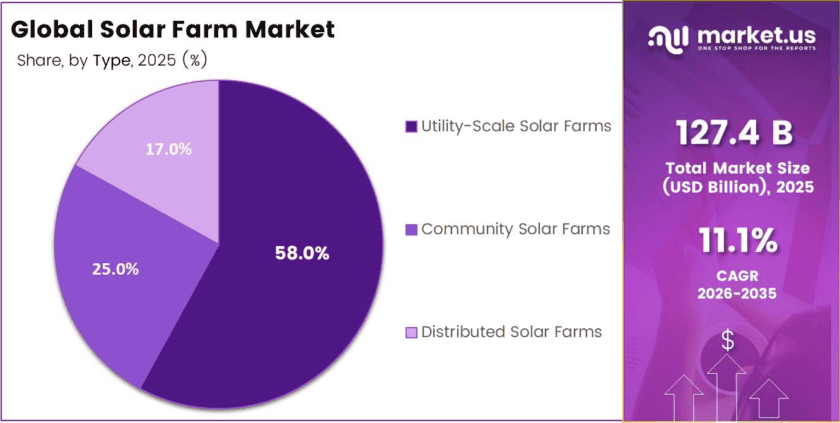
New York, NY – Sep 03, 2026 – The global Solar Farm Market was valued at USD 127.4 billion in 2025 and is projected to reach approximately USD 359.9 billion by 2035, expanding at a CAGR of 11.1% between 2026 and 2035. Asia Pacific remained the leading regional market with more than a 41.6% share, representing approximately USD 53.0 billion in revenue.
Solar farms are becoming a major part of the global electricity system as utilities, industries, municipalities, and communities seek scalable sources of renewable power. Solar photovoltaic generation increased by 620 TWh in 2025, compared with 450 TWh in 2024, bringing solar’s contribution to around 8% of worldwide electricity generation.
Utility-scale projects remain central to market development, while photovoltaic technology continues to dominate new installations. Future growth is increasingly connected with solar-plus-storage systems, agrivoltaics, repowering older plants, digital monitoring, and improved grid integration. Renewable electricity generation is expected to increase from 9,900 TWh in 2024 to 16,200 TWh by 2030, with solar PV contributing more than half of the expected increase.
Key Takeaways
- The global Solar Farm Market reached USD 127.4 billion in 2025 and is expected to approach USD 359.9 billion by 2035, supported by an 11.1% CAGR.
- Utility-Scale Solar Farms led the type segment with approximately 58.0% of total market share.
- Photovoltaic technology dominated the technology category with around an 84.0% share.
- Solar farms with capacities above 100 MW represented the largest capacity segment with around 37.0% share.
- Utilities remained the largest end-user category, accounting for approximately 55.0% of market revenue.
- Asia Pacific dominated the regional market with a 41.6% share and approximately USD 53.0 billion in revenue.
- U.S. utility-scale solar PV capacity reached 149,798.5 MW in 2025, while generation increased 34% to around 296,000 GWh.
- Global renewable additions are projected to approach 4,600 GW between 2025 and 2030, providing a large development base for new solar projects.
Regional Analysis
Asia Pacific Dominates with 41.6% Market Share
Asia Pacific held the leading position in the Solar Farm Market, accounting for more than a 41.6% share and approximately USD 53.0 billion in revenue. Regional growth is supported by large utility projects, expanding electricity networks, manufacturing capacity, and continued investment in renewable power. China’s installed solar capacity reached approximately 1.2 billion kW by the end of 2025, while around 317 million kW was added during the year. The scale of these additions strengthens Asia Pacific’s position as a major center for utility-scale photovoltaic development, equipment demand, grid connections, and large renewable-energy investment.
Europe Shows Strong Growth in Solar Farm Development
Europe is developing as an important growth region as countries strengthen energy security, expand renewable electricity procurement, and reduce dependence on imported fossil fuels. Solar electricity generation across the European Union reached approximately 275 TWh in 2025, increasing 18% from the previous year. The region also installed around 56 GW of new solar capacity during 2025. Continued utility-scale project development, storage integration, transmission upgrades, repowering, and commercial renewable procurement are creating additional opportunities for solar-farm developers and technology providers across European electricity markets.
Market Dynamics
Driver – Growing Demand for Low-Cost Utility-Scale Renewable Power
The strongest market driver is the growing competitiveness of utility-scale solar as a scalable source of new electricity. Solar PV is expected to contribute around 80% of global renewable-capacity growth between 2024 and 2030. Nearly 4,600 GW of renewable capacity additions are projected between 2025 and 2030, roughly double deployment during the previous five years. Utility-scale and distributed solar together are expected to contribute nearly 80% of renewable electricity expansion.
Trend – Solar-Plus-Storage is Becoming a Mainstream Project Model
Solar farms are increasingly being developed alongside battery storage to improve electricity availability beyond daylight hours. In January 2025, a USD 289.7 million financing commitment supported the deployment of up to 1,000 photovoltaic and battery systems across as many as 27 U.S. states. Storage can help solar farms reduce production variability, improve grid support, and shift electricity into higher-value evening periods.
Restraint – Grid Connection Delays Slow Project Commissioning
Grid interconnection remains a major restraint because solar projects can often be constructed faster than transmission systems can accommodate new generation. Solar installations reached only 7.8 GWdc in Q1 2026, decreasing 27% year over year and 42% compared with Q4 2025.
Opportunity – Data-Center Energy Parks Create New Solar Demand
Rapid development of data centers creates opportunities for dedicated solar farms combined with battery storage. Data-center operators increasingly require reliable renewable electricity and are moving toward stronger clean-energy matching requirements. The Climate Neutral Data Centre Pact referenced on the source page targeted 75% renewable-energy matching by 2025 and 100% by 2030.
Emerging Trends
1. Utility-Scale Solar Capacity is Expanding
U.S. utility-scale photovoltaic capacity reached 149,798.5 MW in 2025, compared with 122,060.1 MW in 2024. Electricity generation reached around 296,000 GWh, increasing 34%, showing continued movement toward large centralized solar installations.
2. Solar Farms are Adding Battery Storage
Solar-plus-storage is becoming increasingly common for improving power availability. A USD 289.7 million financing commitment announced in 2025 supported up to 1,000 photovoltaic and battery installations across 27 states, demonstrating growing interest in combined renewable systems.
3. High-Temperature CSP is Developing
Concentrated solar power is gaining attention for dispatchable renewable electricity and industrial heat. A USD 25 million supported pilot is developing multi-megawatt thermal storage capable of providing 6 hours of energy storage at temperatures exceeding 700°C.
4. Very Large Solar Farms are Increasing
Solar farms above 100 MW account for approximately 37.0% of the market. A 400 MW solar facility approved in Nevada covers around 2,469 acres, showing how developers are scaling projects for centralized grid electricity supply.
5. European Solar Development is Accelerating
European Union solar generation reached approximately 275 TWh in 2025, increasing 18% annually. Around 56 GW of new solar capacity was installed during the year, supporting further development of solar farms, storage projects, and transmission infrastructure.
Use Cases
1. Utility Electricity Generation
Utilities represent the largest Solar Farm Market end-user segment with approximately 55.0% share. Large solar farms supply centralized power networks and support renewable procurement as utilities replace or supplement conventional electricity sources with scalable photovoltaic generation.
2. Commercial and Industrial Power
Commercial solar PV capacity reached approximately 16,031.4 MW in 2025, while industrial installations reached 2,999.3 MW. Solar systems help offices, warehouses, factories, and commercial facilities reduce electricity exposure and strengthen long-term energy security.
3. Community Solar Electricity
Community solar allows households and businesses without suitable rooftops to participate in shared projects. Approximately 7.87 GW of community solar capacity was operating across 44 U.S. states and localities by June 2024.
4. Solar with Battery Storage
An 80 MW photovoltaic project paired with a 110 MW battery system demonstrates how solar farms can combine generation and storage. The arrangement improves electricity availability and enables renewable power to serve the grid beyond peak daylight production.
5. Large Renewable Energy Projects
Projects above 100 MW are increasingly used for centralized renewable-power generation. A 400 MW solar development approved across approximately 2,469 acres demonstrates how large facilities can supply significant electricity volumes through a single grid-connected site.
Frequently Asked Questions on Solar Farm Market
What is a solar farm?
A solar farm is a large area containing photovoltaic panels or concentrated solar equipment that generates electricity for connection to the power grid. Projects can serve utilities, businesses, communities, public agencies, and agricultural users.
How large was the Solar Farm Market in 2025?
The global Solar Farm Market was valued at approximately USD 127.4 billion in 2025. Continued renewable-energy investment, utility procurement, electricity-demand growth, storage integration, and large photovoltaic projects are supporting market expansion.
How large could the Solar Farm Market become by 2035?
The Solar Farm Market is projected to reach approximately USD 359.9 billion by 2035, expanding at a CAGR of 11.1% between 2026 and 2035 as solar generation becomes increasingly important worldwide.
Which type dominates the Solar Farm Market?
Utility-scale solar farms represent the leading type with around a 58.0% market share. These facilities provide large quantities of electricity through centralized grid connections and benefit from economies of scale in construction and operation.
Which technology dominates the Solar Farm Market?
Photovoltaic technology dominates the market with approximately an 84.0% share. PV systems are widely used because of their modular design, scalability, compatibility with battery storage, and suitability for both large and distributed solar installations.
Which capacity segment leads the Solar Farm Market?
Solar farms with capacities above 100 MW hold the largest capacity segment, accounting for approximately 37.0% of the market. Large projects benefit from centralized development, substantial electricity output, and stronger integration with utility networks.
Which end user holds the largest Solar Farm Market share?
Utilities represent the largest end-user segment, holding around 55.0% of the market. They purchase or develop large solar projects to supply grid electricity, diversify generation resources, and increase renewable-energy availability.
Which region dominates the global Solar Farm Market?
Asia Pacific leads the global Solar Farm Market with approximately 41.6% share and around USD 53.0 billion in revenue, supported by large-scale renewable developments, expanding transmission networks, and significant solar manufacturing capacity.
Why is battery storage important for solar farms?
Battery storage allows solar farms to retain electricity generated during high-production periods and deliver it later. This improves dispatchability, reduces dependence on immediate grid absorption, and strengthens the ability of solar facilities to serve evening demand.
What is the main challenge facing solar farm developers?
Grid interconnection is a major challenge because new solar capacity can be developed faster than transmission infrastructure. Project delays of around 12 to 36 months can postpone electricity sales and increase financing and development costs.
Conclusion
The global Solar Farm Market is positioned for sustained expansion as utilities, industries, and communities increase renewable-electricity adoption. Valued at USD 127.4 billion in 2025, the market is projected to reach approximately USD 359.9 billion by 2035, advancing at an 11.1% CAGR.
Utility-scale farms, photovoltaic technology, and projects above 100 MW remain major market categories, while Asia Pacific leads with a 41.6% share. Future development will increasingly depend on solar-plus-storage, grid modernization, data-center power demand, agrivoltaics, and project repowering.
Discuss your needs with our analyst
Please share your requirements with more details so our analyst can check if they can solve your problem(s)