Report Overview
In 2025, the Global Offshore Wind Installations Market was valued at USD 38.8 billion. Between 2026 and 2035, the market is projected to expand at a CAGR of 10.4%, reaching approximately USD 104.8 billion by 2035. In 2025, Europe held the leading position, accounting for more than 36.6% of the market, with revenue of USD 14.2 billion.
Offshore wind installations are becoming an increasingly important component of the global renewable energy sector, supported by stronger and more consistent wind conditions available at offshore locations compared with land-based sites.
- According to the Global Wind Energy Council, 2026, approximately 9.3 GW of new offshore wind capacity was connected in 2025, bringing cumulative global capacity to around 92.5 GW. This operational capacity could generate electricity equivalent to the annual consumption of nearly 102 million households, demonstrating the sector’s growing role in energy security and low-carbon power generation.
- Government renewable energy targets continue to support the expansion of offshore wind installations. According to the European Commission, 2024, European Union member states set combined offshore renewable energy ambitions of 86–89 GW by 2030, 259–261 GW by 2040, and 356–366 GW by 2050. These targets are encouraging coordinated maritime planning, cross-border electricity networks, and offshore energy hubs while providing long-term visibility for turbine manufacturers, cable suppliers, engineering companies, utilities, and institutional investors.
- According to the UK Government, 2025, approximately GBP 900 million was allocated for fixed-bottom offshore wind and GBP 180 million for floating offshore wind under the seventh Contracts for Difference allocation round. The government also set an administrative strike price of GBP 113 per MWh for conventional offshore wind. These measures improve revenue certainty, although developers continue to face challenges from high financing costs, construction inflation, and supply-chain pressures.
The medium-term outlook for offshore wind remains positive, although growth is expected to differ across regions. According to the International Energy Agency, 2025, approximately 140 GW of additional offshore wind capacity could be installed between 2025 and 2030. Annual installations are projected to rise from 9.2 GW in 2024 to more than 37 GW by 2030. However, the agency reduced its offshore wind forecast by 27% due to policy uncertainty, project cancellations, higher equipment costs, and weak auction participation. Faster permitting processes and timely grid connections will therefore remain critical to supporting future project development.
- According to the U.S. Department of Energy, 2025, the Floating Offshore Wind Shot aims to reduce floating wind energy costs by more than 70%, reaching USD 45 per MWh by 2035, while supporting the deployment of 15 GW of floating offshore wind capacity. These initiatives are expected to create long-term opportunities for installation vessels, ports, component suppliers, engineering firms, and operations and maintenance service providers.
Key market segment
- The Global Offshore Wind Installations Market was valued at USD 38.8 billion in 2025.
- The market is projected to grow at a CAGR of 10.4% and is estimated to reach USD 104.8 billion by 2035.
- On the basis of service type, Turbine Installation dominated the market, constituting 34.7% of the total market share.
- Based on the location, Shallow Water dominated the market, with a substantial market share of around 43.7%.
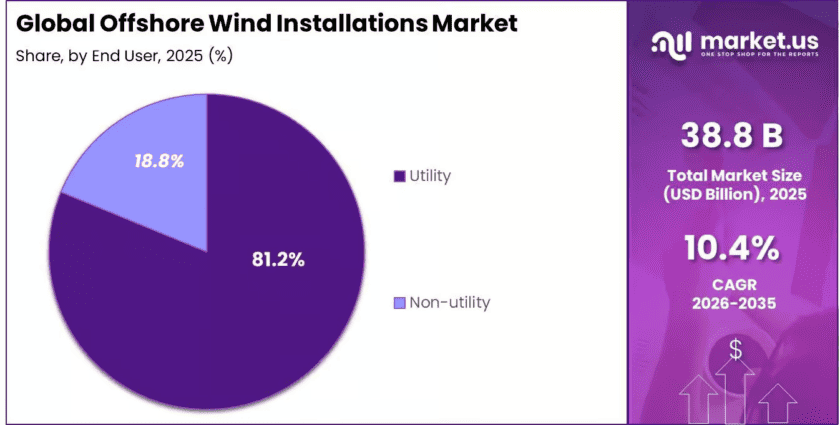
- Based on the end user, Utility led the market, comprising 81.2% of the total market.
- In 2025, Europe was the most dominant region in the market, accounting for 36.6% of the total global consumption.
Service Type Analysis
Turbine Installation Dominates the Market with a 34.7% Share Due to Growing Demand for Large Offshore Wind Projects
In 2025, Turbine Installation dominated the market with more than a 34.7% share, supported by the increasing scale of offshore wind projects and the need for specialised vessels, heavy-lift cranes, skilled marine crews, and precise component handling. In April 2025, the UK government approved the Rampion 2 offshore wind project with 1.2 GW capacity and up to 90 offshore turbines, highlighting the growing demand for turbine transportation, lifting, assembly, and commissioning. Larger turbines and tighter project schedules are also driving investment in advanced installation vessels and port infrastructure.
Foundation Installation is the fastest-growing segment, driven by projects moving into deeper waters and challenging seabed conditions. Larger turbines require stronger monopiles, jackets, gravity-based structures, and floating foundations, increasing demand for seabed surveys, piling equipment, corrosion protection, and floating-platform engineering.
Location Analysis
Shallow Water Leads with a 43.7% Share Due to Easier Fixed-Bottom Installation
In 2025, shallow water held the leading position with more than a 43.7% share, supported by the widespread use of fixed-bottom foundations, established construction methods, simpler seabed anchoring, and lower installation complexity than floating systems. The European Commission reported that the EU connected 916 MW of offshore wind capacity during 2025, while floating projects accounted for only 30 MW, indicating that bottom-fixed projects, particularly in shallow-water locations, remained the main base of commercial offshore wind construction.
Deep water is the fastest-growing segment, supported by increasing development of floating platforms, mooring systems, dynamic cables, and advanced turbine designs. Deeper locations provide access to larger wind-resource areas with stronger and more consistent winds, while reducing competition for near-shore space. Growth is expected to accelerate as floating wind projects move toward commercial-scale deployment and specialised port and vessel infrastructure expands.
End User Analysis
Utility end users lead the offshore wind installations market with an 81.2% share due to strong grid-scale project development.
In 2025, Utility end users dominated the market with more than an 81.2% share, as offshore wind farms are primarily developed as large, grid-connected power projects supported by government auctions, regulated contracts, and long-term electricity agreements. Utilities also have greater access to capital for turbines, foundations, offshore substations, export cables, and grid connections. In January 2026, the UK government secured 8.4 GW of offshore wind capacity through its renewable energy auction, enough to supply more than 12 million homes, demonstrating the strong role of utility-backed projects.
Non-utility is the fastest-growing segment, driven by increasing participation from industrial companies, port operators, technology businesses, and other large electricity consumers. Corporate power purchase agreements, merchant electricity arrangements, joint investments, and dedicated electricity supply contracts are enabling these users to access cleaner power while improving long-term energy cost visibility.
Emerging Trends
1. Europe Accelerates Offshore Wind Deployment
Europe continues to expand offshore wind installations, although annual additions remain below the levels required for long-term targets. In 2025, Europe connected 2 GW of new offshore wind capacity, taking total offshore capacity to 39 GW. WindEurope expects Europe to install 151 GW of new wind capacity between 2026 and 2030, supporting continued offshore project development.
2. Rising Investment in Offshore Wind Projects
Investment in offshore wind is gaining momentum as countries prepare for larger renewable-energy projects. In 2025, Europe connected 2 GW of new offshore wind capacity, while the region’s total offshore capacity reached 39 GW. WindEurope expects Europe to add 151 GW of new wind capacity between 2026 and 2030, creating continued investment opportunities across offshore projects, infrastructure, and supply chains.
3. Larger Offshore Turbines
Offshore wind projects are increasingly moving toward larger turbines to generate more electricity from each installation and reduce the number of turbines required for a project. According to the U.S. Department of Energy, the average offshore turbine capacity installed in 2022 reached 7.7 MW, with an average rotor diameter of 174.6 meters and hub height of 116.6 meters. The industry is also adapting its supply chain, ports, vessels, and testing facilities to support turbines reaching the 15 MW class.
4. Stronger Focus on Offshore Grid Infrastructure
Offshore wind development is increasingly linked with improvements in electricity grids. Europe aims to increase offshore wind capacity to 500 GW by 2050, compared with only 37 GW operational when WindEurope published its 2025 grid-integration report. Cross-border connections, offshore hybrid projects, and coordinated grid planning are therefore becoming important trends.
5. Expansion of Ports and Installation Vessels
The growth of offshore wind is increasing demand for specialised ports, installation vessels, and marine infrastructure. WindEurope estimates that Europe’s current supply chain can install and maintain around 10 GW of offshore wind annually, while the region needs to reach at least 10 GW per year by 2030 and 15 GW per year after 2030. More than €6.7 billion has already been invested in European ports and vessels over the previous three years.
6. Growth of Floating Offshore Wind
Floating offshore wind is gaining importance because it allows developers to access deeper-water areas that are unsuitable for conventional fixed-bottom turbines. DNV estimates that floating offshore wind could represent 24% of the UK’s offshore wind capacity by 2050, with total UK offshore wind capacity reaching around 90 GW, including 10 GW dedicated to off-grid hydrogen production.
7. Increasing Use of Offshore Wind for Integrated Energy Systems
Offshore wind is increasingly being considered as part of broader energy systems rather than only electricity generation. DNV expects dedicated wind capacity for electrolysis to reach approximately 20 GW offshore by 2060, indicating growing opportunities for offshore wind to support green hydrogen production and other energy-intensive applications.
8. Greater Development of North Sea Offshore Wind
The North Sea is emerging as a major offshore wind development zone because of strong wind resources, established ports, and existing offshore energy infrastructure. DNV projects North Sea offshore wind capacity to increase six-fold by 2050, reaching 214 GW, while offshore wind could occupy approximately 9% of North Sea space by that time.
Use Cases
1. Large-Scale Grid Electricity Generation
The primary use of offshore wind installations is supplying large volumes of renewable electricity to national and regional grids. In 2025, global offshore wind capacity reached 92.5 GW, with the installed fleet capable of producing electricity equivalent to the annual consumption of approximately 102 million homes.
2. Supplying Clean Power to Millions of Households
Offshore wind farms can provide electricity for large population centres located near coastlines. In the UK, the 8.4 GW secured through the 2026 renewable energy auction is expected to generate enough clean electricity to power the equivalent of more than 12 million homes, demonstrating its use in large-scale residential electricity supply.
3. Industrial and Commercial Power Supply
Offshore wind is increasingly being used to support electricity-intensive industrial and commercial activities. Large projects can provide long-term renewable power through utility procurement and power purchase arrangements, helping businesses reduce exposure to fossil-fuel price volatility while supporting decarbonisation targets.
4. Deep-Water Electricity Generation
Floating offshore wind installations enable electricity generation in deep-water areas that cannot easily support fixed-bottom turbines. The U.S. Department of Energy estimates that approximately two-thirds of U.S. offshore wind potential is located in deep waters requiring floating platforms, creating a major application for floating technology.
5. Energy Security and Reduced Fossil-Fuel Dependence
Offshore wind installations are increasingly being used as a strategic source of domestic electricity. GWEC reported that more than 9 GW of offshore wind capacity was connected globally in 2025, while the installed 92.5 GW fleet could supply electricity equivalent to more than 100 million homes, supporting energy security and reducing dependence on imported fossil fuels.
6. Industrial Development and Job Creation
Offshore wind projects generate demand across manufacturing, vessel operations, construction, engineering, ports, installation, and maintenance. The UK’s 8.4 GW offshore wind auction in 2026 is expected to unlock around GBP 22 billion in private investment and support approximately 7,000 jobs, demonstrating the wider industrial use and economic impact of offshore wind development.
Conclusion
Offshore wind installations are entering a major expansion phase, supported by rising electricity demand, government renewable-energy targets, larger turbines, floating technology, and improving project economics. Global capacity reached 92.5 GW in 2025, while the IEA expects another 140 GW of capacity to be added between 2025 and 2030. However, faster permitting, grid development, stable policies, and stronger supply chains will be essential for achieving this growth.
Frequently Asked Questions
1. What are offshore wind installations?
Offshore wind installations are wind turbines and related infrastructure built in seas or oceans to generate electricity. These projects include turbines, foundations, subsea cables, offshore substations, installation vessels, and grid connections that transmit generated electricity to land.
2. How much offshore wind capacity was installed in 2025?
According to GWEC, approximately 9.3 GW of new offshore wind capacity was connected to electricity grids globally in 2025. This increased cumulative global offshore wind capacity to approximately 92.5 GW, bringing the industry close to the historic 100 GW milestone.
3. What is the difference between fixed-bottom and floating offshore wind?
Fixed-bottom offshore wind turbines are anchored directly to the seabed and are generally suitable for shallower waters. Floating turbines use floating platforms connected through mooring systems, allowing projects to operate farther offshore and in significantly deeper water.
4. Why is floating offshore wind important?
Floating offshore wind expands the areas available for wind development by allowing turbines to operate in deep waters. The U.S. Department of Energy notes that about two-thirds of U.S. offshore wind potential lies in waters too deep for conventional fixed-bottom foundations.
5. How fast will the offshore wind industry grow?
The International Energy Agency expects approximately 140 GW of additional offshore wind capacity to be installed between 2025 and 2030. Annual installations are projected to rise from 9.2 GW in 2024 to more than 37 GW by 2030, despite current market challenges.
6. What are the major applications of offshore wind installations?
Major applications include utility-scale electricity generation, supplying power to households and industries, supporting energy security, reducing fossil-fuel dependence, and providing renewable electricity to coastal population centres. Floating projects also enable clean-power generation in deep-water locations.
7. What factors are driving the offshore wind installations market?
Key growth factors include government renewable-energy targets, rising electricity demand, decarbonisation efforts, larger turbines, improved installation technology, floating wind development, and competitive auctions. In 2026, the UK secured 8.4 GW through its offshore wind auction.
8. What challenges affect offshore wind installations?
Major challenges include high financing costs, inflation, supply-chain constraints, permitting delays, grid bottlenecks, project cancellations, and auction uncertainty. The IEA reduced its 2025–2030 offshore wind capacity forecast by 27% because of these market and policy challenges.
9. How much does offshore wind cost compared with other power sources?
Offshore wind costs have declined substantially over the long term. IRENA reports that the global weighted-average offshore wind LCOE fell 62%, from USD 0.208/kWh in 2010 to USD 0.079/kWh in 2024, although costs increased 4% year-on-year in 2024.
10. What is the outlook for the Offshore Wind Installations Market?
The outlook remains positive as governments and utilities expand renewable electricity capacity and developers invest in larger turbines and floating platforms. GWEC expects annual offshore wind installations to surpass 50 GW per year by 2035, supporting long-term market expansion.
Discuss your needs with our analyst
Please share your requirements with more details so our analyst can check if they can solve your problem(s)