Report Overview
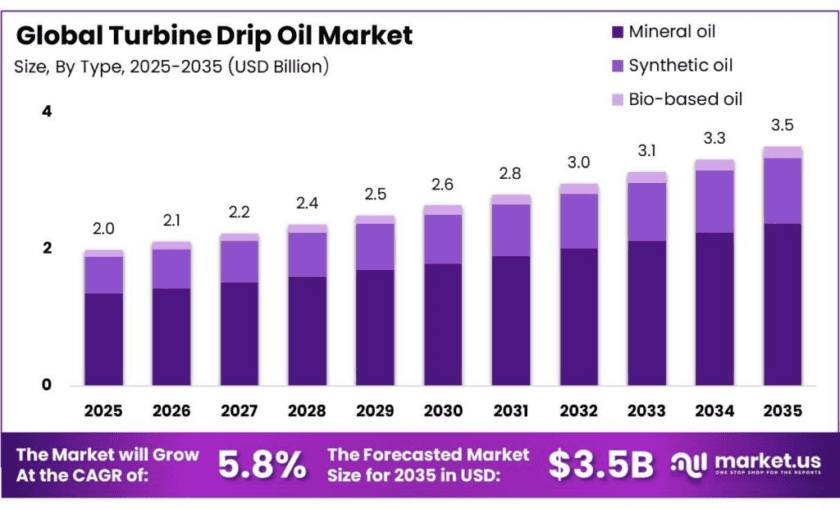
In 2025, the Turbine Drip Oil Market was valued at USD 2.0 Billion. The market is projected to expand at a CAGR of 5.8% between 2026 and 2035, reaching approximately USD 3.5 Billion by 2035. Asia-Pacific led the global market with a 44.60% share, generating USD 0.89 Billion in revenue during 2025.
According to the International Renewable Energy Agency (IRENA), global renewable power capacity reached 4,448 gigawatts (GW) in 2024, following the addition of 585 GW, representing 15.1% growth compared with the previous year. By the end of 2024, global wind energy capacity reached 1,133 GW, while hydropower capacity stood at 1,283 GW. The continued expansion of renewable energy infrastructure is increasing the installed base of turbines that require protective drip lubrication.
- The International Energy Agency (IEA) projects renewable power generation capacity to increase from 4,250 GW to nearly 10,000 GW by 2030 under its Stated Policies Scenario, following the addition of more than 560 GW of new renewable capacity in 2023. This ongoing expansion is expected to create significant opportunities for manufacturers of turbine drip oil formulations.
Government initiatives aimed at supporting turbine deployment are also strengthening market demand. The United States Department of Energy allocated 29.795 million dollars in fiscal year 2025 to its Wind Energy Technologies Office for research and development focused on improving wind turbine reliability and reducing operating costs. Such investments by governments across major global economies are expected to support sustained long-term demand for turbine drip oil and other protective lubrication products.
key Market Segments
- The Global Turbine Drip Oil Market was valued at USD 2.0 billion in 2025.
- The global turbine drip oil market is projected to grow at a CAGR of 5.8% and is estimated to reach USD 3.5 billion by 2035.
- On the basis of grade, Premium dominated the market, constituting 51.0% of the total market share.
- Based on the type, Mineral Oil dominated the market, accounting for 67.8% of the total market share.
- Based on the application, Lubrication dominated the market, accounting for 61.0% of the total market share.
- Based on the end user, Power Generation dominated the market, accounting for 42.0% of the total market share.
- In 2025, Asia Pacific was the most dominant region in the turbine drip oil market, accounting for 44.6% of the global market.
By Grade
Premium leads with 51% share, supported by superior performance and extended equipment protection.
In 2025, the Premium segment accounted for more than 51% of the Turbine Drip Oil Market, making it the leading grade category. Its strong market position is attributed to the widespread use of premium-grade turbine drip oils in critical turbine systems that demand dependable lubrication, excellent oxidation resistance, and consistent performance during continuous operation. Power generation facilities and other industrial users increasingly prefer high-quality lubricants to improve equipment reliability while minimizing unexpected maintenance requirements.
The Traditional/Conventional segment is anticipated to record the fastest growth during the forecast period, driven by its continued adoption across cost-sensitive industrial applications where standard lubrication performance adequately meets operational requirements.
By Type
Mineral Oil dominates with a 67.8% share due to its proven reliability and broad industrial acceptance.
In 2025, Mineral Oil captured more than 67.8% of the Turbine Drip Oil Market, maintaining its position as the leading product type. The segment continues to dominate because mineral oil-based turbine drip oils provide dependable lubrication, stable operating characteristics, and compatibility with a wide variety of turbine systems. Their extensive use across industrial facilities, power generation plants, and utility operations has continued to support steady market demand.
The Synthetic Oil segment is projected to witness the fastest growth over the forecast period as industries increasingly seek lubricants capable of performing under more demanding operating environments. Growing adoption of synthetic formulations is driven by their ability to improve oxidation stability, extend oil service intervals, and support equipment operating under higher temperatures and varying load conditions.
By Application
Lubrication holds a 61% share as continuous lubrication remains essential for reliable turbine performance.
In 2025, the Lubrication segment represented more than 61% of the Turbine Drip Oil Market, making it the largest application category. Lubrication remains the primary purpose of turbine drip oil, helping reduce friction, minimize component wear, and ensure the efficient operation of rotating equipment. It plays a critical role in protecting bearings and other moving parts across turbine systems used in power generation, water utilities, and industrial operations. Equipment manufacturers and maintenance guidelines continue to emphasize proper lubrication to improve equipment reliability and maintain stable operational performance.
The Machine Oil segment is expected to experience the fastest growth during the forecast period, supported by the expanding use of turbine drip oils in a broader range of industrial machinery beyond conventional turbine applications. Increased focus on equipment reliability, preventive maintenance, and extended service life is encouraging greater adoption of specialized lubrication products for industrial machine components.
By End User
Power Generation leads with a 42% share due to the ongoing need for dependable turbine lubrication.
In 2025, the Power Generation segment held a dominant position in the Turbine Drip Oil Market, accounting for more than 42% of total market share. The segment maintained its leadership because turbines are essential assets in electricity generation and require continuous lubrication to ensure safe, efficient, and reliable operation. Turbine drip oil plays a key role in reducing friction, protecting critical moving components, and supporting consistent performance throughout extended operating periods.
The Agriculture segment is projected to register the fastest growth during the forecast period, supported by the increasing adoption of rotating machinery, irrigation equipment, and engine-driven systems requiring reliable lubrication. Greater emphasis on preventive maintenance is helping farm operators improve equipment efficiency while reducing downtime during peak agricultural seasons. As agricultural mechanization advances and maintenance practices become increasingly structured, the use of turbine drip oil and related lubricants across farming operations is expected to continue growing steadily.
Emerging Trends
Federal Recognition Reshapes the Category
One of the most significant developments shaping the turbine drip oil space has been its formal recognition inside U.S. federal procurement policy. The U.S. Department of Agriculture’s BioPreferred Program designated turbine drip oils as an official biobased product category as part of its Round 6 final rule, issued on October 18, 2010, alongside seven other new categories including heat transfer fluids and multipurpose lubricants. This designation matters because it created a formal biobased-content benchmark for the category and opened the door to preferred federal purchasing status, nudging formulators toward plant-derived base stocks rather than conventional mineral oil.
A Widening Federal Biobased Framework
The turbine drip oil designation did not happen in isolation; it was part of a much broader federal push to expand biobased procurement categories. By July 11, 2013, USDA announced eight additional designated categories including the closely related water turbine bearing oils — bringing the total to 97 designated categories covering roughly 10,000 unique types of products. For B2B buyers, this steady expansion signals a long-running regulatory tailwind: federal agencies are increasingly required to favor lubricants, including drip and bearing oils used in turbine systems, that carry verified renewable content.
Power Generation Buildout Is Lifting Underlying Demand
Demand for turbine lubrication products, including drip oils used in line-shaft and auxiliary turbine systems, is closely tied to the pace of new turbine installation across the power sector. The U.S. Energy Information Administration projects a record 86 gigawatts (GW) of utility-scale generating capacity additions in 2026, surpassing the 53 GW added in 2025 and marking the largest single-year increase since 2002. Within that total, developers plan 6.3 GW of new natural gas capacity, split between 3.3 GW of combined-cycle and 2.8 GW of combustion turbine units both of which represent direct end-use points for turbine lubrication and drip-oil systems.
Use Cases
Agricultural and Groundwater Irrigation Systems
According to the U.S. Geological Survey, groundwater withdrawals for irrigation totaled 57,200 million gallons per day in 2015, supporting roughly 63,500 thousand acres of irrigated farmland nationwide, much of it dependent on line-shaft turbine pumps in the arid Western states. This scale of groundwater-dependent irrigation is precisely the environment in which turbine drip oil formulation choices conventional versus biodegradable carry the most consequence, since any oil that escapes the bearing assembly has a direct pathway into the aquifer being pumped.
Municipal and Potable Water Utility Pumping
A second major application sits in municipal water systems, where oil-lubricated vertical turbine pumps are used to lift water from wells into distribution networks. Because these pumps can share the same shaft column as the water itself, utilities increasingly specify NSF-registered food-grade turbine drip oils to prevent contamination of drinking water supplies. Globally, there are now more than 12,000 H1 food-grade lubricants registered for exactly this kind of incidental-contact use, a figure that reflects how deeply food-grade compliance has become embedded in water utility procurement standards rather than remaining a niche specification.
Power Generation: Steam and Gas Turbine Systems
The U.S. Energy Information Administration reports that natural gas was the top source of U.S. utility-scale electricity generation in 2025, supplying about 41% of total output, generated using both steam turbines and gas turbines. Every one of these turbine units, whether in a combined-cycle plant or a simple-cycle peaking unit, depends on continuous, controlled-rate lubrication systems to protect high-speed rotating shafts and bearings — a use case that scales directly with new gas-fired capacity additions.
Oil & Gas Pipeline Compression
The EIA, the U.S. interstate natural gas pipeline network relied on more than 1,200 natural gas compressor stations by 2006, up from about 1,047 stations in 1996, with installed horsepower climbing to roughly 16.9 million from 13.4 million over that decade — a 26% increase in installed horsepower. Each of these stations houses turbine or engine-driven compressor units that require dedicated bearing and shaft lubrication systems, sustaining long-term demand for industrial turbine oils in the midstream sector.
Frequently Asked Questions
What is turbine drip oil?
Turbine drip oil is a lubricant continuously fed, drop by drop, into the oil tube of vertical turbine pumps and certain industrial turbines to protect line-shaft bearings from friction and wear during continuous rotation, particularly in irrigation wells and municipal water systems.
What is turbine drip oil primarily used for?
It is mainly used to lubricate line-shaft bearings in oil-lubricated vertical turbine pumps for agricultural irrigation and municipal water supply, and in related turbine-driven equipment across power generation and natural gas pipeline compression, where continuous shaft lubrication prevents seizing.
Is turbine drip oil a federally recognized product category?
The USDA’s BioPreferred Program formally designated turbine drip oils as a biobased product category under its Round 6 final rule on October 18, 2010, establishing minimum biobased-content standards and preferred federal purchasing status for qualifying products.
Why does groundwater contamination matter for turbine drip oil?
Because drip oil travels down a tube submerged in well water before exiting near the pump bowl, any oil that escapes can enter the aquifer directly. This is why food-grade and biodegradable formulations are increasingly specified for irrigation and drinking-water wells.
Are food-grade turbine drip oils required by law?
Not universally, but municipal utilities widely specify NSF-registered H1 food-grade lubricants for potable water pumps as a safety practice. Globally, more than 12,000 H1 food-grade lubricants are currently registered, reflecting how standard this compliance step has become.
How does power generation growth affect turbine drip oil demand?
Turbine lubrication demand tracks new turbine installations closely. The EIA projects a record 86 gigawatts of U.S. power capacity additions in 2026, including new natural gas turbine capacity, which sustains ongoing demand for turbine bearing and drip lubrication systems.
Is turbine drip oil used in the oil and gas industry?
Natural gas pipeline compressor stations use turbine- or engine-driven compressors that require dedicated shaft lubrication. By 2006, the U.S. interstate network relied on more than 1,200 such compressor stations, up from 1,047 in 1996.
Is there a reliable market size figure for turbine drip oil?
Multiple paid market-research firms publish dollar-value estimates, but these figures could not be verified against primary government, regulatory, or trade-association sources, so no specific market-size number is presented here in line with strict sourcing requirements.
Are biobased alternatives to conventional turbine drip oil available?
USDA-designated biobased categories for related turbine lubricants set minimum biobased-content requirements, with water turbine bearing oils requiring at least 44% biobased content, encouraging formulators to shift away from conventional mineral oil bases.
Conclusion
On the demand side, the fundamentals remain solid: groundwater-fed irrigation alone draws 57,200 million gallons per day, natural gas-fired turbines supplied about 41% of U.S. electricity generation in 2025, and the EIA’s record 86 GW of forecast 2026 capacity additions point to sustained installation of new turbine equipment that will need ongoing lubrication.
Layered on top of this is a steady compliance shift toward food-grade and biodegradable formulations, evidenced by more than 12,000 NSF-registered H1 lubricants worldwide and USDA biobased-content minimums for related turbine categories running as high as 44–46%. Taken together, these factors point to a market that is maturing rather than disappearing: less driven by dramatic growth and more by steady replacement demand, tightening environmental compliance, and a gradual but firm shift away from conventional mineral oils toward biodegradable and food-grade alternatives across irrigation, utility, power, and pipeline applications.
Discuss your needs with our analyst
Please share your requirements with more details so our analyst can check if they can solve your problem(s)