Report Overview
In 2025, the Global E-fuels Market was valued at USD 173.74 billion. Between 2026 and 2035, the market is projected to grow at a CAGR of 18.31%, reaching approximately USD 935.80 billion by 2035. In 2025, Europe dominated the market with a share of more than 48.5%, generating revenue of USD 84.3 Billion.
E-fuels, also known as electrofuels, are synthetic energy carriers produced using low-carbon electricity to generate hydrogen through electrolysis. The hydrogen is then combined with captured carbon dioxide or nitrogen to produce fuels such as e-methanol, e-kerosene, e-gasoline, e-diesel and e-ammonia. These fuels provide alternatives for sectors such as aviation, shipping and industrial activities where direct electrification is challenging.
- According to the International Energy Agency’s Global Hydrogen Review 2026, global hydrogen demand exceeded 100 million tonnes in 2025. However, emerging applications such as synthetic fuels still accounted for only a small portion of overall hydrogen consumption.
The industry is gradually progressing from pilot-scale projects toward commercial deployment. According to the IEA, global installed electrolysis capacity doubled in 2025, exceeding 4 GW, while more than 2.5 GW was under construction for operation during 2026. At the same time, the announced low-emissions hydrogen project pipeline declined to 27 million tonnes per year by 2030. Projects that have already secured commitments could produce around 4.3 million tonnes annually, potentially increasing to more than 6 million tonnes if stronger projects achieve final investment decisions in 2026 or 2027. This difference highlights that, although the e-fuels industry is gaining technical momentum, project delays, uncertain buyers and high financing costs continue to limit expansion.
- According to the IEA, capital spending on low-emissions hydrogen projects reached nearly USD 7 billion in 2025 and could approach USD 10 billion in 2026, with electrolysis accounting for approximately 70% of the expected total. However, new offtake agreements covered around 1.7 million tonnes per year in 2025, and only 20% were supported by firm commitments. As a result, market development continues to depend heavily on long-term purchase contracts, carbon pricing, production incentives and clear fuel-certification rules.
Government mandates are emerging as a major factor supporting e-fuel demand. According to the European Commission, ReFuelEU Aviation requires sustainable aviation fuel to account for 2% of fuel supplied at EU airports from 2025. The requirement for synthetic aviation fuels is set to reach 1.2% in 2030 and 35% by 2050. Similarly, FuelEU Maritime requires the greenhouse-gas intensity of energy used by ships to decline by 2% from 2025 and by as much as 80% by 2050. In addition, the European Hydrogen Bank has selected 15 renewable-hydrogen projects across 5 countries, providing EUR 992 million in support.
- According to the IEA, more than 40% of announced low-emissions hydrogen volumes are planned for international trade by 2030, while more than 40,000 km of hydrogen pipelines have been announced for 2035. Approximately 170 ammonia terminals and 130 methanol terminals are already operating, creating an established logistics foundation. Continued reductions in renewable power costs, larger electrolysers, shared port infrastructure and binding fuel mandates could help shift e-fuels from a premium decarbonisation solution toward a scalable industrial fuel platform.
Key market segment
- The Global E-fuels Market was valued at USD 173.74 billion in 2025.
- The market is projected to grow at a CAGR of 18.31% and is estimated to reach USD 935.80 billion by 2035.
- On the basis of product type, Ethanol dominated the market, constituting 26.9% of the total market share.
- Based on the production method, Power-to-Liquid dominated the market, with a substantial market share of around 41.1%.
- Based on the technology, Hydrogen Technology (Electrolysis) led the market, comprising 60.3% of the total market.
- On the basis of end use, Automotive dominated the market, constituting 52.7% of the total market share.
- Based on the state, Liquid dominated the market, with a substantial market share of around 78.6%.
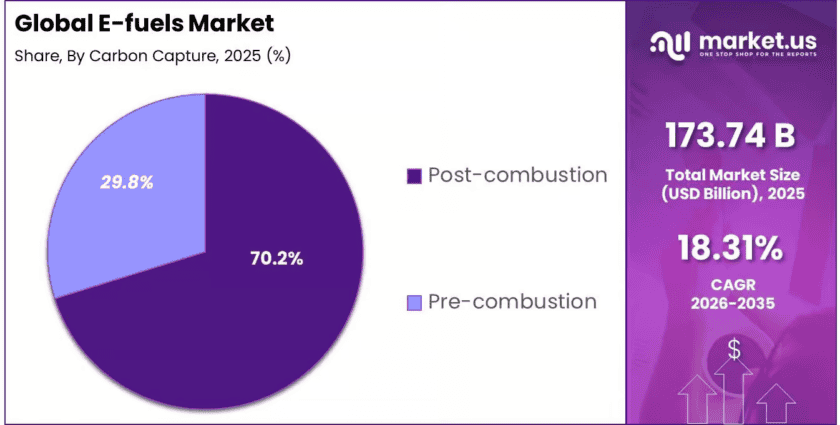
- Based on the carbon capture, Post-combustion led the market, comprising 70.2% of the total market.
- On the basis of e-fuel carbon source, Point Source dominated the market, constituting 82.8% of the total market share.
- In 2025, Europe was the most dominant region in the market, accounting for 48.5% of the total global consumption.
Product Type Analysis
Ethanol dominates the e-fuels market with a 26.9% share, supported by established production capacity and fuel-blending demand.
In 2025, Ethanol held the leading position with more than 26.9% of the E-fuels Market by Product Type, supported by mature production facilities, established distribution networks, and compatibility with conventional gasoline. In December 2025, U.S. fuel ethanol production capacity reached 18,351 million gallons per year, while the U.S. Environmental Protection Agency set the 2025 total renewable-fuel requirement at 22.33 billion ethanol-equivalent gallons, providing a stable consumption base. E-Gasoline is the fastest-growing segment, driven by its potential as a drop-in fuel using renewable hydrogen and captured carbon. In December 2025, the European Commission’s automotive package proposed a 90% tailpipe-emission reduction requirement from 2035, with the remaining 10% addressed through measures including e-fuels and biofuels, strengthening the long-term outlook for e-gasoline.
Production Method Analysis
Power-to-Liquid dominates with 41.1% as liquid e-fuels suit existing transport and fuel infrastructure.
In 2025, Power-to-Liquid held the dominant position with more than a 41.1% share, supported by its ability to convert renewable electricity, hydrogen, and captured carbon into liquid fuels such as e-kerosene and e-methanol for aviation, shipping, and other hard-to-electrify applications. The European Commission’s Joint Research Centre reported in 2026 that renewable hydrogen-based synthetic fuels can deliver more than 70% greenhouse-gas savings compared with conventional fossil fuels, while leading products such as e-kerosene and e-methanol reached technology-readiness levels of 6–8. Power-to-Gas is the fastest-growing segment, supported by renewable energy storage and renewable gas demand. According to the IEA’s Global Hydrogen Review 2026, global installed electrolysis capacity doubled to more than 4 GW in 2025, with over 2.5 GW under construction for operation in 2026, strengthening the production base for Power-to-Gas projects across Europe, China, and North America.
Technology Analysis
Hydrogen Technology (Electrolysis) dominates with 60.3% as renewable hydrogen capacity expands.
In 2025, Hydrogen Technology (Electrolysis) held the leading position with more than a 60.3% share, supported by its ability to produce hydrogen from electricity and water for e-kerosene, e-methanol, e-gasoline, and other synthetic fuels. In March 2025, the European Commission reported proposed renewable hydrogen projects representing around 6.3 GW of electrolyser capacity and more than 7.3 million tonnes of planned renewable hydrogen production over their operating period. Fischer-Tropsch is the fastest-growing segment, as it converts hydrogen-rich synthesis gas and captured carbon into liquid hydrocarbons for synthetic aviation fuel, diesel, and gasoline. In January 2026, the European Commission-backed SAFphyre project began integrating high-temperature electrolysis with a Fischer-Tropsch reactor for sustainable aviation fuel production.
End Use Analysis
Automotive dominates the e-fuels market with a 52.7% share, supported by strong road-fuel demand.
In 2025, Automotive held the dominant position with more than a 52.7% share, supported by the large global base of petrol and diesel vehicles and existing fuel stations, storage, and distribution infrastructure. In the United States, motorists consumed 136.53 billion gallons of finished motor gasoline in 2025, with most gasoline containing around 10% ethanol by volume, demonstrating the existing ability of automotive fuel systems to handle blended liquid fuels. Aviation is the fastest-growing segment because long-distance aircraft have limited alternatives to energy-dense liquid fuels, making synthetic e-kerosene an important decarbonisation option. In 2025, the European Union introduced a requirement for sustainable aviation fuel to represent at least 2% of aviation fuel supplied at EU airports, encouraging investment in production, certification, and airport infrastructure.
State Analysis
Liquid e-fuels dominate the market with a 78.6% share due to their easy storage and transport.
In 2025, Liquid e-fuels held the dominant position with more than a 78.6% share, supported by the suitability of e-kerosene, e-diesel, and e-methanol for aviation, marine, and heavy-duty transport and their compatibility with existing liquid-fuel infrastructure. According to the European Commission’s CORDIS platform, the ECO2Fuel project is developing a 1 MW electrochemical system to convert captured carbon dioxide and renewable electricity directly into liquid e-fuels, with operations scheduled through September 2026. Gas is the fastest-growing segment, supported in 2026 by demand for renewable hydrogen and e-methane for industrial heating, power balancing, and heavy transport. Existing gas storage and pipeline infrastructure, along with the European Commission’s hydrogen market framework, is supporting the development of renewable hydrogen, e-methane, and related commercial supply agreements.
Carbon Capture Analysis
Post-combustion dominates the carbon capture segment with a 70.2% share.
Post-combustion held the dominant position with more than a 70.2% share, supported by its compatibility with existing power plants, cement facilities, refineries, and other industrial operations. The technology captures carbon dioxide from exhaust gases after combustion, allowing companies to upgrade existing facilities without replacing core production systems. Pre-combustion is the fastest-growing segment because it separates carbon dioxide before fuel combustion and produces a concentrated carbon dioxide stream that can support integrated hydrogen and e-fuel production. Increasing investment in clean hydrogen, gasification, and low-emission industrial systems is strengthening its commercial potential, particularly in new energy and chemical production facilities.
E-Fuel Carbon Source Analysis
Point Source dominates the e-fuels carbon-source segment with 82.8% share.
In 2025, Point Source held the dominant position with more than an 82.8% share, supported by the availability of concentrated carbon dioxide from power plants, refineries, cement facilities, and natural gas operations. These sources are generally easier to capture, transport, and utilize than atmospheric carbon, while existing industrial infrastructure provides e-fuel producers with a relatively steady carbon supply and helps reduce technical complexity and operating costs. Direct Air Capture is the fastest-growing segment because it captures carbon dioxide directly from the surrounding air, allowing e-fuel plants to be located near renewable energy and green hydrogen projects. It can also support a closed carbon cycle for e-kerosene, e-methanol, and other synthetic fuels, while improvements in capture materials, energy efficiency, and plant design are expected to support wider commercial adoption.
Emerging Trends
1. Rapid Expansion of Electrolysis Capacity
The e-fuels industry is increasingly benefiting from larger renewable hydrogen projects. According to the IEA, global installed electrolysis capacity doubled in 2025 to more than 4 GW, while over 2.5 GW was under construction for operation in 2026. This expanding hydrogen production base is important for scaling e-methanol, e-kerosene, e-gasoline and other e-fuels.
2. Stronger Demand for E-Fuels in Aviation
Synthetic aviation fuel is becoming one of the most important e-fuel applications because long-distance aviation is difficult to electrify directly. Under ReFuelEU Aviation, SAF must reach 2% of fuel supplied at EU airports from 2025, while synthetic aviation fuels must reach 1.2% in 2030 and 35% by 2050.
3. Growth of E-Fuels in Maritime Transport
Shipping is emerging as another important growth area for e-fuels, particularly hydrogen-based fuels such as e-methanol and e-ammonia. FuelEU Maritime requires the GHG intensity of energy used by ships to decline by 2% in 2025, progressing to as much as 80% by 2050, encouraging investment in cleaner marine fuels.
4. Government Funding Is Supporting Commercial Projects
Public funding is increasingly helping reduce the cost and investment risk of renewable hydrogen and e-fuel projects. The European Hydrogen Bank selected 15 renewable hydrogen projects across 5 countries for EUR 992 million in funding. These projects are expected to produce nearly 2.2 million tonnes of renewable hydrogen over 10 years and avoid more than 15 million tonnes of CO₂ emissions.
5. Increasing Focus on Long-Term Offtake Agreements
E-fuel projects are increasingly being developed around long-term purchase agreements because producers need predictable demand before committing large amounts of capital. The IEA reported that new low-emissions hydrogen offtake agreements were around 1.7 Mtpa in 2025, but only about 20% of newly signed volumes had firm contractual commitments, showing that demand certainty remains a major market challenge.
Use Cases
1. Sustainable Aviation Fuel
E-fuels can be converted into synthetic aviation fuels such as e-kerosene, providing a lower-carbon option for aircraft that cannot easily transition to batteries. The EU requires SAF to reach 2% in 2025, while synthetic aviation fuel must reach 1.2% in 2030 and 35% in 2050, supporting long-term demand.
2. Maritime Shipping
E-methanol, e-ammonia and other hydrogen-based fuels can help reduce emissions from ships while using the existing marine-fuel ecosystem with necessary modifications. FuelEU Maritime applies to ships above 5,000 gross tonnage calling at EU ports and requires GHG-intensity reductions from 2% in 2025 to 80% in 2050.
3. Industrial Fuel and Feedstock
E-fuels and renewable hydrogen can support industrial operations such as refining, chemicals and other processes requiring hydrogen or carbon-based feedstocks. According to the IEA, 2.5 million tonnes of low-emissions hydrogen from committed projects is expected to be consumed in refineries and industrial facilities by 2030, representing 60% of global committed production.
4. Heavy-Duty Road Transport
Synthetic diesel and other e-fuels can provide alternatives for heavy-duty vehicles where battery charging, vehicle weight or long operating distances create challenges. The IEA reported that the global fuel-cell electric vehicle stock grew 20% in 2025 to almost 130,000 vehicles, with trucks and buses accounting for around 60% and 30% of hydrogen use, respectively.
5. Renewable Energy Storage and Gas Applications
Power-to-gas systems can convert renewable electricity into hydrogen and other gaseous fuels that can be stored or used later. Global electrolysis capacity exceeded 4 GW in 2025, while more than 2.5 GW was under construction for 2026, strengthening the infrastructure available for hydrogen-based energy storage and e-fuel production.
6. Existing Fuel Infrastructure
E-fuels can be designed to work with existing engines, fuel storage, transportation systems and distribution networks, reducing the need for completely new infrastructure. This makes them particularly useful in aviation, shipping and some road-transport applications where replacing existing equipment can be technically difficult or expensive.
Conclusion
The E-fuels Market is moving from early demonstration projects toward larger commercial deployment, supported by renewable hydrogen expansion, government mandates and investment programs. Global electrolysis capacity exceeded 4 GW in 2025, while aviation and maritime regulations are creating stronger demand signals. However, high production costs, limited firm offtake agreements, infrastructure requirements and project delays remain important challenges. Continued policy support, larger electrolyser projects, renewable-power cost reductions and stronger long-term purchasing agreements will be critical for e-fuels to achieve wider commercial adoption.
Frequently Asked Questions
1. What are e-fuels?
E-fuels are synthetic fuels produced mainly using renewable electricity, hydrogen and captured carbon dioxide or nitrogen. They include e-methanol, e-kerosene, e-gasoline, e-diesel and e-ammonia, providing lower-carbon fuel options for difficult-to-electrify sectors.
2. Why is the E-fuels Market growing?
The market is growing because governments are introducing stronger decarbonisation rules for aviation, shipping and industry. Renewable hydrogen production is also expanding, with global electrolysis capacity exceeding 4 GW in 2025, supporting greater availability of key e-fuel inputs.
3. Which sector has the highest potential for e-fuels?
Aviation has particularly strong potential because long-distance aircraft require energy-dense fuels and cannot easily rely on batteries. EU rules require synthetic aviation fuels to reach 1.2% by 2030 and 35% by 2050, creating a clear long-term demand signal.
4. What are the major types of e-fuels?
Major e-fuel types include e-kerosene, e-methanol, e-gasoline, e-diesel, e-methane and e-ammonia. Different fuels serve different applications, with e-kerosene mainly associated with aviation and e-methanol and e-ammonia gaining attention for maritime transport.
5. What is the role of hydrogen in e-fuel production?
Hydrogen is a central input for many e-fuels and is generally produced through electrolysis using electricity and water. Global installed electrolysis capacity doubled in 2025 to more than 4 GW, demonstrating the expanding production foundation for hydrogen-based fuels.
6. What are the main challenges facing the E-fuels Market?
The major challenges include high production costs, expensive renewable electricity, limited infrastructure, uncertain demand and insufficient firm purchase agreements. The IEA reported that only around 20% of newly signed low-emissions hydrogen offtake volumes in 2025 had firm contractual commitments.
7. How is Europe supporting e-fuels?
Europe is supporting e-fuels through aviation and maritime regulations, renewable hydrogen funding and infrastructure development. The European Hydrogen Bank selected 15 projects across 5 countries for EUR 992 million, supporting nearly 2.2 million tonnes of renewable hydrogen production over 10 years.
8. Can e-fuels replace conventional fossil fuels?
E-fuels can replace or supplement conventional fuels in selected applications, particularly aviation, shipping and some industrial activities. Their compatibility with existing fuel technologies makes them attractive, but their broader adoption depends on production costs, renewable-energy availability, certification and infrastructure.
9. What is the outlook for e-fuels?
The outlook is positive as renewable hydrogen capacity, government mandates and industrial investment continue to develop. However, commercial growth will depend on reducing costs, securing long-term offtake agreements and converting announced projects into financially committed facilities.
10. What is the importance of e-fuels for decarbonisation?
E-fuels can help reduce emissions in sectors where direct electrification is difficult, especially aviation, shipping and certain industrial processes. Their importance is increasing as governments introduce binding fuel standards and emissions targets that encourage alternatives to conventional fossil-based fuels.
Discuss your needs with our analyst
Please share your requirements with more details so our analyst can check if they can solve your problem(s)