Report Overview
In 2025, the Global Battery Backup Market was valued at USD 30.8 billion. Between 2026 and 2035, the market is projected to grow at a CAGR of 5.2%, reaching approximately USD 51.0 billion by 2035. In 2025, North America dominated the market with more than a 34.0% share, generating USD 10.4 billion in revenue.
Battery backup systems store electricity and provide reliable power when the main grid or renewable energy source is unable to deliver stable electricity. The market covers uninterruptible power supplies, stationary storage systems, battery banks, inverters, power conversion equipment, monitoring software, and transfer controls. These solutions help safeguard data centres, telecommunications networks, hospitals, and commercial and industrial facilities from power outages and voltage fluctuations.
- The International Energy Agency reported that 108 GW of battery storage was installed globally in 2025, marking 40% growth from 2024 and increasing total installed capacity to eleven times its 2021 level. Lithium-iron-phosphate chemistry represented approximately 90% of deployments, while 80% of newly added capacity was utility-scale. Most projects continue to provide around two hours of storage, although four-hour systems are becoming increasingly common as power networks integrate more solar generation.
- Global data-centre electricity demand rose by 17% in 2025, compared with 3% growth in overall electricity demand. At the same time, five major technology companies invested more than $400 billion in capital expenditure. The expansion of this critical infrastructure is increasing demand for UPS systems, modular batteries, and intelligent backup controls.
The United States demonstrates the rapid expansion of battery infrastructure. According to the Energy Information Administration, utility-scale battery capacity surpassed 26 GW in 2024 after 10.4 GW was added during the year. A record 15 GW was commissioned in 2025. Growing digital infrastructure is further supporting demand. The Department of Energy estimated that data centres consumed 176 TWh, equivalent to 4.4% of national electricity demand, in 2023. This figure could increase to 325–580 TWh, representing 6.7–12%, by 2028. As a result, demand is increasing for UPS systems, battery cabinets, microgrids, and on-site power resilience.
- Government initiatives are also supporting battery production and deployment. In January 2025, the U.S. Department of Energy announced plans to provide up to $725 million for battery critical-material processing, components, and advanced battery manufacturing. These initiatives can strengthen supply security while supporting greater production capacity.
Future growth opportunities are expected across microgrids, long-duration energy storage, telecommunications backup, and behind-the-meter systems. European studies suggest that storage capacity could exceed 200 GW by 2030 and reach 600 GW by 2050. The European Commission has also stated that the global storage pledge targets 1,500 GW by 2030. These developments are expected to encourage investment in safer battery chemistries, localized manufacturing, and software-enabled energy management solutions across residential, commercial, and critical infrastructure applications worldwide.
Key market segment
- The global Battery Backup Market was valued at USD 30.8 billion in 2025 and is projected to reach USD 51.0 billion by 2035, at a CAGR of 5.2%.
- Lithium-ion Battery Backup dominated by battery type, accounting for 53.5% of the market share.
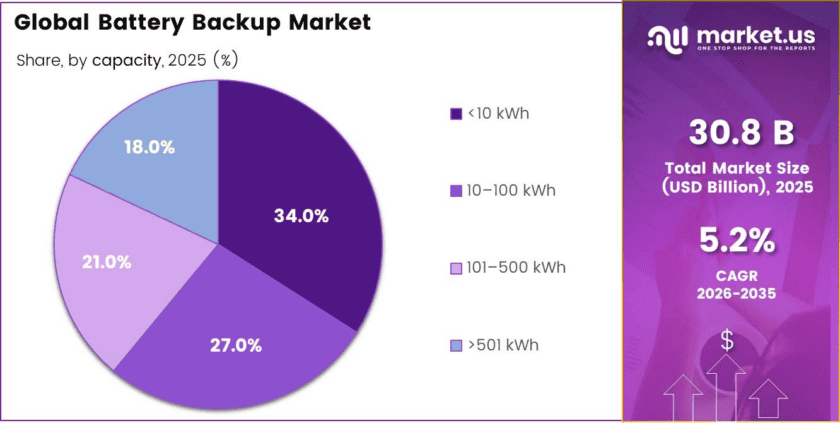
- The <10 kWh capacity segment led with a 34.0% market share.
- Commercial applications led the end-user segment with a 24.0% share.
- OEM/direct sales accounted for a leading 35.0% share among sales channels.
- North America remained the leading region with 34.0% of global consumption in 2025.
- Global battery storage installations reached 108 GW in 2025, representing 40% growth from 2024.
- Lithium-iron-phosphate chemistry represented around 90% of deployments, while 80% of new capacity was utility-scale.
- Global data-centre electricity demand increased 17% in 2025, compared with 3% growth in total electricity demand.
- Five major technology companies invested more than $400 billion in capital expenditure in 2025.
Battery Type Analysis
Lithium-Ion (Li-Ion) Battery Backup represents the dominant segment in the market. Lithium-ion batteries held the leading position with a 53.50% share, supported by their compact structure, quick charging capability and high energy density. These characteristics make them suitable for data centres, telecommunications facilities and commercial backup systems. In June 2026, the U.S. Geological Survey identified nearly 1.43 million metric tons of lithium oxide resources in the southern Appalachian region, potentially sufficient for around 1 million grid-scale batteries. This expanding resource base could strengthen future battery availability and support wider backup deployment.
Lead-acid batteries remain an important segment because of their affordable cost, dependable performance and established recycling network. Under European battery rules, lead-acid batteries must achieve 75% recycling efficiency by the end of 2025. The required recovery rate for lead increases to 90% by 2027 and 95% by 2031, as outlined in the EU Batteries Regulation, Regulation (EU) 2023/1542. These progressive recovery targets support closed-loop material use and help maintain demand across emergency lighting, telecommunications backup and industrial standby systems.
Capacity Analysis
The below 10 kWh segment held the leading position with a 34.00% market share. Compact systems are widely used for household backup, small offices, security equipment and rooftop solar storage because they require less space and are easier to install. The UK government’s 2026 Warm Homes modelling uses a 4 kWh battery as a typical residential installation. The plan provides £15 billion in public investment and aims to upgrade up to 5 million homes with technologies including solar panels and batteries, creating a strong base for smaller backup systems.
The above 501 kWh segment is the growing category, supported by utility, industrial and renewable-energy projects requiring extended backup. In June 2026, Ofgem proposed investment support for 7.6 GW across 16 long-duration storage projects, representing 137 GWh of planned capacity. These projects can increase demand for high-capacity systems capable of balancing renewable generation, reducing grid pressure and maintaining power during prolonged disruptions.
End User Analysis
Commercial applications led the battery backup market with a 24.0% share. Offices, retail facilities, hospitals, warehouses and educational buildings increasingly require backup power to maintain lighting, security, communications and digital operations during outages. The U.S. Energy Information Administration identified approximately 5.9 million commercial buildings covering 96.4 billion square feet and consuming nearly 6.8 quadrillion British thermal units of energy. This extensive building base supports demand for compact UPS units, distributed batteries and building-level energy storage.
Data centres represent the growing application as artificial intelligence and cloud computing increase electricity requirements. The U.S. Department of Energy reported that data centres consumed 4.4% of U.S. electricity in 2023, equal to approximately 176 TWh. Consumption could rise to between 6.7% and 12% by 2028, strengthening demand for high-capacity battery backup, microgrids and rapid-response power systems.
Sales Channel Analysis
OEM/direct sales led the battery backup market with a 35.00% share. This channel remains important because data centres, factories, utilities and telecommunications operators often require customised systems, technical installation and long-term maintenance directly from manufacturers. In March 2026, the U.S. Department of Energy announced up to USD 500 million for battery-material processing, component manufacturing and recycling facilities. The program entered its third funding round and covered three project areas, supporting domestic production and direct supplier relationships.
Online retail is the growing channel as households and small businesses increasingly compare capacities, prices and installation features digitally. The U.S. Census Bureau reported retail e-commerce sales of USD 326.7 billion in the first quarter of 2026, increasing 9.8% from the previous year and 2.7% from the preceding quarter. This digital momentum supports wider online availability of portable UPS units and compact residential backup batteries.
Emerging Trends
Utility-Scale Storage Buildout Sets the Foundation for Backup Capacity
The United States battery storage fleet is expanding at a pace that is reshaping how the grid handles backup power. According to the U.S. Energy Information Administration (EIA), operators added 8.3 gigawatts (GW) of new battery storage capacity during the first six months of 2026, pushing the nation’s total nameplate battery storage capacity to nearly 52 GW. This growth builds on a broader pattern of expansion, with utility-scale battery storage having grown at an average annual rate of 70% over the past three years. For a B2B buyer evaluating the backup power landscape, this scale of deployment signals that battery-based backup is no longer a niche technology but a mainstream grid asset being built at record speed.
Grid Reliability Concerns Are Accelerating Backup Power Demand
A key driver behind the emerging battery backup trend is growing concern over grid reliability itself. The U.S. Department of Energy (DOE), in its July 7, 2025 Report on Evaluating U.S. Grid Reliability and Security, warned that under current generation retirement schedules, annual outage hours could rise from single digits today to more than 800 hours per year, a risk increase of up to 100 times by 2030. The report attributes this strain partly to 104 GW of firm generation capacity set to retire without adequate firm replacement. These findings are pushing utilities, businesses, and households alike to treat battery backup systems as essential infrastructure rather than optional insurance against rare outages.
Residential Battery Backup Adoption Reaches a Record Share of Solar Installations
At the residential level, battery backup is becoming a standard companion to rooftop solar rather than an add-on. The Solar Energy Industries Association (SEIA) reported that in the first quarter of 2026, a record 45% of new residential solar installations were paired with battery energy storage, up from earlier levels, as the United States surpassed 6 million cumulative solar installations and solar plus storage together accounted for 91% of all new electricity-generating capacity added to the grid in that quarter. This trend reflects homeowners’ growing preference for backup protection during outages alongside the traditional bill-savings motivation for going solar.
AI-Driven Data Center Growth Is Elevating the Stakes for Critical Backup Power
The rise of artificial intelligence is intensifying the need for resilient backup power at the infrastructure level. The International Energy Agency (IEA) reports that global electricity demand from data centres grew by 17% in 2025, while consumption from AI-focused data centres surged even faster, climbing 50% in the same year. Capital expenditure by the largest technology companies exceeded USD 400 billion in 2025 and is expected to jump by a further 75% in 2026. As data centre operators race to keep pace with this growth, uninterrupted power protection, including battery backup systems, is becoming a critical safeguard against costly downtime in an increasingly power-constrained environment.
Use Cases
Telecommunications Networks Rely on Battery Backup to Keep 911 Service Alive
Telecommunications infrastructure represents one of the most regulated and mission-critical use cases for battery backup. The Federal Communications Commission (FCC) requires providers of facilities-based, fixed residential voice services that are not line-powered to offer subscribers at least one option for 24 hours of standby backup power for customer premises equipment. This requirement, issued under Docket No. 14-174, became mandatory as of February 13, 2019, giving providers a firm compliance deadline to ensure subscribers could maintain access to 911 service during extended commercial power outages. This regulatory mandate illustrates how battery backup has become a compliance necessity, not just an operational preference, for any B2B provider in the connectivity space.
Hospitals and Healthcare Facilities Depend on Extended Battery and Generator Backup
Healthcare delivery is another sector where battery backup use cases carry life-and-safety weight. Under the Centers for Medicare & Medicaid Services (CMS) Emergency Preparedness Rule, codified at 42 CFR 482.15, all Medicare-certified hospitals must maintain a fuel reserve sufficient to run emergency generators for 96 continuous hours. This requirement, enforced through routine surveys and annual testing exercises, ensures that operating rooms, ventilators, refrigerated medications, and other life-sustaining equipment remain functional through extended grid outages. For B2B suppliers serving the healthcare vertical, this translates into sustained demand for backup power systems engineered for multi-day resilience rather than short-duration ride-through capability.
Storm-Driven Outages Are Pushing Homes and Businesses Toward Backup Power Adoption
Severe weather events have made battery backup an increasingly common use case for both residential and commercial customers. According to a report cited by Utility Dive, U.S. electricity customers experienced an average of 11 hours of power outages in 2024, nearly twice the annual average of the previous decade, with hurricanes accounting for 80% of those lost hours. Hurricane Helene alone left 5.9 million customers without power across 10 states in September 2024, including 1.2 million in South Carolina, while Hurricane Milton left 3.4 million customers in Florida without power the following month. These recurring, large-scale outage events are a direct driver behind rising interest in battery backup systems among homeowners and commercial property operators seeking to maintain continuity during extended weather-related disruptions.
Disaster-Prone Regions Use Battery Backup to Protect Critical Community Infrastructure
In disaster-prone territories, battery backup use cases extend beyond individual buildings to entire community systems. The U.S. government announced $325 million in federal funding for solar and battery storage installations across Puerto Rico, an island of 3.2 million people with a poverty rate exceeding 40%, where chronic power outages have repeatedly endangered residents who depend on medical equipment such as oxygen concentrators, refrigerated insulin, and dialysis machines. The program, funded by the U.S. Department of Energy, is specifically targeted at community centers, healthcare facilities, and common areas in subsidized multi-family housing, underscoring how battery backup is being deployed as essential infrastructure for the most vulnerable populations rather than a discretionary upgrade.
Conclusion
The battery backup market sits at the intersection of two powerful forces: a grid under mounting stress and a technology maturing fast enough to meet that stress. Utility-scale storage capacity has already crossed 52 GW in the United States, while residential battery attachment rates on new solar installations reached a record 45% in early 2026, showing that backup power has moved from a niche purchase to a mainstream expectation. At the same time, federal agencies have flagged real reliability risks, from the Department of Energy’s warning of outage hours climbing toward 800 per year by 2030, to hospitals and telecom networks operating under strict regulatory mandates for extended backup runtime. For B2B buyers, integrators, and investors, this combination of policy pressure, climate-driven outage frequency, and falling technology costs points to sustained, durable demand across residential, commercial, healthcare, telecom, and disaster-response segments. Battery backup is no longer simply a resilience add-on; it is fast becoming core infrastructure across the energy value chain, and stakeholders who position early are likely to capture the greatest share of this expanding opportunity.
Frequently Asked Questions on Battery Backup
What is battery backup, and why is it becoming so important?
Battery backup refers to systems that store electricity and automatically supply power during grid outages. It has become important because severe weather, aging infrastructure, and rising electricity demand from data centers and electrification are making outages more frequent, pushing homes, hospitals, and businesses to seek reliable backup solutions.
How big is the battery backup market today?
The U.S. utility-scale battery storage fleet reached nearly 52 GW of nameplate capacity by mid-2026, growing at roughly 70% annually over the past three years, according to the U.S. Energy Information Administration, reflecting rapid expansion across both grid-scale and residential backup applications.
Who are the main users of battery backup systems?
Battery backup is used by homeowners pairing systems with rooftop solar, hospitals required to maintain emergency power for 96 hours under federal rules, telecom carriers meeting FCC backup power mandates, and disaster-prone regions like Puerto Rico deploying solar-plus-storage microgrids for critical facilities.
Why are residential battery backup systems growing so quickly?
Homeowners increasingly pair solar with batteries to protect against outages and maximize self-consumption. A record 45% of new U.S. residential solar installations included battery storage in early 2026, up sharply from prior years, driven by both resilience needs and changing utility billing structures.
What role does government regulation play in battery backup adoption?
Regulation plays a significant role. The FCC mandates backup power options for telecom subscribers, while CMS requires hospitals to maintain generator fuel reserves for 96 continuous hours. These rules create steady, compliance-driven demand for battery backup systems across regulated industries.
Is grid reliability really getting worse, or is this overstated?
Government data supports the concern. The Department of Energy has warned that annual outage hours could rise significantly by 2030 if generation retirements outpace new firm capacity, while 2024 hurricane data already showed customers experiencing the most outage hours in a decade.
How is artificial intelligence affecting battery backup demand?
AI-driven data center growth is increasing electricity demand sharply, with global data center electricity use rising 17% in 2025 and AI-focused facilities growing even faster. This is pushing operators to prioritize uninterrupted power protection, including battery backup, to avoid costly downtime.
What industries offer the biggest opportunities for battery backup suppliers?
Healthcare, telecommunications, residential solar, and disaster-response infrastructure all represent strong opportunities, given regulatory mandates, recurring severe weather impacts, and growing consumer preference for energy resilience alongside traditional cost-saving motivations for adopting solar and storage systems.
Discuss your needs with our analyst
Please share your requirements with more details so our analyst can check if they can solve your problem(s)