Overview
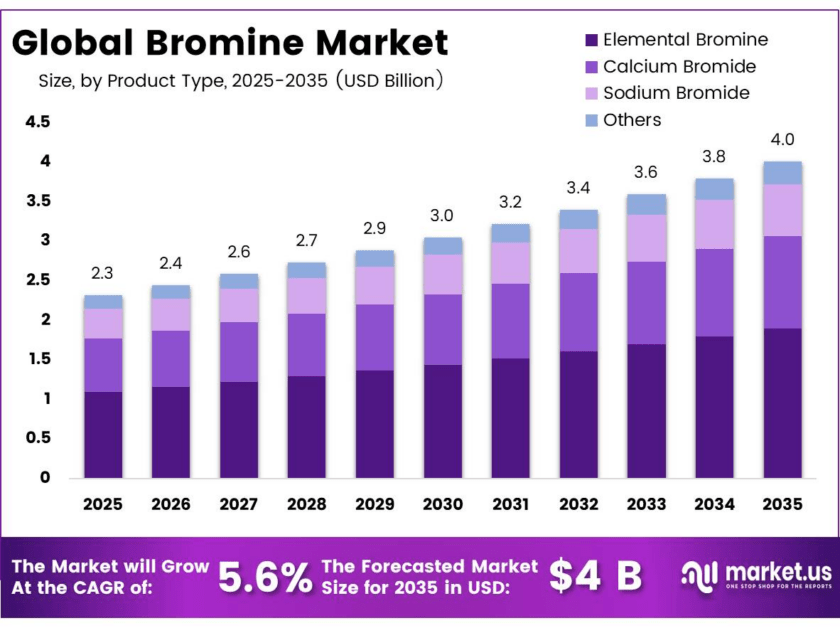
In 2025, the Global Bromine Market was valued at USD 2.3 billion and is projected to reach approximately USD 4 billion by 2035, registering a CAGR of 5.6% during 2026 to 2035. In 2025, Europe led the market, accounting for more than a 42.7% share and generating USD 0.99 Billion in revenue. The global Bromine Market is expected to expand from approximately US$2.3 billion to US$4.0 billion, driven by steady demand from the electronics, construction, oil and gas drilling, and power generation industries. Brominated Flame Retardants (BFRs) continue to represent the largest application segment and are extensively used in electronic devices, printed circuit boards, cables, insulation materials, and building components. The continued growth of electronics manufacturing worldwide is further strengthening market demand.
According to the UN Global E-waste Monitor 2024, global e-waste totaled 62 million metric tons in 2022 and is projected to increase to 82 million metric tons by 2030, reflecting the rising production and consumption of electronic products requiring flame-retardant materials. The construction industry also remains a significant demand contributor, particularly in Europe, where it employs around 15 million people and contributes nearly 10% of the region’s GDP. Supported by stringent fire-safety regulations, bromine-based flame retardants continue to be widely used in insulation, wiring, and construction materials. Reflecting sustained industrial demand, global bromine production increased from about 400,000 metric tons in 2024 to nearly 430,000 metric tons in 2025.
Market Size
- The global Bromine market was valued at USD 2.3 billion in 2025.
- The global Bromine market is projected to grow at a CAGR of 5.6% and is estimated to reach USD 4 billion by 2035.
- On the basis of product type, Elemental Bromine dominated the market, constituting 47.3% of the total market share.
- Based on the form, the liquid Bromine dominated the Bromine market, with a substantial market share of around 81.9%.
- Among the end-uses, the Chemical industry held a major share in the Bromine market, 31.8% of the market share.
- In 2025, the Asia Pacific was the most dominant region in the Bromine market, accounting for 42.7% of the total global consumption.
Product Type Analysis
Elemental Bromine Dominates the Global Market
Elemental Bromine accounted for 47.3% of the global Bromine Market by product type, maintaining its leading position due to its role as the primary raw material used to produce nearly all downstream bromine derivatives. Its strong market presence is driven by extensive demand for Brominated Flame Retardants (BFRs), clear brine drilling fluids, water treatment chemicals, and a wide range of industrial intermediates.
According to the USGS Mineral Commodity Summaries 2026, brominated flame retardants and clear brine fluids remain the largest end-use applications for bromine globally. Worldwide bromine production reached approximately 440,000 metric tons in 2024, with Israel contributing about 190,000 metric tons, making it the world’s largest producer. Trade data further highlights the importance of elemental bromine, as U.S. imports of bromine and bromine compounds totaled 58,300 metric tons in 2024, the highest volume recorded during the past five years. Through mid-2025, Israel supplied around 89% of U.S. bromine imports, reflecting the industry’s dependence on a limited number of major suppliers.
According to the U.S. Energy Information Administration (EIA), U.S. crude oil production averaged a record 13.4 million barrels per day in 2024 and increased to 13.6 million barrels per day in 2025. The number of active producing wells reached 918,481, while production from the Permian Basin climbed to 6.6 million barrels per day. These developments have significantly increased demand for bromide-based completion fluids, with calcium bromide solutions, typically supplied at 52% concentration, remaining the preferred choice for high-pressure and high-temperature drilling environments.
Form Analysis
Liquid Bromine Leads the Form Segment
Liquid Bromine represented 81.9% of the global Bromine Market, making it the dominant form segment. Its leadership is supported by bromine’s unique characteristic as the only non-metallic element that exists as a liquid at room temperature, making it highly suitable for industrial processing, transportation, and numerous end-use applications. The extensive use of liquid bromine derivatives continues to strengthen this segment.
In 2024, global bromine production reached approximately 440,000 metric tons, led by Israel (190,000 MT), Jordan (112,000 MT), and China (100,000 MT). During the same year, U.S. imports of bromine and bromine compounds totaled 58,300 metric tons, with liquid bromide solutions accounting for the majority of traded volumes. Their ease of handling, efficient processing, and widespread industrial use are expected to sustain the segment’s leadership.
End User Analysis
Chemical Industry Holds the Largest Market Share
The Chemical industry accounted for approximately 31.8% of global bromine consumption, making it the largest end-user segment. Its leading position is driven by bromine’s essential role as a key raw material used in numerous industrial and specialty chemical manufacturing processes.
According to the U.S. Geological Survey (USGS), major bromine applications include Brominated Flame Retardants (BFRs), clear brine fluids, industrial intermediates, and water treatment chemicals. Global bromine production increased from about 395,000 metric tons in 2023 to 400,000 metric tons in 2024, reflecting steady demand growth. Bromine is extensively used to manufacture flame retardants such as Tetrabromobisphenol-A (TBBPA) and Decabromodiphenyl Oxide, which are widely used in electronics, construction materials, textiles, and printed circuit boards.
According to the American Chemistry Council (ACC), global chemical production volumes increased by 3.5% in 2024 and are projected to grow by another 3.1% in 2025. As global chemical manufacturing continues to expand, bromine remains an indispensable feedstock for a broad portfolio of industrial and specialty chemical products.
Bromine Emerging Trends
The U.S. bromine industry is contracting on the trade side even as global demand for its downstream compounds holds firm. According to the U.S. Geological Survey, estimated U.S. imports of bromine and bromine compounds fell by about 30% in 2025 compared with 2024, with Israel supplying 89% of gross-weight imports through July and Jordan supplying 6%. The agency also confirms that the United States, Israel, China, and Jordan remain the world’s leading producers, underscoring how concentrated global bromine supply still is around a handful of brine sources. That concentration is visible in Jordan, where the government is actively expanding capacity rather than defending market share passively. Jordanian officials confirmed in 2026 that the Jordan Bromine Company’s expansion is valued at $800 million, part of a broader $2 billion package of chemical-sector investment alongside the Arab Potash Company.
The company’s general manager also disclosed that Jordan Bromine ranks as the world’s second-largest bromine producer, having exported 230,000 tons to more than 34 countries in 2025. Pricing dynamics shifted sharply in early 2026, driven largely by a supply disruption rather than a demand shock. Albemarle’s first-quarter 2026 results attributed an improved Specialties outlook to higher-than-expected bromine pricing in Chinese and Indian spot markets, while confirming that its Jordan Bromine Company joint venture had fully recovered from a flooding event in late December 2025. The same release pointed to continued volume growth concentrated in semiconductors, oil and gas, flame retardants, and pharmaceuticals, even as automotive and petrochemical demand softened. Regulatory pressure on the largest end use, flame retardants, continues to build in Europe.
The European Chemicals Agency reported in December 2024 that non-polymeric additive aromatic brominated flame retardants pose the highest environmental risks among the group due to their tendency to leach from finished materials, a finding that feeds directly into the European Commission’s decision on whether to mandate a formal EU-wide restriction dossier. This keeps regulatory uncertainty embedded in long-term demand planning for brominated flame retardant chemistry even as near-term pricing tightens.
Bromine: Use Cases
In oil and gas, bromine’s largest volume application remains high-density clear brine completion fluids. ICL Industrial Products describes calcium bromide brine as a pale yellow, highly concentrated salt solution typically supplied at 40% to 52% by weight, used to control wellbore pressure during drilling and completion without the formation damage associated with solids-based muds. Its ability to double as a dehydrating agent in natural gas and crude oil production adds a second industrial use case within the same operation. Water treatment is a second core application, particularly for pools and spas operating outside the pH range where chlorine performs best.
The Pool & Hot Tub Alliance notes that in the recommended swimming-pool pH range of 7.2 to 7.8, hypobromous acid (HOBr) formation remains above 90%, and even at a pH of 8.0 it stays at 83%, compared with just 23% hypochlorous acid formation from chlorine at the same pH. This stability under pH drift is why bromine dominates spa and hot tub sanitizing, where heat and usage patterns push pH upward more often than in standard pools. Agriculture remains a legacy use case, though a shrinking one under international environmental law.
The U.S. EPA confirms that methyl bromide is still injected roughly two feet into the ground as a soil fumigant ahead of planting for a range of crops, and that despite plastic tarping immediately after treatment, 50% to 95% of the applied methyl bromide eventually escapes into the atmosphere. This volatilization rate is the underlying reason the compound remains tightly restricted to critical-use and quarantine exemptions under the Montreal Protocol rather than general agricultural use.
Pharmaceutical use of bromine compounds persists in veterinary medicine even as human use has faded. The FDA granted full approval on January 21, 2026 to KBroVet, a potassium bromide chewable tablet, for controlling seizures in dogs with idiopathic epilepsy, a condition the agency notes affects about 5% of the canine population. The approval formalizes decades of off-label veterinary use of potassium bromide and follows the drug’s initial conditional approval in January 2021.
Bromine: Frequently Asked Questions
Why did bromine import volumes fall in the U.S. even as prices rose elsewhere?
U.S. apparent consumption softened while spot prices in China and India climbed, reflecting a market where U.S. demand cooled at the same time supply-side disruptions in Jordan tightened availability from the country’s leading exporters.
Why is Jordan investing so heavily in new bromine capacity right now?
As the world’s second-largest producer, Jordan is capitalizing on Dead Sea brine reserves and an established 25-year partnership between Albemarle and the Arab Potash Company to lock in export share, backing the move with an $800 million expansion tied to a wider $2 billion chemicals investment push.
Is bromine’s role in flame retardants at risk?
Not immediately, but it’s under active review. ECHA’s finding that non-polymeric additive aromatic brominated flame retardants carry the highest environmental risk within their category is feeding into a Commission decision on whether to formally restrict them, which would affect electronics, construction, and textile applications over time.
Why does bromine dominate spa and hot tub sanitizing specifically, rather than general pool use?
Its hypobromous acid form stays effective even as pH drifts upward toward 8.0, where it still forms at 83%, while chlorine’s equivalent compound drops to just 23% under the same conditions — a gap that matters more in hot tubs, where heat pushes pH up faster than in standard pools.
Does agricultural use of bromine still matter to overall demand?
It’s a shrinking piece of the picture. With 50% to 95% of applied methyl bromide volatilizing into the atmosphere per EPA data, the compound remains confined to narrow critical-use and quarantine exemptions rather than broad crop protection, in contrast to bromine’s growing footprint in oil and gas, semiconductors, and pharmaceuticals.
Discuss your needs with our analyst
Please share your requirements with more details so our analyst can check if they can solve your problem(s)