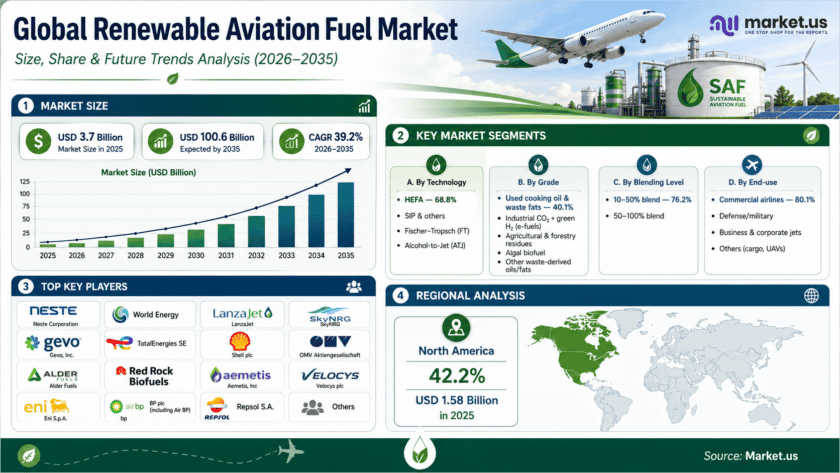
New York, NY – July 29, 2026 – In 2025, the Global Renewable Aviation Fuel Market was valued at USD 3.7 billion and is projected to grow at a CAGR of 39.2% from 2026 to 2035, reaching approximately USD 100.6 billion by 2035. North America dominated the market in 2025, accounting for more than 42.2% share with revenue of USD 1.58 billion. Renewable aviation fuel, also known as sustainable aviation fuel (SAF), is produced from waste oils, agricultural residues, municipal waste, renewable biomass, or synthetic processes using renewable hydrogen and captured carbon.
The demand for SAF is increasing as aviation contributes around 2% of global human-caused carbon dioxide emissions. According to IATA, global SAF production reached 1.9 million tonnes in 2025, representing 0.6% of jet fuel consumption, and is expected to rise to 2.4 million tonnes in 2026. However, higher production costs remain a challenge, with SAF adding nearly USD 3.6 billion to airline fuel expenses in 2025 due to prices exceeding conventional jet fuel costs.
Government policies are strengthening market adoption. The European Union introduced a 2% SAF blending requirement in 2025, increasing toward 70% by 2050, while the United Kingdom implemented a 2% mandate in 2025, targeting 10% by 2030 and 22% by 2040. EASA reported that 193 kilotonnes of SAF supplied during its assessment achieved around 91% lifecycle emissions reduction and avoided approximately 714 kilotonnes of carbon dioxide equivalent emissions.
Investment support is accelerating production capacity. In January 2025, the U.S. Department of Energy completed a USD 1.67 billion loan guarantee for Montana Renewables to expand renewable fuel production. Future opportunities are expected in advanced biofuels, power-to-liquid technologies, renewable hydrogen, carbon capture, and dedicated SAF refining facilities, with IATA estimating that nearly 500 million tonnes of annual SAF supply could be required by 2050.
Key Takeaways
- The global Renewable Aviation Fuel market was valued at USD 3.7 billion in 2025.
- The global market is projected to grow at a CAGR of 39.20% and is estimated to reach USD 100.6 billion by 2035.
- On the basis of Technology, the By HEFA dominated the market, constituting 68.8% of the total market share.
- Based on the grade, the Used cooking oil & waste fats dominated the Renewable Aviation Fuel market, with a substantial market share of around 40.1%.
- Based on the Blending Level, 10–50% blend led the market, comprising 76.2% of the total market.
- Among the end-uses, the Commercial airlines held a major share in the Renewable Aviation Fuel market, 80.1% of the market share.
- In 2025, the North America was the most dominant region in the Renewable Aviation Fuel market, accounting for 42.2% of the total global consumption.
➤ For a deeper understanding, click on the sample report link: https://market.us/report/renewable-aviation-fuel-market/request-sample/
Report Scope
| Market Value (2024) | USD 3.7 Billion |
| Forecast Revenue (2034) | USD 100.6 Billion |
| CAGR (2025-2034) | 39.20% |
| Segments Covered | By Technology (HEFA, Fischer–Tropsch (FT), Alcohol‑to‑Jet (ATJ) and SIP & others), By Grade (Used cooking oil & waste fats, Agricultural & forestry residues, Algal biofuel, Industrial CO₂ + green H₂ (e‑fuels) and Other waste‑derived oils/fats), By Blending Level (10–50% blend and 50–100% blend), By End-use (Commercial airlines, Defense/military, Business & corporate jets and Others (cargo, UAVs)) |
| Competitive Landscape | Neste Corporation, World Energy, LanzaJet, SkyNRG, Gevo, Inc., TotalEnergies SE, Shell plc, OMV Aktiengesellschaft, Alder Fuels, Red Rock Biofuels, Aemetis, Inc, Velocys plc, Eni S.p.A., BP plc (including Air BP), Repsol S.A., Others. |
Key Market Segments
Technology Analysis
HEFA dominates the renewable aviation fuel technology segment with a 68.8% market share in 2025.
Hydroprocessed Esters and Fatty Acids (HEFA) remained the preferred renewable aviation fuel pathway due to its commercial maturity, well-established lipid feedstock supply chain, and compatibility with existing refinery infrastructure. The U.S. Energy Information Administration reported that domestic SAF production capacity, primarily based on HEFA technology, reached nearly 30,000 barrels per day in 2025. U.S. other biofuels production also increased from 33,000 barrels per day in January to 44,000 barrels per day in February 2025, supported by growing SAF demand. Alcohol-to-Jet (ATJ) is emerging as the fastest-growing pathway as producers focus on ethanol and cellulosic feedstocks. UK government analysis projects ATJ production costs to decline from £5,016 per tonne in 2025 to £2,627 per tonne by 2030 and £2,384 per tonne by 2040, improving its long-term commercial potential.
Grade Analysis
Used cooking oil and waste fats lead the renewable aviation fuel feedstock segment with a 40.1% market share in 2025.
Used cooking oil and waste fats continue to represent the major feedstock source due to their availability, established collection systems, and proven performance in HEFA-based SAF production. According to EASA’s 2025 technical assessment, used cooking oil accounted for 81.1% of SAF supplied within the European Union, while 69% of the feedstock was sourced from outside the region. These SAF volumes generated lifecycle emissions savings of approximately 714 kilotonnes of CO₂ equivalent. However, limited availability and increasing concerns regarding feedstock traceability are encouraging producers to explore alternative sources. Industrial carbon dioxide combined with renewable hydrogen is the fastest-growing feedstock pathway, supported by the development of synthetic eSAF projects. In December 2025, the European Commission reported that more than 40 eSAF projects were progressing toward final investment decisions, supported by collaboration among eight European countries to accelerate production and purchasing.
Blending Level Analysis
The 10–50% blending level segment dominated the renewable aviation fuel market with a 76.2% share in 2025.
The 10–50% SAF blending range remains the most widely adopted level due to existing certification approvals, compatibility with current aircraft engines, and minimal modifications required for airport fuel infrastructure. Airlines can integrate these blends through existing storage facilities, pipelines, and fuel distribution networks, supporting faster adoption. The U.S. Department of Energy recognizes seven approved SAF production pathways, while airport fuel systems commonly maintain storage capacity equivalent to 4–6 days of operational demand. The 50–100% blending segment is expected to experience faster growth as aviation companies evaluate higher SAF usage to reduce fossil fuel dependence. NASA tested four SAF fuel configurations across eight engine-thrust conditions and conducted more than 560 minutes of emissions analysis, reporting reduced soot emissions across the tested operating range.
End Use Analysis
Commercial airlines dominate the renewable aviation fuel market with an 80.1% share in 2025.
Commercial aviation remains the largest consumer of renewable aviation fuel due to increasing decarbonization commitments, regulatory requirements, and airline sustainability programmes. The implementation of ICAO’s Carbon Offsetting and Reduction Scheme for International Aviation (CORSIA) has further encouraged airlines to adopt eligible SAF solutions to reduce emissions obligations. Defense and military aviation represents the fastest-growing end-use segment as governments focus on energy security, operational resilience, and reduced dependence on conventional fuels. The U.S. Department of Defense has identified climate change as a strategic challenge and established a long-term objective to achieve net-zero greenhouse gas emissions across its operations by 2050, supporting increased interest in renewable aviation fuel applications.
List of Segments
By Technology
- HEFA
- SIP & others
- Fischer–Tropsch (FT)
- Alcohol‑to‑Jet (ATJ)
By Grade
- Used cooking oil & waste fats
- Industrial CO₂ + green H₂ (e‑fuels)
- Agricultural & forestry residues
- Algal biofuel
- Other waste‑derived oils/fats
By Blending Level
- 10–50% blend
- 50–100% blend
By End-use
- Commercial airlines
- Defense/military
- Business & corporate jets
- Others (cargo, UAVs)
Regional Analysis
North America dominates the Global Renewable Aviation Fuel Market with a 42.2% share in 2025.
North America maintained its leading position due to increasing SAF production capacity, supportive government incentives, strong airport infrastructure, and rising airline adoption. According to the U.S. Department of Energy, SAF consumption in the country increased from 26.3 million gallons in 2023 to 111.86 million gallons in 2024, highlighting strong growth in commercial usage. The ability to integrate SAF with existing aircraft and airport refuelling systems further supports market expansion without requiring major infrastructure changes.
Top Use Cases
1. Commercial Passenger Airlines: Renewable aviation fuel is primarily used by commercial airlines to reduce carbon emissions while continuing to operate existing aircraft fleets. SAF is a drop-in fuel, meaning it can be blended with conventional jet fuel and used without major changes to aircraft engines, airport storage systems, or refuelling infrastructure. According to IATA, SAF could contribute up to 65% of the emissions reductions required for aviation to achieve net-zero carbon emissions by 2050. SAF production reached approximately 1.9 million tonnes in 2025, representing around 0.6% of total jet fuel consumption, showing early adoption among global airlines.
2. Long-Haul and International Aviation: Long-distance flights are one of the strongest application areas for renewable aviation fuel because alternative technologies such as battery-electric systems are currently unsuitable for large commercial aircraft. Airlines use SAF to lower lifecycle emissions on international routes while meeting environmental regulations. The European Union’s ReFuelEU Aviation regulation established a requirement for 2% SAF usage in 2025, creating a structured demand base for international aviation operators. EASA reported that 193 kilotonnes of SAF supplied in the EU avoided around 714 kilotonnes of CO₂ emissions during its assessment period.
3. Cargo and Freight Aviation: Air cargo operators are adopting renewable aviation fuel to reduce the environmental impact of freight transportation. Cargo aircraft operate long-distance routes with high fuel consumption, making SAF an important solution for reducing logistics-related emissions. The ability to use SAF within existing aviation fuel systems allows cargo companies to adopt cleaner fuels without replacing aircraft fleets. As global SAF supply expands, freight operators are expected to increase usage through long-term fuel purchasing agreements with producers. IATA estimates that aviation will require around 500 million tonnes of SAF annually by 2050 to support the industry’s net-zero pathway.
4. Corporate Aviation and Private Jets: Business aviation is increasingly using renewable aviation fuel to achieve sustainability targets and reduce operational emissions. Private aircraft operators can integrate SAF through existing airport fuel networks because certified SAF blends work with current aircraft technologies. The segment is supported by corporate commitments toward lower carbon operations, especially among companies with environmental reporting requirements. SAF typically provides lifecycle carbon reductions of approximately 80% compared with conventional aviation fuel, depending on the feedstock and production pathway.
5. Military and Defense Aviation: Defense organizations are exploring renewable aviation fuel to improve energy security, reduce dependence on petroleum-based fuels, and support long-term climate objectives. Military aircraft require high-performance liquid fuels, making SAF-based solutions attractive because they maintain similar energy characteristics to conventional aviation fuel. Governments are investing in alternative fuel testing and certification programmes to ensure operational reliability under demanding conditions. The U.S. Department of Defense has established a goal of achieving net-zero greenhouse gas emissions across its operations by 2050, supporting future demand for renewable fuels.
Conclusion
The renewable aviation fuel market is entering a critical growth phase as airlines, governments, and fuel producers focus on reducing aviation-related carbon emissions. SAF has become one of the most practical solutions for aviation decarbonization because it can be used with existing aircraft engines and airport fuel infrastructure. According to IATA, global SAF production increased to approximately 1.9 million tonnes in 2025, representing around 0.6% of total jet fuel consumption, and is expected to reach 2.4 million tonnes in 2026.
Discuss your needs with our analyst
Please share your requirements with more details so our analyst can check if they can solve your problem(s)