Overview
New York, NY – Sep 16, 2026 – The global Liquid Feed Supplements Market is developing as livestock producers seek practical ways to deliver energy, protein, minerals, vitamins, and functional ingredients through easily handled liquid formulations. The market was valued at USD 22.3 billion in 2025 and is projected to reach USD 38.0 billion by 2035, expanding at a 5.5% CAGR from 2026 to 2035. Liquid supplements are particularly important in cattle production because they can complement forage, support consistent nutrient intake, and simplify bulk feeding across commercial operations.
The industry is supported by the scale of modern animal agriculture. In July 2026, the United States had 94.2 million cattle and calves, including 28.5 million beef cows, 9.65 million milk cows, and 13.2 million cattle on feed. Globally, FAO reported in 2025 that commercial livestock feed production totals around 1 billion tonnes annually and generates about USD 400 billion in commercial turnover. Molasses, protein ingredients, minerals, urea, and other co-products remain important formulation inputs. Future development is expected to focus on precision nutrition, automated liquid delivery, circular feed ingredients, improved traceability, and functional formulations designed to support productivity and environmental efficiency across beef, dairy, and other livestock systems worldwide.
Key Takeaways
- The global Liquid Feed Supplements Market was valued at USD 22.3 billion in 2025 and is projected to reach approximately USD 38.0 billion by 2035, growing at a 5.5% CAGR.
- Protein supplements dominated the market in 2025, accounting for more than a 42.00% share, supported by commercial beef and dairy nutrition requirements.
- Molasses held more than a 38.00% share by source because of its energy value, palatability, fluid characteristics, and established use in liquid feed formulations.
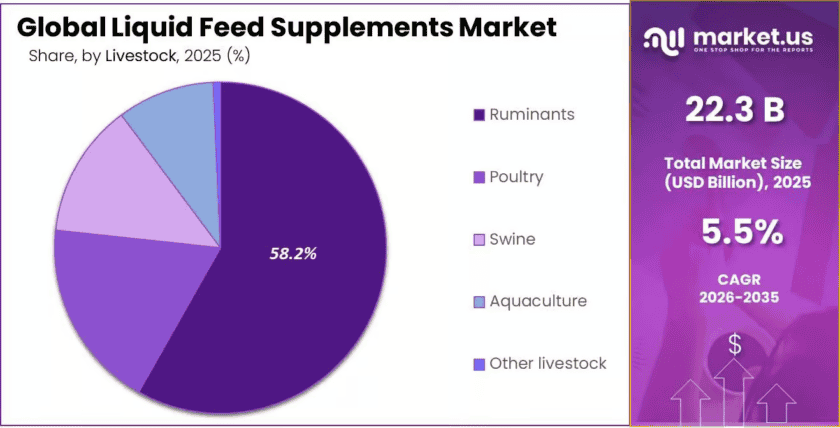
- Ruminants remained the leading livestock category, capturing more than a 58.20% share, supported by large cattle and dairy populations.
- Direct sales accounted for more than a 52.30% share, reflecting bulk purchasing by commercial livestock farms, feedlots, and integrated producers.
- North America dominated the regional market with more than a 35.00% share, generating approximately USD 7.8 billion in 2025.
Regional Analysis
North America held a dominant position in the Liquid Feed Supplements Market in 2025, capturing more than a 35.00% share and generating approximately USD 7.8 billion. The region benefits from large commercial beef and dairy operations, established feed infrastructure, bulk supplementation systems, and widespread use of protein, mineral, and energy supplements.
The livestock base remains substantial. USDA reported 94.2 million cattle and calves in the United States in July 2026, including 28.5 million beef cows, 9.65 million milk cows, and 13.2 million cattle on feed. Cattle-on-feed inventory was 2% higher than a year earlier. In Europe, industrial compound-feed production is forecast at approximately 152 million tonnes in 2026, including 45.358 million tonnes of cattle feed. This established nutrition infrastructure also creates opportunities for liquid energy, protein, mineral, and functional supplementation.
Market Dynamics
Driver – Large Commercial Livestock Population Supports Supplement Demand
Large commercial cattle and dairy populations are a major driver for liquid feed supplements because producers need dependable ways to supply protein, energy, minerals, and vitamins when forage quality changes. USDA reported 94.2 million U.S. cattle and calves in July 2026, including 13.2 million cattle on feed and 9.65 million milk cows. Milk production reached 232 billion pounds in 2025, with average output of 24,390 pounds per cow. Higher-output animals require carefully balanced nutrition, while liquid delivery can simplify supplementation across large herds. This supports steady demand from feedlots, dairy farms, and extensive beef operations.
Trend – Greater Use of Co-products and Circular Feed Ingredients
Circular feed ingredients and flexible formulations are becoming more important in liquid supplementation. The American Feed Industry Association reports that U.S. livestock, poultry, and aquaculture consume nearly 284 million tons of feed annually, while about 37% of ingredients, excluding harvested forage and roughage, are co-products from other industries. Liquid systems can accommodate suitable soluble and fluid by-products and distribute them consistently with minerals, energy, and protein sources. FAO also reported in 2025 that global commercial livestock feed production is around 1 billion tonnes annually. This scale encourages manufacturers to improve blending, traceability, storage, and automated delivery technology.
Restraint – Changing Feed Ingredient and Forage Costs
Feed ingredient and forage-price volatility can limit purchasing decisions for liquid supplements, particularly when livestock margins are under pressure. USDA Dairy Margin Coverage data show that during 2025 corn prices ranged from USD 3.93 to USD 4.64 per bushel, premium alfalfa hay ranged from USD 211 to USD 277 per ton, and soybean meal ranged from USD 259.10 to USD 330.87 per ton. These movements change protein and energy supplementation economics from month to month. Producers may reformulate rations, reduce discretionary additives, or delay purchases, requiring liquid-feed suppliers to offer flexible formulations and tighter cost control.
Opportunity – Precision Nutrition and Functional Feed Delivery
Precision nutrition and environmental feed strategies create an important development opportunity for liquid feed suppliers. A European Commission Joint Research Centre review found that an average 3-NOP dose of about 120 mg per kilogram of dry-matter intake reduced methane formation by around 39% in dairy cattle and 22% in beef cattle. Liquid delivery systems may provide a practical route for accurately distributing approved functional ingredients where formulation stability, regulation, and animal safety requirements are satisfied. Growth opportunities also exist in automated dispensing, remote tank monitoring, intake control, and customized mineral-protein blends that help commercial farms manage nutrition more consistently.
Emerging Trends
- Circular feed formulations: Feed manufacturers are increasingly using co-products to reduce waste and raw-material dependence. Around 37% of U.S. animal-feed ingredients, excluding forage and roughage, come from co-products, supporting further development of liquid formulations using suitable soluble processing streams.
- Automated supplementation: Large feedlots are creating demand for more controlled delivery systems. USDA reported 13.2 million cattle on feed in July 2026, up 2% year over year, supporting automated tanks, pumps, intake monitoring, and scheduled liquid supplementation.
- Methane-focused nutrition: Environmental performance is becoming part of feed innovation. European Commission research found approximately 39% methane reduction in dairy cattle and 22% in beef cattle from an average 120 mg/kg dry-matter dose of 3-NOP.
- Molasses-based energy delivery: Molasses remains important because it provides energy while supporting mixing and palatability. USDA technical information states that finished liquid supplements can contain molasses levels as high as 70% by weight, on a solids basis.
- Greater feed traceability: FAO reported in 2025 that commercial livestock feed production totals about 1 billion tonnes annually and supports more than 250,000 skilled workers. The scale is increasing attention on ingredient safety, traceability, contamination management, and consistent formulation.
Use Cases
- Beef cattle supplementation: Liquid supplements can supply protein, energy, and minerals when pasture or forage does not fully meet requirements. The United States had 28.5 million beef cows in July 2026, creating a large commercial base for seasonal supplementation.
- Feedlot nutrition: Liquid products can be mixed into feedlot rations to deliver nutrients consistently across large groups. USDA recorded 13.2 million cattle on feed in July 2026, with inventory rising 2% from the previous year.
- Dairy herd feeding: Liquid supplements can complement forage and concentrate diets for high-producing dairy animals. U.S. milk production reached 232 billion pounds in 2025, while average production increased to 24,390 pounds per cow, supporting precise nutrition requirements.
- Low-quality forage supplementation: Molasses-urea liquids provide additional nitrogen and energy when cattle consume poorer forage. USDA Agricultural Research Service trials using 0.91 kg per day of molasses-urea supplement recorded improvements in forage intake and fiber digestion.
- Co-product utilization: Liquid feeding provides an outlet for suitable processing co-products that might otherwise be wasted. U.S. livestock, poultry, and aquaculture consume nearly 284 million tons of feed annually, with around 37% of non-forage ingredients coming from co-products.
Frequently Asked Questions on Liquid Feed Supplements
What are Liquid Feed Supplements?
Liquid feed supplements are fluid animal-nutrition products containing combinations of energy, protein, minerals, vitamins, fats, urea, molasses, or functional ingredients. They are mainly used to complement forage and conventional feed while simplifying bulk nutrient delivery.
How large is the Liquid Feed Supplements Market?
The global Liquid Feed Supplements Market was valued at approximately USD 22.3 billion in 2025 and is expected to reach about USD 38.0 billion by 2035, expanding at a 5.5% CAGR.
Which type dominates the Liquid Feed Supplements Market?
Protein-based liquid feed supplements held the dominant position in 2025, accounting for more than a 42.00% share. Their use is supported by the protein requirements of commercial beef and dairy cattle, particularly when forage quality is inadequate.
Why is molasses widely used in liquid feed supplements?
Molasses provides rapidly available energy, improves palatability, and works naturally as a liquid carrier for nutrients. USDA technical information notes that some finished liquid feed supplements can contain up to 70% molasses on a solids basis.
Which livestock segment uses the most liquid feed supplements?
Ruminants held more than a 58.20% market share in 2025. Cattle benefit from liquid protein, energy, and mineral supplementation because forage nutrient content can vary considerably by season, location, and stage of production.
Why are liquid supplements useful for cattle?
Liquid supplements allow energy, protein, minerals, and other nutrients to be distributed consistently. They can complement lower-quality forage and are convenient for large operations where bulk tanks and controlled delivery systems reduce repeated manual feeding requirements.
Which region leads the Liquid Feed Supplements Market?
North America led the market in 2025 with more than a 35.00% share, valued at around USD 7.8 billion. Its position is supported by large beef, dairy, feedlot, and commercial animal-feed industries.
What factors could support future market growth?
Growth is expected to come from precision livestock nutrition, automated dispensing, sustainable co-product use, functional feed ingredients, digital tank monitoring, and demand for efficient feeding. Environmental nutrition and improved traceability may also create new opportunities for liquid formulations.
Conclusion
The Liquid Feed Supplements Market is expected to remain an important part of commercial livestock nutrition as producers focus on efficient nutrient delivery, forage supplementation, and consistent animal performance. Valued at USD 22.3 billion in 2025, the market is projected to reach USD 38.0 billion by 2035, expanding at a 5.5% CAGR. Large cattle populations, higher dairy productivity, increased use of co-products, and advances in precision feeding are supporting demand. Future development is likely to center on automated dispensing, functional ingredients, feed traceability, environmental performance, and flexible formulations that allow producers to respond more effectively to changing feed costs and nutritional requirements.
Discuss your needs with our analyst
Please share your requirements with more details so our analyst can check if they can solve your problem(s)