Report Overview
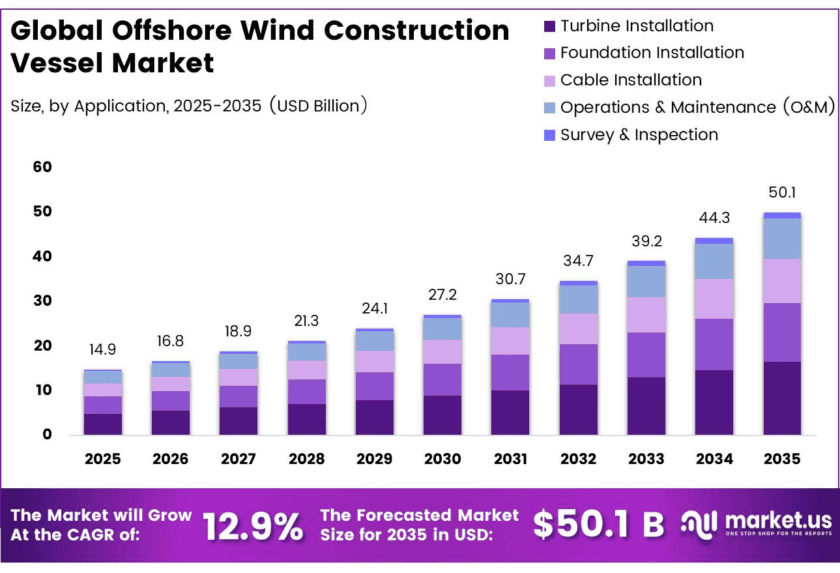
In 2025, the Offshore Wind Construction Vessel Market was valued at USD 14.9 billion. The market is expected to expand at a CAGR of 12.9% between 2026 and 2035, reaching approximately USD 50.1 billion by 2035. During 2025, Europe held the leading position in the global market, accounting for more than 42.3% of the total market share and generating approximately USD 6.3 billion in revenue.
The growth of the offshore wind construction vessel market is strongly supported by the rapid worldwide expansion of offshore wind energy projects. Every additional gigawatt of offshore wind capacity creates long-term demand for specialized marine fleets, including Wind Turbine Installation Vessels (WTIVs), Cable-Laying Vessels, and Service Operation Vessels (SOVs) required for installation, maintenance, and operational support.
According to the International Renewable Energy Agency (IRENA), global offshore wind capacity increased significantly from 3.1 GW in 2010 to 82.9 GW in 2024. Under IRENA’s Net Zero Scenario, offshore wind capacity is projected to expand further to at least 2,000 GW by 2050.
Government initiatives and offshore wind development policies are further strengthening the market outlook. The European Commission has set a target of 300 GW by 2050, while nine North Sea countries agreed in 2026 to jointly develop up to 100 GW of cross-border offshore wind capacity. In 2024, global offshore wind installations added 8 GW of new capacity, supported significantly by China with 6.9 GW and a 23% year-over-year increase in commissioning activity across IEA member countries.
Europe continues to represent the largest regional market for offshore construction vessels due to ongoing investments, established marine infrastructure, and strong government commitments. The updated EU Offshore Renewable Energy Strategy aims to achieve up to 89 GW of offshore wind capacity by 2030 and 366 GW by 2050. With WindEurope reporting 39 GW of installed capacity in 2025, Europe needs to expand its offshore wind infrastructure by more than eightfold to achieve mid-century targets, ensuring sustained demand for construction vessel services.
Other regions are also strengthening their offshore wind supply chains. In the United States, the Government Accountability Office (GAO) reported that by August 2025, 50 offshore wind vessels had been delivered or were under order, with nearly 80% meeting Jones Act requirements. Meanwhile, China continues to increase market demand through an integrated domestic supply chain supporting both large-scale onshore wind growth and its expanding offshore wind sector.
Key Market Segments
- The global Offshore Wind Construction Vessel market was valued at US$14.9 billion in 2025.
- The market is projected to grow at a CAGR of 12.9% and is estimated to reach US$50.1 billion by 2035.
- On the basis of Vessel type, Wind Turbine Installation Vessel (WTIV) dominated the Offshore Wind Construction Vessel market, constituting 28.1% of the total market share.
- Based on the Water Depth, the Shallow Water dominated the Offshore Wind Construction Vessel market, with a substantial market share of around 48.7%.
- Based on the material Application, Turbine Installation led the market, comprising 33.2% of the total market.
- In 2025, the Europe was the most dominant region in the Offshore Wind Construction Vessel market, accounting for 42.3% of the total global consumption.
Vessel Type Analysis
Wind Turbine Installation Vessel (WTIV) Represents the Dominant Segment in the Offshore Wind Construction Vessel Market
In 2025, Wind Turbine Installation Vessels (WTIVs) dominated the offshore wind construction vessel market, accounting for 28.1% of the total market share. The segment’s leadership is driven by the critical role WTIVs play in offshore wind turbine installation, as these specialized vessels are equipped with heavy-lift cranes, jack-up systems, and advanced marine technologies required to safely transport, position, and install large turbine components at sea.
According to the Global Wind Energy Council (GWEC), global offshore wind capacity reached 92.5 GW by the end of 2025 and is projected to expand to 420 GW by 2035, requiring nearly 327 GW of additional offshore wind capacity over the next decade. More than 50 GW of offshore wind projects are currently under construction globally, while annual installations are expected to double in 2026, triple by 2031, and surpass 50 GW annually by 2035. This expanding project pipeline is creating sustained demand for WTIVs. Demand for advanced installation vessels is further increasing as offshore wind turbines continue to grow in size and weight. In January 2026, China installed the world’s first 20 MW offshore wind turbine off Fujian Province, requiring next-generation WTIVs with greater lifting capacity than existing vessels. To address these requirements, DEME developed the Norse Wind WTIV, which can transport seven 15 MW turbine sets or five 20 MW+ turbine sets in a single voyage.
Additionally, WindEurope identified a shortage of WTIV availability across Europe during 2024–2025, with demand expected to exceed supply between 2028 and 2030, when approximately 5 to 9 WTIVs may be required simultaneously in the Baltic Sea. These factors are expected to maintain WTIVs as the leading vessel type throughout the forecast period.
Water Depth Analysis
Shallow Water Represents a Significant Water Depth Segment
The Shallow Water segment held a dominant position in the offshore wind construction vessel market, accounting for 48.7% of the total market share. The segment’s growth is supported by the high concentration of offshore wind projects located in waters below 60 meters, where fixed-bottom foundation technologies offer lower installation costs and established construction methods.
According to the Danish Energy Agency, nearly 50% of the North Sea has water depths below 60 meters, making it one of the most suitable regions for large-scale offshore wind development. By the end of 2024, more than 99% of the world’s 83.2 GW of installed offshore wind capacity was developed using fixed-bottom foundations, including monopiles, jackets, and gravity-base structures, which are primarily designed for shallow and transitional waters. China continues to strengthen the shallow-water segment through large-scale offshore wind development across the Yellow Sea, East China Sea, and Bohai Sea, where average water depths range between 10 and 35 meters. According to the China Wind Energy Association (CWEA) and the IEA Wind TCP 2024 Annual Report, China’s cumulative offshore wind capacity exceeded 40 GW by the end of 2024, with nearly all projects installed in shallow coastal waters using dedicated shallow-draft installation vessels. Furthermore, Rabobank projects that fixed-bottom foundations will remain the dominant offshore wind technology through at least 2030, as floating offshore wind continues to face higher levelized costs of electricity ranging between EUR 85–100/MWh compared with fixed-bottom systems. This trend is expected to support continued demand for shallow-water construction vessels.
The Deep Water segment represents another rapidly expanding opportunity within the Offshore Wind Construction Vessel Market. Governments worldwide are increasingly exploring deeper offshore areas to access stronger wind resources. According to the BOEM report, the United States Outer Continental Shelf includes nearly 15 million acres of leased offshore wind development areas, creating significant opportunities for deep-water and floating offshore wind projects.
Application Analysis
Turbine Installation Represents the Most Widely Used Application Segment
The Turbine Installation segment dominated the offshore wind construction vessel market, accounting for 33.2% of the total market share. The segment leads because every offshore wind project requires specialized vessels to transport, lift, and install turbines at sea, making turbine installation the most critical and vessel-intensive phase of offshore wind development.
According to the GWEC Global Wind Report 2026, the global wind industry installed a record 165 GW of new capacity in 2025, representing a 40% increase compared with the previous record year. Offshore wind contributed 9.3 GW, registering a 16% year-on-year increase. This growth has significantly increased demand for turbine installation vessels, as higher installation volumes directly translate into increased vessel operating requirements. Demand for turbine installation vessels is also being strengthened by the increasing size of offshore wind turbines. The GWEC OEM Market Share Report 2025 stated that the average offshore turbine capacity reached 10,312 kW (10.3 MW) in 2025, compared with approximately 7 MW five years earlier. The European Commission’s Joint Research Centre (JRC) reported that commercial offshore turbines now commonly exceed 14 MW, while prototype models have reached 15–18 MW with rotor diameters above 220 meters. These larger turbines require advanced installation vessels equipped with higher crane capacity, stronger lifting systems, and improved jack-up technologies. According to the American Clean Power Association (ACP), each offshore wind project requires at least 10 dedicated construction and commissioning vessels, with turbine installation vessels achieving the highest utilization rates.
The REN21 Global Status Report 2025 reported that 56.3 GW of offshore wind capacity was auctioned globally in 2024, ensuring strong long-term demand for turbine installation vessels throughout the 2030s. The Foundation Installation application segment is also expanding within the Offshore Wind Construction Vessel Market due to the increasing number and scale of offshore wind projects worldwide. According to the European Commission, the combined offshore wind capacity of the European Union reached approximately 21.6 GW by the end of 2025, supporting continued demand for foundation installation vessels and related marine construction services.
Emerging Trends
Fleet Expansion and Domestic Shipbuilding Momentum
The offshore wind construction vessel segment is undergoing a significant capacity build-out as U.S. shipyards respond to Jones Act requirements governing domestic-flag construction. According to the U.S. Government Accountability Office, fifty new offshore wind vessels have either been delivered, are under construction, or are on order at American shipyards, a pipeline capable of generating work across nearly 20 shipyards nationwide. The GAO’s review of three offshore wind projects found that 80% of vessels deployed were U.S.-flagged, with the remaining foreign-flagged vessels being larger, specialized units requiring proportionally similar mariner staffing despite their smaller share of the fleet. This dynamic illustrates a structural trend: domestic construction is scaling rapidly for coastal and shallow-water work, while large, purpose-built heavy-lift and installation vessels are still sourced internationally for the most complex components of offshore projects.
Global Capacity Growth Driving Long-Term Vessel Demand
The underlying demand base for offshore wind construction vessels continues to expand as global installed offshore wind capacity climbed to nearly 83 gigawatts in 2024, according to the International Renewable Energy Agency. IRENA reports that offshore wind installed costs fell 48% between 2010 and 2024, while the levelized cost of electricity for offshore projects declined 62% over the same period, reinforcing the sector’s long-term investment case. With offshore wind development potential identified across 115 countries, vessel operators are positioning for a multi-decade construction cycle rather than a short-term buildout, as national programs beyond Europe’s traditional strongholds begin to require dedicated installation and support vessel capacity.
European Construction Activity Slows, Signaling Near-Term Vessel Rebalancing
Despite long-term growth, near-term construction activity in Europe—the vessel market’s most mature region—has softened. WindEurope’s Annual Statistics Report shows that Europe connected only 2 gigawatts of new offshore wind capacity to the grid in 2025, the lowest annual figure recorded since 2016, with construction delays cited as a primary cause. Only three countries—the United Kingdom, Germany, and France—commissioned new offshore turbines during the year, bringing Europe’s cumulative installed offshore base to 38.6 gigawatts. This slowdown is creating a temporary imbalance between vessel supply entering the market and the pace of confirmed installation work, a pattern the industry expects to reverse as delayed projects resume construction in 2026.
Use Cases
Fixed-Bottom Commercial Wind Farm Installation
Fixed-bottom turbine installation remains the dominant application for offshore wind construction vessels, exemplified by the UK’s Dogger Bank wind farm, the world’s largest offshore wind project under construction. According to the official Dogger Bank Wind Farm project site, the 3.6 gigawatt facility is being built 130 kilometres off the North East coast of England, with the first of 277 GE Vernova Haliade-X turbines installed using Jan de Nul’s jack-up vessel Voltaire, which has a lifting capacity of 3,200 tonnes and is described as the largest offshore jack-up installation vessel of its kind in the world. Projects of this scale depend entirely on high-capacity jack-up vessels to place monopile foundations, towers, nacelles, and blades in sequence, with vessel availability and lifting capability directly determining project completion timelines. Source: https://doggerbank.com/construction/worlds-largest-offshore-wind-farm-produces-power-for-the-first-time/
Global Grid-Connection Activity Sustaining Vessel Charter Demand
Construction vessel demand is directly tied to the pace of new offshore wind capacity reaching commercial operation. The Global Wind Energy Council reports that 9.3 gigawatts of new offshore wind capacity was grid-connected worldwide in 2025, a 16% increase over the prior year and the third-highest annual total on record, lifting cumulative global installed capacity to 92.5 gigawatts. China accounted for the largest share of this activity, commissioning 6.6 gigawatts of new capacity and bringing its national total to 48.4 gigawatts. Each gigawatt of newly connected capacity represents sustained vessel operating days for turbine, foundation, and cable installation fleets, making grid-connection volumes one of the most direct indicators of near-term vessel utilization.
Next-Generation Turbine Lift Capacity Requirements
As turbines scale up, construction vessels are being deployed specifically to handle heavier and taller components. GWEC’s 2026 Global Offshore Wind Report data, as reported by offshoreWIND.biz, shows the average size of offshore wind turbines installed in 2025 exceeded 10 megawatts for the first time, reaching 10.3 MW. This upscaling directly drives use-case-specific vessel specifications, since larger turbines require greater crane lift height, heavier deck load capacity, and deeper jack-up leg penetration to install safely at sea. Vessel operators are consequently prioritizing newbuild construction vessels engineered around these next-generation lift requirements rather than retrofitting older tonnage.
Floating Wind Platform Construction and Deep-Water Deployment
A distinct and growing use case is construction vessel support for floating offshore wind platforms in deep-water sites unsuitable for fixed-bottom foundations. The U.S. Department of Energy’s Floating Offshore Wind Shot initiative targets a 70% reduction in floating offshore wind costs, to $45 per megawatt-hour, by 2035 for deep-water sites far from shore. The DOE notes that these floating structures will be among the largest ever constructed by humankind, requiring specialized heavy-lift and tow vessels for assembly, mooring installation, and offshore commissioning rather than the jack-up vessels used for fixed-bottom projects. This distinction is creating a separate vessel-demand category as floating wind moves from pilot to commercial scale.
Frequently Asked Questions
What is an offshore wind construction vessel?
An offshore wind construction vessel is a specialized ship used to transport, lift, and install turbines, foundations, and cables at sea. These include jack-up installation vessels, heavy-lift vessels, cable-layers, and service operation vessels supporting offshore wind farm construction and maintenance.
Why are these vessels important for the offshore wind industry?
These vessels are essential because turbines, monopiles, and substations cannot be installed at sea without stable, high-capacity lifting platforms. Without sufficient vessel availability, project timelines slip, charter rates rise, and entire offshore wind pipelines face delays or cancellations.
What is a jack-up vessel used for?
A jack-up vessel uses extendable legs to raise itself above the waterline, creating a stable platform unaffected by waves. This stability allows cranes to precisely lift and install heavy turbine components, foundations, and towers during offshore construction.
How is the offshore wind construction vessel market expected to grow?
The market is expected to grow steadily as global offshore wind capacity expansion continues and turbines increase in size. Rising installation volumes, deeper water projects, and floating wind development are pushing operators toward newer, higher-capacity vessels.
What is the difference between fixed-bottom and floating wind construction vessels?
Fixed-bottom projects use jack-up vessels anchored to the seabed for stability during installation. Floating wind requires different vessels entirely, including heavy-lift and towing vessels, since turbines are assembled onshore or nearshore before being towed and moored offshore.
Why is vessel size increasing over time?
Turbines are getting larger and heavier to improve energy output, requiring vessels with greater crane lift height, larger deck space, and stronger structural capacity. Older vessels often cannot handle next-generation turbines, driving demand for newly built, larger-capacity ships.
What role do cable-laying vessels play in offshore wind projects?
Cable-laying vessels install the subsea cables connecting turbines to offshore substations and onshore power grids. These specialized ships carry large cable reels and use precise positioning systems to bury or lay cables safely along the seabed route.
Are offshore wind construction vessels expensive to build?
Yes, these vessels require significant capital investment due to their specialized cranes, dynamic positioning systems, and reinforced hulls. High construction costs and long build times contribute to limited vessel supply relative to growing global project demand.
Which regions have the highest demand for these vessels?
Europe, China, and the United States currently drive the highest demand, given their large offshore wind pipelines. Emerging markets across Asia-Pacific are also increasing vessel demand as new offshore wind projects move from planning into construction phases.
What challenges does the vessel market currently face?
Key challenges include limited vessel availability, high newbuild costs, long construction lead times, and skilled labor shortages. Permitting delays and inconsistent project timelines also make it difficult for vessel operators to plan long-term fleet investments confidently.
Conclusion
The offshore wind construction vessel market sits at the intersection of rapid capacity growth and structural fleet renewal. Global installed offshore wind capacity reached 92.5 gigawatts by the end of 2025, with 9.3 gigawatts added during the year alone, a 16% increase over 2024, according to the Global Wind Energy Council.
In the United States, fifty new offshore wind vessels are delivered, under construction, or on order at domestic shipyards, per the U.S. Government Accountability Office, while average turbine size crossed 10.3 MW for the first time, pushing operators toward higher-capacity jack-up and heavy-lift newbuilds. Floating wind adds a further growth vector, with the U.S. Department of Energy targeting $45 per megawatt-hour by 2035. Sustained project pipelines, turbine upscaling, and deep-water expansion together point to durable, multi-decade vessel demand.
Discuss your needs with our analyst
Please share your requirements with more details so our analyst can check if they can solve your problem(s)