Market Overview
The global skin tightening products market reached USD 964.3 Million in 2025 and is projected to reach USD 2,915.7 Million by 2035. The market is expanding at a CAGR of 11.7% during 2026–2035. Strong demand for non-invasive skincare solutions continues to drive consistent global revenue growth.
Skin tightening products include creams, serums, and oils designed to improve firmness and reduce visible aging signs. Consumers use these products to boost collagen production and enhance skin elasticity. Dermatology-backed formulations now influence purchase decisions, especially among users seeking clinical-like results without undergoing medical procedures.
Data-Driven Insights for Smarter Business Decisions: Explore the Full Report
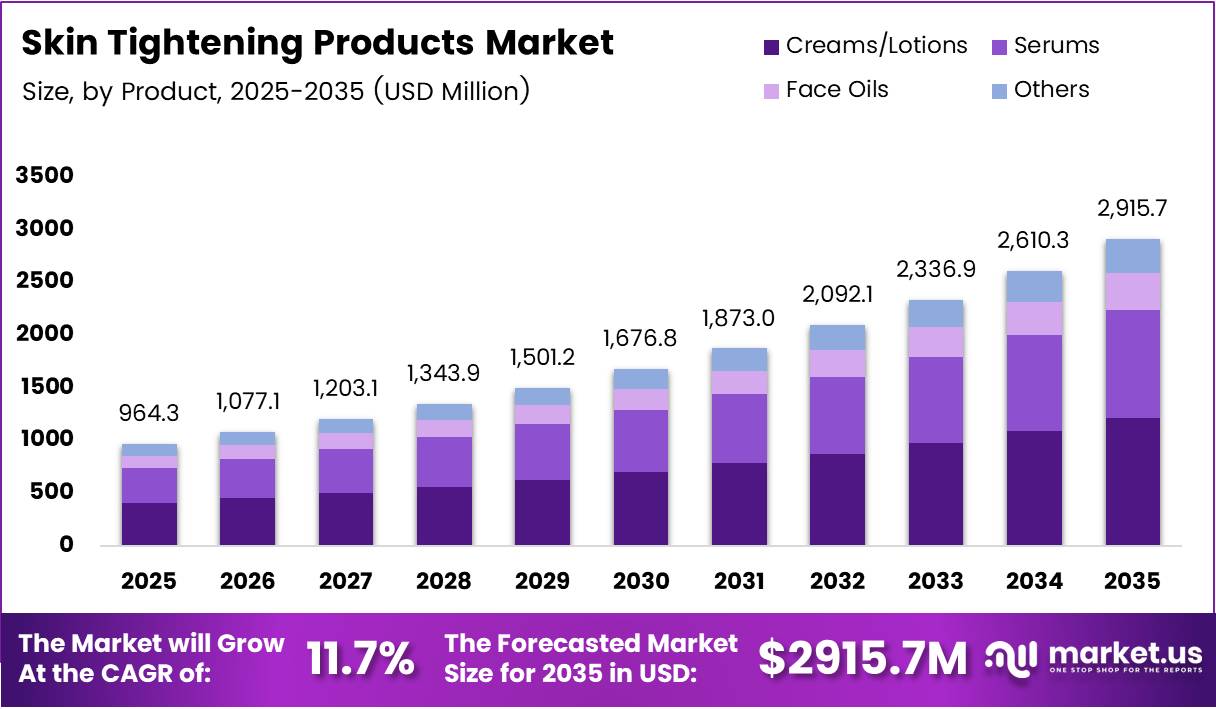
Cosmetics, dermatology, and personal care industries drive adoption across global markets. Beauty brands, clinics, and retail chains integrate these products into anti-aging and skincare routines. Consumers use them for facial contouring, wrinkle reduction, and skin hydration, especially in urban populations with rising disposable incomes.
Technology advancements improve product effectiveness and consumer trust. Manufacturers integrate peptide-based compounds, retinol, and AI-driven formulation techniques. Digital platforms also accelerate ingredient awareness, enabling faster product adoption. Consequently, brands respond quickly to trends, reducing product development cycles and improving innovation speed.
Regulatory frameworks support safe product development and market expansion. Governments enforce ingredient safety standards, labeling rules, and clinical validation requirements. These regulations improve consumer confidence and ensure product quality. Therefore, established brands benefit from compliance capabilities, strengthening their competitive position in global markets.
Clinical studies reinforce consumer expectations and influence product positioning. Research from PubMed shows 53.1% of patients reported over 50% improvement after treatments. This validates performance benchmarks and pushes brands to prove measurable outcomes. Additionally, studies showing 20–30% improvement levels shape realistic consumer expectations and marketing strategies.
Key Takeaways
- Market valued at USD 964.3 Million in 2025 and projected to reach USD 2,915.7 Million by 2035.
- Market expected to grow at a CAGR of 11.7% during 2026–2035.
- Creams/Lotions dominate product segment with 51.3% share due to ease of use.
- Face Lifting leads application segment with 71.2% share driven by demand for visible results.
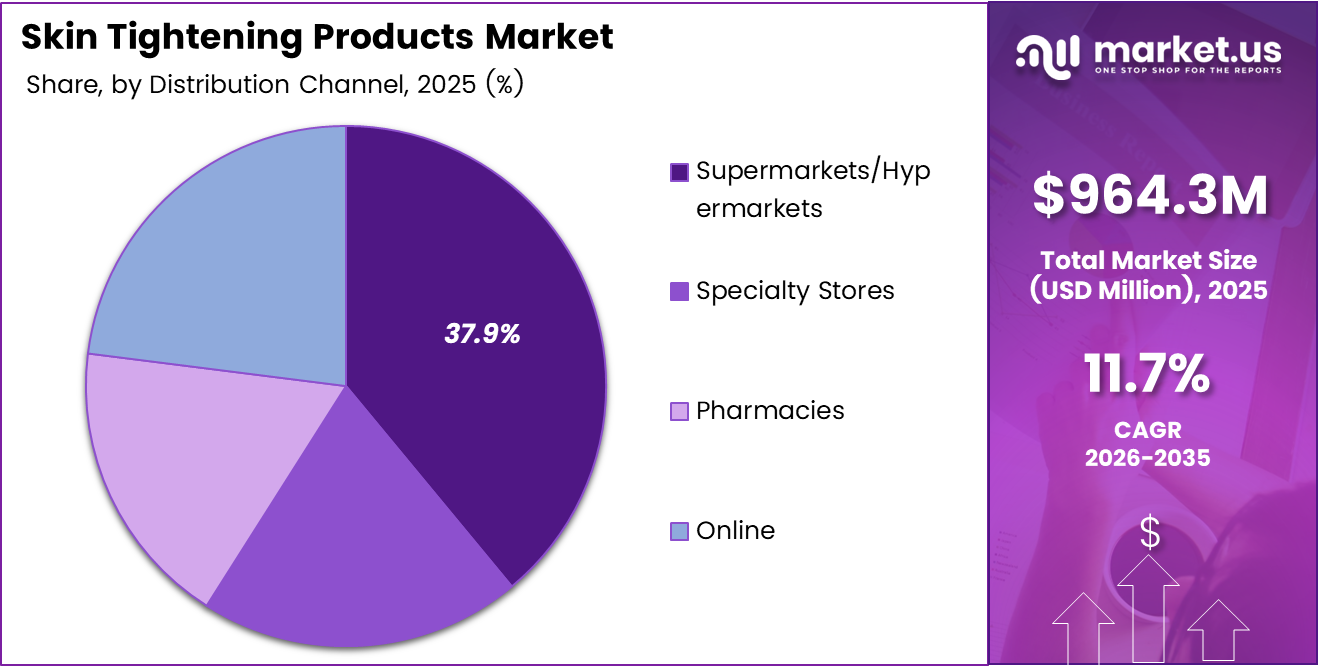
- Supermarkets/Hypermarkets lead distribution with 37.9% share due to accessibility.
- North America holds 34.80% share, valued at USD 335.5 Million in 2025.
Market Segmentation Overview
Creams and lotions lead the product segment with a 51.3% share. This dominance reflects consumer familiarity and ease of integration into daily routines. These products require no professional guidance, which drives higher adoption. Consequently, mass-market accessibility and affordability support consistent demand across global retail channels.
Face lifting dominates the application segment with a 71.2% share. Consumers prioritize visible facial contouring results, especially jawline and cheek definition. This demand drives repeat purchases and brand loyalty. Therefore, companies focus on targeted facial solutions to maintain competitive advantage and maximize revenue generation.
Supermarkets and hypermarkets lead distribution with a 37.9% share. High footfall and product visibility encourage impulse purchases. Additionally, these outlets provide broad reach for entry-level consumers. As a result, brands use this channel to scale volume while introducing new users to skin firming products.
Drivers
Rising aging populations drive strong demand for skin tightening solutions. Consumers increasingly prefer non-invasive alternatives over surgical procedures. This shift expands the customer base beyond traditional anti-aging users. Consequently, brands experience higher product volumes as more consumers adopt topical treatments as part of routine skincare.
Premium skincare spending accelerates market growth globally. Consumers invest in advanced formulations with clinically proven ingredients. This trend reflects growing awareness of product effectiveness. Therefore, manufacturers prioritize innovation and premium positioning to capture higher margins and strengthen brand differentiation.
Use Cases
Facial contouring represents a major use case across the beauty industry. Consumers use tightening creams and serums to enhance jawline definition and reduce sagging. This application delivers visible results, improving user satisfaction. Consequently, brands develop targeted formulations for facial lifting and sculpting benefits.
Anti-aging treatment remains another critical application area. Users apply products to reduce wrinkles and improve elasticity over time. This long-term use increases customer lifetime value. Additionally, early-stage users adopt these products as preventive care, expanding the total addressable market significantly.
Major Challenges
High regulatory compliance costs limit market entry for smaller brands. Companies must invest heavily in testing, certification, and claims validation. These requirements increase product development expenses. Therefore, only well-funded companies can scale effectively, creating a barrier for emerging players.
Consumer skepticism regarding product effectiveness affects repeat purchases. Users expect quick visible results, but biological changes require time. This mismatch reduces customer retention. Consequently, brands must invest in education and clinical evidence to manage expectations and maintain credibility.
Business Opportunities
Advanced formulations using peptides and retinol create strong growth opportunities. These ingredients improve product performance and align with clinical benchmarks. Brands leveraging scientific validation can charge premium prices. Therefore, innovation-driven companies can capture higher-value segments and expand profitability.
Emerging markets offer untapped growth potential due to rising middle-class income. Online channels enable easy market entry without physical infrastructure. This expansion lowers operational costs. Consequently, companies can scale globally while targeting new consumer segments across developing regions.
Regional Analysis
North America leads the market with a 34.80% share, valued at USD 335.5 Million in 2025. Strong consumer spending and dermatologist-backed products drive regional dominance. Additionally, premium pricing strategies sustain high revenue concentration, making the region a key contributor to global market growth.
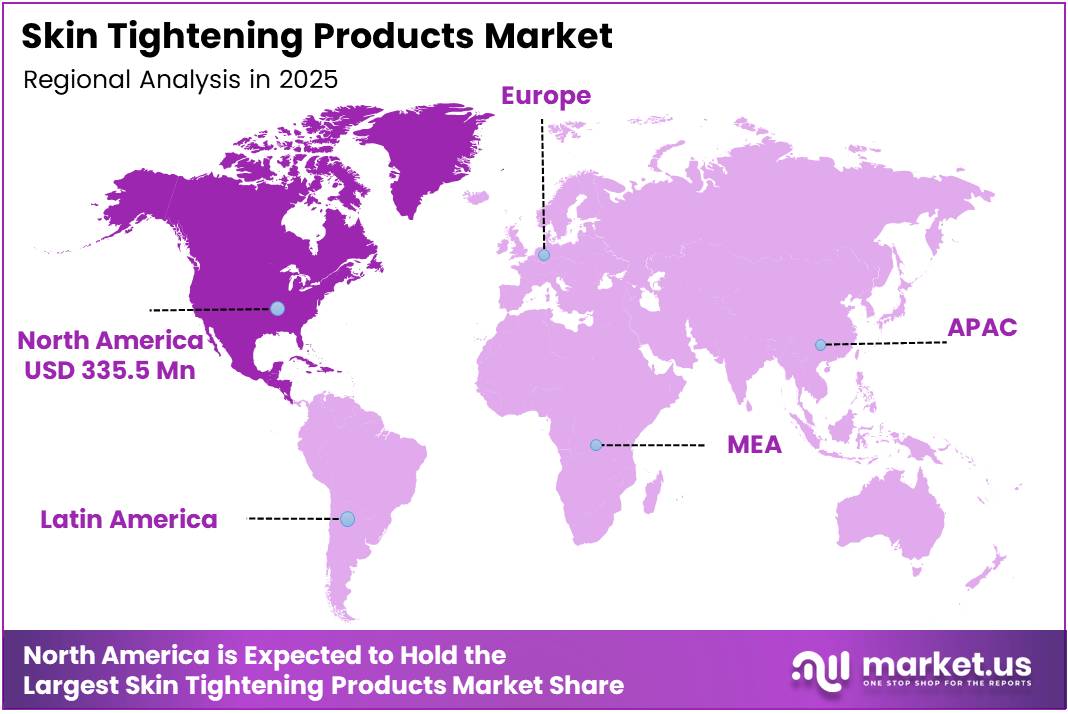
Asia Pacific represents the fastest-growing region due to rising beauty awareness and spending. Countries like China, Japan, and South Korea drive demand. Additionally, innovation in cosmeceuticals supports regional growth. Therefore, Asia Pacific is expected to become a major revenue generator during the forecast period.
Recent Developments
- September 2024 — Merz Aesthetics launched Ultherapy PRIME with 20% faster treatments, improving efficiency and user experience.
- March 2025 — ENDYMED merged with Shanghai Haohai to strengthen global supply chain and innovation capacity.
- August 2025 — Cynosure Lutronic received FDA clearance for XERF RF system enabling noninvasive tightening with zero downtime.
- November 2025 — Classys acquired JL Health for $13 million, expanding presence in Latin America.
Conclusion
The skin tightening products market shows strong growth driven by aging populations and demand for non-invasive solutions. Consumers increasingly prefer clinically effective skincare products. This shift supports sustained market expansion and encourages innovation across product categories.
Dominant segments such as creams and face lifting applications lead due to ease of use and visible results. North America maintains leadership with strong spending patterns. Meanwhile, Asia Pacific emerges as a high-growth region with expanding consumer demand and innovation capacity.
Companies must invest in clinical validation, advanced formulations, and digital engagement strategies to stay competitive. Expanding into emerging markets will unlock new revenue streams. The market is expected to reach USD 2,915.7 Million by 2035, creating significant long-term growth opportunities.
Looking for data tailored to your specific market, region, or business need? Request a custom report or consultation — write to us at sales@market.us
Discuss your needs with our analyst
Please share your requirements with more details so our analyst can check if they can solve your problem(s)