Market Overview
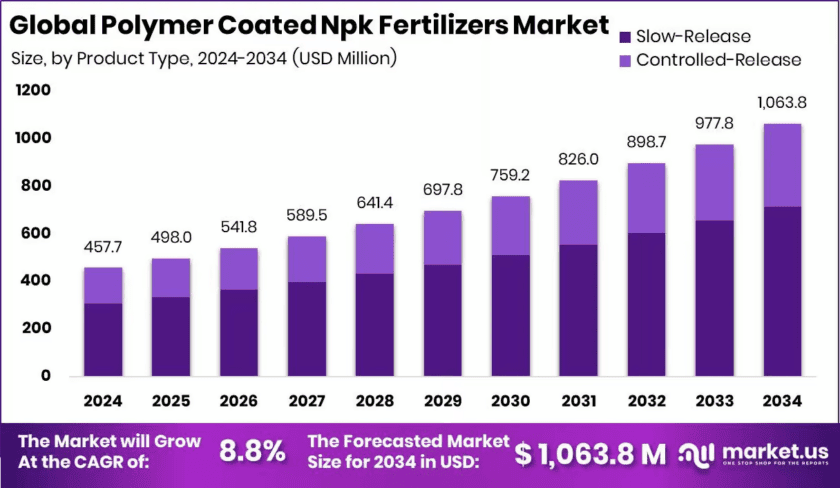
The Global Polymer Coated NPK Fertilizers Market shows strong growth potential. The sector will rise from 457.7 million USD in 2024 to 1,063.8 million USD by 2034. This expansion represents a compound annual growth rate of 8.8 percent from 2025 to 2034. Consequently, manufacturers see increasing demand for controlled-release solutions.
North America currently leads the global market with a 42.8 percent share. The region reached 195.5 million USD in 2024 alone. Therefore, North American farmers demonstrate a strong preference for advanced fertilizer technologies. Additionally, regulatory support for sustainable farming accelerates regional adoption rates.
Polymer-coated NPK fertilizers deliver nitrogen, phosphorus, and potassium through a protective polymer layer. This coating mechanism controls nutrient release over extended periods. Consequently, crops receive steady nutrition matching their natural growth cycles. Moreover, the technology significantly reduces nutrient loss from leaching and volatilization.
Traditional fertilizers often waste nutrients through rapid dissolution and runoff. Polymer-coated alternatives solve this inefficiency by timing release patterns. Therefore, farmers achieve higher nutrient uptake efficiency with less product. Additionally, environmental benefits include reduced groundwater contamination and lower greenhouse gas emissions from fertilizer breakdown.
Market growth depends on increasing global food production demands. According to agricultural experts, soil degradation threatens crop yields across major farming regions. Polymer-coated fertilizers help maintain soil health while boosting output. Consequently, both large agribusinesses and smallholders invest in these efficiency products.
Sustainable farming practices drive the shift toward controlled-release technologies. Precision agriculture techniques require precise nutrient timing for optimal results. Polymer-coated NPK fertilizers fit perfectly within these modern farming systems. Therefore, the market expects continued expansion throughout the forecast period.
Key Takeaways
- The Global Polymer Coated NPK Fertilizers Market will reach approximately 1,063.8 million USD by 2034 at a 8.8 percent CAGR between 2025 and 2034
- North America dominates with a 42.8 percent market share worth 195.5 million USD in 2024
- Polymer coating technology reduces nutrient losses through controlled release mechanisms
- Sustainable agriculture awareness drives adoption among farmers worldwide
- Precision farming techniques increase demand for timed-release fertilizer products
- Water-scarce regions present significant growth opportunities for market players
- Environmental regulations favor slow-release fertilizers over conventional options
➤ Download Exclusive Sample Of This Premium Report (Including Full TOC, Table & Figures)- https://market.us/report/polymer-coated-npk-fertilizers-market/request-sample/
Market Segmentation Overview
The market segments by nutrient composition, crop type, and application method. Standard NPK ratios dominate current product offerings in the industry. Manufacturers develop specialized blends for specific crop families and soil conditions. Consequently, farmers select products based on their unique growing environment requirements.
Controlled-release technology represents the largest product category within this market. This segment benefits from strong demand in high-value crop production. Moreover, polymer thickness and composition determine release duration from 30 to 180 days. Therefore, growers match product selection to their specific crop cycle length.
By crop type, cereals and grains account for the highest consumption volume. Row crops like corn, wheat, and rice benefit significantly from controlled nutrition. Additionally, fruits and vegetables represent a fast-growing segment for polymer-coated fertilizers. These high-value crops require precise nutrient timing for quality and yield optimization.
Application methods include broadcast spreading, banding, and fertigation integration. Polymer-coated products work effectively with modern precision application equipment. Consequently, farmers reduce total fertilizer usage while maintaining or improving yields. Additionally, specialty distributors focus exclusively on controlled-release product lines.
Drivers
Environmental regulations increasingly restrict conventional fertilizer usage across major agricultural regions. According to environmental agencies, nutrient runoff causes significant water pollution problems. Polymer-coated fertilizers reduce this runoff by controlling release timing. Therefore, regulators encourage farmers to adopt these environmentally friendly alternatives through subsidies and incentives.
Rising global food demand pushes farmers toward higher crop productivity per acre. According to the United Nations, food production must increase by 70 percent by 2050. Polymer-coated NPK fertilizers help achieve this target through improved nutrient efficiency. Consequently, agricultural ministries promote controlled-release technology adoption through educational programs and financial support.
Use Cases
Large-scale grain production benefits significantly from polymer-coated fertilizer application. Corn farmers in the Midwest United States apply these products at planting time. The controlled release matches corn’s nitrogen demand peaks during rapid growth stages. Consequently, growers achieve higher yields while reducing application frequency from three passes to a single application.
Greenhouse and nursery operations rely heavily on polymer-coated NPK fertilizers. These operations grow high-value plants in confined containers with limited soil volume. Controlled release prevents nutrient burn while ensuring consistent feeding throughout the growing season. Therefore, commercial nurseries achieve better plant uniformity and reduce labor costs associated with frequent liquid feeding.
Major Challenges
Higher product costs compared to conventional fertilizers limit adoption among price-sensitive farmers. Polymer-coated NPK fertilizers typically cost 20 to 50 percent more than standard alternatives. Many smallholder farmers cannot afford this premium despite long-term efficiency benefits. Consequently, market penetration remains concentrated in developed agricultural economies with stronger farm economics.
Limited farmer education about proper application methods reduces product effectiveness. Polymer-coated fertilizers require different handling compared to conventional products. Incorrect application timing or placement can waste the controlled-release benefits entirely. Therefore, manufacturers invest significantly in training programs and technical support for distributor networks.
Business Opportunities
Water-scarce agricultural regions present substantial growth opportunities for polymer-coated fertilizers. According to water management studies, irrigation efficiency directly affects nutrient availability. Controlled-release products maximize nutrient uptake even under limited water conditions. Therefore, companies targeting drought-prone regions can capture significant market share through specialized product development.
Organic farming expansion creates opportunities for bio-based polymer coating materials. Traditional polymer coatings use synthetic materials not approved for organic production. New biodegradable coating technologies from renewable sources meet organic certification standards. Consequently, manufacturers developing bio-polymer coatings can access the growing organic fertilizer market segment.
Regional Analysis
North America currently leads the global market with a 42.8 percent share. The region reached 195.5 million USD in 2024 alone. The United States and Canadian farmers invest heavily in efficiency technologies. Controlled-release fertilizer usage grew by 15 percent annually. Therefore, major manufacturers maintain regional production facilities and distribution networks across North America.
Asia-Pacific represents the fastest-growing regional market for polymer-coated NPK fertilizers. Countries like China and India face severe soil degradation and water scarcity issues. Government agricultural programs actively promote controlled-release technology adoption. Consequently, international manufacturers partner with local distributors to capture this expanding market opportunity.
Top Key Players in the Market
- Nutrien Ltd.
- Yara International ASA
- ICL Group Ltd.
- The Mosaic Company
- Kingenta Ecological Engineering Group Co., Ltd.
- Haifa Group
- Shandong Shikefeng Chemical Industry Co., Ltd.
- Compo Expert GmbH
- J.R. Simplot Company
- Helena Chemical Company
Conclusion
The global polymer-coated NPK fertilizers market demonstrates strong growth fundamentals through 2034. Increasing environmental regulations and food demand drive adoption across major agricultural regions. North America maintains market leadership while Asia-Pacific presents the fastest growth trajectory. Consequently, manufacturers continue expanding production capacity to meet rising global demand for controlled-release solutions.
Discuss your needs with our analyst
Please share your requirements with more details so our analyst can check if they can solve your problem(s)