Market Overview
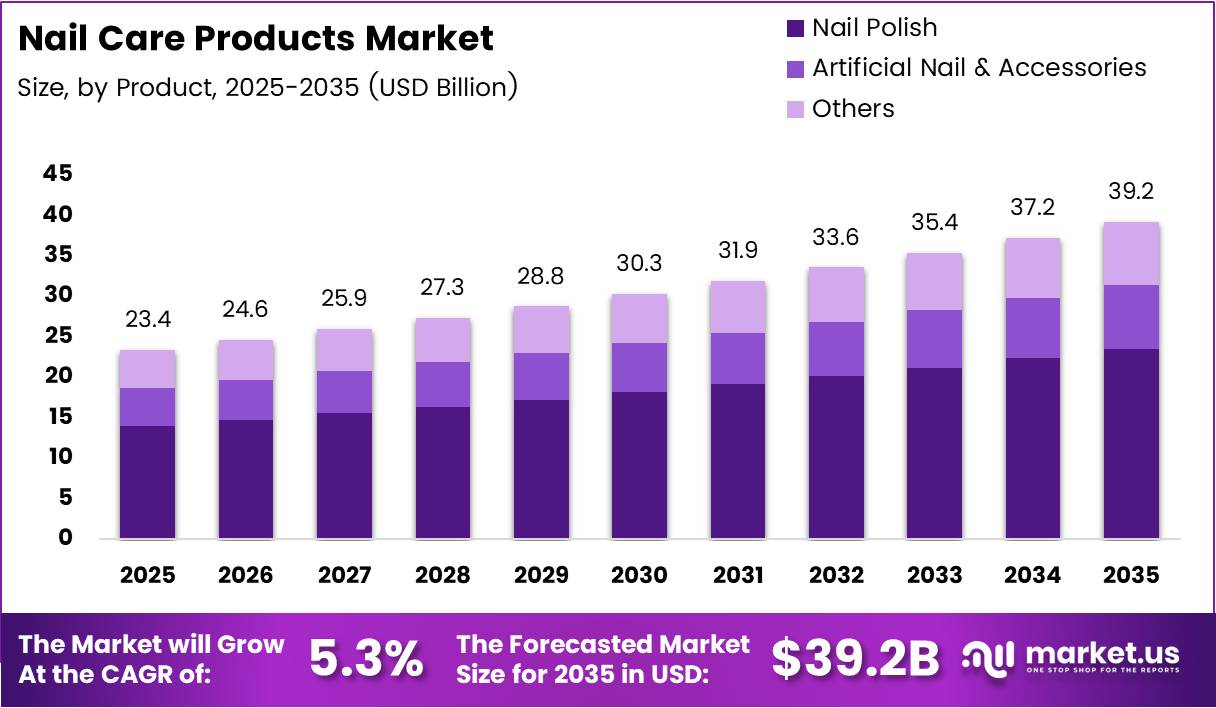
The global nail care products market reached USD 23.4 Billion in 2025 and is projected to hit USD 39.2 Billion by 2035. The market will grow at a CAGR of 5.3% during 2026–2035. This steady growth reflects rising consumer spending on beauty routines and frequent product usage across salon and home environments.
Nail care products include items like nail polish, artificial nails, treatments, and cuticle care solutions. Consumers use these products for grooming, styling, and nail health maintenance. Professional salons and individual users both rely on these products, which makes the category diverse and stable across multiple price points.
Data-Driven Insights for Smarter Business Decisions: Explore the Full Report
Beauty and personal care industries drive strong demand for nail products globally. Salons use these items daily for client services, while households adopt them for self-care routines. Fashion and social media industries also influence demand, as consumers follow nail trends and experiment with designs more frequently.
Technology improves product performance and user experience across this market. Brands integrate advanced formulations, gel systems, and LED curing devices into their offerings. AI-powered customization tools also help brands create personalized shades, which increases customer engagement and drives repeat purchases.
Regulatory frameworks support safer product development and sustainable manufacturing practices. Governments restrict harmful chemicals and promote eco-friendly formulations. These rules encourage brands to innovate with clean ingredients, which improves consumer trust and strengthens long-term market growth.
Industry data highlights strong sustainability progress and operational efficiency. Fiabila reports up to 86% natural origin ingredients, which reflects rising demand for clean products. Additionally, 68% of solvents are reused in manufacturing, which lowers costs and improves ESG performance, supporting long-term competitiveness.
Key Takeaways
- Market valued at USD 23.4 Billion in 2025 and expected to reach USD 39.2 Billion by 2035.
- Market growing at a CAGR of 5.3% during 2026–2035.
- Nail Polish leads product segment with 58.3% share due to universal usage.
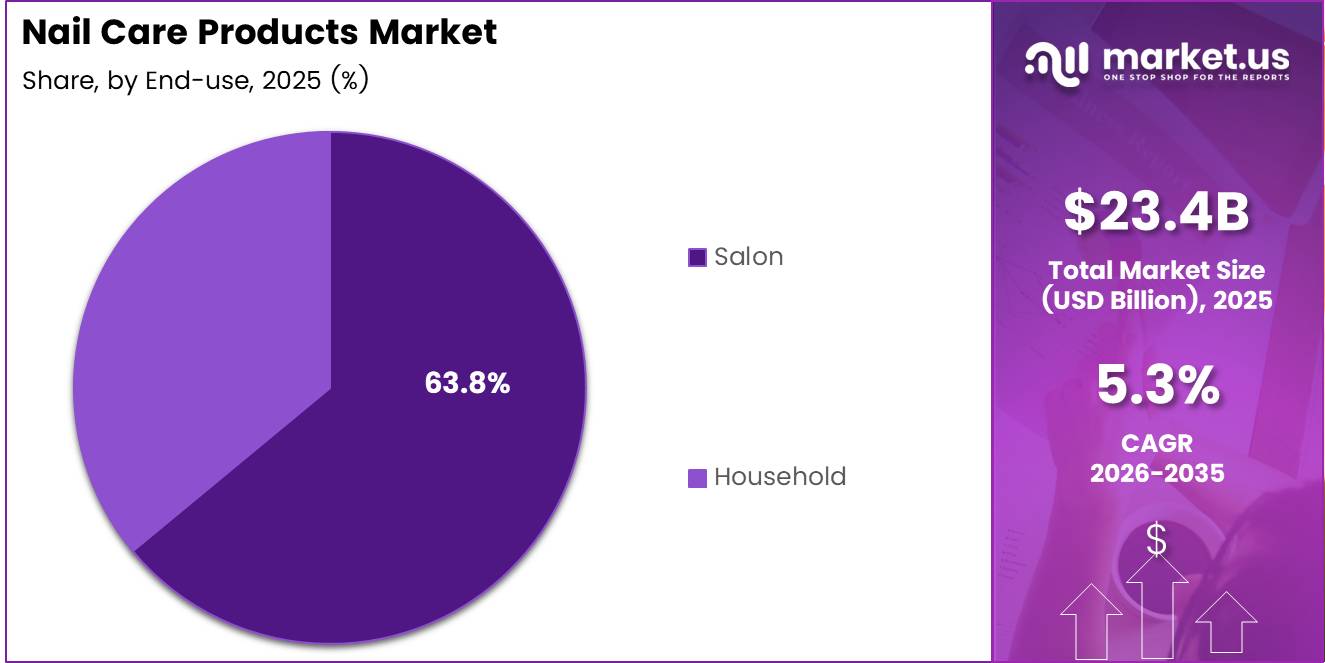
- Salon dominates end-use segment with 63.8% share driven by high-volume demand.
- Online distribution leads with 64.5% share due to e-commerce growth.
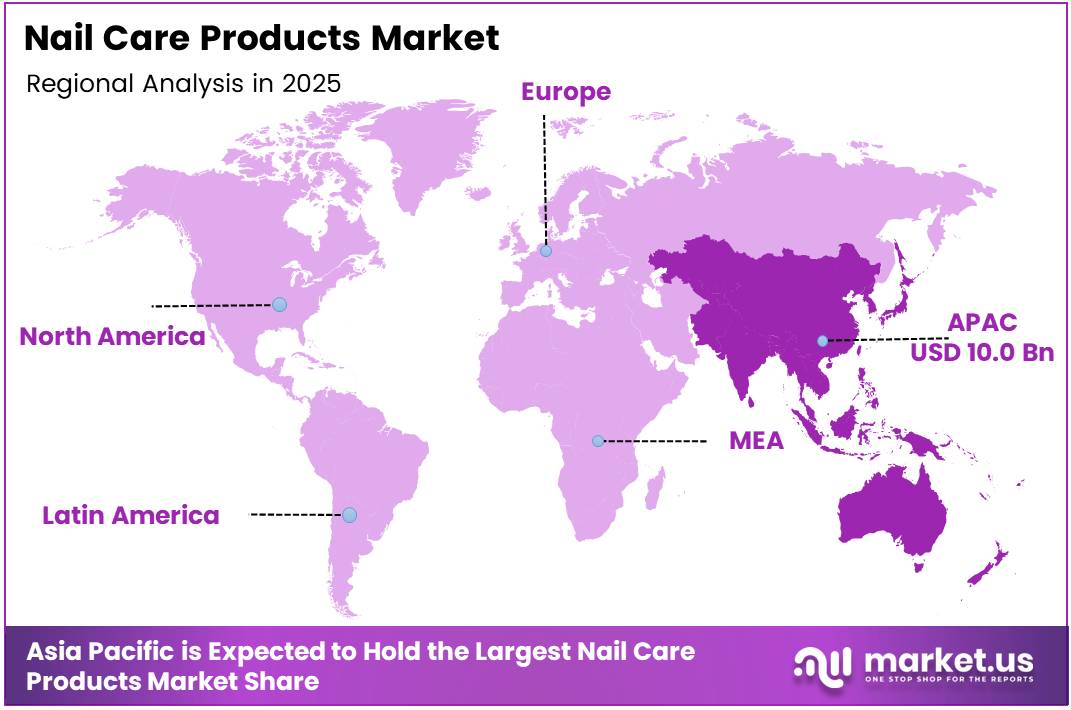
- Asia Pacific holds 42.80% share, valued at USD 10.0 Billion in 2025.
- Premium and sustainable formulations gain strong consumer preference globally.
- AI-driven personalization and smart devices create new revenue streams.
Market Segmentation Overview
Nail Polish dominates the product segment with a 58.3% share. This leadership reflects its affordability and widespread use across salons and households. Consumers prefer nail polish as an entry-level product, which ensures consistent demand. Consequently, brands continue investing in faster-drying and long-lasting formulations.
Salon leads the end-use segment with a 63.8% share due to high service volumes. Professional salons require continuous product restocking, which ensures stable B2B demand. However, household usage is growing rapidly as consumers adopt DIY nail care, which pushes brands to design easy-to-use products.
Online distribution holds a 64.5% share, driven by convenience and direct-to-consumer models. E-commerce platforms allow brands to collect customer data and build subscription services. Therefore, companies prioritize digital channels to improve customer retention and expand market reach globally.
Drivers
Professional salon culture drives consistent product demand across global markets. Salons treat nail care as a routine service, which increases customer visit frequency. This behavior ensures steady product consumption and predictable revenue streams for manufacturers, strengthening the overall stability of the market.
At-home manicure adoption expands the consumer base significantly. Social media platforms promote DIY nail trends, which encourages regular product usage. Consequently, brands invest in user-friendly kits and tools, which increases accessibility and drives higher sales across household segments.
Use Cases
Beauty salons use nail care products for daily client services, including manicures and nail treatments. Professionals rely on high-performance products to deliver consistent results. This demand ensures continuous product replenishment, which supports stable revenue streams for suppliers and manufacturers.
Household consumers use nail products for self-care and styling routines. Individuals apply nail polish and artificial nails at home for convenience and cost savings. Therefore, brands design products that simplify application while maintaining salon-quality results, which improves user satisfaction.
Major Challenges
Chemical regulations restrict the use of certain ingredients in nail products. Manufacturers must reformulate products to meet safety standards, which increases production costs. Smaller brands face challenges in compliance, which limits their ability to compete effectively in regulated markets.
Consumer concerns about toxic ingredients affect purchasing decisions. Buyers actively seek clean and vegan products, which forces brands to adjust formulations. Consequently, companies must invest in research and development to maintain performance while meeting safety expectations.
Business Opportunities
Plant-based formulations create strong opportunities for premium product positioning. Consumers prefer clean and sustainable ingredients, which allows brands to charge higher prices. This trend improves profit margins and opens access to eco-conscious retail channels globally.
AI-powered personalization offers new growth potential for nail care brands. Companies develop tools for custom color creation and product recommendations. Therefore, brands can enhance customer engagement and generate recurring revenue through personalized product offerings.
Regional Analysis
Asia Pacific leads the market with a 42.80% share, valued at USD 10.0 Billion in 2025. This dominance reflects strong beauty culture and high population density. Additionally, rapid income growth increases spending on personal care, which supports consistent market expansion.
North America represents a key growth region driven by advanced retail systems and high consumer spending. The region benefits from strong salon infrastructure and digital channels. Therefore, companies focus on omnichannel strategies to capture demand across both professional and household segments.
Recent Developments
- December 2024 — Helen of Troy acquired Olive & June for $240 million, expanding into DIY nail care.
- May 2025 — Blank Beauty raised $6.5 million to advance AI-based nail polish customization.
- April 2025 — Fiabila launched SPF50+ nail treatment to protect keratin from UV damage.
- August 2025 — Londontown introduced a new nail polish line with advanced hydration formulas.
- October 2025 — Olive & June launched Builder Gel lasting up to 21 days.
- December 2025 — Fiabila released a product reducing keratin damage by 83%.
Conclusion
The nail care products market shows steady growth supported by rising beauty awareness and frequent product usage. Professional salon demand and at-home adoption both contribute to market expansion. These trends ensure consistent revenue generation across multiple consumer segments.
Nail polish and salon segments dominate due to widespread usage and high service volumes. Asia Pacific leads regional growth with strong consumer demand and innovation trends. Meanwhile, online distribution channels strengthen global market reach and improve customer engagement.
Companies must invest in sustainable formulations, digital platforms, and personalized solutions to remain competitive. Innovation in AI and smart devices will shape future growth strategies. The market is expected to reach USD 39.2 Billion by 2035, offering strong opportunities for expansion.
Looking for data tailored to your specific market, region, or business need? Request a custom report or consultation — write to us at sales@market.us
Discuss your needs with our analyst
Please share your requirements with more details so our analyst can check if they can solve your problem(s)