Market Overview
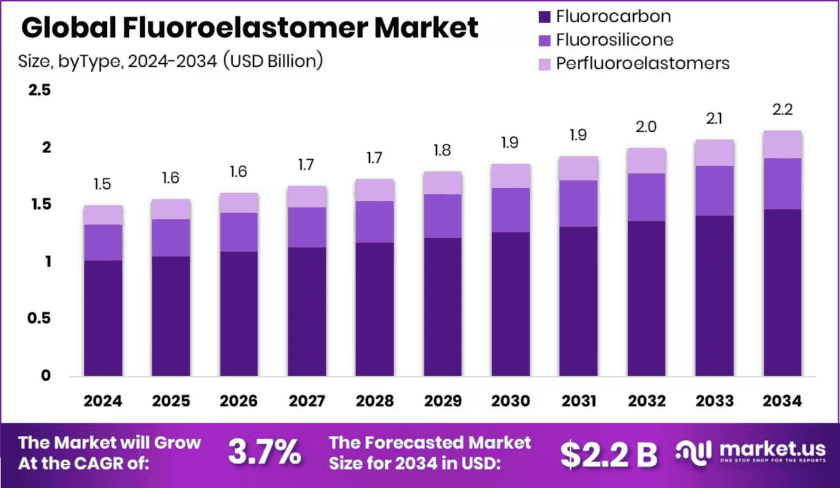
The Global Fluoroelastomer Market expects growth from USD 1.5 billion in 2024 to USD 2.2 billion by 2034. Consequently, the market will expand at a compound annual growth rate of 3.7% from 2025 to 2034. Rising industrial applications, especially in the Asia Pacific, drive this steady growth.
Fluoroelastomer represents a synthetic rubber that withstands extreme conditions like high temperatures and aggressive chemicals. Industries such as automotive, aerospace, and oil & gas rely on this material for seals, gaskets, and O-rings. Additionally, its resistance to heat and corrosive substances makes it superior to conventional rubbers.
This material provides exceptional durability where standard rubbers fail quickly. Therefore, manufacturers choose fluoroelastomers for high-performance environments that demand safety and reliability. The material’s proven track record supports its growing adoption worldwide.
Market demand links directly to industrial applications that require long-lasting sealing performance. Growth in automobile production and aerospace advancements keeps the market strong. Moreover, expansion in chemical processing industries further fuels steady market expansion.
The automotive sector increasingly needs heat- and chemical-resistant sealing materials. Modern engines and fuel systems operate at higher temperatures than before. Consequently, manufacturers adopt fluoroelastomers to ensure performance, safety, and compliance with stricter standards.
Key Takeaways
- The Global Fluoroelastomer Market expects to reach USD 2.2 billion by 2034, up from USD 1.5 billion in 2024, growing at a CAGR of 3.7% from 2025 to 2034.
- Fluorocarbon dominates the market by type, holding a 67.8% global share.
- O-rings lead the market by product, accounting for 44.3% of total demand.
- The automotive sector drives end-use consumption, contributing 38.5% of the market.
- Asia Pacific captures a strong market position, reaching USD 0.7 billion in value.
➤ Download Exclusive Sample Of This Premium Report – https://market.us/report/fluoroelastomer-market/request-sample/
Market Segmentation Overview
By type, fluorocarbon dominates the fluoroelastomer market with a 67.8% share in 2024. This segment’s strong performance comes from exceptional resistance to high temperatures, fuels, and aggressive chemicals. Consequently, automotive, aerospace, and chemical processing industries prefer fluorocarbon for critical sealing applications.
Fluorocarbon’s durability and reliability help manufacturers reduce maintenance costs and equipment downtime. Growing industrialization and rising demand for high-performance sealing solutions further strengthen this segment. Therefore, fluorocarbon remains a key contributor to overall market growth.
By product, O-rings lead the market with a 44.3% share in 2024. These components provide reliable sealing solutions in high-temperature and chemically aggressive environments. Moreover, automotive, aerospace, and industrial machinery applications depend heavily on fluoroelastomer O-rings.
O-rings made from fluoroelastomer materials offer excellent resistance to fuels, oils, and corrosive chemicals. This resistance ensures long-term durability and reduces maintenance requirements. Therefore, industries increasingly adopt these components for leak-proof sealing in demanding conditions.
By end-use, the automotive sector holds a dominant 38.5% share in 2024. Growing demand for high-performance sealing solutions in engines, fuel systems, and transmission components drives this leadership. Additionally, these applications operate under extreme temperatures and chemical exposure.
Fluoroelastomer materials provide exceptional resistance to oils, fuels, and harsh environmental conditions. Increasing vehicle production and stricter emission regulations boost adoption of these components. Consequently, the automotive sector sustains significant growth in the overall fluoroelastomer market.
Drivers
Government funding accelerates fluoroelastomer innovation across multiple industries. In the United States, the Department of Energy and the Environmental Protection Agency allocate substantial resources to advanced materials research. For example, the DOE’s Advanced Materials and Manufacturing Technologies Office invests in projects that enhance material performance and sustainability.
The EPA provides research grants focused on understanding per- and polyfluoroalkyl substances, which are integral to fluoroelastomers. These funding initiatives foster innovation while ensuring materials meet stringent environmental standards. Consequently, automotive, aerospace, and chemical processing sectors increase their adoption of these advanced materials.
Use Cases
Automotive manufacturers use fluoroelastomers extensively in engine and fuel system seals. Modern engines operate at higher temperatures, requiring materials that resist heat and chemical degradation. Therefore, automakers rely on fluoroelastomer O-rings and gaskets to maintain performance and prevent leaks.
Oil and gas operators employ fluoroelastomers in downhole sealing equipment and pipeline components. These applications face extreme pressure, harsh chemicals, and high temperatures daily. Consequently, fluoroelastomer seals extend equipment life and reduce unplanned downtime, saving operators significant maintenance costs.
Major Challenges
High production costs limit widespread fluoroelastomer adoption across price-sensitive industries. Complex manufacturing processes, specialized equipment, and expensive fluorine-based raw materials contribute to elevated expenses. Consequently, some manufacturers choose alternative materials when cost efficiency becomes the primary priority.
Government funding has not substantially addressed the underlying cost issues of fluoroelastomer production. This financial barrier hinders market expansion in applications where cheaper alternatives offer acceptable performance. Therefore, overcoming these high production costs remains essential for broader market reach.
Business Opportunities
Government funding fuels fluoroelastomer research advancements, creating new commercial opportunities. The EPA has awarded over USD 15 million in grants to institutions researching PFAS exposure reduction. Similarly, the National Institute of Environmental Health Sciences funds PFAS research through its Superfund Research Program.
These funding initiatives open new application avenues across various industries. As governments continue investing in advanced materials research, the fluoroelastomer market positions for growth. Innovations that meet both industrial demands and environmental standards will capture significant market share in coming years.
Regional Analysis
Asia Pacific region captures a dominant 46.9% share of the fluoroelastomer market, valued at USD 0.7 billion. Rapid industrialization and expansion in automotive manufacturing drive this leadership. Moreover, increasing demand from chemical and oil & gas industries further strengthens the region’s position.
Countries like China, Japan, and India invest heavily in advanced material technologies. Government initiatives supporting manufacturing and industrial innovation encourage fluoroelastomer adoption for O-rings, gaskets, and hoses. Consequently, Asia Pacific reinforces its dominant position with strong industrial base and supportive policies.
Top Key Players in the Market
- The Chemours Company
- DAIKIN INDUSTRIES, Ltd.
- Solvay
- 3M
- Shin-Etsu Chemical Co., Ltd.
- AGC Inc.
- Gujarat Fluorochemicals Limited (GFL)
- DuPont
- Swastik
- Eagle Elastomer Inc
- Zhejiang Funolin Chemical New Materials Co., Ltd.
Conclusion
The global fluoroelastomer market continues its steady expansion, driven by rising demand from automotive, aerospace, and chemical processing industries. Asia Pacific remains the dominant region due to rapid industrialization and strong government support for advanced materials. Consequently, manufacturers increasingly rely on fluoroelastomers for critical sealing applications where conventional rubbers fail.
Discuss your needs with our analyst
Please share your requirements with more details so our analyst can check if they can solve your problem(s)