Overview
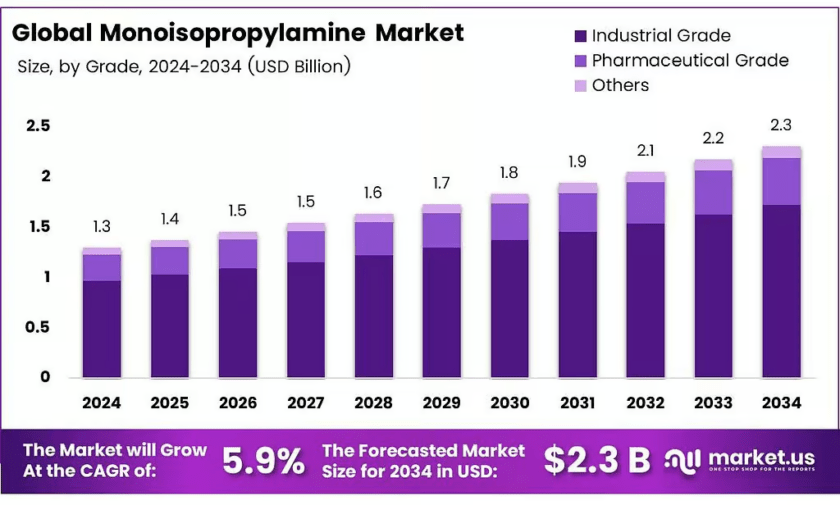
New York, NY – May 22, 2026 – The Global Monoisopropylamine Market is expected to reach around USD 2.3 billion by 2034. This growth starts from USD 1.3 billion in 2024. Consequently, the market will expand at a CAGR of 5.9% from 2025 to 2034. North America leads regional markets with a 42.8% share in 2024. This region generated approximately USD 0.5 billion in revenue. Additionally, strong agrochemical manufacturing and coatings sectors support this leadership. Consequently, the region maintains a commanding market position.
Monoisopropylamine (MIPA) serves as a clear, colorless liquid with a strong ammonia-like odor. It is a highly flammable primary aliphatic amine. Moreover, its low flash point below –30°C requires careful handling. Therefore, safety measures remain critical during storage and transport. Agricultural applications drive most MIPA demand globally. Farmers rely on it for producing herbicides like glyphosate and atrazine.
The chemical works as a key intermediate in pharmaceuticals and surfactants. Consequently, multiple industries depend on this versatile compound. Industrial grade dominates market share with 74.9% due to cost efficiency. This grade supports bulk production processes across various sectors. Moreover, manufacturers prefer its reliability for diverse chemical syntheses. Therefore, industrial applications continue to fuel steady market growth.
Key Takeaways
- The Global Monoisopropylamine Market projects to reach USD 2.3 billion by 2034, up from USD 1.3 billion in 2024, at a CAGR of 5.9% during 2025–2034.
- Industrial Grade dominates with a 74.9% share due to versatile applications and cost efficiency.
- The Agriculture segment leads with 38.4% share, driven by rising crop protection needs.
- North America held a 42.8% market share in 2024, valued at around USD 0.5 billion.
➤ Preview Key Insights with an Exclusive Sample Report Download – https://market.us/report/monoisopropylamine-market/request-sample/
Market Segmentation Overview
By Grade
Industrial Grade dominates the monoisopropylamine market with a 74.9% share. Manufacturers choose this grade for bulk production and cost efficiency. Moreover, its reliability supports diverse industrial needs. Therefore, it leads the segment strongly in 2024. Pharmaceutical Grade holds a notable position due to stringent purity standards. Drug manufacturers rely on this grade for safe, high-quality outputs.
Additionally, tighter health regulations boost demand. Consequently, this segment gains steady traction in specialized markets. Other grades form a smaller but essential market category. These specialized variants serve niche applications and emerging innovations. Moreover, they cater to custom manufacturing requirements. Therefore, this segment sustains a gradual but meaningful market presence.
By End-User
Agriculture dominates with a 38.4% share of the monoisopropylamine market. Farmers use MIPA extensively in pesticide and herbicide synthesis. Additionally, global food security needs drive this adoption. Therefore, agriculture commands the largest end-user segment. Pharmaceuticals play a key role as MIPA aids drug intermediate production. It ensures precise chemical reactions for effective medicine manufacturing.
Chemicals represent another vital end-user segment for monoisopropylamine. Industries leverage MIPA as a building block for surfactants and additives. Additionally, manufacturing expansions raise demand for these applications. Therefore, this segment maintains robust market involvement. Water treatment and other sectors complete the end-user landscape. MIPA functions as a corrosion inhibitor and pH adjuster in these applications.
Regional Analysis
North America leads the global monoisopropylamine market with a 42.8% share valued at USD 0.5 billion in 2024. The United States serves as the central hub for herbicide production. Moreover, the EPA monitors amine-based formulations for crop protection. Therefore, strong agrochemical output sustains regional dominance.
Europe and the Asia Pacific follow as significant regional markets for MIPA. European Union regulations like Directive 2004/42/EC push low-VOC coating adoption. Additionally, the Asia Pacific benefits from expanding manufacturing in China and India. Consequently, these regions present substantial growth opportunities for market players.
Drivers
Low-VOC regulations worldwide drive monoisopropylamine demand in water-borne coatings. The EU caps VOCs at 30-140 g/L for many decorative paint categories. Moreover, the EPA’s AIM coatings rule creates a federal compliance floor. Therefore, formulators increasingly need amine neutralizers like MIPA for pH stability.
Steady agricultural volumes further lift MIPA consumption globally. Herbicides like glyphosate rely on isopropylamine salt formulations as standard chemistry. According to FAO data, global pesticide use reached 3.70 million tonnes, up 4% year-over-year. Consequently, rising herbicide intensity translates directly into more MIPA demand.
Use Cases
Agrochemical manufacturers use monoisopropylamine as a key intermediate for herbicide production. It forms stable amine salts with glyphosate and other weed-control agents. Moreover, these formulations enhance herbicide efficacy for better crop yields. Therefore, farmers benefit from improved pest management solutions.
Pharmaceutical companies employ MIPA in drug intermediate synthesis for antiprotozoal medications. It acts as a chemical initiator in preparing chlorguanide and related compounds. Additionally, the compound ensures precise chemical reactions for effective medicine production. Consequently, healthcare manufacturers value its reliability and purity.
Business Opportunities
Water-borne coating formulations present a clear growth opportunity for MIPA suppliers. Manufacturers need amine neutralizers to achieve target pH levels between 8.5 and 9.3 in latex paints. Moreover, tightening global VOC regulations accelerates this market shift. Therefore, companies can expand by targeting coating formulators directly.
Specialty surfactant production offers another avenue for market expansion. Personal care and industrial cleaning formulations increasingly incorporate amine-based ingredients. Additionally, emerging innovations require custom MIPA variants for specific performance needs. Consequently, chemical companies can differentiate through application-focused product development.
Major Challenges
Stringent safety regulations restrict widespread MIPA adoption across smaller facilities. The compound carries H225, H311, H314, and H332 hazard classifications under EU CLP rules. Moreover, its flash point is as low as -26°C, requiring explosion-proof equipment. Therefore, high compliance costs limit entry for new manufacturers.
Worker exposure risks create ongoing operational burdens for MIPA users. Inhalation may irritate the respiratory tract, while skin contact can cause severe burns. Additionally, facilities must invest in ventilation, inerting systems, and protective gear. Consequently, operational complexity raises overall production costs significantly.
Top Key Players in the Market
- BASF SE
- Dow Chemical Company
- Eastman Chemical Company
- Alkyl Amines Chemicals Ltd.
- Air Products and Chemicals, Inc.
- Zhejiang Jianye Chemical Co., Ltd.
- Shandong IRO Amine Industry Co., Ltd.
Conclusion
The global monoisopropylamine market shows steady growth driven by agricultural and coating applications. Industrial grade dominates production, while agriculture remains the largest end-user segment. North America leads regional markets with strong herbicide manufacturing and regulatory support. However, safety hazards and handling complexity pose ongoing challenges. Overall, low-VOC trends and herbicide demand will continue shaping market expansion over the coming decade.
Discuss your needs with our analyst
Please share your requirements with more details so our analyst can check if they can solve your problem(s)