Market Overview
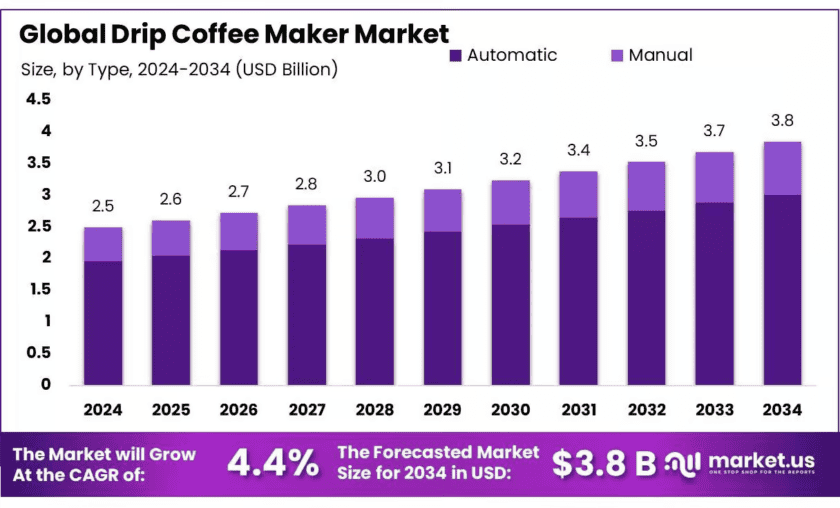
The Global Drip Coffee Maker Market demonstrates steady expansion driven by rising coffee consumption worldwide. The industry will grow from USD 2.5 billion in 2024 to USD 3.8 billion by 2034. This growth reflects a compound annual growth rate of 4.4% during the forecast period.
Europe leads the global market with a dominant 38.3% share in 2024, generating approximately USD 0.9 billion in revenue. European consumers drink over 200 million cups of coffee daily, according to the European Coffee Federation. Consequently, this region provides a strong foundation for drip coffee maker manufacturers.
The National Coffee Association reports that US coffee consumption has reached 66% of the population. This high penetration rate signals sustained demand for coffee brewing equipment. Therefore, manufacturers continue investing in product innovation for the North American market.
India demonstrates remarkable growth in coffee culture and consumption patterns. Domestic coffee consumption rose from 84,000 tonnes in 2012 to 91,000 tonnes in 2023. Moreover, 41% of Indian coffee consumers prefer powder-to-brew coffee, while 31% choose instant coffee options.
Packaging preferences reveal that 53% of Indian coffee consumers favor bottle or jar packaging. Additionally, 63% purchase coffee from traditional kirana or general stores. These behavioral insights help manufacturers tailor their product offerings and distribution strategies accordingly.
The drip coffee maker industry remains essential within the global home appliances market. Consumers consistently choose this brewing method for its affordability, ease of use, and reliable results. Therefore, steady growth will continue throughout the forecast period.
Key Takeaways
- The Global Drip Coffee Maker Market size will reach USD 3.8 billion by 2034, up from USD 2.5 billion in 2024, growing at a CAGR of 4.4%.
- Automatic drip coffee makers dominate with more than a 78.3% share of the global market.
- Power range of 500 to 1000 watts captures more than a 49.2% market share.
- The residential segment holds a dominant position with more than a 67.7% share in the industry.
- Supermarkets and hypermarkets lead distribution with more than a 37.8% share.
- Europe holds the largest market share at 38.3%, valued at approximately USD 0.9 billion.
➤ Evaluate the Report Quality with an Exclusive Sample Download – https://market.us/report/drip-coffee-maker-market/request-sample/
By Type Analysis
Automatic drip coffee makers held a dominant market position in 2024, capturing more than a 78.3% share globally. Consumers favor this type for its ease of use and consistent brewing results. Moreover, advancements in coffee-making technology continue driving the adoption of automatic machines.
Manual drip coffee makers serve a smaller but dedicated consumer segment. These machines appeal to coffee enthusiasts who prefer greater control over the brewing process. However, automatic models remain the mainstream choice for most households and offices.
By Power Analysis
Drip coffee makers with 500 to 1000 watts captured more than a 49.2% market share in 2024. This power range delivers balanced brewing performance without excessive energy consumption. Consequently, most consumers choose these energy-efficient options for home use.
Below 500-watt machines serve budget-conscious buyers and small households. Above 1000-watt models offer faster brewing times but consume more electricity. Therefore, the mid-range power segment remains the most popular choice.
By End Use Analysis
The residential segment held a dominant market position in 2024, capturing more than a 67.7% share. Home brewing offers convenience and cost-effectiveness for daily coffee drinkers. Additionally, modern models feature programmable settings and energy-efficient functions.
Commercial applications, including offices, cafes, and restaurants, make up the remaining market share. These settings require durable, high-capacity machines for continuous operation. However, residential growth outpaces commercial expansion due to remote work trends.
By Distribution Channel Analysis
Supermarkets and hypermarkets held a dominant position in 2024, capturing more than a 37.8% share. These retail channels offer a wide product variety and competitive pricing. Moreover, consumers appreciate the ability to compare models and receive immediate support.
Online distribution channels continue to gain market share rapidly. Specialty stores serve dedicated coffee enthusiasts seeking premium equipment. Consequently, multi-channel distribution strategies help manufacturers reach diverse consumer segments.
Drivers
Government support and export growth drive India’s drip coffee maker market forward. In fiscal year 2023–24, India achieved a remarkable 125% increase in coffee export value, reaching USD 1.8 billion. This growth stems from global recognition of Indian coffee quality and supportive government initiatives.
The Coffee Board of India provides financial incentives, including a ₹3 per kilogram subsidy for value-added coffee. Additionally, subsidies of up to 40% (up to ₹15 lakh) support advanced coffee machinery adoption. Consequently, rising exports drive consumer interest in quality brewing equipment for home use.
Use Cases
Residential consumers use drip coffee makers daily for convenient, consistent coffee preparation. Home brewing saves money compared to café purchases while delivering reliable quality. Moreover, programmable features allow users to wake up to freshly brewed coffee each morning.
Commercial establishments, including offices and cafes, rely on drip coffee makers for high-volume service. These machines brew large quantities quickly while maintaining consistent taste profiles. Therefore, businesses invest in durable, high-capacity models to serve employees and customers efficiently.
Major Challenges
Regulatory compliance requirements present significant challenges for drip coffee maker manufacturers. The European Union’s Deforestation Regulation (EUDR), effective from December 30, 2025, mandates deforestation-free certification for coffee exports. This requirement demands precise geolocation and polygon mapping of coffee plantations.
Smallholder farmers in India lack technical expertise and resources for compliance. Over 30,000 farmers in Wayanad, Kerala, remain unregistered for the certification process. Consequently, non-compliance could exclude exporters from high-value EU markets, creating potential financial losses.
Business Opportunities
Government initiatives fueling India’s coffee export growth create significant opportunities for drip coffee maker manufacturers. In fiscal year 2024–25, India’s coffee exports reached a record USD 1.81 billion. This represents a 40.37% increase from USD 1.29 billion in the previous year.
The Integrated Coffee Development Project (ICDP) focuses on improving yields and expanding cultivation. As Indian coffee gains international recognition, domestic consumers seek quality brewing equipment. Therefore, manufacturers can capitalize on the growing demand for café-style home brewing experiences.
Regional Analysis
Europe leads the global drip coffee maker market with a 38.3% share valued at USD 0.9 billion in 2024. Strong coffee traditions in Germany, France, and Italy drive consistent demand. Moreover, robust retail infrastructure through supermarkets and hypermarkets supports widespread product availability.
North America represents the second-largest market with strong growth potential. The US coffee consumption rate of 66% provides a substantial customer base. Additionally, the Asia Pacific shows the fastest growth rate, driven by emerging coffee cultures in India and China.
Top Key Players Outlook
- Black & Decker
- Breville
- BSH Hausgeräte GmbH
- Budan
- Capresso
- Cuisinart
- De’Longhi
- Electrolux AB
- Espresso Supply, Inc.
- Glen Appliances
- GROUPE SEB UK, Ltd.
- Cimbali S.p.A.
Conclusion
The global drip coffee maker market continues its steady expansion, driven by rising coffee consumption worldwide. Consumers increasingly prefer home brewing for its convenience, cost savings, and consistent quality. Manufacturers respond with innovative features, including smart technology integration and energy-efficient designs. Emerging markets across the Asia Pacific present significant growth opportunities for forward-thinking manufacturers.
Discuss your needs with our analyst
Please share your requirements with more details so our analyst can check if they can solve your problem(s)