Report Overview
In 2025, the Global Cabbages and Other Brassicas Market was valued at USD 43.2 billion. During 2026 to 2035, the market is projected to grow at a CAGR of 4.2%, reaching approximately USD 65.3 billion by 2035. In 2025, Asia-Pacific dominated the market with more than 53.5% share, generating revenue of USD 23.1 Billion. Cabbages and other brassicas represent a significant segment of the global fresh vegetable industry, including cabbage, broccoli, cauliflower, knol khol, kale, Brussels sprouts, and related crops. These vegetables are supplied through retail, foodservice, and processing channels.
Their commercial demand is supported by consistent year-round consumption, adaptability across different climatic conditions, and applications in fresh, frozen, fermented, and prepared food products. According to FAOSTAT, 2025 update, agricultural production data covers more than 245 countries and territories, demonstrating the extensive global cultivation base and widespread production of brassica crops across diverse agricultural regions.
In August 2025, Eurostat reported that the European Union harvested 62.2 million tonnes of fresh vegetables in 2024, representing a 6% increase from 58.8 million tonnes in 2023. During 2024, Spain produced 14.8 million tonnes, Italy produced 13.9 million tonnes, and France produced 5.8 million tonnes. Together, these three countries accounted for approximately 55% of the European Union’s fresh vegetable production for the respective crop category. According to the UK Department for Environment, Food & Rural Affairs (Defra), Horticulture Statistics 2025, the planted area for brassicas increased by 7.0% to 22,000 hectares.
However, production declined by 3.6% to 341,000 tonnes, while the total production value decreased by 9.2% to £350 million. Dry establishment conditions, heat stress, and limited irrigation availability affected yields and placed pressure on grower returns. Market demand continues to increase as consumers seek affordable vegetables, wider dietary options, and convenient products such as shredded cabbage, salad mixes, frozen broccoli, and fermented foods. Brassicas also support retail strategies focused on plant-forward meals and cost-efficient food solutions due to their availability across multiple product formats and pricing levels.
According to the Food and Agriculture Organization of the United Nations (FAO), 2025 update, fruits and vegetables recorded the highest food-loss rate among major commodity groups, increasing from 23.2% in 2015 to 25.4% in 2023. To reduce losses and improve supply efficiency, investment in rapid cooling, controlled-atmosphere storage, improved crates, grading systems, and shorter supply chains is becoming increasingly important. Future growth opportunities include climate-resilient varieties, precision irrigation, protected cultivation, biological crop protection, mechanised harvesting, and value-added processing. Producers can expand market opportunities through ready-to-cook packs, fermented cabbage, frozen florets, vegetable powders, and by-product utilisation.
In September 2025, the USDA awarded $72.9 million across 56 states and territories for 586 specialty-crop projects, including initiatives focused on fruit and vegetable competitiveness. According to the UK Department for Environment, Food & Rural Affairs (Defra), 2025, the UK Government introduced the ADOPT (Accelerating Development of Practices and Technologies) competition, supported by £12.5 million to encourage on-farm trials and adoption of innovative agricultural technologies and practices. The initiative aims to improve productivity, reduce environmental impacts, and strengthen farming-sector resilience, including projects involving precision breeding where applicable.
Over the long term, market competitiveness will depend on maintaining a balance between production volume and environmental performance. Growers adopting resistant seed varieties, water monitoring systems, integrated pest management, renewable-powered cold storage, and direct buyer contracts are expected to be better positioned to address weather volatility, labour shortages, quality requirements, and pricing pressures while ensuring consistent year-round supply.
Key Takeaways
- The Global Cabbages and Other Brassicas Market was valued at USD 43.2 billion in 2025.
- The market is projected to grow at a CAGR of 4.2% and is estimated to reach USD 65.3 billion by 2035.
- On the basis of Brassica Type, Cabbage dominated the market, constituting 62.3% of the total market share.
- Based on the Farming Practice, Open-field dominated the market, with a substantial market share of around 76.8%.
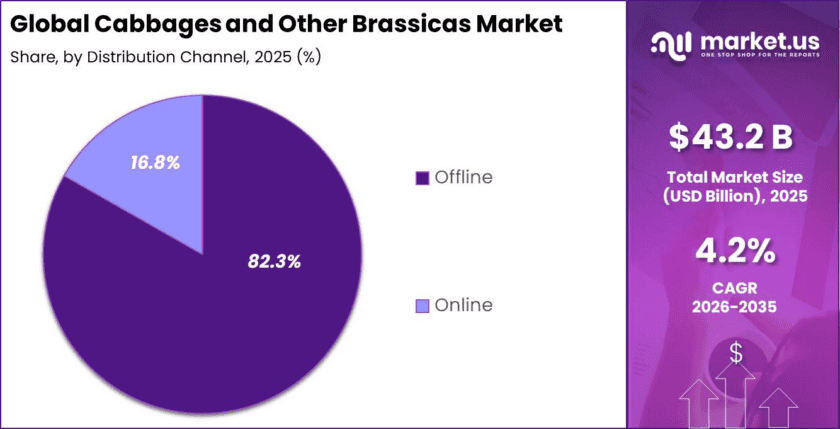
- Based on the Distribution Channel, Offline led the market, comprising 83.2% of the total market.
- In 2025, Asia-Pacific was the most dominant region in the market, accounting for 53.5% of the total global consumption.
Brassica Type Analysis
Cabbage Leads the Market with 62.3% Share Owing to Strong Household and Food Processing Demand
In 2025, cabbage accounted for more than 62.3% of the Global Cabbages and Other Brassicas Market by brassica type, making it the leading segment. Its dominant position is supported by widespread household consumption, cost-effective pricing, extended storage life, and broad application across salads, soups, fermented products, ready meals, and foodservice offerings. Compared with several other brassica vegetables, cabbage is easier to transport and store, allowing retailers to maintain reliable year-round availability.
According to the USDA National Agricultural Statistics Service, U.S. cabbage production reached 22.0 million cwt in 2025, increasing from the previous year. The harvested area totaled 49,600 acres, while 17.4 million cwt of cabbage was supplied to the fresh market.
Broccoli emerged as the fastest-growing brassica type in 2025, driven by rising consumer demand for fresh, frozen, convenient, and nutrient-rich vegetables. Its growing use in salads, soups, pasta dishes, frozen meal packs, stir-fry products, and restaurant menus continues to strengthen demand across both retail and foodservice sectors. Increasing consumer interest in balanced diets and plant-based eating patterns is expected to further support broccoli consumption, particularly among urban and health-conscious consumers.
Farming Practice Analysis
Open-field Farming Dominates with 76.8% Share Due to Large-Scale Production Efficiency
In 2025, Open-field farming held the largest share of the Cabbages and Other Brassicas Market, accounting for more than 76.8%. This cultivation method remains the preferred choice for commercial growers because it supports large-scale production of cabbage, cauliflower, broccoli, and kale with relatively low infrastructure requirements. The use of standard agricultural machinery, natural sunlight, crop rotation practices, and the ability to expand cultivation areas efficiently makes open-field farming suitable for high-volume brassica production.
According to the UK Department for Environment, Food and Rural Affairs, the total brassica cultivation area increased by 7.0% to 22 thousand hectares in 2025, reinforcing the continued importance of outdoor cultivation for maintaining commercial brassica production.
Protected cultivation is the fastest-growing farming practice within the market. Growers are increasingly adopting greenhouses, tunnels, net houses, and other covered production systems to protect brassica crops from extreme weather conditions, insect damage, and irregular rainfall. These controlled environments improve crop consistency, appearance, and harvest scheduling while supporting the production of premium broccoli, cauliflower, kale, and specialty cabbage varieties that require greater control over temperature, moisture, and pest exposure.
According to the UK Department for Environment, Food and Rural Affairs, the area dedicated to protected vegetable production increased by 4.7% to 866 hectares in 2025. During the same year, protected farms produced 258 thousand tonnes of vegetables and generated a production value of £431 million.
Distribution Channel Analysis
Offline Distribution Holds 83.2% Share as Consumers Prefer Selecting Fresh Produce in Person
In 2025, the Offline distribution channel captured more than 83.2% of the Cabbages and Other Brassicas Market, making it the dominant sales channel. Supermarkets, grocery stores, wholesale produce markets, farmers’ markets, and local vegetable retailers continued to account for the majority of purchases because brassicas are highly perishable. Consumers generally prefer to personally examine freshness, firmness, colour, size, and visible quality before purchasing vegetables such as cabbage, broccoli, and cauliflower.
According to USDA data released in June 2026, U.S. food-at-home expenditure reached USD 1.10 trillion in 2025, reflecting the significant volume of grocery purchases made for household consumption.
The Online segment is experiencing the fastest growth among distribution channels. Expansion is being driven by increasing smartphone adoption, faster grocery delivery services, improved digital payment infrastructure, and greater availability of fresh vegetables through supermarket applications and online grocery platforms. Retailers are also enhancing temperature-controlled fulfilment systems, protective packaging, delivery scheduling, and real-time inventory management to minimize quality loss during transportation and improve customer satisfaction.
Emerging Trends
Domestic Demand Is Softening, Reshaping Category Priorities
U.S. per-capita availability of vegetables and pulses — the primary proxy analysts use for consumption — fell to 376 pounds in 2024, according to USDA’s Economic Research Service, marking the lowest level since the category’s peak of 426 pounds in 1996. For a category as foundational to the produce aisle as cabbage and its brassica relatives, this broad-based softening is prompting category managers and processors to re-examine volume assumptions built during the previous decade’s steadier demand environment. The decline is structural rather than seasonal, reflecting several consecutive years of gradually contracting fresh-vegetable footprint at retail.
Brassica Crops Are Diverging From One Another
Within the fresh-vegetable basket, overall per-capita fresh vegetable availability dropped to 148 pounds per person, a decline attributed in USDA reporting cited by Blue Book Services. Yet brassicas are not moving as a bloc: cauliflower and cabbage availability actually rose by 7% and 1% respectively in 2024, even as broccoli and leafy brassica greens such as kale, collards, and mustard greens fell by 4%. This divergence signals that buyers are rotating dollars within the brassica family rather than abandoning it outright, favoring formats — such as pre-cut cabbage blends and cauliflower rice — that align with convenience-driven meal preparation.
Organic Certification Is Becoming a Growth Lever
Certified organic produce, the category housing much of the premium cabbage, kale, and Brussels sprouts assortment, posted sales of $21.5 billion in 2024 — a 5.2% year-on-year increase that outpaced the broader food marketplace’s 2.5% growth, according to the Organic Trade Association’s 2025 Organic Market Report. Organic produce now represents 30.1% of total organic food sales, reinforcing its role as the primary entry point through which shoppers adopt organic purchasing habits more broadly. For brassica suppliers, this points toward continued margin opportunity in expanding certified acreage and packaged organic brassica lines.
Import Flows Are Increasingly Filling Domestic Supply Gaps
Weekly shipping-point data compiled by USDA’s Agricultural Marketing Service shows that cabbage imports are playing a growing balancing role in regional U.S. markets. In one late-2024 reporting period, season-to-date cabbage imports totaled 11,637 units (each equal to 10,000 pounds), with Canada supplying 9,455 units and Mexico contributing 2,172 units, against 24,054 units of domestic truck shipments over the same window. This import share, layered directly onto domestic truck movement data, underscores a trend toward cross-border supply integration as growers and distributors manage seasonal domestic production variability.
Nutritional Science Is Reinforcing Long-Term Category Demand
Ongoing research into the compounds unique to brassica vegetables continues to support their positioning as a health-driver category. The National Cancer Institute notes that cruciferous vegetables — including cabbage, broccoli, and Brussels sprouts — contain glucosinolates, sulfur-containing compounds that break down during preparation and digestion into biologically active substances such as indole-3-carbinol and sulforaphane, compounds that have been studied for their potential role in inhibiting cancer development in laboratory and animal research across multiple organ systems. This continued scientific attention gives brassica marketers a durable, evidence-based health narrative to support premiumization and functional-food positioning independent of short-term consumption swings.
Use Cases
Industrial Oilseed Processing Remains the Largest-Volume Application
Beyond the vegetable case, the brassica family’s largest industrial footprint comes from canola (Brassica napus and Brassica campestris/rapa), grown across Western Canada’s fields and harvested at a rate of 18–20 million metric tonnes annually, according to the Canola Council of Canada. Each seed contains approximately 44% oil, extracted for use as a culinary and industrial oil, with the industry publicly targeting an increase to 26 million metric tonnes of annual production to meet rising global demand. This scale places industrial brassica oilseed processing well ahead of any other single use case for the crop family in terms of raw tonnage handled.
Renewable Fuel Feedstock Demand Is Absorbing a Growing Share of Brassica Oil Output
Canola oil is increasingly diverted into the biofuel supply chain rather than food channels. Monthly feedstock-use data reported by the U.S. Energy Information Administration and compiled in industry biofuel reporting shows canola oil usage in domestic biofuel production climbing 68% month-over-month to 239 million pounds in a recent reporting period, even as total feedstock use across all oils reached 2.918 billion pounds. For B2B buyers in the renewable diesel and biomass-based diesel space, this signals canola-derived brassica oil’s growing importance as a feedstock alternative alongside soybean oil, corn oil, and used cooking oil.
Institutional Food Service Procurement Is Shaped by Federal Nutrition Mandates
Brassica vegetables classified in the “dark green” subgroup — including broccoli, kale, and related crops — are subject to specific federal procurement requirements in the U.S. National School Lunch Program. Under current USDA meal pattern regulations, schools must offer at least ½ cup of dark green vegetables weekly for all grade levels, contributing to a broader requirement of 3¾ cups of vegetables per week for grades K-8 and 5 cups per week for grades 9-12. This regulatory structure creates a stable, mandate-driven institutional demand channel for brassica vegetables that is largely insulated from retail consumption swings, making school food service a distinct and durable B2B procurement category.
Processed and Value-Added Cabbage Products Extend the Category’s Commercial Reach
A significant share of cabbage volume moves beyond the fresh produce aisle into processed formats. Industry data compiled by the Agricultural Marketing Resource Center indicates that 45% of processed cabbage is directed toward coleslaw production, 35% toward fresh head cabbage, and 12% toward sauerkraut, with the remainder split among other fresh-cut applications. Supporting this processing base, 78% of the nation’s total cabbage production is concentrated in five states — California, Wisconsin, New York, Florida, and Texas — with national average yield estimated at 39,600 pounds per acre. This concentration allows processors to secure consistent contracted supply for coleslaw kits, kraut production, and fresh-cut retail lines.
Conclusion
The cabbages and other brassicas market presents a picture of steady, selective growth rather than uniform expansion. U.S. per-capita vegetable availability has softened to 376 pounds in 2024, its lowest level since 1996, yet individual brassica crops are moving in different directions, with cauliflower and cabbage availability rising 7% and 1% respectively even as broccoli and leafy greens decline. This divergence reflects a market being reshaped by convenience formats, organic demand, and institutional procurement rather than falling out of favor altogether. Organic produce sales, growing 5.2% to $21.5 billion in 2024, and record fermented-cabbage exports from South Korea, up 5.2% to $163.6 million, show that value-added and health-driven brassica products are outperforming the broader category. Beyond the vegetable aisle, canola continues to anchor the family’s industrial relevance, with Canadian production near 18–20 million metric tonnes annually feeding global edible oil, livestock feed, and renewable fuel supply chains. For B2B buyers, processors, and investors, the takeaway is clear: success in this category increasingly depends on targeting the specific brassica crop, product format, or end-use segment showing genuine momentum, rather than treating cabbages and brassicas as a single, homogeneous commodity group.
Frequently Asked Questions
What are cabbages and other brassicas?
Brassicas are a vegetable family that includes cabbage, broccoli, cauliflower, kale, Brussels sprouts, mustard greens, and canola. They share a peppery flavor profile from sulfur compounds and are valued for their versatility across fresh, processed, and industrial applications worldwide.
Why are brassicas important to the global food and agriculture market?
Brassicas serve dual roles as dietary staples and industrial inputs. Cabbage and leafy greens anchor fresh produce sections, while canola supplies edible oil, livestock feed, and renewable fuel feedstock, making the category commercially significant across multiple downstream industries.
What is driving current demand for cabbage and brassica vegetables?
Demand is shaped by shifting consumer habits, with convenience formats like pre-cut coleslaw and cauliflower rice gaining traction. Health-conscious buying, organic certification growth, and institutional procurement through school nutrition programs are also reinforcing steady baseline demand.
Are brassica vegetables considered healthy?
Yes. Brassicas contain glucosinolates, compounds that break down into biologically active substances studied for potential health benefits. Their nutrient density and low calorie content continue to support their positioning in dietary guidelines and functional-food marketing strategies.
Which regions lead global brassica production?
Production is concentrated regionally by crop type. The United States, China, and India are major fresh cabbage and vegetable-brassica producers, while Canada leads global canola output, exporting seed, oil, and meal to more than fifty countries worldwide.
What role does canola play within the brassica market?
Canola, a brassica oilseed, is processed into edible oil, animal feed meal, and biodiesel feedstock. It represents the highest-volume industrial use case within the brassica family, connecting agricultural production to food, feed, and renewable energy supply chains.
What challenges does the brassica market face?
Challenges include softening per-capita vegetable consumption in some markets, weather-sensitive yields, import dependency for certain crops, and cost pressures in processing. Producers must also navigate diverging demand trends across individual brassica crop types.
What is the outlook for the cabbages and brassicas market?
Outlook remains steady, supported by organic segment growth, expanding fermented-food trade, institutional procurement mandates, and continued industrial demand for canola-based products. Diverging performance across individual crops suggests selective growth rather than uniform category-wide expansion.
Discuss your needs with our analyst
Please share your requirements with more details so our analyst can check if they can solve your problem(s)