Market Overview
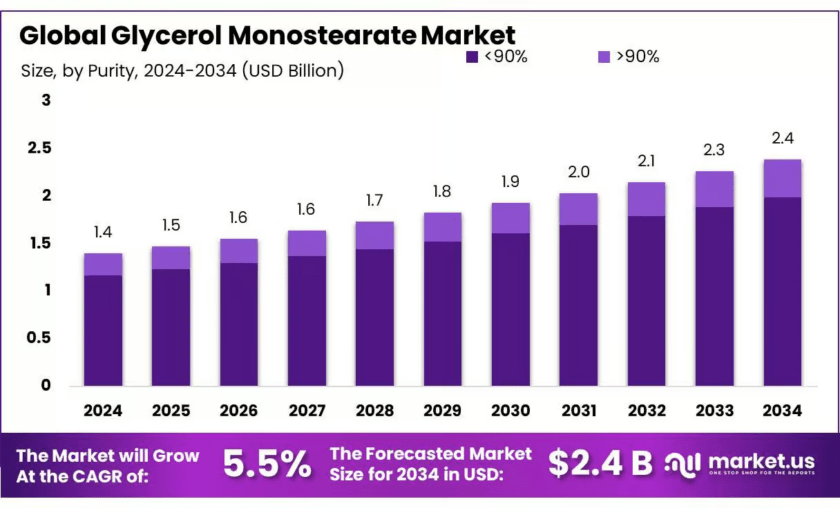
The Global Glycerol Monostearate Market demonstrates steady growth across multiple industries. Market size stood at USD 1.4 billion in 2024, with projections reaching USD 2.4 billion by 2034. This expansion represents a compound annual growth rate of 5.5% during the forecast period from 2025 to 2034.
Asia Pacific leads the global market with a dominant position. The region captured more than 43.20% share in 2024, generating USD 0.6 billion in revenue. Consequently, manufacturers focus their expansion strategies on this high-growth region.
Glycerol Monostearate (GMS) serves as a versatile emulsifier, stabilizer, and surfactant across many sectors. Food, cosmetics, pharmaceuticals, and personal care products rely heavily on this compound. Moreover, manufacturers derive GMS from renewable vegetable oils, making it a sustainable choice.
The compound improves product texture, enhances stability, and extends shelf life effectively. Processed foods, creams, lotions, and oral hygiene products particularly benefit from GMS addition. Therefore, expanding end-user industries drives consistent demand growth.
Additionally, the European Union provides strong regulatory support through Regulation (EC) No 1333/2008. This framework ensures safety and quality standards for food additives, including GMS. Consequently, manufacturers confidently apply GMS across the European food industry.
Key Takeaways
- The Global Glycerol Monostearate Market size will reach USD 2.4 billion by 2034 from USD 1.4 billion in 2024, growing at a CAGR of 5.5%.
- Powdered Glycerol Monostearate held a dominant market position, capturing more than 67.3% of the total market share.
- Emulsifier applications held a dominant market position, capturing more than 47.2% of the total market share.
- The Food & Beverages sector held a dominant market position, capturing more than 38.9% of the total market share.
- Asia Pacific leads the global market with a 43.2% share, valued at approximately USD 0.6 billion.
➤ Download Exclusive Sample Of This Premium Report (Including Full TOC, Table & Figures)- https://market.us/report/global-glycerol-monostearate-market/request-sample/
Market Segmentation Overview
By Purity
Glycerol Monostearate with purity below 90% dominates the market with 83.4% share in 2024. Lower purity grades offer cost-effectiveness for food, pharmaceutical, and cosmetic applications where ultra-high purity is unnecessary. Consequently, emerging markets prefer this grade due to its affordability and functional performance.
Manufacturers project this segment to maintain leadership through 2025. Increasing consumption of processed foods, dairy substitutes, and affordable personal care products drives consistent demand. Moreover, economic conditions in the Asia-Pacific regions favor cost-efficient functional ingredients, further boosting this purity segment.
By Form
Powdered Glycerol Monostearate commands a 67.3% share in 2024 due to easy handling and storage advantages. Food processors add this powder form directly to dry mixes for baked goods, snack foods, and powdered beverages. Therefore, manufacturers prefer powdered GMS for its stability and convenient blending characteristics.
The convenience food industry continues driving powdered GMS growth into 2025. Pharmaceutical and cosmetic sectors also adopt this form for precise dosages and easy formulation incorporation. Additionally, the powder disperses well in both oil and water-based systems, making it a versatile choice.
By Application
Emulsifier applications lead with a 47.2% share in 2024. GMS ensures smooth textures and prevents separation in margarine, ice cream, and salad dressings. Consequently, the growing demand for processed and convenience foods drives this segment’s market dominance.
Plant-based and dairy alternative products further strengthen the emulsifier segment through 2025. GMS helps achieve desirable textures and consistency in non-dairy beverages and vegan products. Therefore, multifunctional benefits and increasing stability requirements position this segment for continued growth.
By End-use
Food & Beverages sector captures a 38.9% share in 2024. Margarine, ice cream, bakery products, and ready-to-eat meals rely on GMS for texture improvement and shelf life extension. Moreover, increasing consumer demand for convenience foods directly supports this segment’s strong performance.
Plant-based and dairy-free alternatives will maintain this segment’s dominance through 2025. These products require GMS to preserve texture and stability during storage. Additionally, clean-label ingredient trends drive formulation innovations, ensuring GMS remains crucial in food manufacturing.
Drivers
Rising Demand for Processed Foods: Busy lifestyles push consumers toward ready-to-eat meals and packaged snacks. According to the International Food Information Council (IFIC), over 80% of American consumers regularly eat packaged foods. This shift directly increases demand for GMS as an emulsifier, stabilizer, and thickener in bakery, dairy, and meat products.
Manufacturers rely on GMS to prevent oil-water separation and improve product consistency. The compound also prevents staling in bread and enhances creaminess in whipped toppings and ice cream. Therefore, regulatory bodies approve GMS as E471 under the International Numbering System, confirming its safety for specified limits.
Regulatory Support and Safety Approvals: Governments worldwide establish clear frameworks for food additive usage. The European Union’s Regulation (EC) No 1333/2008 provides legal guidance for GMS application across the food industry. Consequently, manufacturers confidently formulate products containing GMS within established safety thresholds.
The United States Food and Drug Administration implements regulations under 21 CFR Parts 170-186. These rules require good manufacturing practices and limit GMS levels to safe thresholds. Therefore, regulatory clarity encourages broader GMS adoption across multiple product categories.
Use Cases
Food and Beverage Texture Improvement: Food manufacturers add GMS to margarine to create smooth, spreadable textures. Ice cream producers use this emulsifier to prevent ice crystal formation and maintain creaminess. Additionally, bakery operations incorporate GMS to extend shelf life and prevent staling in bread products.
Ready-to-eat meals benefit from GMS stabilization during processing and storage. Salad dressings remain uniformly mixed without separation over time. Therefore, food processors across all segments depend on GMS for consistent quality and consumer satisfaction.
Personal Care and Cosmetic Formulations: Cosmetic companies integrate GMS into lotions and creams for improved texture and stability. The compound acts as a co-emulsifier in oil-in-water and water-in-oil formulations. Moreover, oral hygiene products like toothpaste use GMS as a binder and texturizing agent.
Makeup products achieve smoother application and longer wear through GMS incorporation. The compound’s compatibility with various ingredients makes it valuable for premium skincare lines. Consequently, expanding personal care markets create sustained demand for high-quality GMS.
Major Challenges
Health Concerns and Regulatory Scrutiny: A 2016 study found that chronic GMS intake may increase phthalate monoesters (PAEs) exposure by 30 to 49%. This exposure reduced testosterone levels by 23.4 to 42.1% in rats. Therefore, health researchers continue examining long-term safety implications of food emulsifier consumption.
A 2024 French observational study correlated E471 intake with increased cancer risks. High consumers faced a 15% higher overall cancer risk, with breast cancer risk up 24% and prostate cancer up 46%. Consequently, some consumers actively avoid products containing GMS, pressuring manufacturers to seek alternatives.
Clean Label Consumer Preferences: Modern consumers increasingly demand transparent, recognizable ingredients in food products. Health-conscious buyers scrutinize labels and avoid synthetic or chemically derived additives like GMS. Therefore, manufacturers face pressure to reformulate products using natural emulsifiers such as lecithin or plant-based gums.
This shift requires significant research and development investment from food companies. Reformulating products without sacrificing texture, stability, or shelf life presents technical challenges. Additionally, natural alternatives often cost more than conventional GMS, impacting profit margins for price-sensitive product categories.
Business Opportunities
Emerging Market Expansion: Asia-Pacific, Latin America, and Africa present significant growth opportunities for GMS manufacturers. Urbanization accelerates in these regions, driving demand for processed and convenience foods. Moreover, rising disposable incomes enable consumers to purchase packaged products that require emulsifiers like GMS.
Governments in these regions actively support food processing industry development. Food safety initiatives and manufacturing policies encourage the adoption of approved additives, including GMS. Consequently, companies establishing distribution networks in emerging markets will capture substantial market share as consumption patterns evolve.
Plant-Based Product Formulations: The global shift toward plant-based and dairy-free alternatives creates new GMS applications. Non-dairy beverages and vegan products require emulsifiers to achieve texture and stability comparable to traditional options. Therefore, GMS manufacturers can partner with plant-based food companies to develop optimized formulations.
Clean-label plant-based emulsifiers represent a premium product category with higher margins. According to market trends, consumers willingly pay more for natural, recognizable ingredients. Manufacturers investing in research to produce plant-derived GMS variants will capture value from this growing consumer segment.
Regional Analysis
Asia Pacific leads the global GMS market with a 43.2% share, generating USD 0.6 billion in 2024. China, India, Japan, and South Korea drive demand across the food, pharmaceutical, and cosmetic industries. According to the Food and Agriculture Organization (FAO), the region houses over 60% of the world’s population.
Rising disposable incomes in India and China have surged processed food consumption. Ready-to-eat meals, dairy products, and bakery items increasingly require GMS as an emulsifying agent. Therefore, manufacturers prioritize the Asia Pacific for production capacity expansion and distribution network development.
North America and Europe maintain steady GMS demand driven by established food processing industries. The United States packaged food market alone reaches USD 420 billion by 2025. However, these regions face stronger clean-label pressures and regulatory scrutiny compared to emerging markets.
European manufacturers comply with strict EU regulations while serving health-conscious consumers. Consequently, companies in these regions invest in natural emulsifier alternatives alongside conventional GMS portfolios. This dual strategy maintains market position while preparing for evolving consumer preferences.
Top Key Players Outlook
- Lonza Group AG
- Stepan Company
- Croda International Plc
- Evonik Industries AG
- BASF SE
- Wilmar International Limited
- Kao Corporation
- Cargill, Incorporated
- Godraj
- Fengchen Group Co., Ltd
Conclusion
The global Glycerol Monostearate market continues its steady expansion driven by processed food demand and regulatory support. Asia Pacific leads regional markets, while emerging economies present the strongest growth opportunities. Manufacturers must balance serving traditional applications with adapting to clean-label consumer preferences. Health concerns and regulatory scrutiny present challenges that companies cannot ignore.
Discuss your needs with our analyst
Please share your requirements with more details so our analyst can check if they can solve your problem(s)