Table of Contents
Overview
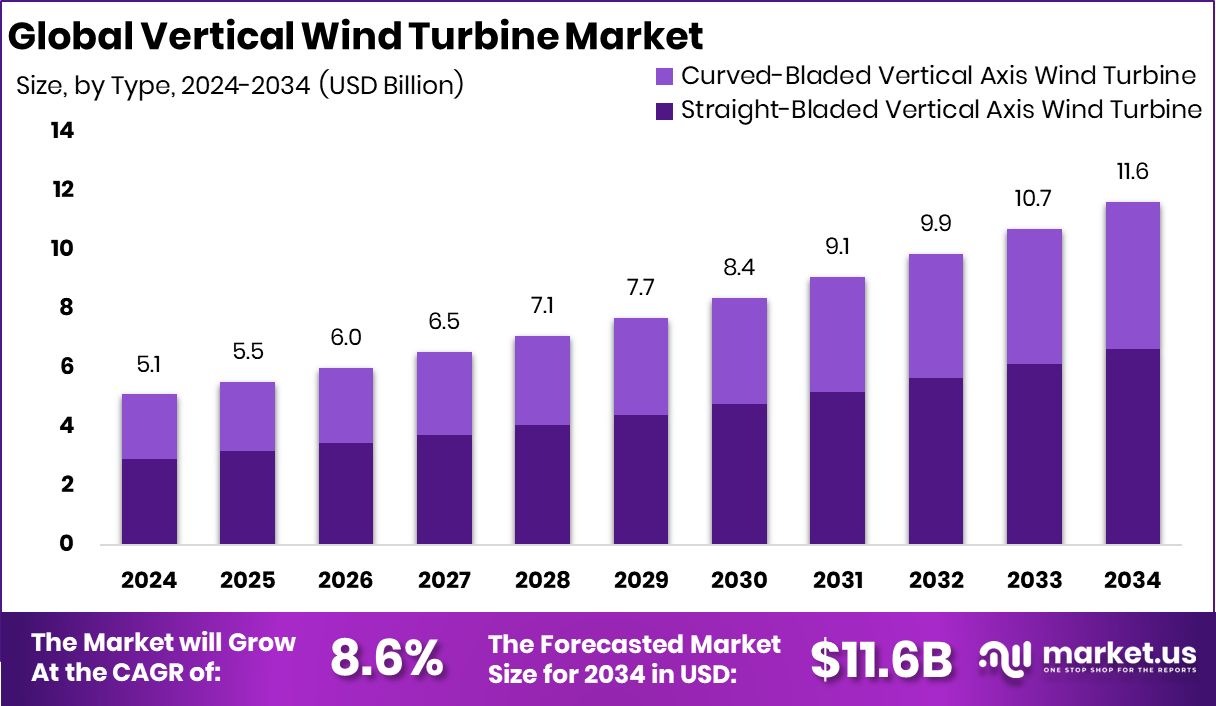
New York, NY – March 23, 2026 – The global vertical wind turbine market is projected to grow significantly, increasing from USD 5.1 billion in 2024 to approximately USD 11.6 billion by 2034, at a CAGR of 8.6%. Asia Pacific leads the sector with a 42.5% share, supported by investments worth USD 2.1 billion. Vertical wind turbines differ from traditional designs by rotating around a vertical axis, allowing them to capture wind from any direction. This makes them especially effective in urban, coastal, and turbulent wind environments. Their compact size, low noise, and simple installation make them suitable for homes, commercial buildings, and community-based energy systems, particularly in low-wind conditions.
Market growth is driven by rising demand for clean, decentralized energy solutions and supportive policies encouraging renewable adoption. Technological improvements in materials and efficiency further enhance their appeal. Investment activity continues to strengthen the ecosystem, including INR 30 crore secured by Wind O&M specialist GreenTech, €135 million allocated by Encavis for renewable assets in Spain, and a $500K grant awarded by the NSF to WindSTAR, all contributing to innovation and operational capabilities.
Increasing awareness of cost savings from wind energy, highlighted by over £100 billion saved by UK consumers since 2010, boosts adoption. Additionally, major developments such as Ørsted exploring the sale of a stake in an £8.5 billion UK wind project to Apollo signal strong investor confidence, creating opportunities for urban deployment and hybrid renewable integration.
➤ Click the sample report link for complete industry insights: https://market.us/report/global-vertical-wind-turbine-market/request-sample/
Key Takeaways
- The Global Vertical Wind Turbine Market is expected to be worth around USD 11.6 billion by 2034, up from USD 5.1 billion in 2024, and is projected to grow at a CAGR of 8.6% from 2025 to 2034.
- The vertical wind turbine market shows strong dominance as straight-bladed designs capture 57.2% of global preference.
- In the vertical wind turbine market, systems under 1 MW hold a leading 52.4% share worldwide.
- The vertical wind turbine market benefits from the popularity of H-Type rotor configurations, commanding a 78.3% share.
- Residential users significantly shape the vertical wind turbine market, contributing a substantial 39.8% segment share.
- The Asia Pacific’s 42.5% share reflects strong clean-energy adoption worth USD 2.1 Bn.
➤ Directly purchase a copy of the report – https://market.us/purchase-report/?report_id=174595
Market Segments
By Type Analysis
Straight-bladed vertical axis wind turbines hold a dominant 57.2% market share due to their simple structure, durability, and strong performance in turbulent wind conditions. Their ability to operate efficiently regardless of wind direction makes them ideal for urban and off-grid environments. Manufacturers favor this design because it offers lower production costs, easier maintenance, and reliable startup speeds.
Increasing investments in distributed renewable energy and supportive government policies are boosting adoption. Demand continues to grow as users seek quiet, compact, and efficient solutions suitable for rooftops, microgrids, and hybrid systems, reinforcing this segment’s leading position.
By Power Outlook Analysis
The less than 1 MW segment leads with a 52.4% share, driven by rising demand for small-scale renewable energy systems across residential, commercial, and small industrial applications. These turbines are preferred due to lower installation costs, simpler permitting processes, and suitability for decentralized energy generation. They are widely used for backup power, hybrid solar-wind systems, and electrification in remote areas.
Government initiatives promoting household-level renewable adoption further support growth. Technological advancements improving efficiency, blade design, and low-wind performance continue to enhance their appeal, making sub-1 MW systems essential for reliable, cost-effective distributed energy solutions.
By Rotor Configuration Analysis
H-type rotor configurations dominate the market with a 78.3% share, making them the most widely used vertical wind turbine design. Their strong aerodynamic stability, high torque output, and efficiency in low and variable wind conditions make them suitable for diverse environments. These turbines operate with reduced noise and vibration while maintaining strong mechanical balance, ensuring durability over time.
They are commonly used in building-mounted systems, small wind farms, and hybrid microgrids. Ongoing innovations in composite materials, magnetic levitation, and lightweight designs continue to improve performance, supporting the segment’s continued dominance in global clean energy deployment.
By End User Analysis
The residential segment accounts for 39.8% of the market, reflecting growing adoption of vertical wind turbines for household energy generation. Homeowners prefer these systems for their quiet operation, compact size, and efficiency in turbulent urban wind conditions. Rising electricity costs and increasing awareness of sustainability are encouraging individuals to invest in personal renewable energy solutions.
Government incentives, rooftop wind programs, and hybrid solar-wind installations are further accelerating adoption. Residential users benefit from easy installation, low maintenance, and the ability to supplement grid power, making vertical turbines a practical and accessible solution for decentralized clean energy in urban areas.
Regional Analysis
Asia Pacific dominates the vertical wind turbine market with a 42.5% share, valued at USD 2.1 billion, driven by strong adoption of small-scale renewable systems in urban and semi-urban areas. The region benefits from rising demand for distributed clean energy and the suitability of vertical turbines for dense city environments.
North America is witnessing steady growth as residential and commercial users adopt compact wind systems for localized power generation, particularly in areas with inconsistent wind patterns. Europe continues to expand through community-based energy initiatives and demand for quiet, space-efficient solutions.
The Middle East & Africa region shows gradual adoption, mainly through hybrid solar-wind systems in remote areas, while Latin America is steadily growing with increased installations in rural and peri-urban regions seeking affordable renewable energy options.
Top Use Cases
- Rooftop Power for Homes & Buildings: Vertical wind turbines are widely used on rooftops to generate electricity for homes, offices, and apartments. They work well in cities because they can handle changing wind directions and low wind speeds. These systems can power lights, small devices, and reduce electricity bills.
- Urban Street Lighting: These turbines are used to power street lights in cities. Since they are small, quiet, and safe, they can be installed near roads or public areas. They generate clean energy locally without needing large wind farms.
- Community Buildings & Public Facilities: Vertical turbines can supply power to community centers, schools, or small public buildings. For example, small turbines installed on rooftops can run lights and fans, helping reduce energy costs and support local energy needs.
- Remote & Rural Electrification: In remote areas, vertical wind turbines help generate electricity where grid access is limited. They are useful for small power needs like lighting, charging devices, or running basic equipment.
- Telecom & Small Equipment Power: They are used to power small telecom stations, sensors, and mobile systems. Because they are compact and cost-effective, they are ideal for locations needing a reliable, low-energy power supply.
Notable Company Developments
- In May 2025, SeaTwirl launched a new two-blade floating vertical wind turbine based on its patented technology. This design aims to improve efficiency, reduce cost, and simplify offshore installation and maintenance.
- In November 2024, the company opened an equity crowdfunding campaign, allowing everyday people to invest in its vertical wind turbine projects. This supports its goal of making clean energy more accessible and expanding urban wind installations.
- In March 2024, Ryse Energy partnered with U-Solar to deliver a hybrid wind, solar, and battery project for three islands in Sri Lanka. This project uses their wind turbine technology to provide reliable, clean electricity in remote locations.
Conclusion
The vertical wind turbine market is growing steadily as demand rises for compact, efficient, and clean energy solutions. These turbines are well-suited for urban and decentralized applications due to their ability to work in low and turbulent wind conditions. Increasing investments, supportive policies, and technological improvements are driving adoption across residential, commercial, and small-scale industrial sectors. As the focus on sustainability and local power generation strengthens, vertical wind turbines are expected to play an important role in the future renewable energy landscape.
Discuss your needs with our analyst
Please share your requirements with more details so our analyst can check if they can solve your problem(s)