Table of Contents
Overview
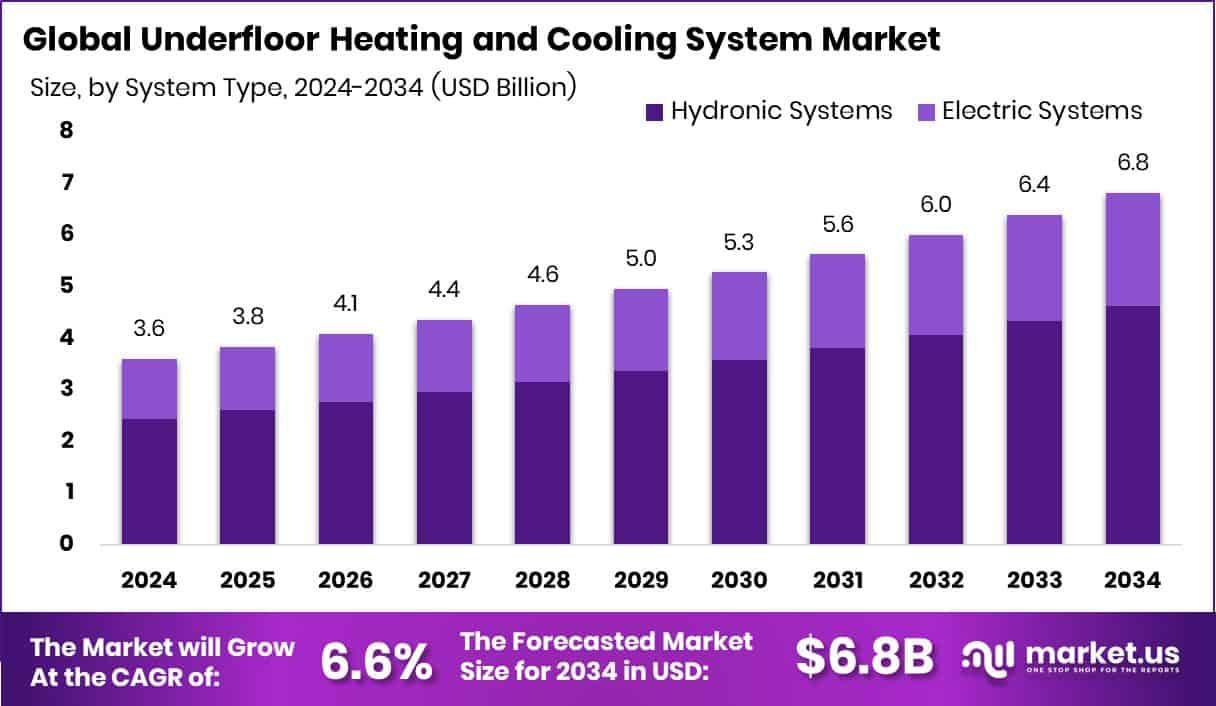
New York, NY – December 10, 2025 – The global underfloor heating and cooling system market is projected to grow steadily, reaching around USD 6.8 billion by 2034, up from USD 3.6 billion in 2024, supported by a 6.6% CAGR between 2025 and 2034. Europe plays a leading role, accounting for 43.40% of global demand, with a regional value of about USD 1.5 billion, driven by strict energy-efficiency rules and low-carbon building goals.
Underfloor heating and cooling systems regulate indoor temperature by circulating warm or cool water, or electric elements, beneath floor surfaces. This approach delivers even comfort, minimizes drafts and noise, and improves energy efficiency compared to conventional HVAC systems. As a result, these solutions are increasingly adopted in residential housing, offices, and public facilities.
Strong government and private funding is a major growth drivers. Key examples include USD 273 million secured for Manhattan rehabilitation projects, a USD 169 million fund supporting U.S. heat pump manufacturing, and USD 40 million in Washington State grants for electric heating and cooling installations. Adoption is also visible in localized projects, such as USD 14.4 million awarded in Colorado for geothermal energy, a USD 1.2 million grant for the Village of Chase arena upgrades, and USD 3 million provided to Hydronic Shell Technologies in Syracuse.
Looking ahead, the strongest opportunity lies in retrofitting aging public buildings and expanding geothermal-integrated underfloor systems, offering long-term energy savings, lower emissions, and improved indoor comfort.
➤ Click the sample report link for complete industry insights: https://market.us/report/global-underfloor-heating-and-cooling-system-market/request-sample/
Key Takeaways
- The Global Underfloor Heating and Cooling System Market is expected to be worth around USD 6.8 billion by 2034, up from USD 3.6 billion in 2024, and is projected to grow at a CAGR of 6.6% from 2025 to 2034.
- Hydronic systems lead the Underfloor Heating and Cooling System Market with 67.9% share due to energy-efficient water-based heat transfer.
- Heating and cooling pipes and cables hold a 37.1% share in the Underfloor Heating and Cooling System Market, driven by durable infrastructure demand.
- New installations dominate the Underfloor Heating and Cooling System Market at 72.4%, supported by green building construction growth.
- Residential applications account for 57.6% of the Underfloor Heating and Cooling System Market, reflecting rising home comfort investments.
- Europe represents a strong demand worth USD 1.5 Bn, holding 43.40% market share region.
➤ Directly purchase a copy of the report – https://market.us/purchase-report/?report_id=168213
Report Scope
| Report Features | Description |
|---|---|
| Market Value (2024) | USD 3.6 Billion |
| Forecast Revenue (2034) | USD 6.8 Billion |
| CAGR (2025-2034) | 6.6% |
| Segments Covered | By System Type (Hydronic Systems, Electric Systems), By Component (Heating/Cooling Pipes and Cables, Manifolds and Control Units, Insulation and Panels, Sensors and Thermostats, Others), By Installation Type (New Installation, Retrofit Installation), By End-User (Residential, Commercial, Industrial) |
| Competitive Landscape | Danfoss A/S, Uponor Corporation, Emersion Electric Co, Honeywell International, Robert Bosch, Pentair PLC, Mitsubishi Electric Corporation, Schneider Electric SE, Siemens AG, Nexans S.A |
Key Market Segments
By System Type Analysis
In 2024, hydronic systems led the By System Type segment of the underfloor heating and cooling system market, accounting for a dominant 67.9% share. This strong position reflects growing preference for water-based floor systems that deliver uniform indoor temperatures while minimizing energy losses. By circulating warm or cool water beneath floor surfaces, hydronic setups ensure consistent comfort without sharp temperature swings.
These systems are especially valued for their high energy efficiency and seamless integration with modern, low-energy, and sustainable building designs. Their ability to support both heating in winter and cooling in summer using the same infrastructure adds to their functional appeal across residential, commercial, and public buildings.
Additional advantages such as quiet operation, effective heat transfer, and long operational life further strengthen their market adoption. Together, these features make hydronic systems the most widely used and trusted solution within this segment, helping them maintain clear leadership in the underfloor heating and cooling system market.
By Component Analysis
In 2024, heating and cooling pipes and cables held a leading position in the By Component segment of the underfloor heating and cooling system market, capturing a 37.1% share. Their dominance is linked to their critical function in transferring heat or cooling evenly beneath floor surfaces, directly shaping system efficiency and indoor comfort.
These components act as the main working layer within underfloor systems, affecting thermal performance, reliability, and long-term durability. By enabling uniform temperature distribution, pipes and cables help limit energy losses while keeping indoor conditions stable. Their design allows easy integration into floor structures, making them suitable for both new buildings and renovation projects.
A long service life combined with steady thermal output continues to drive strong demand. As a result, heating and cooling pipes and cables remain the most essential and widely adopted components within this market segment.
By Installation Type Analysis
In 2024, new installation led the By Installation Type segment of the underfloor heating and cooling system market, accounting for a dominant 72.4% share. This leadership highlights the rising preference for installing underfloor systems during initial building construction, when layouts and system performance can be planned efficiently from the outset.
New installations allow for optimized floor design, seamless system integration, and higher long-term energy efficiency compared to retrofit options. Developers and property owners favor this approach to achieve stable indoor comfort while minimizing future repair or maintenance issues.
Embedding heating and cooling components directly into floor structures ensures dependable operation throughout the building’s lifespan. This combination of performance reliability, design flexibility, and reduced lifecycle challenges continues to make new installations the most preferred and dominant option within this market segment.
By End-User Analysis
In 2024, the residential segment dominated the end-user landscape of the underfloor heating and cooling system market, accounting for a 57.6% share. This leading position is driven by the growing use of floor-based comfort solutions in homes to achieve uniform temperature control and improved everyday living conditions.
Underfloor systems suit residential spaces due to their quiet operation, ability to eliminate visible radiators or equipment, and efficient distribution of heating and cooling across multiple rooms. Homeowners increasingly prefer these systems for maintaining steady indoor temperatures while preserving interior design flexibility.
Strong adoption during new home construction and major renovation projects further supports residential demand. The ease of embedding heating and cooling elements into floor structures enhances long-term reliability and comfort. Together, these advantages continue to position the residential sector as the largest and most influential end-user segment within the global market.
Regional Analysis
Europe leads the underfloor heating and cooling system market, holding a dominant 43.40% share valued at USD 1.5 billion. This leadership is driven by widespread use of energy-efficient construction methods, strict building standards, and strong demand for uniform indoor comfort. High adoption across residential renovations and new housing continues to strengthen Europe’s mature market position.
North America is expanding steadily as awareness grows around indoor comfort, space-saving heating solutions, and efficient building design. Demand is rising in residential and light commercial projects, especially in premium and climate-controlled properties.
Asia Pacific is emerging rapidly, supported by urbanization, infrastructure growth, and large-scale residential construction, creating increasing opportunities for system adoption.
The Middle East & Africa market is progressing gradually, mainly in high-end developments where efficient cooling is critical. Latin America shows early growth, driven by urban housing expansion and rising acceptance of modern temperature control systems.
Top Use Cases
- Warm, cozy floors in homes during winter: Underfloor heating spreads gentle, even warmth from the floor up through rooms. This eliminates cold spots and makes walking around barefoot or with kids safe and comfortable.
- Year-round comfort: heating in winter, cooling in summer: Many underfloor systems circulate warm water in winter and chilled water in summer — so the same setup can heat in cold months and cool rooms when it’s hot.
- Energy savings and lower bills: Because underfloor systems operate at lower temperatures than traditional radiators and distribute heat over a large floor area, they use less energy — reducing heating and cooling costs.
- Cleaner air and better health for allergy-sensitive people: These systems heat or cool without forced air movement, reducing dust circulation, allergens and mold risk — helping people with asthma, allergies or respiratory issues.
- More flexible use of interior space: Since there are no bulky radiators or wall-mounted units, underfloor systems free up wall space. That means homeowners or building designers can place furniture or configure rooms more freely.
- Comfortable climate for commercial or large spaces: Offices, shops, schools, and public buildings benefit from underfloor heating/cooling for steady indoor comfort, energy efficiency, and quieter environments — better for productivity and comfort than noisy ducts or radiators.
Recent Developments
- In October 2024, Uponor launched a new pipe product called Uponor ServicePEX (PEX-a piping technology) for water service applications. This pipe is designed for clean, safe water from the main supply to buildings. Though it’s aimed at plumbing, its durable PEX-a technology reflects Uponor’s commitment to long-lasting, high-quality flow solutions that also support heating/cooling infrastructure.
- In March 2024, Danfoss launched Danfoss Ally, a new smart-heating control system. It allows homeowners to manage heating and floor-heating via a mobile app or voice control, offering easier scheduling, remote access, and up to 30 % energy savings
Conclusion
The underfloor heating and cooling system market continues to gain importance as buildings move toward more comfortable, efficient, and modern indoor climate solutions. These systems offer quiet operation, even temperature distribution, and better space utilization, making them well suited for homes, offices, and public buildings.
Growing focus on sustainable construction and long-term energy efficiency supports wider adoption. Integration with modern heating sources and cooling technologies further improves system appeal.
As new construction and renovation projects increasingly prioritize comfort, design flexibility, and lower operating impact, underfloor heating and cooling systems are expected to remain a preferred solution for improving indoor living and working environments worldwide.
Discuss your needs with our analyst
Please share your requirements with more details so our analyst can check if they can solve your problem(s)