Table of Contents
Overview
New York, NY – March 26, 2026 – The specialty crops for cosmetics market is evolving as demand grows for plant-based ingredients used in beauty and personal care products. These crops—such as botanicals, essential oils, plant extracts, and seed-derived ingredients—are cultivated specifically to deliver natural fragrance, functional benefits, and skin or hair nourishment. Their appeal lies in being clean-label, traceable, and aligned with consumer preferences for safer, nature-driven formulations.
This market spans the full value chain, including cultivation, extraction, processing, and formulation of plant-derived compounds. Expansion is driven by a shift toward sustainability and ethical sourcing, encouraging brands to integrate eco-friendly ingredients into their products.
Investment activity is accelerating innovation in this space. Secret Alchemist raised $500K in seed funding to advance natural ingredient development and strengthen sourcing capabilities. Similarly, Colipi secured EUR 1.8 million to support bio-based ingredient technologies, while Cano-ela obtained €1.6 million to expand seed-based ingredient applications.
Academic collaboration is also playing a role. University of Mississippi entered a $5 million research agreement, highlighting growing scientific interest in essential-oil-based actives. Such efforts enhance validation, innovation, and future adoption of specialty crops in premium cosmetic formulations.
➤ Click the sample report link for complete industry insights: https://market.us/report/specialty-crops-for-cosmetics-market/request-sample/
Key Takeaways
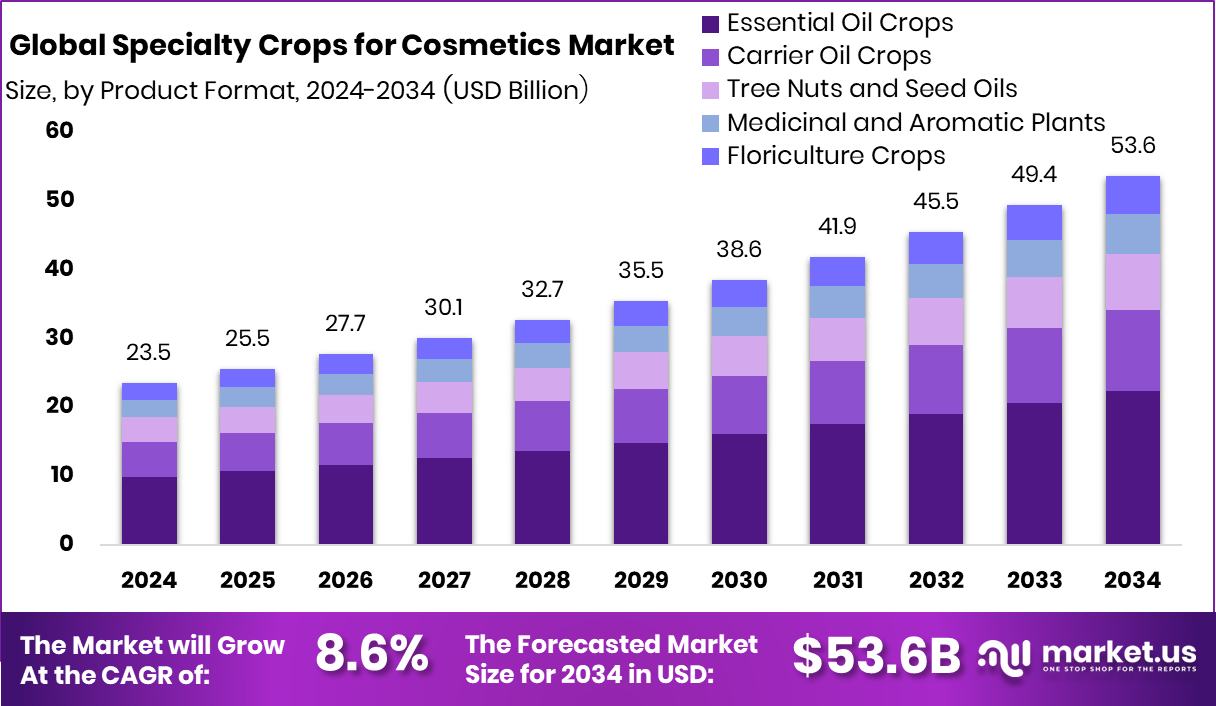
- The Global Specialty Crops for Cosmetics Market is expected to be worth around USD 53.6 billion by 2034, up from USD 23.5 billion in 2024, and is projected to grow at a CAGR of 8.6% from 2025 to 2034.
- Essential oil crops dominate specialty cosmetic ingredients, driving natural formulations with their strong 41.8% market share.
- Steam-distilled essential oils lead cosmetic applications, reflecting rising demand for pure extracts at 44.3% share.
- In 2024, Europe maintained 36.1% dominance, generating USD 8.4 Bn revenue.
➤ Directly purchase a copy of the report – https://market.us/purchase-report/?report_id=174816
Market Segments
By Product Format (Essential Oil Crops)
Essential oil crops lead the specialty crops for the cosmetics market, accounting for 41.8% of the share in 2024. Their dominance is driven by increasing demand for natural, plant-based ingredients in skincare, haircare, and aromatherapy. Oils such as lavender, rosemary, chamomile, and tea tree are widely used for their antimicrobial, antioxidant, and calming benefits.
Growing consumer preference for clean-label and sustainably sourced products is pushing brands to adopt botanical oils. In addition, the rise of premium cosmetics and wellness-focused beauty routines is fueling demand for organic, cold-pressed oils used in serums, treatments, and holistic formulations.
By Consumer Segment (Steam-Distilled Essential Oils)
Steam-distilled essential oils hold a leading 44.3% share in the consumer segment, supported by their purity, stability, and suitability for high-end cosmetic formulations. This extraction method is widely preferred for flowers, herbs, and aromatic crops used in perfumes, skincare, and personal care products. Increasing demand for toxin-free and minimally processed ingredients is boosting their popularity, as steam distillation ensures cleaner processing and safety. Luxury brands favor these oils for their consistent quality and enhanced sensory appeal, while manufacturers benefit from reliable yields, driving further growth in cosmetic-grade essential oil crop production.
Regional Analysis
Europe leads the specialty crops for cosmetics market with a 36.1% share valued at USD 8.4 billion, driven by strong demand for natural formulations and a well-established cosmetic industry. North America shows steady growth due to clean beauty trends and increasing use of plant-based ingredients. The Asia Pacific region is expanding rapidly, supported by rising beauty industries and interest in herbal extracts. Meanwhile, the Middle East & Africa are gradually adopting premium cosmetic products, and Latin America continues to grow with the use of locally sourced botanical ingredients in regional beauty formulations.
Top Use Cases
- Natural Anti-Aging Skincare: Plant extracts and essential oils are widely used in anti-aging creams and serums. They contain antioxidants that help reduce wrinkles, fine lines, and skin damage caused by pollution and sunlight.
- Acne and Skin Treatment Products: Specialty crops like tea tree and chamomile are used in creams and gels to treat acne, redness, and skin irritation. Their antimicrobial and anti-inflammatory properties help improve skin conditions naturally.
- Natural Fragrance in Cosmetics: Essential oils from crops such as lavender, citrus, and eucalyptus are used as natural fragrances in perfumes, creams, and shampoos. They also help replace synthetic chemicals in beauty products.
- Hair Care and Scalp Health: Botanical oils like rosemary and coconut are used in hair oils, shampoos, and conditioners. They help improve scalp circulation, support hair growth, and nourish hair naturally.
- Moisturizing and Skin Nourishment: Seed oils and plant-based oils (like almond or jojoba) are used in lotions and creams to hydrate the skin, repair the skin barrier, and keep it soft and healthy.
- Aromatherapy and Wellness Products: Essential oils are used in aromatherapy products like massage oils and bath products. They help reduce stress, improve mood, and provide relaxation benefits through natural scents.
Notable Company Developments
- In May 2025, Symrise showcased joint innovations with Probi at Vitafoods Europe, focusing on nature-based health and ingredient solutions.
- In July 2024, Givaudan completed the acquisition of b.kolormakeup & skincare, an Italian company that develops makeup and skincare products.
- In March 2024, IFF announced it would sell its Pharma Solutions business to Roquette for up to $2.85 billion. This unit included plant-derived excipients and specialty ingredients.
Conclusion
The specialty crops for cosmetics market is growing steadily as consumers increasingly prefer natural, plant-based, and sustainable beauty products. Ingredients such as essential oils, botanical extracts, and seed oils are becoming key components in skincare, haircare, and wellness formulations due to their safety and effectiveness.
Continuous innovation, supported by funding, research partnerships, and new technologies, is improving ingredient quality and expanding applications. Additionally, rising demand for clean-label and ethically sourced products is strengthening supply chains. Overall, the market is set to advance further, driven by sustainability trends, scientific validation, and the global shift toward nature-inspired cosmetic solutions.
Discuss your needs with our analyst
Please share your requirements with more details so our analyst can check if they can solve your problem(s)