Table of Contents
Overview
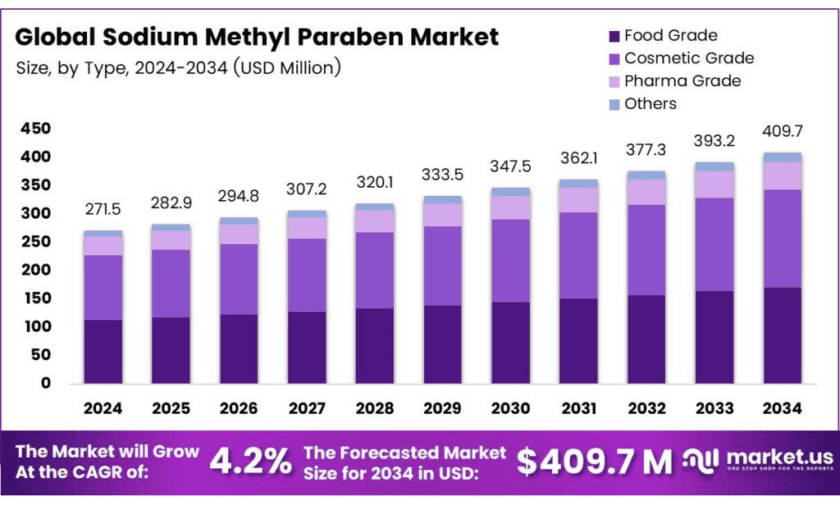
New York, NY – Dec 15, 2025 – The Global Sodium Methyl Paraben Market is projected to reach USD 409.7 million by 2034, rising from USD 271.5 million in 2024 at a steady 4.2% CAGR between 2025 and 2034. Sodium Methyl Paraben, the sodium salt of methylparaben with the formula C₈H₇NaO₃, has been a trusted preservative across food, cosmetic, and pharmaceutical applications for more than five decades. It also occurs naturally in fruits like blueberries, where it exhibits natural antimicrobial activity. Its effectiveness comes from its strong ability to inhibit microbial growth, making it suitable for both topical and ingestible formulations.
Safety assessments from global regulatory bodies further strengthen its acceptance. The EU’s Scientific Committee on Consumer Safety (SCCS) considers methylparaben safe in cosmetics at 0.4% (as acid) when used alone and up to 0.8% when blended with other parabens. JECFA assigns an acceptable daily intake (ADI) of 0–10 mg/kg body weight for methylparaben (E218) and ethylparaben (E214) in food applications. In the U.S., the FDA permits its use in cosmetics without pre-market approval and recognizes it as GRAS in animal feed up to 0.1%. Toxicological studies also support its safety profile, showing it is practically non-toxic through oral or injectable routes and does not exhibit carcinogenic, teratogenic, mutagenic, or embryotoxic effects.
Key Takeaways
- The Global Sodium Methyl Paraben Market is projected to grow from USD 271.5 million in 2024 to USD 409.7 million by 2034, at a CAGR of 4.2%. properties in creams, lotions, and shampoos.
- The Food Industry led applications in 2024 with a 33.8% share, driven by its use in bakery items, sauces, and beverages.
- Asia Pacific dominated the market in 2024 with a 46.8% share, valued at USD 126.8 million, led by strong demand in China, India, Japan, and South Korea.
➤ For a deeper understanding, click on the sample report link: https://market.us/report/global-sodium-methyl-paraben-market/free-sample/
Report Scope
| Market Value (2024) | USD 271.5 Million |
| Forecast Revenue (2034) | USD 409.7 Million |
| CAGR (2025-2034) | 4.2% |
| Segments Covered | By Type (Cosmetic Grade, Food Grade, Pharma Grade, Others), By Application (Food Industry, Pharmaceutical Industry, Textile Industry, Daily Industrial Products, Others) |
| Competitive Landscape | Alta Laboratories, Ueno Fine Chemicals Industry, Mubychem, NBS Biological, Others |
➤ Directly purchase a copy of the report – https://market.us/purchase-report/?report_id=161537
Key Market Segments
By Type Analysis
In 2024, Cosmetic Grade emerged as the leading segment in the By Type analysis of the Sodium Methyl Paraben Market, capturing a 42.2% share. Its dominance comes from its strong antimicrobial efficiency and excellent compatibility with lotions, creams, shampoos, and other personal care formulations. By preventing microbial contamination and extending product shelf life, it remains the preferred choice for global cosmetic manufacturers.
By Application Analysis
In 2024, the Food Industry held the dominant position in the By Application segment, accounting for a 33.8% share. Sodium methyl paraben is widely incorporated into bakery products, sauces, beverages, and packaged meals to prevent bacterial degradation. Growing global consumption of convenient, ready-to-eat foods and stricter food safety regulations underpin the segment’s leading share.
List of Segments
By Type
- Cosmetic Grade
- Food Grade
- Pharma Grade
- Others
By Application
- Food Industry
- Pharmaceutical Industry
- Textile Industry
- Daily Industrial Products
- Others
Regional Analysis
Asia-Pacific remains the leading region in the global Sodium Methyl Paraben market, accounting for 46.8% of the total share and reaching a market value of USD 126.8 million in 2024. Its dominance is driven by the strong presence of large personal care, food processing, and pharmaceutical industries across China, India, Japan, and South Korea—markets known for extensive manufacturing capacity and export-oriented production.
China continues to act as the central hub for chemical synthesis and downstream formulation, benefiting from cost-effective raw materials and integrated industrial clusters. Meanwhile, India is strengthening its position through government-backed initiatives such as Make in India and the Production Linked Incentive (PLI) schemes, which support pharmaceutical and specialty chemical production.
Top Use Cases
Preservative in Cosmetics & Personal Care Products: One of the most common uses of sodium methyl paraben is as a preservative in the cosmetics and personal care industry. Because it is effective at preventing the growth of bacteria, yeast, and molds, it is added to many water-based products like shampoos, conditioners, lotions, creams, face washes, serums, and shower gels. The sodium form dissolves easily in water, which makes it particularly suitable for liquid formulations. Typical recommended use levels in finished cosmetic products range from 0.1% to 0.3% by weight to achieve broad-spectrum antimicrobial protection while maintaining formulation stability.
Pharmaceutical Preservation and Safety: In the pharmaceutical sector, sodium methyl paraben is used to help keep medicines safe and stable. This includes oral liquids, syrups, injectables, and topical creams. Because multi-dose products are opened repeatedly, they have higher risk of becoming contaminated — preservatives like sodium methyl paraben help prevent this. In these applications, typical preservative concentrations vary, but they often fall within 0.015% to 0.2% of the formulation, depending on the type of medicine. This range aligns with pharmacopeial standards such as the United States Pharmacopeia (USP) and National Formulary (NF).
Food Preservation (E219 Food Additive): Sodium methyl paraben is also recognized as a food additive identified by the E number E219, where it serves as an antimicrobial preservative in certain food products. While its use in food is less widespread than in cosmetics or pharmaceuticals, it still plays a role in extending shelf life and preventing spoilage in some processed foods and beverages. In some regulatory frameworks, parabens — including methylparaben and its sodium salt — are considered GRAS (Generally Recognized as Safe) for use in food when used under prescribed limits, such as no more than 0.1% of the product’s weight in many cases. This helps maintain food safety and reduces waste in distribution and retail settings.
Industrial and Technical Uses: Beyond the main consumer-facing industries, sodium methyl paraben’s antimicrobial properties have applications in industrial and technical sectors. For example, it can be used as part of maintenance formulations to prevent bacterial or fungal growth in fluids stored in factories and warehouses. It may also serve as a fungicide in biological research settings or in the preservation of non-food laboratory media, often at low concentrations such as 0.1% for specific uses.
Auxiliary Applications in Textiles and Materials: While less common, sodium methyl paraben can be included in textile processing as an auxiliary antimicrobial agent to protect dyes and finishing solutions from microbial deterioration during storage. This helps ensure consistent color quality and reduces waste due to spoilage before fabrics reach manufacturing lines.
Recent Developments
Alta Laboratories Ltd., based in Mumbai, India, is a long-standing chemical manufacturer and supplier of preservatives including methyl paraben sodium (sodium methyl paraben) and related compounds, serving industries such as pharmaceuticals and personal care in 2024–2025. The company offers white crystalline sodium methyl paraben products in various bulk quantities (e.g., 1 kg–1 MT), supporting formulation needs with water-soluble preservative grades suitable for creams, lotions, and syrups. Alta’s product offerings also include methyl paraben IP/BP/USP and sodium paraben variants, reflecting its broad engagement in preservative-grade chemicals across domestic markets.
Ueno Fine Chemicals Industry, a Japanese specialty chemical producer, manufactures sodium methyl p-hydroxybenzoate (sodium methylparaben) as part of its paraben preservative portfolio for cosmetics, pharmaceuticals, and food applications in 2024–2025. Their product line includes various paraben derivatives such as methylparaben and ethylparaben, which are recognized for low toxicity and effective antimicrobial protection against molds and yeasts. Ueno’s focus on leveraging Japanese technology and ongoing material development positions it as a key supplier of preservative chemicals used to ensure product stability and safety in formulation industries.
Mubychem Pvt. Ltd. is an established Indian manufacturer and exporter of specialty chemicals, pharmaceutical excipients and preservative compounds, including sodium methyl paraben in various pharmaceutical, food and cosmetic grades as of 2024–2025. The company, which operates GMP-certified facilities and supplies high-purity antimicrobial preservatives for formulations, is known for offering products meeting IP, BP, USP, FCC and ACS standards suitable for global use. Mubychem supports bulk industrial buyers and formulation companies with reliable preservative chemicals that help extend product shelf life and meet safety requirements in creams, syrups and food additives.
NBS Biologicals (NBSbio) distributes a range of biochemical and laboratory reagents, including preservative chemicals related to parabens such as methyl paraben as of 2024–2025, which is closely related to sodium methyl paraben in preservative use. While its catalogue does not explicitly list sodium methyl paraben, NBS Biological supplies methyl-4-hydroxybenzoate (methyl paraben) reagent grades used in research, quality control and formulation studies supporting preservative effectiveness testing. Their focus is on making quality biochemical reagents accessible for scientific research and formulation development in laboratories working with antimicrobial and preservative chemistry.
Conclusion
In conclusion, Sodium Methyl Paraben has maintained its role as an important preservative across multiple industries due to its reliable antimicrobial properties and broad regulatory acceptance. As the sodium salt of methylparaben (E219), it is widely used in cosmetics and personal care products to prevent microbial growth and extend shelf life, with typical use levels in formulations falling between 0.1% and 0.3% of the finished product. This preservative is approved for such purposes in many regions, including the U.S. where it does not require special pre-market approval and is treated like other cosmetic ingredients under federal law.
Discuss your needs with our analyst
Please share your requirements with more details so our analyst can check if they can solve your problem(s)