Table of Contents
Overview
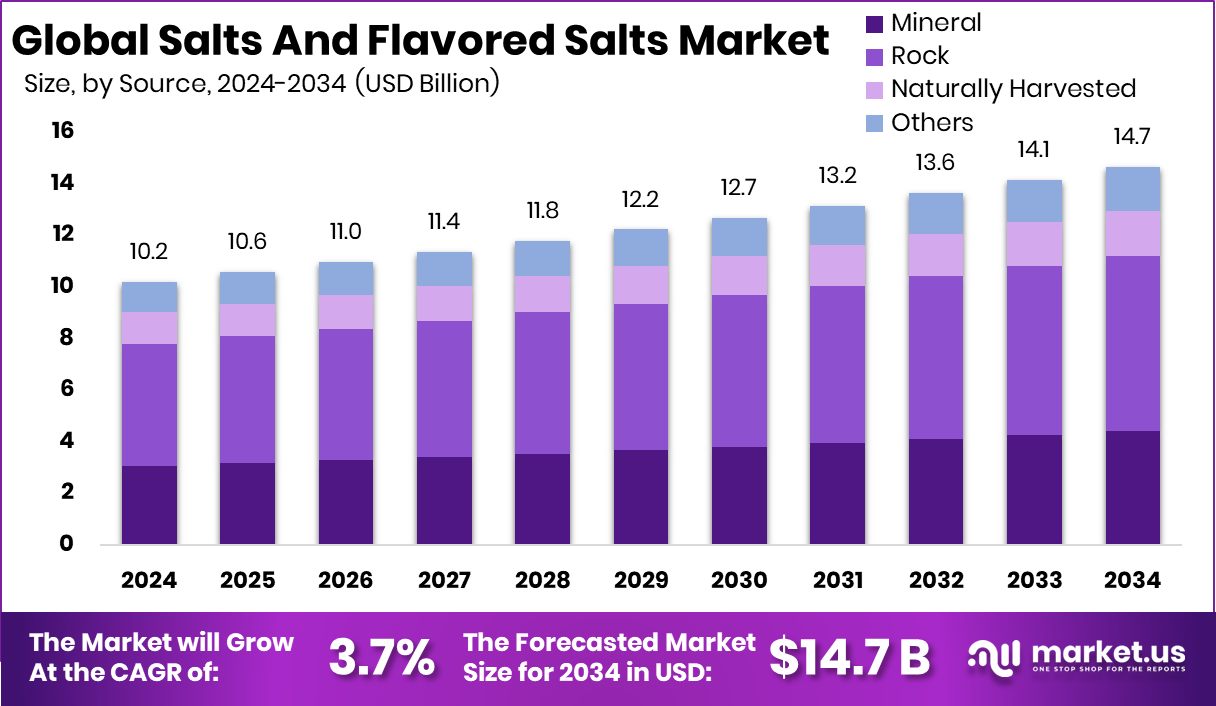
New York, NY – March 12, 2026 – The global salts and flavored salts market is projected to reach USD 14.7 billion by 2034, increasing from USD 10.2 billion in 2024, with a CAGR of 3.7% from 2025 to 2034. North America accounts for a significant share of the market, representing 34.20%, valued at USD 3.4 billion.
Salt remains a fundamental ingredient in cooking, widely used to enhance flavor, balance taste, and preserve food. While traditional salt is a daily kitchen staple, flavored salts combine salt with herbs, spices, or natural seasonings to create more complex flavors. These products are commonly used in home cooking, restaurants, and packaged food manufacturing because they provide convenient flavor enhancement without requiring complicated preparation.
The market includes the production, processing, and distribution of both standard and specialty salts through retail and foodservice channels. Consumer purchasing patterns reflect demand for both everyday salt and premium flavored varieties that offer convenience and culinary variety. Growth in this sector is closely tied to evolving food habits, the expansion of packaged foods, and changing consumer flavor preferences.
A notable driver is the growing interest in clean-label and alternative food products. Startups in the mycelium-based food segment highlight this shift. MyForest Foods raised USD 15 million in a Series A-2 funding round, while Matr Foods secured USD 23 million to expand production of clean-label mycelium meat. These emerging products still depend on salt and seasoning to deliver appealing taste.
At the same time, more consumers are cooking at home and looking for simple ways to improve meals. Flavored salts offer an easy seasoning solution without relying on sauces or artificial additives. They also complement plant-based and protein-alternative foods that require balanced seasoning to satisfy consumer expectations.
Opportunities in the market are supported by evolving food formats and lifestyle trends. Broader economic realities—such as managing life on a USD 45,000 salary in Washington, D.C.—illustrate the growing importance of affordable home cooking. As a result, cost-effective seasonings like salt continue to play a vital role in both everyday meals and premium culinary experiences, supporting steady long-term demand.
➤ Click the sample report link for complete industry insights: https://market.us/report/salts-and-flavored-salts-market/request-sample/
Key Takeaways
- The Global Salts And Flavored Salts Market is expected to be worth around USD 14.7 billion by 2034, up from USD 10.2 billion in 2024, and is projected to grow at a CAGR of 3.7% from 2025 to 2034.
- In the Salts and Flavored Salts Market, table salt dominates product type, holding 83.2% share.
- Rock salt leads the source in the Salts and Flavored Salts Market, accounting for 46.4% share.
- Supermarket and hypermarket channels dominate the salts and flavored salts market distribution, capturing 42.7% of sales share.
- North America region generated USD 3.4 Bn with 34.20% market share Salts Flavored.
➤ Directly purchase a copy of the report – https://market.us/purchase-report/?report_id=174225
Market Segments
By Product Type Analysis
In 2024, table salt remained the most dominant product type in the salts and flavored salts market, accounting for 83.2% of total demand. Its strong position is driven by widespread daily use in households, restaurants, and packaged food manufacturing. Table salt is favored for its affordability, long shelf life, and consistent performance in cooking and food preservation.
Food processors rely on refined table salt to maintain uniform taste, texture, and product stability. Even as consumers explore gourmet and flavored salts, table salt continues to be a staple purchase, particularly in emerging urban markets. Its accessibility, stable pricing, and deep integration into everyday diets ensure it remains the leading product category across the global salts and flavored salts market.
By Source Analysis
By source, rock salt led the salts and flavored salts market in 2024 with a 46.4% share. The segment’s strength is largely linked to consumer preference for naturally sourced and minimally processed food ingredients. Rock salt is often perceived as purer and closer to its natural state, aligning with the growing clean-label trend and traditional food preferences.
Many consumers also associate rock salt with the presence of natural minerals, which supports its popularity in household cooking and food processing. In developing regions, rock salt remains widely used due to its local availability and cost efficiency. Additionally, manufacturers frequently use rock salt as a raw material for refining and flavor infusion, reinforcing its importance within the market.
By Distribution Channel Analysis
In 2024, supermarkets and hypermarkets dominated the distribution channel segment, capturing 42.7% of total sales in the salts and flavored salts market. These large retail outlets attract consumers by offering a broad selection of salt products, including table salt, rock salt, and flavored varieties. Shoppers benefit from the ability to compare brands, packaging sizes, and prices in one location, making these stores a preferred purchasing destination.
Promotional offers, discounts, and bulk packaging also encourage higher sales volumes. For manufacturers, supermarkets and hypermarkets provide strong product visibility and valuable shelf space, helping strengthen brand recognition and encourage impulse buying as organized retail continues expanding in urban areas.
Regional Analysis
The Salts and Flavored Salts Market shows notable regional differences in consumption patterns, retail systems, and product preferences. North America leads the market with a 34.20% share, valued at USD 3.4 billion, supported by strong household usage, high packaged food consumption, and wide availability through organized retail. Consumers frequently purchase both table salt and flavored varieties for home cooking and processed foods, maintaining a stable demand.
Europe follows with steady demand driven by traditional cooking practices and increasing interest in specialty and flavored salts. Asia Pacific represents a high-volume market where salt remains an essential daily ingredient due to large populations and diverse cuisines.
In the Middle East & Africa, demand is tied to traditional diets and food preservation, while Latin America shows balanced consumption supported by home cooking and expanding retail availability.
Top Use Cases
- Flavor Enhancement in Cooking: Salt and flavored salts are mainly used to improve the taste of food. When added during cooking, salt helps bring out the natural flavors of ingredients and balances sweetness, bitterness, and acidity in dishes. Flavored salts combine salt with herbs or spices, giving food extra taste without needing many ingredients. This makes cooking easier and more flavorful.
- Food Preservation: Salt is widely used to preserve food and extend shelf life. It works by drawing moisture out of food and microorganisms, which slows down or stops bacterial growth. This method helps keep foods safe for longer periods and has been used for centuries in many cultures.
- Processed and Packaged Food Production: Salt is an important ingredient in processed foods. It helps control microbial growth, improves flavor, and maintains the texture and stability of food products such as meats, snacks, and ready-to-eat items. These functions make salt essential in food manufacturing.
- Quick Seasoning for Home Cooking: Flavored salts provide a simple way to season food quickly. Because they already contain salt mixed with herbs, spices, or other flavorings, they reduce the need to add multiple ingredients separately. This saves time while still giving dishes a richer taste.
- Fermentation and Pickling: Salt plays an important role in fermentation and pickling processes. It helps create an environment where beneficial bacteria grow while harmful microbes are controlled. This process helps develop flavor and improves the shelf life of fermented foods.
- Nutritional and Body Functions: Salt contains sodium, which is necessary for important body functions. Small amounts help maintain fluid balance, support nerve signals, and help muscles contract and relax. Because of these roles, salt is an essential mineral in the human diet when consumed in moderate amounts.
Notable Company Developments
- In February 2026, Tata Chemicals announced an investment of ₹515 crore to build a new greenfield manufacturing facility in Tamil Nadu to produce Iodised Vacuum Salt Dried (IVSD). The plant will have a capacity of 210 KTPA and aims to strengthen salt supply, improve distribution efficiency, and support growing demand for iodised salt in southern India.
- In November 2025, AkzoNobel announced a merger agreement with Axalta Coating Systems to combine both companies in an all-stock merger. The deal aims to create a large global coatings company with stronger innovation capabilities, wider product offerings, and expanded global reach. The combined business is expected to serve customers across multiple industries with improved technology and supply capabilities.
- In March 2024, McCormick launched four new seasoning blends for its foodservice portfolio. The products included Grill Mates Cracked Black Pepper & Garlic with Sea Salt and Fiery Habanero with Roasted Garlic, designed to help chefs add bold flavors to dishes with ready-to-use seasoning mixes
Conclusion
The salts and flavored salts market continues to remain an essential part of the global food industry due to its strong connection with everyday cooking and food preparation. Salt is a basic ingredient used across households, restaurants, and food manufacturing, while flavored salts add convenience and a unique taste to meals.
Changing consumer preferences toward simple ingredients and natural seasonings are supporting steady demand. Flavored varieties are also gaining attention as people look for easy ways to enhance dishes without complex preparation. As home cooking, packaged foods, and diverse cuisines continue to grow, salts and flavored salts will maintain their importance in both traditional and modern food applications.
Discuss your needs with our analyst
Please share your requirements with more details so our analyst can check if they can solve your problem(s)