Table of Contents
Overview
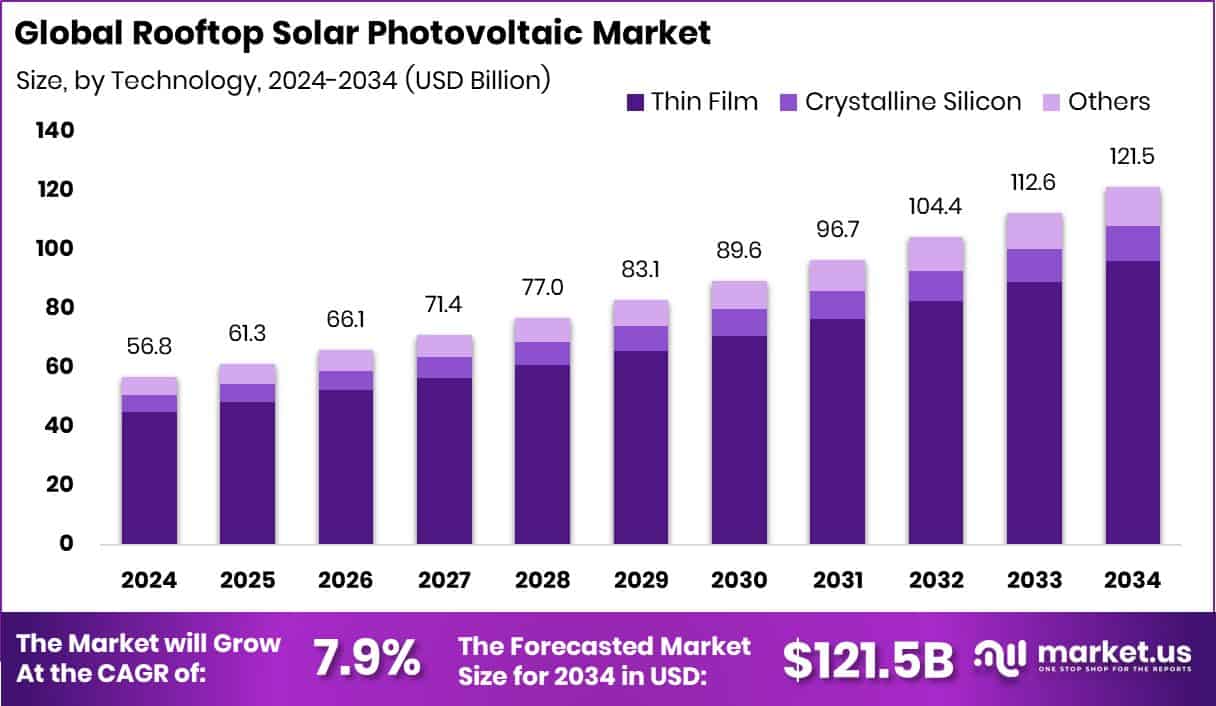
New York, NY – December 08, 2025 – The global Rooftop Solar Photovoltaic Market is expanding steadily, driven by the need for affordable, reliable, and clean electricity generation at the point of use. The market is projected to increase from USD 56.8 billion in 2024 to nearly USD 121.5 billion by 2034, growing at a CAGR of 7.9% between 2025 and 2034. Asia Pacific plays a leading role, holding 34.90% of the global market, valued at around USD 19.8 billion, due to rapid urbanization, supportive government policies, and strong rooftop adoption across residential and commercial buildings.
Rooftop solar photovoltaic systems are installed on building roofs and convert sunlight into electricity using photovoltaic panels. These systems help reduce electricity bills, improve energy independence, and make efficient use of unused roof space. The market includes system sales, installation, maintenance, and energy management services across homes, offices, factories, and public infrastructure.
Growth is supported by rising power tariffs, grid stability concerns, and clean energy incentives. Innovation is also critical. Funding activities highlight this trend, including £1.3 million raised by OPV thin-film start-up Eight19 invested €3.5 million in thin-film equipment manufacturing, $10 million was directed toward improving battery efficiency through advanced coatings, and $2 million was allocated for thin-film solar development. Additional momentum comes from $24 million invested by Invesco funds into thin-film technologies, supporting lightweight panels, storage integration, and scalable rooftop solar solutions aligned with long-term energy transition goals.
➤ Click the sample report link for complete industry insights: https://market.us/report/global-rooftop-solar-photovoltaic-market/request-sample/
Key Takeaways
- The Global Rooftop Solar Photovoltaic Market is expected to be worth around USD 121.5 billion by 2034, up from USD 56.8 billion in 2024, and is projected to grow at a CAGR of 7.9% from 2025 to 2034.
- Crystalline silicon dominated the rooftop solar photovoltaic market with a strong 79.2% share, driven by efficiency.
- On-grid systems dominated the Rooftop Solar Photovoltaic Market, accounting for a commanding 89.1% share overall.
- Residential applications dominated the Rooftop Solar Photovoltaic Market, securing a notable 48.8% share globally.
- In the Asia Pacific, the Rooftop Solar Photovoltaic Market reaches a 34.90% share, USD 19.8 Bn.
➤ Directly purchase a copy of the report – https://market.us/purchase-report/?report_id=167938
Report Scope
| Report Features | Description |
|---|---|
| Market Value (2024) | USD 56.8 Billion |
| Forecast Revenue (2034) | USD 121.5 Billion |
| CAGR (2025-2034) | 7.9% |
| Segments Covered | By Technology (Thin Film, Crystalline Silicon, Others), By Grid Type (On Grid, Off Grid), By Application (Residential, Commercial, Industrial) |
| Competitive Landscape | 3M, Philips N.V., Pentair PLC, Panasonic, Unilever PLC, LG Electronics, EcoWater Systems, A.O. Smith, Cilligan International, Kinetico Incorporated |
Key Market Segments
By Technology Analysis
In 2024, Crystalline Silicon dominated the By Technology segment of the Rooftop Solar Photovoltaic Market, accounting for a 79.2% market share. This strong position is largely due to its proven reliability and long-standing performance record across residential, commercial, and industrial rooftop applications. Building owners prefer crystalline silicon panels because they provide steady electricity generation over extended lifespans, helping deliver predictable energy output and long-term savings.
The technology benefits from a mature manufacturing ecosystem and widely standardised installation methods, which allow quicker and more cost-effective rooftop deployment in both urban and semi-urban areas. Crystalline silicon modules also maintain consistent efficiency under changing weather conditions, improving overall returns on investment for system owners.
These technical and operational strengths continue to build strong customer trust and support high adoption rates. As a result, crystalline silicon remains the preferred rooftop solar technology where performance stability, reliability, and long-term value are critical decision-making factors.
By Grid Type Analysis
In 2024, the On-Grid segment led the By Grid Type category of the Rooftop Solar Photovoltaic Market, capturing a dominant 89.1% market share. This leadership is mainly due to the simple integration of rooftop solar systems with existing electricity networks, which allows users to efficiently manage power generation and consumption.
On-grid systems enable excess electricity produced during peak sunlight hours to be exported back to the utility grid, improving energy utilisation and supporting stable financial returns. Since these systems do not rely heavily on large battery storage, they involve lower installation complexity and reduced maintenance requirements. This makes them especially appealing for urban residential users and commercial properties.
Dependable grid access also assures a continuous power supply during periods of low solar output, enhancing system reliability. These practical and economic benefits continue to drive widespread adoption, reinforcing on-grid systems as the most preferred configuration within the rooftop solar market.
By Application Analysis
In 2024, the Residential segment led the By Application category of the Rooftop Solar Photovoltaic Market, accounting for a 48.8% market share. This dominant position underscores the growing preference among homeowners to install rooftop solar systems as a means to reduce long-term electricity bills and enhance control over daily energy usage.
Residential buildings offer easily accessible roof space, allowing solar installations without the need for extra land or complex construction. This makes deployment simpler and more cost-effective compared to other applications. Growing awareness of clean and renewable energy at the household level has also encouraged wider adoption, as residents increasingly seek environmentally responsible power solutions.
Additionally, residential users benefit from predictable energy generation, improved energy independence, and lower exposure to rising electricity tariffs. These practical and economic advantages continue to support strong demand, reinforcing residential rooftops as the largest application segment within the rooftop solar photovoltaic market.
Regional Analysis
Asia Pacific leads the Rooftop Solar Photovoltaic Market with a 34.90% share, valued at USD 19.8 Bn, supported by rapid urban growth, dense housing patterns, and extensive rooftop availability across residential and commercial buildings. Rising electricity demand and large-scale rooftop deployment across major economies continue to strengthen the region’s dominant position.
North America remains a well-established market, driven by strong residential adoption and high awareness of clean energy benefits. Rooftop systems are widely used to lower grid dependence, supported by reliable policies and advanced installation practices.
Europe shows steady progress due to sustainability-led energy planning, compact urban structures, and widespread rooftop integration in homes and commercial properties, helping ease grid pressure.
The Middle East & Africa region is expanding gradually, benefiting from high solar potential and growing interest in decentralised power solutions.
Latin America is witnessing gradual growth, particularly in urban residential areas, as energy independence and efficient rooftop use gain importance.
Top Use Cases
- Powering Homes & Reducing Electricity Bills: Rooftop solar panels on houses can generate clean electricity for everyday use — lighting, fans, appliances, etc. This reduces dependence on the grid and lowers monthly electricity bills.
- Running Businesses, Offices & Commercial Buildings: Offices, shops, malls, or commercial buildings with good roof space can install solar PV systems to meet their power needs. That helps them cut electricity costs and reduce reliance on grid power — especially useful in places with high electricity tariffs or unstable grid supply.
- Supporting Public Institutions: Schools, Hospitals, Government Buildings: Schools, hospitals, community centres, and other public-use buildings can benefit significantly. Solar systems on their rooftops can lower their energy expenses, making more budget available for other needs.
- Reducing Grid Dependence & Improving Energy Security: By generating electricity on-site, rooftop solar reduces pressure on central power supply and increases resilience — especially in places with frequent outages. Excess power (when more is generated than used) can often be fed back to the grid via net-metering.
- Utilising Unused Roof Space — Turning Wasted Space into Value: Many buildings have rooftops that are not used. Installing solar panels there turns this idle space into productive assets — generating clean energy without needing additional land.
- Environmental Benefits: Clean Energy & Lower Carbon Footprint: Solar power replaces or reduces the need for electricity generated from fossil fuels. That means lower greenhouse gas emissions, cleaner air, and a smaller carbon footprint — supporting sustainability and climate goals.
Recent Developments
- In September 2025, Pentair acquired Hydra‑Stop LLC to extend its water/infrastructure offerings.
- In February 2025, Unilever signed a 20-year power purchase agreement (PPA) in India to supply renewable electricity (mostly solar) to ten of its contract manufacturers and several of its own factories. This deal will supply electricity from a 45 MW off-site solar project and is expected to cover nearly a quarter of Unilever’s operational power demand in India, delivering ~25% cost savings.
- In July 2024, A. O. Smith acquired Pureit (from Unilever) to expand its reach in water purification and treatment markets.
Conclusion
The rooftop solar photovoltaic market is becoming an essential part of modern energy systems as individuals, businesses, and institutions look for cleaner and more reliable power options. By using unused rooftop space, these systems support on-site electricity generation, reduce dependence on central grids, and promote environmental responsibility.
Technological improvements, better system design, and growing awareness of sustainability are making rooftop solar more accessible and practical across different building types. Urbanisation and rising interest in energy independence continue to strengthen adoption.
As integration with storage and smart energy management improves, rooftop solar is expected to play a long-term role in decentralised power generation, supporting stable, resilient, and sustainable energy infrastructures worldwide.
Discuss your needs with our analyst
Please share your requirements with more details so our analyst can check if they can solve your problem(s)