Table of Contents
Overview
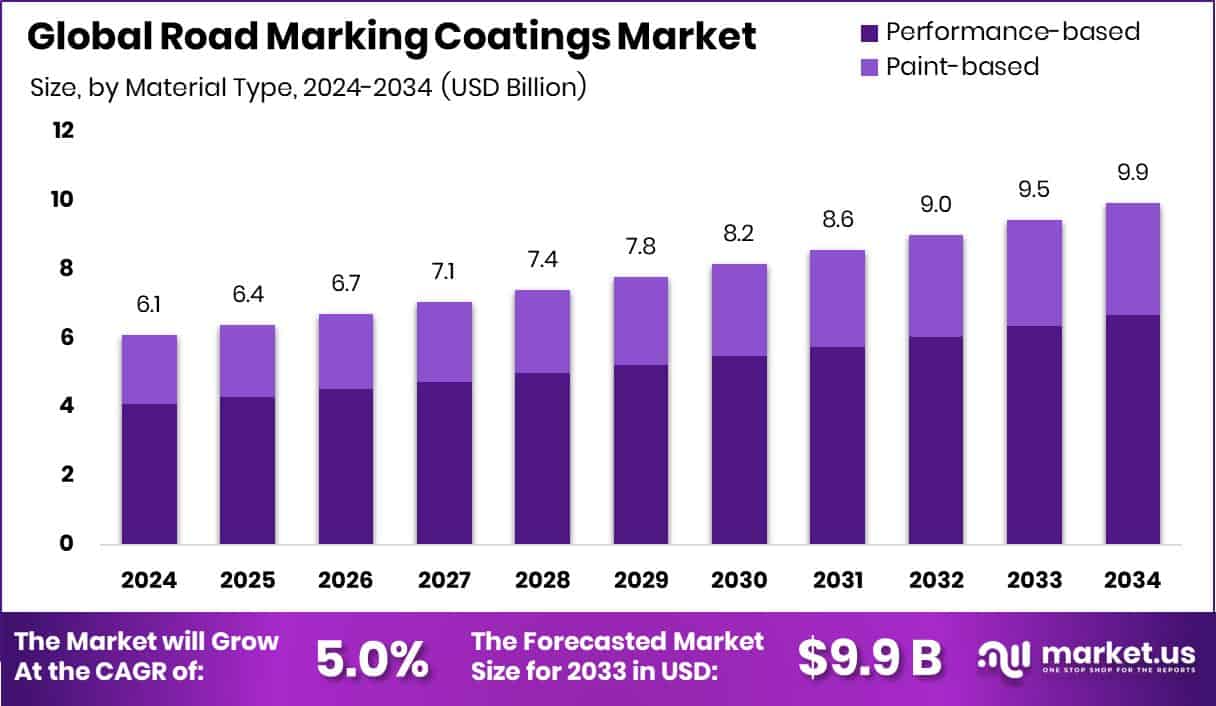
New York, NY – Dec 04, 2025 – The Global Road Marking Coatings Market is projected to grow from USD 6.1 billion in 2024 to around USD 9.9 billion by 2034, expanding at a 5.0% CAGR from 2025 to 2034. Europe currently leads the market, holding a strong 43.70% share, supported by continuous infrastructure upgrades and strict road safety standards.
Road marking coatings include specialized paints and materials used on roads, highways, airports, parking areas, and pedestrian zones to display lane lines, symbols, and traffic instructions. These coatings are engineered for high visibility, durability, reflectivity, and resistance to weather and wear, ensuring road safety in both daytime and nighttime conditions. Common materials include thermoplastics, water-based systems, cold plastics, and newer bio-based solutions.
Market growth is largely driven by rising public spending on transportation safety and urban infrastructure renewal. Governments worldwide are modernizing mobility networks to improve traffic efficiency and reduce accidents, which increases demand for long-lasting and high-performance road markings.
Sustainability is also shaping market momentum. Funding activity highlights this shift, including Lignin Industries raising €3.9 million, UBQ Materials securing $70 million, and a greentech startup receiving a €5 million grant for bio-based and waste-derived materials. Additionally, opportunities are emerging as smart mobility advances. Spokane’s aerospace technology hub securing $48 million reflects growing interest in advanced testing environments that may support future integration of reflective, intelligent, and long-life road coating systems.
➤ Click the sample report link for complete industry insights: https://market.us/report/global-road-marking-coatings-market/request-sample/
Key Takeaways
- The Global Road Marking Coatings Market is expected to be worth around USD 9.9 billion by 2034, up from USD 6.1 billion in 2024, and is projected to grow at a CAGR of 5.0% from 2025 to 2034.
- In the Road Marking Coatings Market, performance-based materials hold 67.2% share, driven by durability and long-term road visibility.
- The Road Marking Coatings Market shows strong dominance in permanent markings with 73.8%, supporting long-lasting traffic guidance.
- Within the Road Marking Coatings Market, retroreflective coatings account for 69.9%, improving safety during nighttime and low-light travel.
- The Road Marking Coatings Market is led by roads and highways at 58.1%, due to expanding infrastructure worldwide.
- The market value in Europe reached USD 2.6 billion in 2024.
➤ Directly purchase a copy of the report – https://market.us/purchase-report/?report_id=167386
Report Scope
| Report Features | Description |
|---|---|
| Market Value (2024) | USD 6.1 Billion |
| Forecast Revenue (2034) | USD 9.9 Billion |
| CAGR (2025-2034) | 5.0% |
| Segments Covered | By Material Type (Performance-based (Thermoplastic, Cold-plastic/MMA, Epoxy/Polyurea), Paint-based (Waterborne Acrylic, Solvent-Borne Alkyd, Epoxy Paint)), By Type (Permanent, Removable), By Reflectivity (Retroreflective (Dry-Night RL, Wet-Night Enhanced, Profiled/Rib), Non-reflective/colored Markings (Bike/Bus/EV Colored, Standard Non-Reflective)), By Application (Roads and Highways (Long-Line Center/Edge, Intersections and Pedestrian, Expressways/Toll), Parking and Urban Spaces (Surface Lots, Garages, EV Lanes/Zones), Airports and Other (Runways/Taxiways, Factories/Warehouses, Sports/Fields)) |
| Competitive Landscape | 3M Company, PPG Traffic Solutions (Ennis-Flint), The Sherwin-Williams Company, Nippon Paint Holdings, Geveko Markings, Hempel A/S, SWARCO AG, Dow Inc., Asian Paints PPG, Berger Paints |
Key Market Segments
By Material Type Analysis
In 2024, performance-based materials held a dominant position in the By Material Type segment of the Road Marking Coatings Market, capturing a significant 67.2% share. This leadership is driven by the increasing demand for durable road markings as traffic volumes rise and safety standards become more stringent across global road networks.
Performance-based materials are widely adopted due to their superior reflectivity, strong abrasion resistance, and reliable adhesion in extreme weather conditions such as heavy rain, heat, and freezing temperatures. These properties help maintain clear visibility and safety for longer periods, even on high-traffic highways and dense urban corridors.
Their extended service life also reduces the need for frequent repainting and maintenance, lowering operational costs for municipalities and road authorities. As governments continue to invest in infrastructure upgrades, smart roads, and sustainable mobility programs, reliance on high-performance road marking materials is steadily increasing, reinforcing their position as the most dependable solution for long-term traffic safety applications
By Type Analysis
In 2024, permanent road marking coatings led the By Type segment of the Road Marking Coatings Market, accounting for a strong 73.8% share. This dominance reflects a clear shift toward marking solutions that deliver long service life with minimal maintenance requirements.
Permanent markings are commonly applied on highways, expressways, and well-developed road networks where continuous visibility and safety are critical. These coatings are designed to endure heavy traffic volumes, extreme weather conditions, and ongoing surface wear without fading quickly, ensuring stable road guidance over time.
Their durability helps road authorities reduce repainting cycles and maintenance costs, offering better long-term value compared to temporary alternatives. As infrastructure expansion continues and governments place greater emphasis on safety performance and lifecycle efficiency, adoption of permanent road marking coatings keeps rising, reinforcing their role as the most reliable and cost-effective choice for long-lasting traffic management systems.
By Reflectivity Analysis
In 2024, retroreflective coatings dominated the By Reflectivity segment of the Road Marking Coatings Market, holding a 69.9% share. This strong position reflects the growing emphasis on road visibility and driver safety, particularly during night travel, fog, rain, and other low-light conditions.
Retroreflective coatings are designed to return light from vehicle headlights directly back to drivers, making lane markings, crossings, and directional symbols easier to see. This feature plays a critical role in helping motorists maintain lane discipline and react quickly to road instructions.
Their use continues to increase as transportation authorities adopt stricter safety guidelines and invest in high-visibility road infrastructure. With rising traffic volumes and large-scale highway expansion projects, retroreflective markings remain a preferred choice due to their dependable performance, proven safety benefits, and effectiveness in reducing accident risks while improving overall traffic flow and navigation accuracy.
By Application Analysis
In 2024, roads and highways dominated the By Application segment of the Road Marking Coatings Market, accounting for a substantial 58.1% share. This leadership is closely tied to the ongoing expansion, resurfacing, and upkeep of national and regional transportation networks worldwide.
Roads and highways carry high traffic volumes and heavy vehicles, making durable and highly visible markings essential for lane separation, speed regulation, pedestrian crossings, and warning signs. Strict safety regulations further strengthen the need for long-lasting coatings that can withstand constant wear and varying weather conditions.
As governments continue to invest in large-scale infrastructure projects, smart transport corridors, and safer long-distance travel routes, demand for reliable road marking solutions remains strong. The segment maintains its leading position due to its direct impact on traffic organization, driver awareness, road efficiency, and overall transportation safety performance.
Regional Analysis
In 2024, Europe led the Road Marking Coatings Market with a commanding 43.70% share, valued at USD 2.6 billion. This dominance is driven by strict traffic safety regulations, extensive highway networks, and regular government-funded maintenance programs. Strong emphasis on pedestrian protection, night-time visibility standards, and smart mobility corridors continues to strengthen the region’s leadership.
North America maintains stable demand as aging road infrastructure and urban transport systems require durable and permanent marking solutions. Ongoing federal and state safety initiatives support continuous road resurfacing and marking improvements.
Asia Pacific is experiencing faster adoption due to rapid urbanization and rising investments in transportation infrastructure, particularly in expanding cities and newly built highway corridors.
The Middle East & Africa show gradual growth supported by infrastructure modernization and expanding road networks. Latin America continues to develop its transport framework, with routine maintenance spending and modernization programs sustaining regional demand for road marking coatings.
Top Use Cases
- Guiding Vehicles on Highways and Urban Roads: Coatings are used to paint lane lines, center lines, edge lines, arrows, and other markings on highways, expressways, and city roads. These markings guide drivers on where to stay, where to turn, and how to safely navigate traffic — helping prevent collisions and keep traffic flowing smoothly.
- Pedestrian Crossings and Safety Zones: Road markings create visible crosswalks, stop lines, and pedestrian zones so that drivers know where to yield and pedestrians know where to cross safely. This helps reduce accidents involving pedestrians, especially in busy urban areas.
- Parking Lots, Garages, and Private Grounds: Beyond public roads, road marking coatings are common in parking lots, parking garages, warehouses, and private driveways. They define parking spaces, directional arrows, no-parking zones or handicap spots — helping organize vehicle movement and improve safety in these areas.
- Airports, Runways, and Taxiways: Specialized coatings (for example, highly durable or reflective ones) are used to mark runways, taxiways and other paved surfaces in airports. These markings help pilots and ground vehicles navigate safely under various conditions, including night or poor weather.
- Improving Night and Low-Light Visibility (Retroreflectivity): Some road marking coatings embed glass beads or other reflective materials to bounce back headlights toward the driver. This “retroreflectivity” ensures that lane lines, signs, and road markings remain visible at night, in rain, fog or other low-visibility conditions — greatly enhancing safety.
- Long-Term Durability & Low Maintenance for Heavy Traffic Zones: Thermoplastic and other performance-based coatings form tough, abrasion-resistant, weather-resistant layers that withstand heavy vehicle loads, rain, sun, and wear. Because these coatings last much longer than ordinary paint, they reduce the need for frequent repainting — saving time and maintenance costs for highways, busy roads, and industrial zones.
Recent Developments
- In 2025, Sherwin-Williams remains active in its industrial coatings business and, while some of its new coatings (e.g. plant-based topcoats) are for wood interior finishes, its protective, marine, and industrial divisions continue to maintain a broad portfolio of coatings used in structural, flooring, and surface-marking applications.
- In March 2025, Nippon Paint completed the acquisition of AOC (via its investment vehicle “LSF11 A5 TopCo LLC”), a global specialty formulator operating in the Americas and Europe. This makes AOC a subsidiary of Nippon Paint.
Conclusion
The road marking coatings market plays a vital role in improving traffic safety, road visibility, and organized mobility across urban and intercity transportation networks. Growing investments in infrastructure, stricter safety regulations, and expanding highway development continue to support steady demand for durable and high-visibility coatings.
Innovation in materials, including eco-friendly and smart marking solutions, is helping the market adapt to modern mobility needs such as intelligent transport systems and connected roads.
As traffic density increases and governments focus on long-term performance and lower lifecycle costs, reliable road marking coatings remain essential for safe navigation, efficient traffic flow, and sustainable transportation development worldwide.
Discuss your needs with our analyst
Please share your requirements with more details so our analyst can check if they can solve your problem(s)