Table of Contents
Market Overview
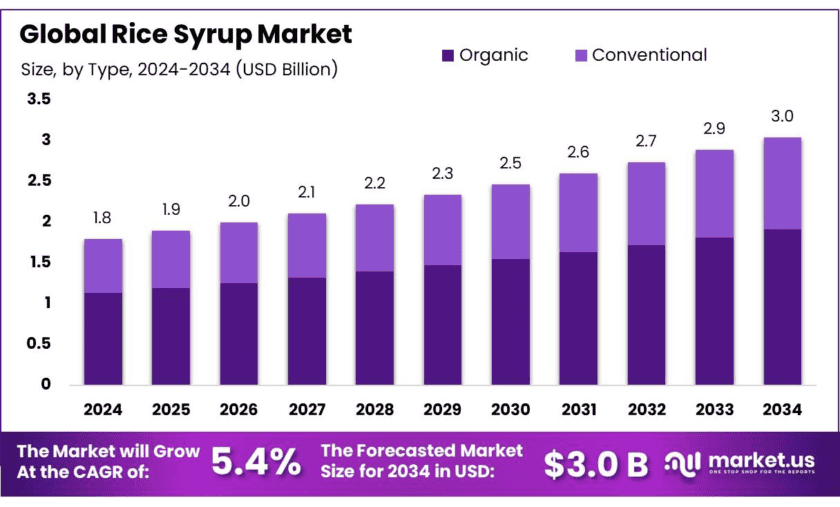
The Global Rice Syrup Market demonstrates steady expansion driven by health-conscious consumer choices. The market size will grow from USD 1.8 billion in 2024 to USD 3.0 billion by 2034. This growth represents a compound annual growth rate CAGR of 5.4% during the forecast period from 2025 to 2034.
Rice syrup offers manufacturers a healthier alternative to traditional sweeteners like cane sugar. The product derives from broken rice through enzymatic hydrolysis, providing mild sweetness and a low glycemic index. Therefore, food producers increasingly select rice syrup for clean-label formulations.
Government initiatives actively support the rice syrup industry’s expansion across multiple regions. For instance, India’s National Bank for Agriculture and Rural Development provides subsidies and loans for agro-processing units. Additionally, the Operation Greens Scheme offers a 50% subsidy on transportation and storage costs for rice.
The export potential for rice syrup continues to grow substantially in international markets. India exported 139 shipments of rice syrup from May 2024 to April 2025. This upward trend aligns perfectly with the global shift toward organic and clean-label products worldwide.
India’s record rice production of 149 million metric tons in 2025 creates surplus raw materials. The government approved selling 5.2 million metric tons of rice for ethanol production in 2024. Consequently, manufacturers gain better access to affordable rice for syrup production.
Key Takeaways
- The Rice Syrup Market size will reach USD 3.0 billion by 2034 from USD 1.8 billion in 2024 at 5.4% CAGR.
- Organic rice syrup dominated the Indian market, capturing over 62.9% of the total share.
- Liquid rice syrup led the Indian market, capturing over 73.2% of the total share.
- The Food and Beverage sector emerged as the dominant application in India, capturing over 45.8% share.
- Supermarkets and hypermarkets held a dominant position in India, capturing more than 46.1% share.
- North America captured a substantial 36.9% share, translating to approximately USD 0.6 billion.
➤ Download Exclusive Sample Of This Premium Report (Including Full TOC, Table & Figures): https://market.us/report/global-rice-syrup-market/request-sample/
Market Segmentation Overview
By Type Analysis
Organic rice syrup dominated the Indian market in 2024, capturing over 62.9% of the total share. Growing consumer preference for natural and healthier sweeteners drives this significant market presence. As health consciousness rises, more consumers actively choose organic products over conventional alternatives.
Government initiatives promoting organic farming further support organic rice syrup demand. This expansion in organic farming areas ensures a steady raw material supply for production. Consequently, organic rice syrup maintains its leadership position in the Indian market.
By Form Analysis
Liquid rice syrup led the Indian market in 2024, capturing over 73.2% of the total share. Its versatility and ease of use across various applications explain this dominance. Manufacturers prefer liquid forms for beverages, sauces, and dressings to achieve consistent product quality.
Consumer preference for natural and minimally processed ingredients further boosts liquid rice syrup demand. Health-conscious consumers actively seek alternatives to refined sugars in their daily diets. Therefore, liquid rice syrup’s mild sweetness and natural origin attract many buyers.
By Application Analysis
The Food & Beverage sector emerged as the dominant application in India, capturing over 45.8% share in 2024. Consumers increasingly prefer natural and minimally processed ingredients in their food products. Rice syrup’s mild sweetness and clean label appeal directly address this growing demand.
Rice syrup serves as a natural sweetener and moisture-retaining agent in bakery products. It enhances texture and shelf life for cakes, cookies, and bread items effectively. Additionally, beverages like health drinks and smoothies benefit from its smooth sweetness without overpowering flavors.
By Distribution Channel Analysis
Supermarkets and hypermarkets held a dominant position in India’s rice syrup market, capturing more than 46.1% share in 2024. Major chains like Reliance Retail, DMart, and Big Bazaar provide easy access to rice syrup products. This extensive retail reach enhances product visibility and builds consumer trust effectively.
Urbanization, rising disposable incomes, and changing consumer preferences drive this distribution channel growth. These retail outlets offer consumers convenient access to a wide variety of rice syrup options. Consequently, supermarkets and hypermarkets remain the preferred purchasing channel for most buyers.
Drivers
Government support and policy initiatives actively drive rice syrup growth in India. India’s rice production reached a record high of 149 million metric tons in 2025, up from 137.8 million tons previously. The government approved selling 5.2 million metric tons of rice from FCI for ethanol production in 2024, effectively managing surplus stocks.
The Pradhan Mantri Kisan Samman Nidhi (PM-KISAN) initiative further bolsters the rice industry’s economic viability. These measures ensure a steady raw material supply for rice syrup production facilities. Moreover, the Basmati Export Development Foundation center in Uttar Pradesh improves premium rice quality and export capacity, potentially increasing high-quality rice availability for syrup production.
Major Challenges
High production costs present a significant challenge for the rice syrup industry in India. Establishing a processing plant with 280 metric tons daily capacity requires approximately ₹78.9 crore for plant and machinery alone. The total capital investment for such a facility reaches an estimated ₹62.9 crore with a break-even point of 28%.
Fluctuating raw material prices further complicate the economic viability of rice syrup production. In May 2025, the Indian government raised the minimum support price for common rice paddy by 3% to ₹2,369 per 100 kg. Government warehouses held 59.5 million tons of rice—over four times the official stockpile target—creating price uncertainty for producers.
Business Opportunities
Government allocation of surplus rice for ethanol production creates new opportunities for rice syrup manufacturers. India allocated 5.2 million metric tons of surplus rice for ethanol production to support 20% blending targets by 2025/26. This strategic move ensures steady rice availability for syrup production while stabilizing raw material prices.
The emphasis on sustainable practices aligns with growing consumer preference for clean-label products. Manufacturers can capitalize on this trend by promoting rice syrup as an eco-friendly sweetener option. Consequently, companies that adopt sustainable production methods gain a competitive advantage in the expanding organic rice syrup segment.
Regional Analysis
North America dominated the global rice syrup market in 2024, capturing a substantial 36.9% share worth USD 0.6 billion. The United States accounts for a significant portion of this regional consumption. Growing preference for gluten-free, allergen-free products and plant-based diets drives North American demand for rice syrup.
Asia Pacific presents substantial growth potential due to India’s record rice production and government support. China and Japan also contribute significantly to regional market expansion. Therefore, manufacturers should focus on both established North American markets and high-growth Asia Pacific countries for maximum returns.
Top Key Players
- Axiom Foods Inc.
- Archer Daniels Midland Company (ADM)
- Cargill, Incorporated
- Wuhu Deli Foods Co., Ltd.
- Habib-ADM Limited
- ABF Ingredients (ABFI)
- Nature Bio-Foods Ltd.
- Navitalo
- Khatoon Industries
- Gehl Foods, LLC
Conclusion
The global rice syrup market. Food and beverage applications represent the largest end-use sector for rice syrup manufacturers worldwide. Government initiatives, particularly in India, create favorable conditions for market expansion. However, high production costs and raw material price fluctuations remain significant challenges. Companies that focus on organic product lines and sustainable practices will capture the most growth opportunities.
Discuss your needs with our analyst
Please share your requirements with more details so our analyst can check if they can solve your problem(s)