Table of Contents
Market Overview
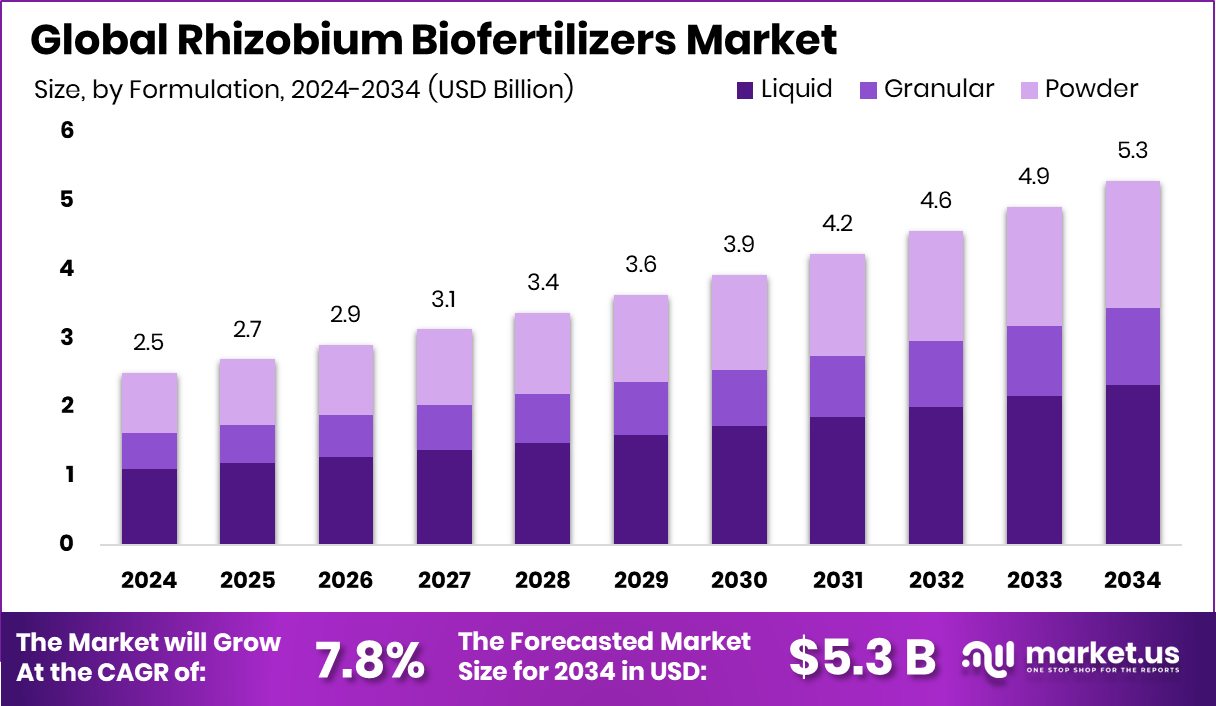
The global Rhizobium Biofertilizers Market will grow from USD 2.5 billion in 2024 to USD 5.3 billion by 2034. This growth represents a CAGR of 7.8% from 2025 to 2034. Consequently, farmers increasingly prefer natural soil enrichment methods over synthetic chemicals.
Rhizobium biofertilizers contain live bacteria that form symbiotic relationships with legume roots. These bacteria fix atmospheric nitrogen into a form that plants can use directly. Therefore, this natural process reduces the need for expensive synthetic fertilizers while improving long-term soil fertility.
North America captured 37.9 percent of the global market share in 2024, reaching USD 0.9 billion. This regional dominance reflects strong farmer awareness and advanced agricultural infrastructure. Additionally, government programs support the shift toward eco-friendly farming inputs.
Sustainable agriculture drives market expansion as farmers recognize chemical fertilizer damage. Soil degradation, water pollution, and rising input costs push growers toward bio-based alternatives. Rhizobium biofertilizers offer a cost-effective solution that maintains crop yields while protecting environmental health.
Consumer demand for organic food further strengthens market fundamentals. People increasingly avoid chemical residues in their food supply chains. Therefore, farmers respond by adopting Rhizobium biofertilizers to meet organic certification requirements and access premium pricing.
Key Takeaways
- The Global Rhizobium Biofertilizers Market will reach USD 5.3 billion by 2034, up from USD 2.5 billion in 2024, at a CAGR of 7.8% from 2025 to 2034.
- Liquid Rhizobium biofertilizers dominate the formulation segment with a 43.9% share due to easy application and longer shelf life benefits.
- Leguminous crops lead the application segment at 48.2%, highlighting strong farmer reliance on nitrogen-fixing biofertilizers for bean and pea cultivation.
- Agriculture end-use secures a 67.3% share, showing widespread adoption of sustainable farming practices across commercial crop production.
- North American farmers drive Rhizobium adoption with a 37.9% market share, totaling USD 0.9 billion in regional revenue.
➤ Download Exclusive Sample Of This Premium Report – https://market.us/report/rhizobium-biofertilizers-market/request-sample/
Market Segmentation Overview
By Formulation Analysis
Liquid Rhizobium biofertilizers hold a dominant 43.9% share of the formulation segment in 2024. This formulation offers higher shelf life and maintains bacterial viability longer than granular or powder alternatives. Consequently, farmers prefer liquid products for their reliable performance and ease of storage.
Farmers apply liquid formulations through drip irrigation and seed treatment methods efficiently. This application flexibility improves nitrogen fixation rates and boosts overall crop productivity. Therefore, liquid Rhizobium biofertilizers will likely retain market leadership as sustainable farming expands globally.
By Application Analysis
Leguminous crops account for 48.2% of the Rhizobium biofertilizers market by application. The natural compatibility between Rhizobium bacteria and legume roots enables effective nitrogen fixation in beans, peas, and lentils. Consequently, farmers using these biofertilizers reduce chemical fertilizer costs while improving soil fertility.
Global demand for protein-rich legumes continues rising as consumers adopt healthier diets. This demand growth supports further Rhizobium adoption among legume farmers seeking higher yields. Therefore, leguminous crops will remain the primary application driver for the foreseeable future.
By End Use Analysis
Agriculture end-use dominates the Rhizobium market with a 67.3% share in 2024. Farmers across commercial crop production turn to bio-based inputs to maintain long-term soil health. Consequently, Rhizobium biofertilizers help growers reduce dependence on expensive synthetic nitrogen fertilizers.
Government support for sustainable farming practices strengthens the agriculture segment growth. Additionally, farmer awareness programs highlight the cost benefits of biological inputs over chemicals. Therefore, agriculture will continue driving consistent demand for Rhizobium biofertilizers worldwide.
Drivers
Rising global demand for sustainable farming practices drives Rhizobium biofertilizer adoption. Farmers recognize that excessive chemical fertilizer use causes soil degradation, water pollution, and reduced crop quality. Rhizobium biofertilizers offer an eco-friendly alternative that naturally fixes atmospheric nitrogen. Consequently, this biological approach improves soil fertility while reducing expensive synthetic input costs.
Government subsidies and awareness programs further accelerate market growth. Policymakers encourage organic and eco-friendly farming through financial incentives and training. Additionally, consumers increasingly demand chemical-free food products from verified sustainable sources. Therefore, Rhizobium biofertilizers will see steady adoption as these trends reinforce each other.
Major Challenges
Limited shelf life restricts wider Rhizobium biofertilizer adoption across global markets. These products contain live microorganisms that remain sensitive to heat, moisture, and improper handling. Exposure to unfavorable storage conditions reduces bacterial viability and product effectiveness significantly. Consequently, farmers in regions lacking cold storage infrastructure hesitate to adopt these biofertilizers at scale.
Transportation and distribution challenges further compound shelf life limitations. Distributors must maintain specific temperature controls throughout the supply chain to preserve product quality. Additionally, farmers cannot stockpile Rhizobium biofertilizers for long periods like synthetic alternatives. Therefore, overcoming these preservation challenges requires advanced packaging technologies and better cold chain infrastructure investments.
Business Opportunities
Expanding Rhizobium use beyond traditional leguminous crops creates significant market growth potential. New research shows promising results when applying these biofertilizers to cereals, vegetables, and oilseeds. Consequently, farmers growing non-legume crops can now access natural soil enrichment benefits. This expansion widens the total addressable market substantially beyond current boundaries.
Climate change and rising fertilizer costs push farmers toward biological alternatives globally. Rhizobium biofertilizers reduce chemical input requirements while boosting crop yields naturally. Therefore, companies that develop effective formulations for diverse crop systems will capture significant market share. This opportunity aligns perfectly with global sustainability goals and farmer economic incentives.
Regional Analysis
North America dominates the Rhizobium biofertilizers market with a 37.9% share worth USD 0.9 billion in 2024. Farmers in the United States and Canada widely adopt advanced farming techniques and bio-based inputs. Government support for organic agriculture and soil health programs strengthens this regional leadership. Consequently, North America will maintain its dominant position through continued innovation and farmer education.
Asia Pacific projects the fastest growth rate for Rhizobium biofertilizers moving forward. Countries like India and China promote biofertilizer use to meet rising food demand while preserving soil fertility. Additionally, government subsidies make biological inputs affordable for smallholder farmers across the region. Therefore, the Asia Pacific represents the most attractive expansion opportunity for market participants.
Top Key Players
- Symborg
- BASF
- Novozymes
- Lallemand Inc.
- Stanes and Company Limited
Conclusion
The Rhizobium biofertilizers market is driven by sustainable farming demand, government support, and organic food trends, which drive this steady expansion. Therefore, market participants should focus on overcoming shelf life limitations while expanding into non-leguminous crop applications. Consequently, companies that innovate in preservation technology and crop system expansion will capture significant market opportunities globally.
Discuss your needs with our analyst
Please share your requirements with more details so our analyst can check if they can solve your problem(s)