Table of Contents
Overview
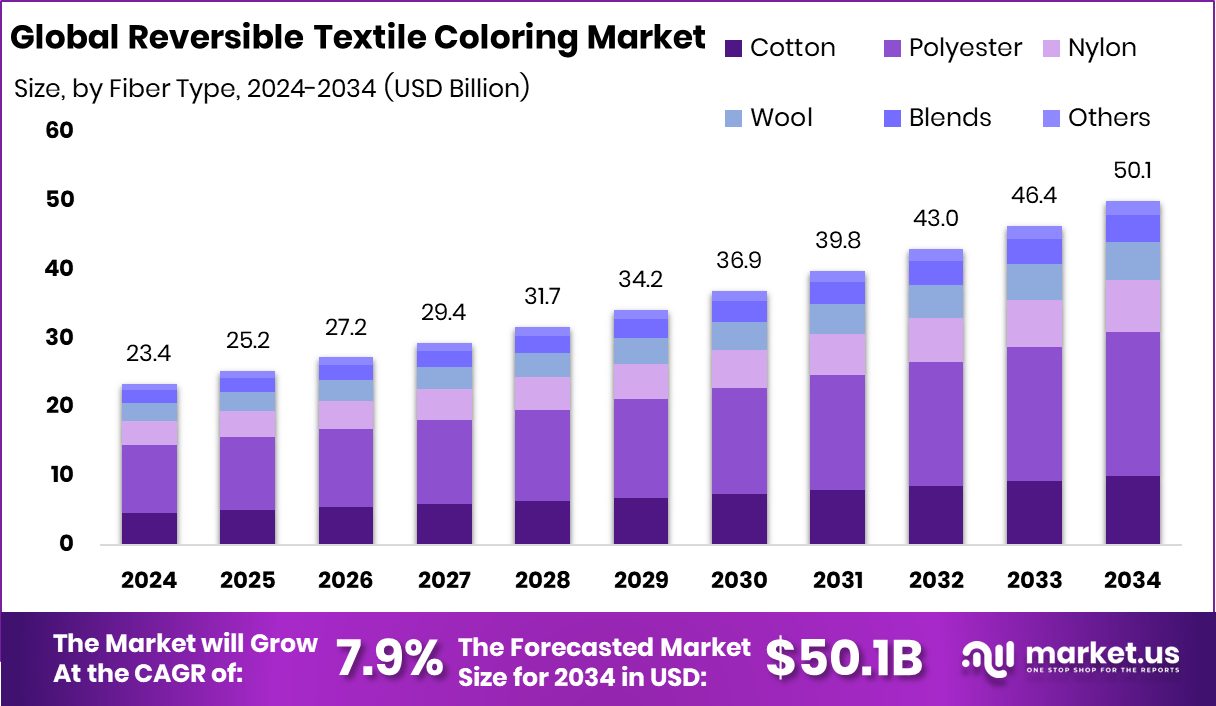
New York, NY – March 16, 2026 – The global reversible textile coloring market is projected to reach USD 50.1 billion by 2034, growing from USD 23.4 billion in 2024 at a CAGR of 7.9%. Asia Pacific leads with a 41.6% share, generating USD 9.7 billion, driven by strong apparel demand. Reversible textile coloring involves advanced techniques that enable fabrics to change color in response to stimuli such as temperature, light, moisture, or touch, and revert to their original state. This innovation enhances interactivity and functionality without damaging fabric integrity, making it valuable for fashion, sportswear, and performance apparel.
The market integrates material science with design, allowing brands to create adaptive garments while aligning with sustainability goals. Increasing emphasis on circular systems and eco-friendly production is shaping industry growth. Significant investments support this transition, including Syre—backed by H&M—securing $700 million following a Nike partnership, along with a USD 1 billion polyester recycling project approved in Binh Dinh.
DePoly has raised $30 million, including $23 million to establish an industrial-scale facility converting PET and polyester waste into reusable raw materials. Additionally, Eeden secured €18 million to advance textile-to-textile recycling. These initiatives strengthen recycled fiber supply, enabling scalable, sustainable reversible coloring solutions.
➤ Click the sample report link for complete industry insights: https://market.us/report/reversible-textile-coloring-market/request-sample/
Key Takeaways
- The Global Reversible Textile Coloring Market is expected to be worth around USD 50.1 billion by 2034, up from USD 23.4 billion in 2024, and is projected to grow at a CAGR of 7.9% from 2025 to 2034.
- Thermochromic textile coloring leads the Reversible Textile Coloring Market with 47.5% share, driven by temperature demand.
- Polyester dominates usage in the Reversible Textile Coloring Market, holding 41.9% due to its durability affinity.
- Apparel and fashion applications account for 39.7% of the Reversible Textile Coloring Market demand globally today.
- Asia Pacific dominance reached 41.6%, valuing the Reversible Coloring Market at USD 9.7 Bn.
➤ Directly purchase a copy of the report – https://market.us/purchase-report/?report_id=174361
Market Segments
By Type (Thermochromic Textile Coloring)
Thermochromic textile coloring led the market in 2024 with a 47.5% share, driven by its ability to change color in response to temperature shifts. This feature makes it highly attractive for fashion, sportswear, and functional clothing, where interactivity and visual appeal are key. Designers use it to reflect body heat, environmental conditions, or touch, enhancing product uniqueness and user experience.
Brands also adopt thermochromic effects for seasonal collections and limited-edition releases to stand out in competitive retail spaces. Advancements in pigment durability and wash resistance have improved reliability, boosting adoption. As demand for smart, expressive apparel grows, thermochromic coloring continues to play a major role in innovation and product differentiation.
By Fiber Type (Polyester Fiber)
Polyester dominated the market by fiber type in 2024, accounting for 41.9% of the share due to its strong compatibility with advanced color-changing pigments. Its durability, heat resistance, and ability to retain color make it ideal for reversible textile applications. Polyester supports stable bonding with thermochromic and photochromic dyes without weakening the fabric, ensuring long-lasting performance.
Its widespread use in sportswear, mass-market apparel, and performance clothing further strengthens its demand. Additionally, polyester is cost-efficient and suitable for large-scale production, allowing brands to cater to both premium and affordable segments. With increasing demand for functional and visually dynamic textiles, polyester remains the preferred fiber for scalable and reliable reversible coloring solutions.
By Application (Apparel and Fashion)
Apparel and fashion applications held a 39.7% share of the market in 2024, making them the leading segment. Growing consumer interest in interactive, personalized, and visually engaging clothing is driving this demand. Reversible textile coloring allows garments such as jackets, dresses, and athleisure wear to change appearance, creating unique and expressive fashion statements.
Social media and fast-fashion trends further accelerate adoption, as color-changing designs enhance visual appeal and online engagement. Brands also use these technologies for premium collections and limited editions, increasing exclusivity. As fashion increasingly integrates technology with creativity, apparel remains the primary driver of growth, shaping how reversible textile coloring evolves in the global market.
Regional Analysis
In 2024, Asia Pacific led the reversible textile coloring market with a 41.6% share, generating USD 9.7 billion. This dominance is driven by strong textile manufacturing infrastructure, large consumer bases, and rapid adoption of innovative apparel technologies. The region’s fashion demand and large-scale production capabilities make it the key growth engine globally. North America shows steady growth, supported by rising interest in smart apparel and high-performance clothing.
Europe maintains a stable demand due to its focus on design innovation and advanced textile technologies. Meanwhile, the Middle East & Africa are emerging markets with gradual adoption, and Latin America is progressing moderately, supported by developing fashion industries and increasing exposure to advanced textile solutions.
Top Use Cases
- Fashion & Color-Changing Clothes: Reversible coloring is widely used in fashion items like T-shirts, jackets, and dresses. These clothes change color with heat, sunlight, or touch, making them interactive and stylish. For example, thermochromic fabrics change color when temperature changes, creating fun and unique designs.
- Sportswear & Performance Clothing: Sportswear uses color-changing textiles to react to body heat or weather conditions. This helps athletes visually track temperature changes or performance conditions. These fabrics are popular in activewear because they combine function with modern design.
- Safety & Industrial Workwear: Reversible textiles are used in safety gear to warn about heat or dangerous conditions. For example, color-changing fabrics or labels can indicate high temperature on machines or equipment, helping prevent accidents.
- UV-Sensitive Outdoor Clothing: Photochromic textiles change color when exposed to sunlight (UV rays) and return indoors. This is useful in outdoor clothing, helping people understand UV exposure while also adding visual appeal.
- Military & Camouflage Applications: Color-changing textiles are used for camouflage, allowing fabrics to adapt to surroundings or temperature conditions. This helps improve concealment in different environments.
- Smart Textiles & Temperature Control: Advanced fabrics can adjust color while also helping regulate heat. Some new textiles cool or warm the body without external power while changing appearance, improving comfort and efficiency.
Notable Company Developments
- In October 2025, OliKrom announced its participation in the Big 5 Dubai event to present its color-changing solutions like LuminoKrom®. These materials react to light and environmental conditions, supporting innovation in smart surfaces and textiles.
- In July 2024, CTI introduced a new thermochromic ink designed for solvent ink systems. This was one of the first solutions of its kind, helping brands use color-changing effects in more durable and flexible applications like packaging and textiles.
- In June 2024, Matsui Shikiso Chemical Co. is a Japan-based company that makes thermochromic and photochromic pigments used in textiles and printing. In June 2024, the company introduced an improved Chromicolor thermochromic slurry with very low formaldehyde content, making it safer and more eco-friendly for textile applications while keeping strong color-changing performance.
Conclusion
The reversible textile coloring market is evolving as innovation and sustainability reshape the textile industry. Color-changing fabrics are gaining attention for their ability to combine functionality with creative design, making apparel more interactive and appealing. Growing interest in eco-friendly materials and circular production is further supporting adoption.
Advances in smart pigments and fiber compatibility are improving durability and performance, encouraging wider use across fashion and functional clothing. As brands focus on differentiation and consumer engagement, reversible coloring offers a unique way to enhance product value. Overall, the market is set to grow steadily as technology, sustainability, and design continue to align.
Discuss your needs with our analyst
Please share your requirements with more details so our analyst can check if they can solve your problem(s)