Table of Contents
Overview
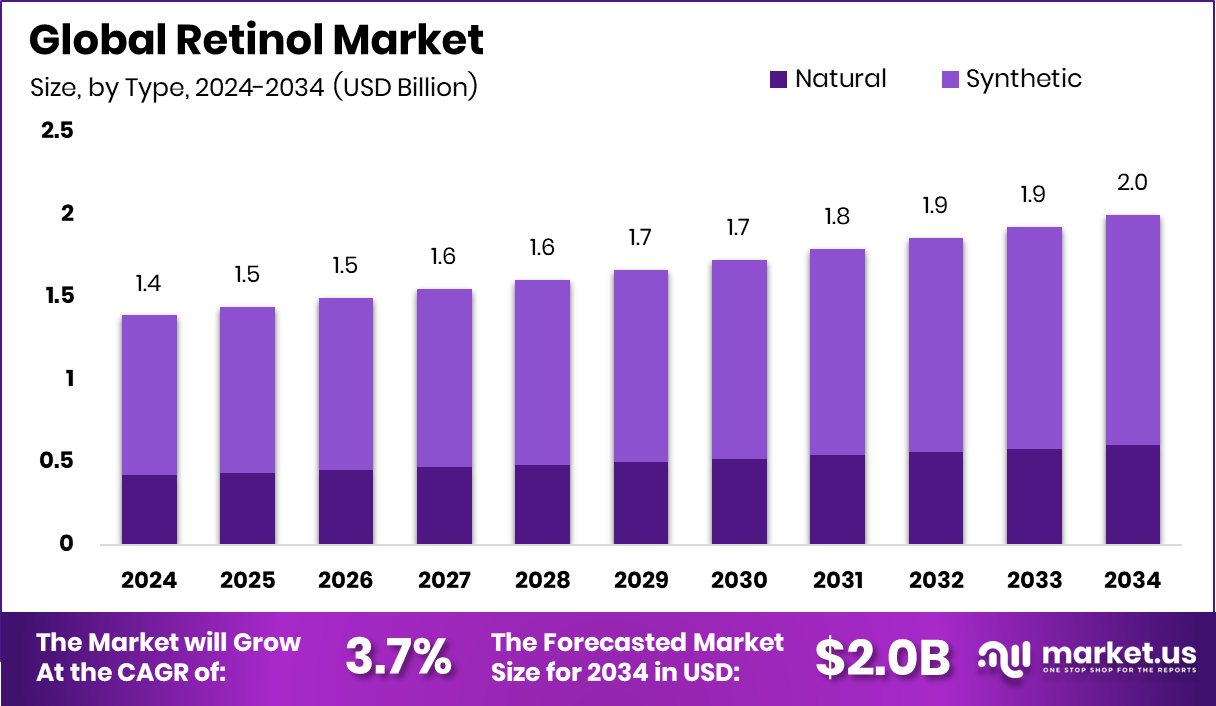
New York, NY – February 03, 2026 – The global retinol market is set to reach USD 2.0 billion by 2034, rising from USD 1.4 billion in 2024 at a 3.7% CAGR, with Europe holding 34.70% of the share, worth USD 0.4 billion. Retinol, a key vitamin A derivative, continues to be essential for skin repair, immune strength, and healthy cell renewal. Its applications span skincare, supplements, functional foods, and medical nutrition, driven by rising awareness of micronutrient deficiencies and the need for fortified products.
Government and public-sector support remain strong contributors to market growth. The FDA’s USD 7.2 billion budget request to enhance food safety and nutrition strengthens the regulatory environment for compliant vitamin A use. At the state level, funding such as the USD 400,000 MDARD–Michigan Ag Commission grant further supports innovation linked to nutritional products and agricultural inputs.
Private-sector investment is also accelerating demand for nutrient-enriched formulations. ARTAH Nutrition’s £2.85 million raise, Milkfed’s request for a ₹50 crore NDDB grant for cattle feed, and Wastelink’s USD 3 million + ₹27 crore + USD 3 million funding rounds highlight strong interest in fortified nutrition and feed solutions.
Innovation-driven opportunities are growing through biotechnology. Full Circle Biotechnology’s investment in a 7,000-ton facility and Provectus Algae’s US$10.1 million raise to advance sustainable feed supplements signal long-term potential for integrating retinol into evolving health and food ecosystems.
➤ Click the sample report link for complete industry insights: https://market.us/report/global-retinol-market/request-sample/
Key Takeaways
- The Global Retinol Market is expected to be worth around USD 2.0 billion by 2034, up from USD 1.4 billion in 2024, and is projected to grow at a CAGR of 3.7% from 2025 to 2034.
- The retinol market synthetic type dominates with a 69.3% share, driven by consistency, scalability, and cost efficiency.
- Personal care and cosmetics lead the retinol market applications with a 56.8% share, supported by anti-aging demand.
- In Europe, the retinol market reached a 34.70% share, generating USD 0.4 Bn in revenue annually.
➤ Directly purchase a copy of the report – https://market.us/purchase-report/?report_id=172012
Report Scope
| Report Features | Description |
|---|---|
| Market Value (2024) | USD 1.4 Billion |
| Forecast Revenue (2034) | USD 2.0 Billion |
| CAGR (2025-2034) | 3.7% |
| Segments Covered | By Type (Natural, Synthetic), By Application (Personal Care and Cosmetics, Dietary Supplements, Food and Beverage, Animal Feed, Others) |
| Competitive Landscape | BASF SE, Beauty Solutions LTD, Biotics Research Corporation, Divi’s Laboratories Limited, DRUNK ELEPHANT, Eluminex Biosciences, Guangzhou ZIO Chemical Co., Ltd, DSM |
Key Market Segments
By Type
The synthetic retinol segment dominates the global market with a 69.3% share in 2024, reflecting its strong acceptance across manufacturers and formulators. Its leadership comes from the material’s consistent molecular profile, predictable behavior in formulations, and ability to meet regulatory requirements with precision. Synthetic variants allow brands to control concentration levels accurately, ensuring product stability, uniformity, and performance—key expectations in skincare, nutrition, and pharmaceutical applications.
The segment’s dominance also stems from mature production technologies that offer scalability and reliable supply, making it easier for companies to maintain quality standards while meeting global demand. With its stability, compatibility, and regulated potency, synthetic retinol remains the preferred choice for high-volume commercial use, reinforcing its long-standing leadership within the retinol value chain.
By Application
The personal care and cosmetics segment leads the retinol market with a 56.8% share in 2024, driven by its widespread use in anti-aging, skin renewal, and complexion-enhancing products. Retinol continues to be a flagship ingredient in serums, creams, and treatment formulations due to its strong consumer trust and proven clinical performance. The segment benefits from ongoing product innovation as brands introduce advanced delivery systems and gentler formulations to appeal to a broader consumer base.
The 56.8% share also reflects the steady rise in skincare routines and the popularity of active-rich products that promise visible improvements in texture, tone, and fine lines. With continuous demand for high-efficacy cosmetic ingredients, personal care remains the dominant application area, shaping overall market growth and reinforcing retinol’s relevance in modern beauty formulations.
Regional Analysis
Europe leads the global retinol market with a 34.70% share, valued at USD 0.4 billion, supported by its highly developed skincare industry and strong preference for clinically validated cosmetic ingredients. Consumers in the region consistently adopt retinol-based products across both luxury and mainstream brands, reinforcing its dominant position.
North America holds a significant position as well, driven by the presence of major cosmetic companies, widespread use of advanced skincare routines, and strong retail distribution of retinol formulations. Asia Pacific continues to grow rapidly, supported by expanding urban populations, rising interest in active skincare ingredients, and an increasing shift toward premium beauty products.
The Middle East & Africa region shows steady improvement as access to personal care products widens and awareness of dermatological solutions strengthens. Latin America maintains consistent growth, fueled by a beauty-focused consumer base and rising availability of retinol-based skincare through organized retail and pharmacy networks.
Top Use Cases
- Reduces Fine Lines & Wrinkles: Retinol stimulates collagen in the skin, which helps make the skin firmer and smooths out small lines and wrinkles caused by aging. Over time, regular use can make skin look younger and more resilient.
- Helps Clear Acne & Keeps Pores Clean: By speeding up how fast skin cells renew themselves and preventing clogged pores, retinol helps reduce acne breakouts and makes skin texture smoother. This makes it popular in acne treatment products.
- Improves Skin Texture & Tone: Retinol encourages old skin cells to shed and fresh cells to appear, which can make skin feel smoother, more even, and brighter in tone. It can also help fade dark spots from sun damage or scars.
- Reduces Hyperpigmentation & Dark Spots: Consistent use can help lighten patches of darker skin caused by sun damage, acne marks, or age spots, making skin tone look more uniform.
- Used in Body Skin Care: Retinol isn’t just for the face — it’s also used in lotions for body skin to help reduce rough texture, smooth skin, and slow signs of aging on areas like arms or legs.
- Improves Firmness & Elasticity: By promoting collagen and elastin production beneath the skin’s surface, retinol can help skin feel firmer and more elastic, reducing sagging over time.
Recent Developments
- In April 2025, Divi’s Laboratories entered a long-term manufacturing and supply agreement with a major global pharmaceutical company. The deal focuses on making and delivering advanced chemical intermediates—important components used by drugmakers. To support this deal, Divi’s planned to invest ₹650–750 crore (≈ USD 80-100M) to expand its manufacturing capacity. This shows the company’s push to scale up operations in API & ingredient production, which includes vitamins and related building blocks used in nutrition products.
- In November 2024, Drunk Elephant voluntarily withdrew three skincare products because of ingredient mix-ups. While this was not exactly a retinol launch, it shows the company took action on product quality issues during this time.
- In August 2024, BASF announced a temporary force majeure—a pause on supply—for selected vitamin A, vitamin E, and carotenoid products after a fire damaged part of a key plant in Ludwigshafen, Germany. This affected the production and delivery of vitamin A-related ingredients while repair work began.
Conclusion
The retinol market continues to strengthen as consumers increasingly look for effective skin-renewal and nutrition solutions. Its role in supporting healthy skin, improving texture, and aiding cellular repair keeps demand steady across personal care, supplements, and fortified products. Brands are focusing on gentler, more stable formulations, while ongoing research expands its use in beauty and wellness applications.
Growing awareness of ingredient benefits and rising interest in science-backed skincare ensure retinol remains a trusted choice for both everyday users and professionals. With steady innovation and wider availability, the market is poised to maintain a positive, resilient outlook.
Discuss your needs with our analyst
Please share your requirements with more details so our analyst can check if they can solve your problem(s)