Table of Contents
Overview
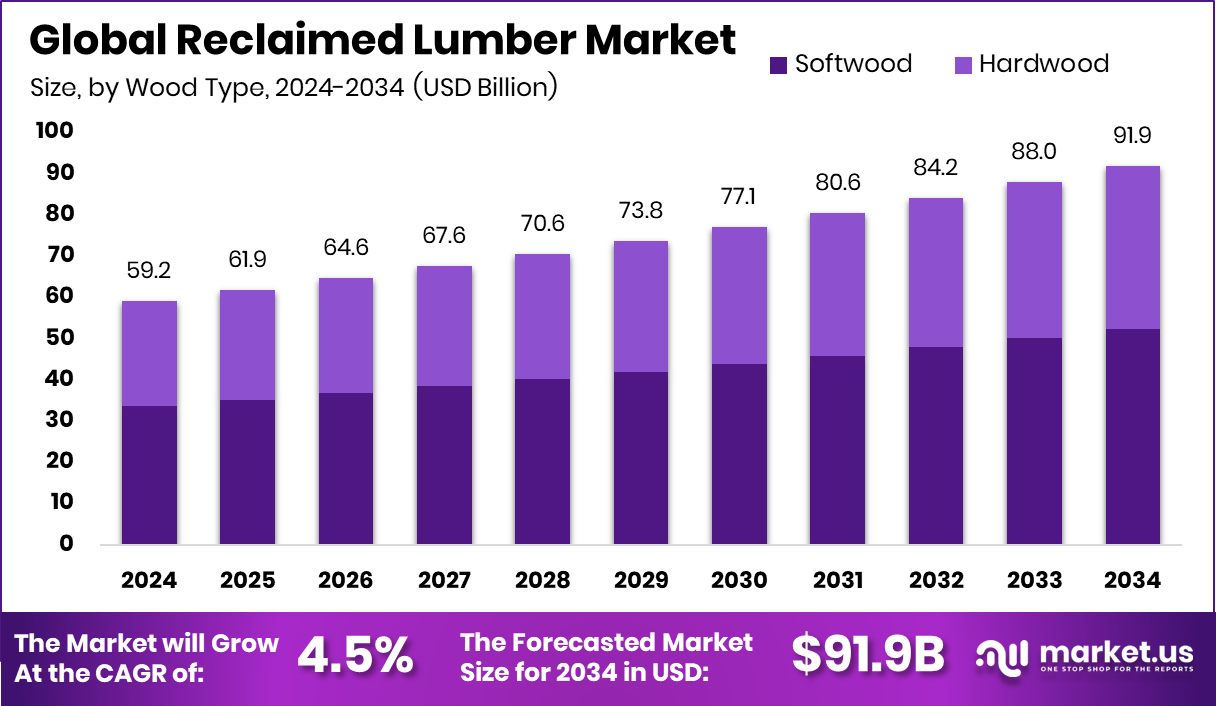
New York, NY – March 02, 2026 – The global reclaimed lumber market is on a steady growth path, expected to rise from USD 59.2 billion in 2024 to USD 91.9 billion by 2034, driven by a 4.5% CAGR. Asia Pacific remains the leading region with a 45.20% share, generating USD 26.7 billion in revenue.
Reclaimed lumber—sourced from old factories, barns, warehouses, bridges, and dismantled buildings—has become a preferred material due to its strength, aged look, and lower environmental footprint. It plays a central role in sustainable construction by reducing landfill waste, conserving forests, and extending the lifecycle of wood across residential, commercial, and industrial applications.
Market momentum is reinforced by broader developments in the lumber sector. Canada announced $700 million in support for its struggling softwood lumber industry, while Ottawa committed another $20 million to help British Columbia’s forest sector manage ongoing softwood trade pressures. At the same time, U.S. allegations that Canada is subsidizing the industry with $1.2 billion highlight the extent of government involvement influencing lumber availability and indirectly shaping reclaimed wood supply chains.
Opportunities continue to expand as policy support strengthens. Renewed optimism in British Columbia followed the Prime Minister’s announcement of $1.2 billion in softwood lumber support, reinforcing long-term resilience, recovery, and value-added growth for reclaimed lumber.
➤ Click the sample report link for complete industry insights: https://market.us/report/global-reclaimed-lumber-market/request-sample/
Key Takeaways
- The Global Reclaimed Lumber Market is expected to be worth around USD 91.9 billion by 2034, up from USD 59.2 billion in 2024, and is projected to grow at a CAGR of 4.5% from 2025 to 2034.
- Reclaimed Lumber Market by wood type shows softwood is dominant with a 56.9% share globally today.
- Reclaimed Lumber Market by application indicates flooring dominated demand with a 38.1% share worldwide currently.
- Reclaimed Lumber Market by end-use highlights commercial-dominated consumption, holding a 62.8% share across sectors.
- Asia Pacific dominated the reclaimed lumber market with a 45.20% share, valued at USD 26.7 Bn revenue.
➤ Directly purchase a copy of the report – https://market.us/purchase-report/?report_id=173598
Report Scope
| Report Features | Description |
|---|---|
| Market Value (2024) | USD 59.2 Billion |
| Forecast Revenue (2034) | USD 91.9 Billion |
| CAGR (2025-2034) | 4.5% |
| Segments Covered | By Wood Type (Softwood, Hardwood), By Application (Flooring, Paneling, Beams and Boards, Furniture, Others), By End-Use (Residential, Commercial, Industrial) |
| Competitive Landscape | Vintage Timberworks, Inc, Carpentier Hardwood Solutions, NV, Imondi Flooring, TerraMai, Jarmak Corporation, Elemental Republic, Olde Wood Ltd., Trestlewood, True American Grain Reclaimed Wood, Beam and Board, LLC |
Key Market Segments
By Wood Type
Softwood maintained its dominant position in the reclaimed lumber market in 2024, capturing 56.9% of the total wood-type share. This leadership stems from the abundant availability of reclaimed softwood sourced from old barns, warehouses, pallets, and industrial sites. Species such as pine, spruce, and fir are easier to reclaim, lighter to handle, and simpler to process, which lowers refurbishment costs and broadens their applications. Their workability makes softwoods ideal for both structural reuse and decorative purposes in modern design.
Growing interest in sustainable construction further strengthens this segment, as reclaimed softwood supports circular building practices, reduces environmental impact, aligns with green certifications, and offers an appealing balance of affordability, versatility, and eco-friendly performance.
By Application
In 2024, flooring dominated the reclaimed lumber application segment with a 38.1% share, driven by strong demand for durable and visually distinctive reclaimed wood flooring. Its natural aged appearance, weathered texture, and unique grain patterns provide an authentic aesthetic highly valued in residential, retail, and hospitality interiors.
Reclaimed flooring often originates from mature old-growth timber, offering outstanding hardness, stability, and long-term wear resistance. These characteristics, combined with its sustainability benefits—such as reducing landfill waste and lowering pressure on forests—make reclaimed flooring a preferred choice in renovation projects. As consumers and designers increasingly prioritize premium, eco-conscious interior materials, reclaimed lumber flooring continues to lead the market with strong, steady demand.
By End-Use
The commercial sector dominated the reclaimed lumber market in 2024, accounting for a substantial 62.8% share. Offices, hotels, restaurants, retail stores, and branded corporate spaces are increasingly adopting reclaimed wood for walls, flooring, ceilings, and signature design elements to create warm, character-rich environments. Businesses also favor reclaimed lumber for its sustainability value, using it to strengthen eco-friendly branding and meet green building requirements.
Large commercial projects benefit from the consistent supply provided by structured reclamation operations, enabling uniform quality across installations. With rising adoption of environmental certifications and corporate goals focused on lowering carbon impact, reclaimed lumber has become a strategic material choice, reinforcing the commercial segment’s strong leadership in overall market demand.
Regional Analysis
Asia Pacific led the Reclaimed Lumber Market with a dominant 45.20% share and USD 26.7 billion in value, supported by rapid construction activity, urban redevelopment, and growing use of sustainable materials. North America remains a mature market, driven by strong reuse culture and demand from commercial interiors and green-certified projects. Europe continues steady adoption through strict environmental standards and widespread circular-economy initiatives that favor reclaimed wood across residential and commercial designs.
The Middle East & Africa is gradually expanding as premium construction and tourism-driven projects incorporate sustainable aesthetics. Latin America shows rising potential through urban renewal efforts and increasing awareness of reclaimed materials. Together, these regions reflect a market shaped by sustainability goals and evolving architectural preferences.
Top Use Cases
- Flooring in Homes & Businesses: Old wood boards are cleaned and turned into floors with a warm, rustic feel that looks great and lasts a long time. Many people choose reclaimed wood flooring because it adds character and history to a space.
- Beams & Structural Pieces: Reclaimed wood from barns and mills is strong and often repurposed as beams or support posts in houses or buildings, letting new structures benefit from old, sturdy wood.
- Furniture (Tables, Chairs, Cabinets): Craftspeople make tables, chairs, cabinets, and shelves from reclaimed wood. Sometimes broken or old wood becomes beautiful, unique furniture with its own story.
- Wall Paneling & Accent Walls: Reclaimed wood boards are used to cover wall surfaces to give rooms a cozy farmhouse or vintage look. They add texture and warmth that new wood often can’t match.
- Decorative Pieces & Art: Small reclaimed-wood pieces can be used for creative decor — such as picture frames, wall art, and wooden signs — turning scrap wood into attractive home accents.
- Outdoor Projects (Benches & Garden Features): Wood salvaged from old structures or pallets can be used to build benches, planters, or raised garden beds. This gives outdoor spaces a rustic, sustainable touch.
Recent Developments
- In June 2025, TerraMai highlighted specific water-reclaimed hardwood products such as Angelique, reclaimed from submerged reservoir wood using underwater chainsaws. These wood products are prized for their fine grain, stability, and decay resistance, making them strong choices for exterior cladding and design.
- In January 2024, Olde Wood Ltd., a custom reclaimed-wood flooring and building materials maker in Ohio, showcased a “Camo Plank” reclaimed-wood product on its website. This product style highlights natural color and texture variations that mimic camouflage patterns, adding a unique look to flooring or wall projects.
Conclusion
The reclaimed lumber market continues to strengthen as builders, designers, and manufacturers look for materials that combine sustainability, durability, and character. Reclaimed wood has become a preferred choice in residential, commercial, and specialty projects because it offers a unique look while reducing the need for newly harvested timber.
Growth in renovation activity, rising interest in eco-friendly design, and wider acceptance of circular construction practices further support long-term demand. With expanding applications in flooring, furniture, cladding, and architectural features, the market is set to benefit from both environmental priorities and evolving design trends that favor authentic, low-impact materials.
Discuss your needs with our analyst
Please share your requirements with more details so our analyst can check if they can solve your problem(s)