Table of Contents
Overview
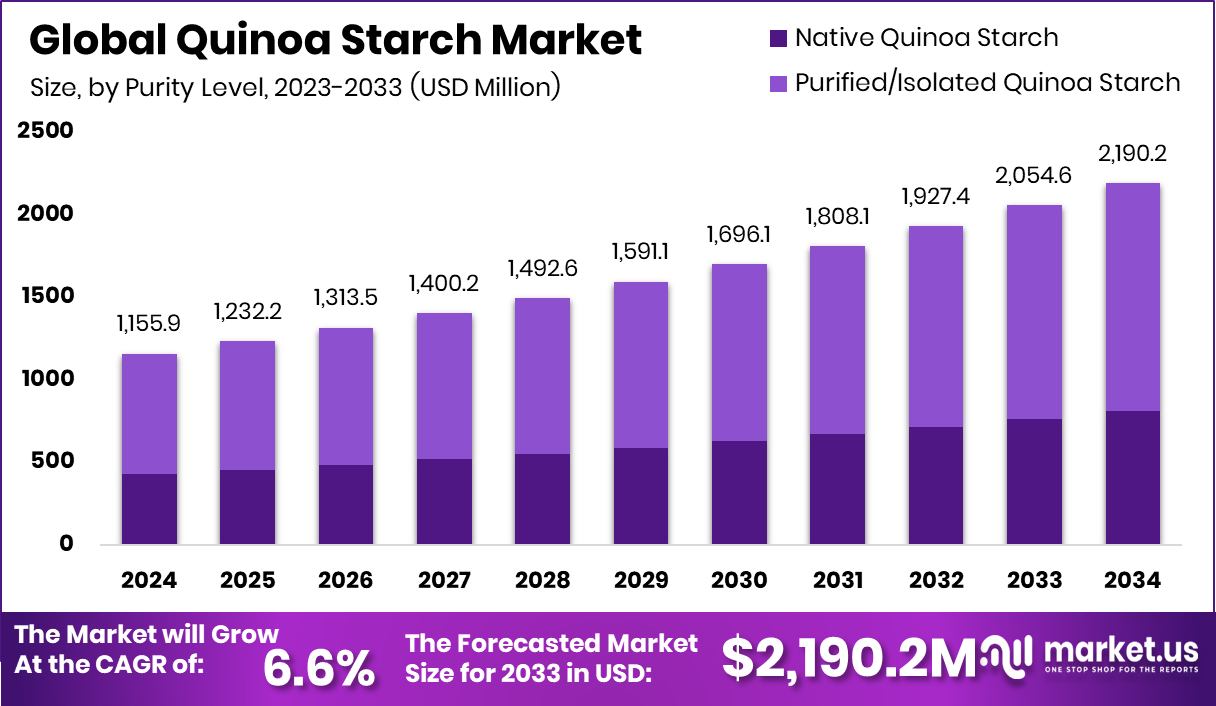
New York, NY – February 16, 2026 – The global quinoa starch market is projected to reach USD 2,190.2 million by 2034, rising from USD 1,155.9 million in 2024, expanding at a CAGR of 6.6% between 2025 and 2034. North America leads the market with a 43.90% share, valued at USD 507.4 million.
Quinoa starch, a fine white carbohydrate extracted from quinoa seeds, is widely used as a natural thickener, binder, and texture enhancer in sauces, soups, gluten-free bakery items, and dairy alternatives. Its gluten-free nature, neutral taste, and strong heat stability make it suitable for clean-label and health-focused food formulations, as well as selected industrial uses.
The market covers the cultivation, processing, distribution, and commercial use of quinoa starch by food producers, nutraceutical companies, and ingredient suppliers worldwide. Rising demand for plant-based and functional ingredients continues to strengthen its position. Investor confidence is evident, with Nourish You securing INR 16 crore in Series A funding led by SIDBI Venture Capital, and the brand also raised $2 million in seed funding.
At the grassroots level, quinoa cultivation initiatives, such as its introduction in Ladakh, where farmers can earn up to Rs 1,000 per kg, are expanding supply potential. Meanwhile, Temasek’s investments in seed technology and ClearPath Robotics, raising $30 million, highlight broader agri-tech momentum supporting future efficiency and scalability.
➤ Click the sample report link for complete industry insights: https://market.us/report/global-quinoa-starch-market/request-sample/
Key Takeaways
- The Global Quinoa Starch Market is expected to be worth around USD 2,190.2 million by 2034, up from USD 1155.9 million in 2024, and is projected to grow at a CAGR of 6.6% from 2025 to 2034.
- In the Quinoa Starch Market, white quinoa sources dominated with 49.7% share globally overall.
- Powder format led the Quinoa Starch Market, capturing 56.3% demand across food applications globally.
- Purified or isolated quinoa starch held 63.2% share, driven by clean-label requirements worldwide.
- Thickening agent functionality accounted for 31.6% usage within the evolving Quinoa Starch Market landscape.
- B2B distribution channels dominated with 81.4% share, reflecting strong industrial and ingredient demand growth.
- In North America, the quinoa starch market reaches a 43.90% share, totaling USD 507.4 Mn.
➤ Directly purchase a copy of the report – https://market.us/purchase-report/?report_id=172730
Report Scope
| Report Features | Description |
|---|---|
| Market Value (2024) | USD 1155.9 Million |
| Forecast Revenue (2034) | USD 2,190.2 Million |
| CAGR (2025-2034) | 6.6% |
| Segments Covered | By Source (White Quinoa, Red Quinoa, Black Quinoa, Mixed/Tricolor Quinoa), By Product Format (Powder, Granules, Gel), By Purity Level (Native Quinoa Starch, Purified/Isolated Quinoa Starch), By Functionality (Thickening Agent, Stabilizer, Binder, Texturizer, Fat Replacer), By Distribution Channel (B2B, B2C) |
| Competitive Landscape | Inka Crops, Northern Quinoa Production Corporation, Andean Naturals, Barentz, Oegema Grains, Quessentials Pvt Ltd., Ardent Mills, The British Quinoa Company |
Key Market Segments
By Source
In 2024, white quinoa led the quinoa starch market with a 49.7% share due to its reliable starch yield and neutral taste profile. Processors favor white quinoa because it provides stable viscosity, clean color, and consistent performance across food and industrial applications. Its broad cultivation base ensures a dependable raw material supply, reducing sourcing risks for manufacturers.
White quinoa starch is widely used in gluten-free bakery, sauces, and ready meals where texture and visual appeal are important. It also supports clean-label formulations with minimal processing adjustments. The combination of availability, functional reliability, and consumer acceptance positions white quinoa as the primary and most commercially scalable source for global quinoa starch production.
By Product Format
Powdered quinoa starch accounted for 56.3% of the market in 2024, reflecting strong demand for practical and versatile ingredient formats. The powder form offers better storage stability, easy transportation, and accurate dosing during formulation. Manufacturers prefer it because it blends uniformly into dry mixes, instant foods, and nutraceutical products without requiring extra processing steps.
It also works efficiently with automated production systems, reducing operational complexity and labor costs. In foodservice and packaged foods, powdered starch disperses quickly and provides consistent thickening results. Compared to liquid forms, it has a longer shelf life, making powder the most scalable and commercially efficient format in the global quinoa starch market.
By Purity Level
Purified or isolated quinoa starch dominated with a 63.2% share in 2024, driven by demand for high-quality and application-specific ingredients. This form delivers superior consistency, lower impurities, and better control over texture and viscosity. It is especially valued in premium foods, infant nutrition, and pharmaceutical applications where strict quality standards apply. Manufacturers prefer purified starch because it performs predictably under heat, shear, and varying pH conditions.
Its gluten-free and allergen-friendly profile further supports its use in specialized diets. Although purification increases production costs, the enhanced performance and reliability justify the investment, making purified quinoa starch the preferred option for high-margin and value-added applications.
By Functionality
Thickening functionality led the market with a 31.6% share in 2024. Quinoa starch is widely used to enhance texture and mouthfeel in soups, sauces, dairy alternatives, and plant-based products. It provides smooth, stable viscosity without altering flavor, making it suitable for clean-label and health-focused formulations.
Compared to conventional starches, quinoa starch performs effectively at lower inclusion levels, helping optimize formulation costs. It also maintains stability during freezing and reheating, which is important for ready-to-eat and convenience foods. These performance benefits make quinoa starch a preferred natural thickening solution across various food and beverage categories worldwide.
By Distribution Channel
B2B channels accounted for 81.4% of the quinoa starch market in 2024, highlighting its strong industrial focus. Most volumes are supplied directly to food manufacturers, nutraceutical companies, and pharmaceutical producers through long-term contracts. Industrial buyers prioritize consistent quality, bulk pricing, and technical support, which strengthens direct supplier relationships.
B2B distribution also allows customization of purity levels and functionality based on formulation requirements. Compared to retail sales, this channel offers stable demand and predictable order volumes. As the use of quinoa starch expands in gluten-free and clean-label products, B2B distribution continues to serve as the backbone of global market growth and scalability.
Regional Analysis
In 2024, North America led the quinoa starch market with a 43.90% share valued at USD 507.4 million, supported by strong demand for gluten-free, clean-label, and plant-based food formulations. The region benefits from advanced ingredient processing infrastructure and high usage of alternative starches in packaged and nutritional products. Europe shows stable growth due to strict clean-label regulations and increasing use of quinoa starch in bakery, dairy alternatives, and infant nutrition.
Asia Pacific is an emerging market, driven by expanding food processing industries and rising awareness of plant-based functional ingredients. Meanwhile, the Middle East & Africa sees gradual demand growth through premium imports, while Latin America remains important as a key quinoa-producing region and expanding consumer market.
Top Use Cases
- Natural Thickener in Foods: Quinoa starch can be used to make sauces, soups, and gravies thicker and smoother without changing taste. This works because starches swell and trap water when heated, improving texture in many dishes.
- Stable Ingredient for Emulsions: Small quinoa starch granules can help keep oil and water mixed together (like in dressings or creamy foods), acting as natural stabilizers for stable food blends.
- Encapsulation of Active Ingredients: Scientists are using quinoa starch to wrap tiny food or nutrient particles so they stay fresh longer and release slowly, useful in special foods and nutrition products
- Instant Food Products: Modified quinoa starch can be made into instant mixes (like instant soups or drinks) that thicken immediately without cooking for long.
- Biodegradable Films & Packaging: Because starches can form films, quinoa starch is being explored for making biodegradable packaging or edible coatings that break down naturally.
- Personal Care & Cosmetics: Quinoa starch can be added to face creams, powders, and sprays to improve feel and help carry active ingredients on skin, offering a gentle texture in beauty products.
Recent Developments
- In July 2025, Ardent Mills entered an agreement to acquire Stone Mill, a grain cleaning facility in Richardton, North Dakota. Stone Mill specializes in cleaning and processing gluten-free and identity-preserved grains, pulses, and seeds, and has microbial reduction capabilities.
- In July 2024, Barentz bought Anshul Life Sciences Group in India, a company that distributes specialty chemicals and ingredients for pharmaceuticals, food & nutraceuticals, and personal care products. This gives Barentz a stronger footprint in India and the Asia-Pacific region.
Conclusion
The quinoa starch market is steadily gaining attention as food manufacturers and ingredient suppliers look for clean label, plant based, and gluten free solutions. Its neutral taste, smooth texture, and reliable thickening ability make it suitable for a wide range of food applications, including bakery, sauces, dairy alternatives, and ready meals.
Growing interest in functional and natural ingredients continues to support its expansion across global markets. Improvements in cultivation practices and processing technologies are also strengthening supply stability. As consumer awareness around healthy and sustainable food choices increases, quinoa starch is expected to remain an important ingredient in future food innovation.
Discuss your needs with our analyst
Please share your requirements with more details so our analyst can check if they can solve your problem(s)