Table of Contents
Overview
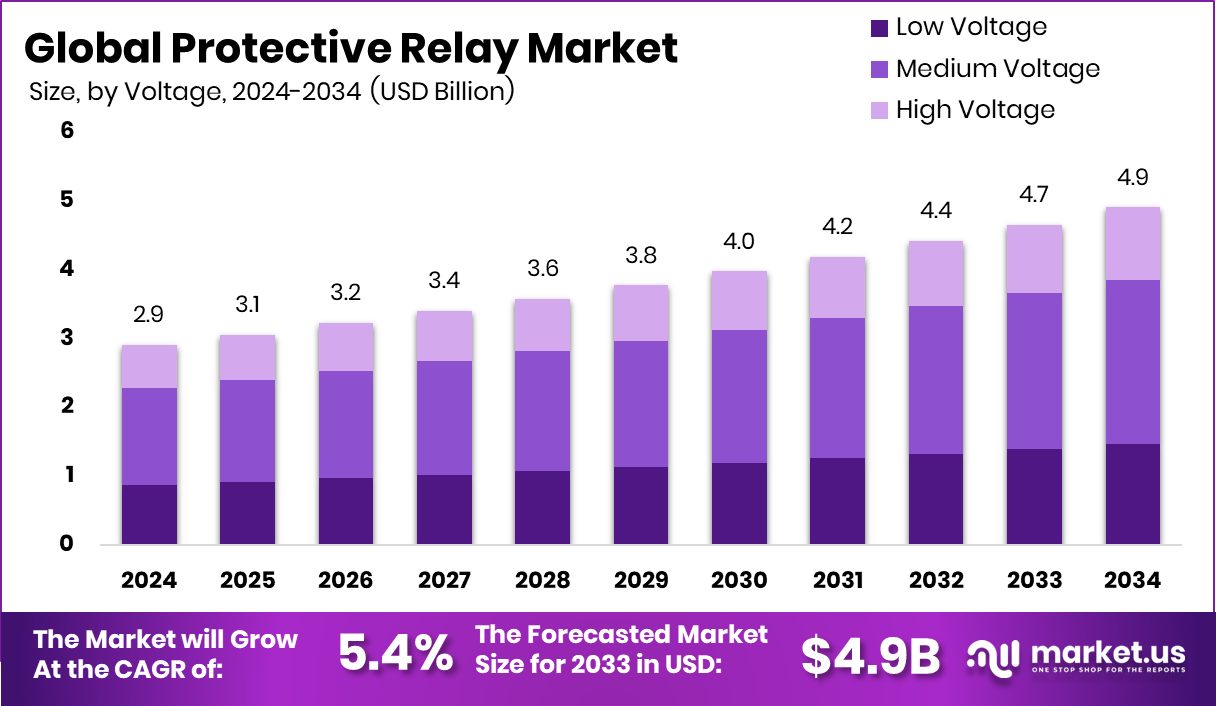
New York, NY – March 23, 2026 – The global protective relay market is projected to grow from USD 2.9 billion in 2024 to approximately USD 4.9 billion by 2034, registering a CAGR of 5.4% between 2025 and 2034. North America leads the market, accounting for 37.8% share and generating around USD 1.0 billion in revenue.
Protective relays are critical electrical devices designed to detect faults such as overloads, short circuits, and voltage irregularities. By quickly isolating affected sections of the network, they help prevent equipment damage, reduce fire risks, and avoid widespread power outages. Their role is essential across power generation, transmission, and distribution systems, ensuring grid safety and operational stability.
Market growth is being driven by increasing investments in grid resilience and reliability. For instance, the African Development Bank approved over $68 million to strengthen Bamako’s power infrastructure, emphasizing the importance of dependable protection systems. At the same time, financial constraints on utilities—reflected in declining stock performance of companies like Power Finance Corporation—are pushing the adoption of cost-efficient and reliable relay technologies.
Technological advancements are also accelerating demand. Funding initiatives such as MythWorx’s $5M, Atmosic Technologies’ $40M, Innatera’s $21M, Ceremorphic’s $50M, and FMC’s €100M are supporting innovations in energy-efficient electronics and intelligent control systems. Additional opportunities stem from programs like Ofgem’s £5.8M SIF, Forbion’s $200M decarbonization fund, and Fortress-led $500M investments, fostering smarter grid infrastructure and advanced protection solutions.
➤ Click the sample report link for complete industry insights: https://market.us/report/global-protective-relay-market/request-sample/
Key Takeaways
- The Global Protective Relay Market is expected to be worth around USD 4.9 billion by 2034, up from USD 2.9 billion in 2024, and is projected to grow at a CAGR of 5.4% from 2025 to 2034.
- In the Protective Relay Market, medium voltage dominates with 48.6%, driven by widespread utility and industrial adoption.
- Feeder protection holds 28.1% share in the Protective Relay Market, supported by grid reliability requirements.
- The power sector accounts for 34.4% of the Protective Relay Market, driven by network expansion.
- Protective Relay Market in North America reached 37.8% share, totaling USD 1.0 Bn.
➤ Directly purchase a copy of the report – https://market.us/purchase-report/?report_id=174498
Market Segments
By Voltage Analysis
The medium-voltage segment led the protective relay market in 2024 with a 48.6% share, mainly due to its critical role in power distribution systems operating between 1 kV and 35 kV. These systems are widely used across substations, industrial feeders, and distribution networks, making reliable fault detection essential.
Utilities are increasingly adopting advanced digital relays at this level to enhance grid reliability, reduce outages, and protect equipment. The growing integration of automation, remote monitoring, and communication technologies further supports demand. Additionally, medium-voltage networks are key to renewable energy integration and smart grid development, strengthening their importance globally.
By Application Analysis
Feeder protection accounted for 28.1% of the market in 2024, driven by its vital role in securing distribution lines against faults such as overloads, short circuits, and ground issues. Feeders connect substations directly to consumers, making their protection crucial for maintaining uninterrupted power supply and system stability.
Utilities prioritize fast and selective fault isolation to ensure minimal disruption. Increasing urbanization, expansion of distribution infrastructure, and the rise of distributed energy resources have heightened the need for advanced and adaptive feeder protection systems, supporting consistent adoption across urban and semi-urban regions.
By End Use Analysis
The power sector dominated end-use demand with a 34.4% market share in 2024, supported by ongoing investments in generation, transmission, and distribution infrastructure. Utilities depend on protective relays to prevent equipment damage, reduce blackout risks, and maintain grid safety under varying loads.
Aging infrastructure and rising electricity demand are accelerating modernization and relay replacement initiatives. Furthermore, the shift toward renewable energy and digital grid systems has increased network complexity, underscoring the need for advanced, reliable protection solutions across both traditional and modern energy systems.
Regional Analysis
In 2024, North America led the protective relay market with a 37.8% share (USD 1.0 Bn), driven by mature infrastructure and a strong focus on reliability and upgrades. Europe remains stable, emphasizing digital relay replacement for interconnected grids.
The Asia-Pacific region is growing rapidly due to grid expansion and rising power demand. The Middle East & Africa see demand from new projects and reliability needs, while Latin America experiences steady growth through modernization efforts and improved grid stability initiatives across utility networks.
Top Use Cases
- Feeder Protection (Distribution Lines): Protective relays are widely used to protect electrical feeders that carry power from substations to homes and industries. They detect problems like overloads, short circuits, and earth faults, and quickly disconnect the faulty section to avoid power outages.
- Transformer Protection: Relays protect transformers from internal faults like winding failures or overheating. They compare input and output current and disconnect the transformer if something goes wrong, preventing costly damage.
- Transmission Line Protection: On long-distance power lines, relays detect faults such as short circuits or abnormal currents. They isolate only the affected section so the rest of the grid keeps running smoothly.
- Overcurrent and Fault Detection: Relays continuously monitor current levels. If current exceeds safe limits, they instantly send a signal to trip circuit breakers, preventing equipment damage and fire risks.
- Generator Protection: In power plants, relays protect generators from faults like imbalance, overload, or earth faults. They ensure safe operation and avoid major failures in electricity production systems.
- Substation Equipment Protection: Relays are used in substations to monitor voltage, current, and frequency. When abnormal conditions occur, they isolate faulty equipment, ensuring overall system safety and stability.
Notable Company Developments
- In April 2025, Eaton announced a major update for its E-Series protective relays by extending the warranty to 10 years. This applies to multiple relay models used in power distribution and industrial systems. This shows Eaton’s focus on improving the reliability and long-term performance of protection devices used in grids and facilities.
- In October 2024, ABB launched a new hardware version of its REX640 protection relay in October 2024. This updated relay is smaller (fewer modules), making it easier to install in compact switchgear systems. It is used in power distribution and generation to protect equipment and manage faults. The new design also helps replace older ABB relay models and improves flexibility and cost efficiency
- In October 2024, Doble expanded training and usage of its RTS (Relay Testing Software) platform. This software helps utilities test protective relays automatically and manage test data efficiently. It improves accuracy, reduces manual errors, and standardizes relay testing processes across power systems.
Conclusion
The protective relay market is steadily evolving as power systems become more complex and reliability demands increase. These devices play a critical role in detecting faults, preventing equipment damage, and ensuring continuous electricity supply across generation, transmission, and distribution networks. Growth is supported by grid modernization, renewable energy integration, and the need to upgrade aging infrastructure. Advancements in digital relays, automation, and communication technologies are further improving system efficiency and response times. As utilities focus on safety, stability, and reduced downtime, protective relays will remain essential components in building resilient and intelligent power networks worldwide.
Discuss your needs with our analyst
Please share your requirements with more details so our analyst can check if they can solve your problem(s)