Table of Contents
Overview
New York, NY – Dec 08, 2025 – The global polyglycerol market was valued at USD 2.7 billion in 2024 and is projected to reach USD 5.2 billion by 2034, growing at a CAGR of 6.8% from 2025 to 2034. In 2024, Asia Pacific led the market with a 39.5% share, generating approximately USD 1.1 billion in revenue.
Polyglycerol, a highly branched polymer of glycerol, is water-soluble, non-volatile, and can be modified into polyglycerol esters, which serve as emulsifiers in food, cosmetics, and pharmaceuticals. Its biodegradable and non-toxic nature supports the rising demand for natural and sustainable products.
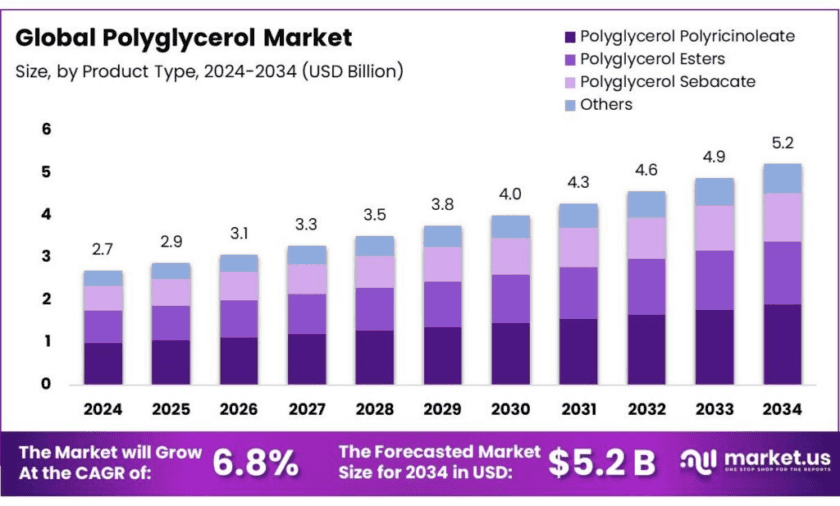
Emerging applications in 3D printing, bioplastics, and biochemical industries are creating new growth opportunities, though technical and economic challenges limit large-scale production. Key importers in 2024 included the United States, Singapore, and the Philippines, primarily sourcing from Malaysia, Japan, and Germany.
Key Takeaways
- The global polyglycerol market was valued at USD 2.7 billion in 2024.
- The global polyglycerol market is projected to grow at a CAGR of 6.8% and is estimated to reach USD 5.2 billion by 2034.
- In the product segment, polyglycerol polyricinoleate dominates the market with around 36.3% of the total market.
- Among the applications of the polyglycerol, personal care & cosmetics held the majority of revenue share in 2024 at 47.8%.
- Asia Pacific was at the forefront of the polyglycerol market, accounting for around 39.5% of the total global consumption.
➤ For a deeper understanding, click on the sample report link: https://market.us/report/global-polyglycerol-market/free-sample/
Report Scope
| Market Value (2024) | USD 2.7 Billion |
| Forecast Revenue (2034) | USD 5.2 Billion |
| CAGR (2025-2034) | 6.8% |
| Segments Covered | By Type (Polyglycerol Polyricinoleate, Polyglycerol Esters, Polyglycerol Sebacate, and Others), By Application (Personal Care & Cosmetics, Food & Beverage, Pharmaceuticals, and Others) |
| Competitive Landscape | Cargill, Mitsubishi Chemical Group Corporation, Estelle Chemicals, Palsgaard A/S, Foodchem International Corporation, Oleon NV, Sakamoto Yakuhin Kogyo, Savannah Surfactants, Kasco Chemtech, ABITEC Corp., Hydrior AG, Spiga Nord, Other Players. |
➤ Directly purchase a copy of the report – https://market.us/purchase-report/?report_id=161417
Key Market Segments
Type Analysis – Polyglycerol Polyricinoleate Dominates
The polyglycerol market is categorized by product types, including polyglycerol polyricinoleate (PGPR), polyglycerol esters (PGEs), polyglycerol sebacate (PGSeb), and others. Among these, PGPR leads with a 36.3% market share due to its highly effective emulsifying properties, especially in the food industry. PGPR is particularly valued for reducing the viscosity of chocolate and other fat-based products, improving texture and flow without affecting flavor.
Its compatibility with other emulsifiers, such as lecithin, enhances its functional performance. In contrast, PGEs serve as general-purpose emulsifiers for baked goods and margarine, while PGSeb finds primary use in biomedical applications. PGPR’s specialized performance and cost-efficiency make it the preferred choice among polyglycerol derivatives.
Application Analysis – Personal Care & Cosmetics Lead
The polyglycerol market is segmented by application into personal care & cosmetics, food & beverage, pharmaceuticals, and others. In 2024, the personal care and cosmetics sector held a dominant 47.8% share of the global market. Polyglycerol is extensively used in this industry because of its excellent skin compatibility, moisturizing properties, and ability to form stable emulsions without harsh chemicals.
Its non-toxic, non-irritating nature makes it ideal for lotions, creams, and cleansers, especially products marketed for sensitive skin or natural formulations. The functional requirements of personal care products, such as long-lasting hydration and smooth texture, align closely with the properties of polyglycerol, making it the preferred choice for cosmetic formulators over other sectors.
List of Segments
By Type
- Polyglycerol Polyricinoleate
- Polyglycerol Esters
- Polyglycerol Sebacate
- Others
By Application
- Personal Care & Cosmetics
- Skin Care
- Hair Care
- Others
- Food & Beverage
- Bakery & Confectionery
- Dairy & Dairy Products
- Beverages
- Others
- Pharmaceuticals
- Others
Regional Analysis
In 2024, the Asia Pacific region dominated the global polyglycerol market, holding approximately 39.5% of the market share, equivalent to around USD 1.1 billion in revenue. The region’s leadership is driven by a strong industrial base, growing population, and rising demand for sustainable, multifunctional ingredients across sectors such as food, cosmetics, and pharmaceuticals.
China, India, Japan, and South Korea are major consumers, with China extensively using polyglycerol polyricinoleate (PGPR) in confectionery and bakery products, while Japan and South Korea favor polyglycerol esters for mild, skin-friendly cosmetic formulations. Access to glycerol from biodiesel production and supportive government initiatives for bio-based industries further strengthen Asia Pacific’s role as a key production and consumption hub for polyglycerol.
Top Use Cases
Food & Confectionery — Emulsifier and Viscosity Modifier: Polyglycerol derivatives — especially Polyglycerol Polyricinoleate (PGPR, E476) — are widely used in chocolate, confectionery, spreads and sauces to improve flow, texture and emulsion stability. PGPR reduces the viscosity of molten chocolate, enabling smoother flow and easier molding, while helping coat confectionery uniformly.
Cosmetics & Personal Care — Emulsifier, Moisturizer, Texture Enhancer: Polyglycerol and its esters are used extensively in personal care products such as lotions, creams and cleansers due to their emulsifying capability and skin‑friendly properties. They enable stable blending of oil and water phases, resulting in smooth, uniform textures without harsh chemicals. Moreover, polyglycerol-based formulations help provide moisturizing and conditioning effects — beneficial for products designed for sensitive or dry skin.
Pharmaceuticals & Nutraceuticals — Excipient and Delivery Aid: Polyglycerol’s capacity to form micelles and stable emulsions has been applied in pharmaceutical formulations as a delivery agent to encapsulate drugs or actives, enhancing solubility and controlled delivery of compounds that are otherwise poorly water-soluble. This property opens possibilities for polyglycerol in oral, topical or encapsulated drug products, where stable dispersion and compatibility are critical.
Industrial & Specialty Applications — Stabilizer and Functional Additive: Beyond food and personal care, polyglycerol derivatives are adopted in industrial emulsions, lubricants, and specialty formulations where oil‑in‑water or water‑in‑oil stability is required. For example, polyglycerol‑derived emulsifiers help stabilize high-fat or oil-based systems, maintain uniformity, and enhance processing efficiency. In addition, polyglycerol’s biodegradability and non-toxicity support its use where environmental or regulatory compliance is desired — an advantage as industries shift toward greener ingredient solutions.
Recent Developments
Cargill markets polyglycerol under its bio‑industrial portfolio (e.g., Oxi‑Cure® 500 and 510 polyols), offering high‑functionality polyols derived from glycerin used in coatings, emulsifiers, and industrial formulations. In 2024, its diversified chemicals & derivatives operations — including polyglycerol — contributed to the company’s bio‑industrial throughput, supporting demand for sustainable, renewable‑based ingredients globally.
Mitsubishi Chemical is listed among the major global players in the polyglycerol and polyglycerol‑ester market landscape in 2025, suggesting active involvement in supply and formulation of polyglycerol‑based emulsifiers and derivatives for food, cosmetics, and industrial sectors. Mitsubishi Chemical is listed among the major global players in the polyglycerol and polyglycerol‑ester market landscape in 2025, suggesting active involvement in supply and formulation of polyglycerol‑based emulsifiers and derivatives for food, cosmetics, and industrial sectors.
Estelle Chemicals Pvt. Ltd. — Estelle Chemicals produces polyglycerol‑derived emulsifiers and surfactants, including polyglycerol esters (PGEs) and polyglycerol polyricinoleate (PGPR), supplying food, bakery, cosmetic and personal‑care industries. As of 2024–2025 the company reports a total manufacturing capacity of 7,000 metric tons per annum, with infrastructure that includes a pilot plant and quality‑control laboratories to comply with international standards (FSSC 22000, ISO 9001:2015, RSPO, Halal, Kosher) enabling export‑grade production.
Palsgaard A/S — Palsgaard is a globally recognized leader in plant‑based emulsifiers and plays a significant role in the polyglycerol segment through its PGPR and PGE product lines used in food, bakery, and personal‑care formulations. The company initiated a major expansion in 2023, and by 2024 is expected to have doubled its global PGPR production capacity to ~11,500 metric tons per annum, reflecting strong global demand (noted growth ~10 % per year).
Foodchem International Corporation is a China‑based supplier and manufacturer of polyglycerol derivatives, including polyglycerol esters (PGE) and polyglycerol polyricinoleate (PGPR), used widely as emulsifiers in food, bakery, oil-and-fat products, and other industrial applications. Foodchem International Corporation is a China‑based supplier and manufacturer of polyglycerol derivatives, including polyglycerol esters (PGE) and polyglycerol polyricinoleate (PGPR), used widely as emulsifiers in food, bakery, oil-and-fat products, and other industrial applications. Its active role in 2024–2025 positions it as a reliable source for food‑grade polyglycerol additives, supporting demand for stable emulsions and clean-label formulations worldwide.
Oleon NV is a global oleochemicals company that produces glycerine and related natural‑based chemical building blocks, offering a broad portfolio of oleochemical products for food, cosmetics, chemicals, and polymer applications. While Oleon primarily markets glycerine, its product range and global production presence suggest potential involvement in polyglycerol and related ester synthesis, aligning with rising demand for sustainable, bio-based ingredients in food, personal care, and specialty formulations.
Sakamoto Yakuhin Kogyo Co., Ltd. — A Japanese glycerin‑derivatives specialist, Sakamoto produces plant‑derived glycerin and a range of polyglycerol and polyglycerol‑fatty‑acid esters under its “SY‑Glyster” line. The company’s 2024 workforce numbered 332 employees. Its polyglycerol derivatives are certified to global food‑ and cosmetic‑grade standards (Kosher, Halal, RSPO) and are used across foods, cosmetics, pharmaceuticals and specialty industrial formulations.
Savannah Surfactants — Based in Goa, Savannah has long produced emulsifiers including polyglycerol‑derived products. Savannah Surfactants — Based in Goa, Savannah has long produced emulsifiers including polyglycerol‑derived products. Its key offering, polyglycerol polyricinoleate (PGPR, E476), is used widely in chocolate, baked goods, low‑fat spreads and other food‑industry formulations, offering viscosity reduction and stable emulsions.
Hydrior AG — Hydrior AG, based in Wettingen, Switzerland, produces polyglycerol esters and related surfactants for cosmetics, detergents, and personal‑care products. Its 2025 product range — under the “HYDRIOL®” brand — includes polyglyceryl‑3 caprate and polyglyceryl‑4 isostearate used as non‑toxic, PEG‑free emulsifiers, thickeners and solubilizers for creams, shampoos, and lotions, offering skin‑friendly, clean‑label formulations.
Spiga Nord S.p.A. — Spiga Nord is an Italian manufacturer of high‑purity, vegetable‑derived glycerine and polyglycerols. As of 2024, their refined polyglycerol products comply with Kosher, Halal, GMO‑free, ECOCERT and COSMOS standards, making them suitable for use in cosmetics, food emulsifiers (e.g., E475/E476 esters), and pharmaceuticals.
Conclusion
In conclusion, Polyglycerol continues to gain traction across a diverse set of industries due to its multifunctional properties as an emulsifier, stabilizer, humectant, and biodegradable polyol. Its growing adoption in food, personal care and pharmaceutical applications — driven by the demand for natural, clean‑label and skin‑friendly ingredients — supports sustained market expansion.
Discuss your needs with our analyst
Please share your requirements with more details so our analyst can check if they can solve your problem(s)