Table of Contents
Overview
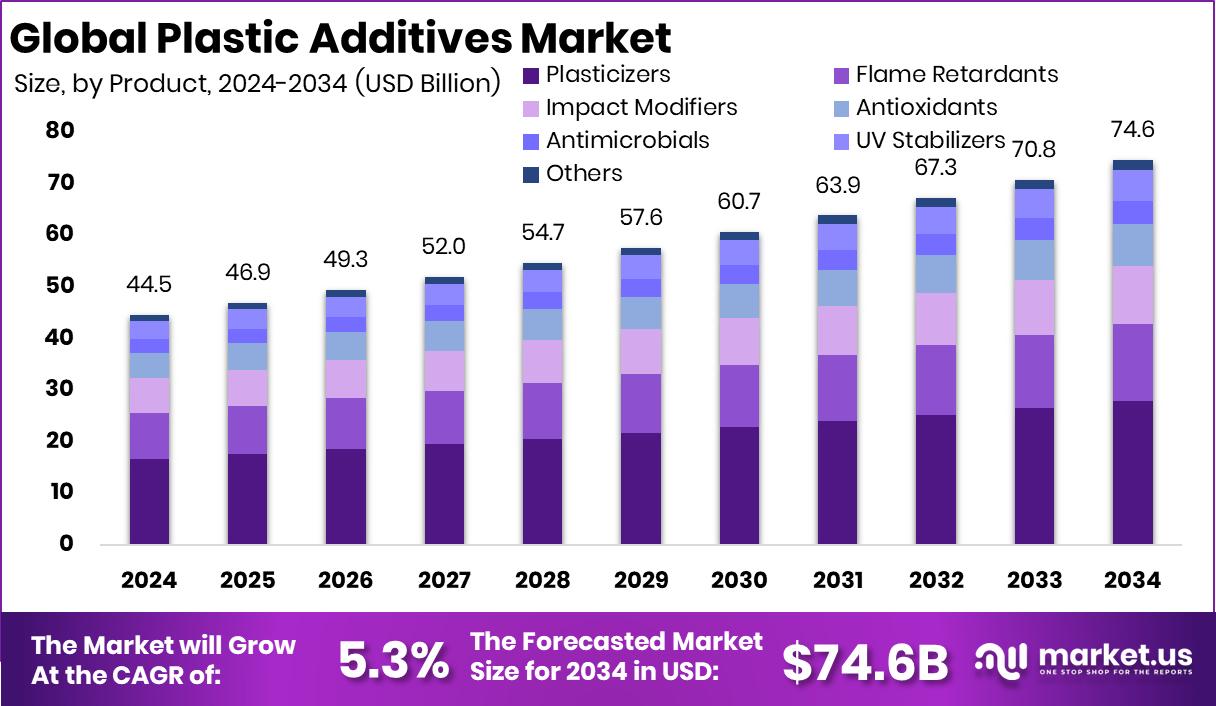
New York, NY – February 26, 2026 – The global plastic additives market, valued at USD 44.5 billion in 2024, is set to reach USD 74.6 billion by 2034, growing at a steady 5.3% CAGR as industries demand stronger, safer, and longer-lasting plastics. Asia Pacific remains a core growth hub, holding 39.8% market share, equal to USD 17.7 billion, driven by heavy manufacturing activity and rising plastic consumption. Plastic additives play an essential role in improving durability, flexibility, heat resistance, and overall usability, making them indispensable for packaging, construction, consumer goods, and electronics.
Market momentum is supported by targeted investments that expand production capability and accelerate innovation. For instance, Arclin invested $60 million to upgrade its South Carolina facility, reinforcing supply strength for industrial plastic applications. Advanced additive development is also progressing through new financing, with FRX Polymers securing $22 million in Series D equity, enabling safer and more functional plastic material technologies.
Future opportunities lie in specialized and high-performance additive solutions, supported partly by broader scientific research funding. Initiatives such as the $1 million allocation for weapons of mass destruction research indirectly enhance material science advancement, paving the way for next-generation additives suited for regulated, safety-critical environments.
➤ Click the sample report link for complete industry insights: https://market.us/report/global-plastic-additives-market/request-sample/
Key Takeaways
- The Global Plastic Additives Market is expected to be worth around USD 74.6 billion by 2034, up from USD 44.5 billion in 2024, and is projected to grow at a CAGR of 5.3% from 2025 to 2034.
- In the Plastic Additives Market, plasticizers dominate by product, holding 37.5% share globally across industries.
- Within the Plastic Additives Market, commodity plastics lead by plastic type with 58.3% share worldwide.
- In the Plastic Additives Market, packaging leads end-use demand, accounting for 38.6% consumption globally today.
- Asia Pacific accounted for 39.80% of Plastic Additives Market, reaching USD 17.7 Bn.
➤ Directly purchase a copy of the report—https://market.us/https://market.us/purchase-report/?report_id=173460
Report Scope
| Report Features | Description |
|---|---|
| Market Value (2024) | USD 44.5 Billion |
| Forecast Revenue (2034) | USD 74.6 Billion |
| CAGR (2025-2034) | 5.3% |
| Segments Covered | By Product (Plasticizers, Flame Retardants, Impact Modifiers, Antioxidants, Antimicrobials, UV Stabilizers, Others), By Plastic (Commodity Plastics, Engineering Plastics, High Performance Plastics), By End-use (Packaging, Automotive, Consumer Goods, Construction, Others) |
| Competitive Landscape | BASF SE, Clariant AG, Albemarle Corporation, Songwon Industrial Co., Ltd., Nouryon, LANXESS AG, Evonik Industries AG, Kaneka Corporation, The Dow Chemical Company, ExxonMobil Corporation |
Key Market Segments
By Product Analysis
Plasticizers remained the leading product category in the Plastic Additives Market in 2024, holding a significant 37.5% global share. Their dominance reflects their critical function in enhancing softness, flexibility, and durability in plastics, especially PVC-based applications used across packaging films, wires, cables, flooring materials, and everyday consumer goods. Demand stayed strong as industries continued to rely on these additives to prevent brittleness and extend product life.
Manufacturers focused on improving formulation efficiency and compatibility, gradually adopting safer, low-volatility alternatives in response to regulatory scrutiny on harmful chemicals. Rather than restricting the segment, safety-driven regulations accelerated innovation toward more sustainable and compliant plasticizer technologies. Their extensive use in large-volume applications—particularly construction and packaging—underscores why plasticizers remain indispensable for achieving the required performance standards. Their broad applicability and ongoing formulation advancements ensured their leadership position across global plastic additive consumption.
By Plastic Analysis
Commodity plastics continued to dominate the Plastic Additives Market in 2024, accounting for 58.3% of total demand, driven by widespread use of polyethylene, polypropylene, and PVC in daily manufacturing. These high-volume materials rely heavily on stabilizers, plasticizers, impact modifiers, and processing aids to enhance heat resistance, efficiency, and durability during large-scale production. Growth was reinforced by steady demand in packaging, consumer products, and industrial components, where affordability and consistent performance are essential.
Additive producers focused on providing cost-effective yet high-performance solutions to match the massive consumption of commodity plastics globally. Their strong market share reflects their role as the foundation of the polymer industry, supplying essential materials used across major sectors. The continued expansion of mass-market manufacturing, particularly in packaging and household applications, ensured stable, long-term reliance on additives to maintain quality and functional standards within these widely used plastic types.
By End-use Analysis
Packaging emerged as the leading end-use segment in the Plastic Additives Market in 2024, representing 38.6% of total demand. Both rigid and flexible packaging formats depend significantly on additives for strength, clarity, UV protection, shelf-life enhancement, and processing stability. Continued growth in food, beverage, personal care, and consumer goods packaging maintained strong demand for antioxidants, UV stabilizers, and plasticizers. Additives help packaging materials withstand transportation, environmental exposure, and storage conditions while ensuring safety and product integrity.
Sustainability initiatives also influenced additive trends, with manufacturers developing optimized formulations that reduce material use without compromising performance. The segment’s large share reflects packaging’s continuous production cycles and its irreplaceable role in global supply chains. With rising consumption of packaged goods and expanding e-commerce logistics, packaging remains a high-volume, reliable consumer of plastic additives worldwide, sustaining long-term market demand.
Regional Analysis
Asia Pacific led the Plastic Additives Market with a 39.80% share valued at USD 17.7 billion, driven by its extensive manufacturing base, high plastic production, and strong demand from the packaging and consumer industries. In contrast, North America reflects a mature market where growth is steady and shaped by regulatory standards and replacement-driven needs.
Europe shows similar stability, with demand supported by quality-focused applications and performance-oriented plastic formulations. The Middle East & Africa market remains selective, influenced by varying industrial development and regional consumption trends.
Latin America continues to expand gradually, with rising adoption of plastic additives driven by growth in packaging, consumer products, and developing manufacturing activity across the region.
Top Use Cases
- Improving Flexibility in Plastic Products: Plastic additives like plasticizers help plastics become softer and more flexible. This is useful for products like cables, flooring, flexible tubes, and film wraps where the material must bend without breaking. Plasticizers reduce stiffness in polymers such as PVC, making them easier to shape and use in everyday products.
- Protecting Against Sunlight Damage (UV Stabilization): Plastics used outdoors (e.g., garden furniture, greenhouse films, car parts) can become brittle or fade when exposed to sunlight. Additives called UV stabilizers protect against ultraviolet light, helping products last longer without cracking or degrading from sun exposure.
- Reducing Static Electricity: In some plastic products, static build-up can attract dust or interfere with electronics. Antistatic additives help reduce static charge on plastic surfaces, keeping them cleaner and safer in applications like electronic housings or packaging materials.
- Increasing Fire Safety: Additives such as flame retardants make plastics less likely to catch fire or burn quickly. This is especially important in electronic devices, construction materials, and transportation components, where safety standards require reduced flammability.
- Making Plastic Colors and Visual Effects: Colorants and pigments are additives that impart color and brightness to plastics. These are used in products such as toys, household items, packaging, and automotive interiors to enhance visual appeal or create specific designs.
- Helping Manufacturing Process (Processing Aids): Some additives don’t change the plastic’s final use properties but help the production process itself. Lubricants, slip agents, and internal additives make it easier for plastic to flow in manufacturing machines, preventing sticking, improving molding, and speeding up production.
Recent Developments
- In June 2025, Clariant announced the launch of AddWorks™ PPA, a new line of PFAS-free polymer processing aids. These additives help plastic makers extrude polyolefin films more efficiently without using harmful PFAS chemicals. This supports smoother production and better quality films for packaging and other uses.
- In April 2024, BASF participated in the major plastics event CHINAPLAS 2024 to present advanced additive products focused on making plastics more sustainable. They highlighted solutions like IrgaCycle®, which helps improve the mechanical recycling of plastics by boosting the strength and quality of recycled material. These additives also include improved light stabilizers and antioxidants that make plastics tougher and longer-lasting.
Conclusion
The Plastic Additives Market continues to evolve as industries rely on materials that offer better strength, safety, and performance. Growing demand for durable packaging, advanced consumer goods, and improved construction materials keeps the need for additives strong. Innovation in stabilizers, plasticizers, and processing aids is expanding as manufacturers seek safer and more sustainable solutions.
Companies are also focusing on additives that support recycling and reduce environmental impact, helping plastics remain useful in modern applications. With steady industrial activity, ongoing product innovation, and rising interest in sustainable materials, the market is positioned for consistent progress across global manufacturing sectors.
Discuss your needs with our analyst
Please share your requirements with more details so our analyst can check if they can solve your problem(s)